



Arriving, attuning, assembling, and adapting

Abstract
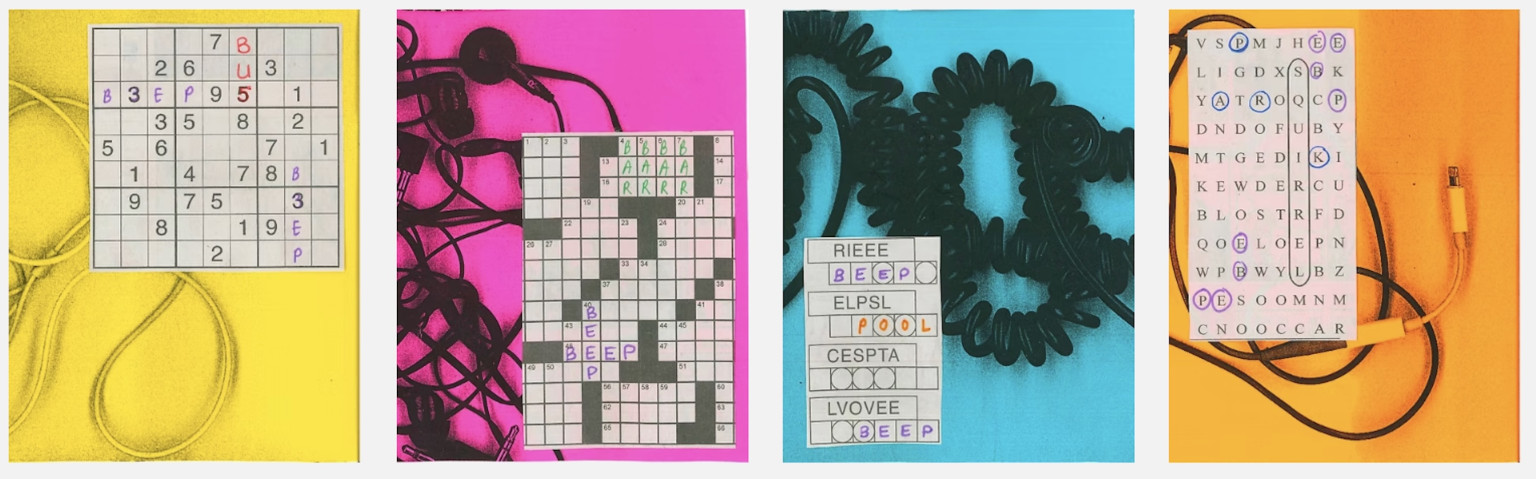
In this article, we offer four listening modalities emerging from the process of making, listening, and launching BEEP zine: a multimedia zine that audibly maps the urban soundscapes of Toronto, Canada, through field recordings, collage, and manifesto (beepzine.com). Extending histories of listening prompts and BEEP zine’s four editions (Bus, Park, Bar, and Pool), arriving, attuning, assembling, and adapting are invitations to new forms of sonic citizenship. In exploring each modality, we offer reflections grounded in each edition of BEEP zine and its accompanying manifesto, soundscapes, and collages, as well as new listening prompts to deepen listeners’ engagement with the sonic environments they occupy. By activating these listening modes, BEEP zine pays attention to and participates with human and non-human members of the city: technologies, species, materialities, and ecologies. Negotiating concerns about urban noise pollution and the “livability of cities” (Droumeva, Copeland and Ashleigh, 2022), the four disruptive and alternative listening modes offered by BEEP zine are invitations to generating relational sonic futures.
Introduction
This article extends a research creation project titled BEEP zine: a multimedia zine that audibly maps the urban soundscapes of Toronto, Canada, through field recordings, collage, and manifesto (beepzine.com) across four editions (Bus, Park, Bar, and Pool). Each edition centers a term that functions as both verb and location, conceptually grounded to how urban inhabitants interact with space. For example, to "bus" can be read as a process, as in to clear a table, or to be transported; simultaneously, a "bus" is a mode of transportation in itself. The four editions explore urban spaces sonically through the context of locations and activations. As a standalone piece, BEEP zine functions as its own form of “creation-as-research” (Chapman & Sawchuk, 2015, p.49); however, we position this paper as an extension of this project through what communication studies scholars and practitioners Owen Chapman and Kim Sawchuk (2015) term “research from creation: the extrapolation of theoretical, methodological, ethnographic, or other insights from creative processes, which are then looped back into the project that generated them” (p.49). Reflecting on the material development and our co-creative experience of publishing BEEP zine across its physical and digital formats, we propose four listening modalities as emergent from the project: arriving, attuning, assembling, adapting. The modalities invite listeners to reflect on their relationship to urban soundscapes through guided questions, prompts, personal reflections, and co-creative sonic remixing.
As the co-creators of this project, listening to BEEP zine in both its digital and physical formats, we situate the possibilities of urban listening as generative and active. Developed in relation to previous scholarship on acoustic ecology and soundscapes (Arkette, 2004; Schafer, 1977; Westerkamp, 2019; Droumeva and Jordan, 2019), this project purposefully reflects on sound as an important marker of social, cultural, and ecological relations in a city. We take up the work of soundwalking as a mode through which we have collected recordings and materials across our own situated relationships to Toronto: "Soundwalking is unlike other, more geometrical soundscape research practices (such as sound level measurement or acoustic mapping) in that it does not try to create an idealised or regularised acoustic map, graph or profile of a particular place. Rather, it focuses on varying subjective experiences of places, moving narratives. Soundwalking could then be called situational work" (Westerkamp, 2023). We exhibit BEEP zine across formats as invitations for listening which center relational assemblages of human and nonhuman members of urban spaces. For our listeners, some of these sounds might ignite a specific memory, reaction, or image as “each sound is imbued with its own lexical code: sound as sign, symbol, index” (Arkette, 2004, p.160). Yet, the meanings of various beeps and horns across public transit, crosswalks, and vehicle warnings might be decoded differently for listeners outside of the city. In listening to Toronto through BEEP zine, we ask: How do we make audible sonic citizenship in Toronto through BEEP zine’s four editions: Bus, Park, Bar, and Pool? How might our extension through modalities invite listeners and readers to consider reflective and relational forms of listening within BEEP zine and their own urban environments?
Positioning ourselves and BEEP zine
Listening to urban soundscapes in the context of our zine enables a particular call to action that extends beyond the locality of Toronto as the site of our creative experimentation. As co-creators and inhabitants of Toronto, our representation of place is shaped by our own personal filters and perspectives of the sonic identity of Toronto. We define Toronto as place through sonic researcher Sophie Arkette’s reflection on urban soundscapes: "Place allows particular localities to be defined in terms of their history and social use, investing them with cultural meanings and values and making them available for active intervention and transformation" (Arkette, 2004, p. 160). Toronto’s soundscapes are social, ecological, political, and cultural entities informed by communities and sonic forms of place-making. Through forms of creative experimentation, we create particular representations of Toronto across these vectors, but we recognize the limitations of our listening biases. As xwélmexw (Stó:lō/Skwah) author Dylan Robinson notes, defining one’s positionality is important not only as a static construct, but as "a process or state that fundamentally guides our actions and perceptions" (2020, p. 39).
As the co-creators of BEEP zine, our choices, biases, and relationship to the city informs how we represent Toronto, Canada. These are our sonic relationships that inform our listening, recording, and collaging of Toronto, that underpin BEEP zine: Lauren Knight grew up in a small town and found the first few months of busy urban living to be quite frustrating. As a result, she found herself adapting to the soundscapes of city living through ear plugs and noise cancelling headphones. Having moved to Vancouver for a few years to study noise-cancelling headphones, soundwalking, and modes of sonic escapism, she returned to Toronto with a new perspective on urban listening. Lauren’s weekly soundwalks through local parks are featured in Park soundscapes, her commute to school is heard in the interior of moving vehicles and transit systems, and bubbles in Pool come from time spent relaxing in hot tubs. Living in Toronto for more than a decade now, Aline Rossi Zara has always called big cities and suburbs their home. Never wearing headphones but sometimes custom earplugs, their impromptu cellphone audio recordings of protests, concerts, and subway rides are juxtaposed by on-purpose recordings of cafés, swimming pools, and streetcar errands via handheld audio recorder. Together, we have collaboratively remixed our recordings into soundscapes; developed visual collages; and written manifestos for each of BEEP zine’s four editions. Working together, this co-creation negotiates between both our sonic citizenship to Toronto, grappling with questions of sonic belonging and acoustic environments (Højlund et al, 2024). Recognizing the ways in which our natural listening filters – which sounds do we find important or interesting – are evident across our zines, we situate the manifestos as offering an important collection of listening prompts, moving through the project from presentation to interaction, situating this paper and zine listening as invitations.
Listening to BEEP zine
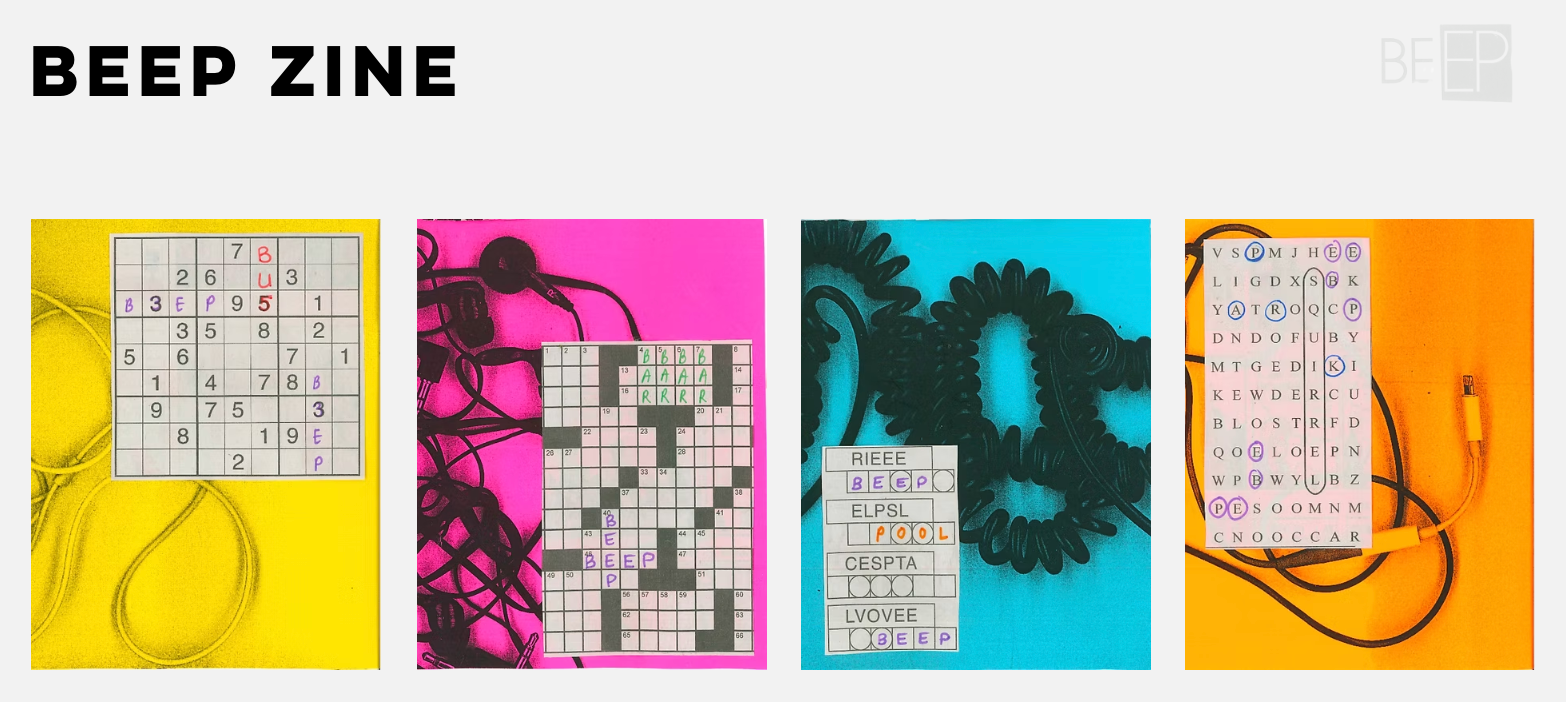
BEEP zine contains multiple parts: each edition featuring a collection of field recordings, collaged materials, and manifestos. In their physical version, each zine includes three sound modules that, once clicked, activate soundscape compositions developed with field recordings. Once fully opened, a listener can activate all 3 modules to generate their own soundscape composition. In its digital format (beepzine.com), these soundscapes are available as play buttons while a listener flips through the zine; we have generated a soundscape composition with all 3 layered to simulate the possibilities of opening the zine in its entirety. Every edition of BEEP zine also includes three collages made from photographs taken of Toronto (often locations of our field recordings), found objects from these locations and elsewhere, and magazines. Each of the four editions are titled to represent both a location and listening modality: Bus, Park, Bar, and Pool. Organizing the soundscapes of the city in this way, we address sonic citizens as they interact with various urban spaces: parking in vehicles or in their neighbourhood green spaces, pooling in subways or swimming laps in the local gym, bussing as ordering at a cafe or being in transit, and barring movement through protest or listening to musical performance. These editions activate and amplify sonic communities through the focused lens (Bus, Park, Bar, and Pool) through which they are placed in conversation and prompted via the manifesto created for each edition.
However, it was through the process of watching viewers interact with BEEP zine during a launch event, shared physical copies, digital links, conference panels, and gifted editions, that our relationship to the project as a finished creative material began to shift. Witnessing our proposed remixing in action – of playing the 3 modules in each edition at various times, thus shaping the output across soundscape layers – we began to imagine the extension of BEEP zine as listening modalities that similarly activate listeners and readers in sonic co-creation. Our perception of Toronto’s citizens in this format re-imagined the zine’s listeners as sonic activators in their own cities.
Developing listening modalities
Importantly, this evolution of the project through modalities oriented us towards scholarship on soundscape ecology and the relationship between listener and sounder, exploring the potential for sound to be a cultural, social, and democratizing tool (Droumeva, Copeland and Ashleigh, 2022; Schafer, 1992; Westerkamp, 2019). The choice to develop modalities emerges from a longer history of listening prompts in sound studies scholarship. Soundscape studies scholar R. Murray Schafer’s 100 exercises provided a variety of prompts through which individuals could become critical listeners and soundmakers. Schafer had hoped through these sets of exercises would enable communities to demand sonic change: "After we have developed some critical acumen, we may go on to larger projects with social implications so that others may be influenced by our experiences. The ultimate aim would be to begin to make conscious design decisions affecting the soundscape about us" (Schafer, 1992, p. 11). Composer Pauline Oliveros similarly invited audiences to become critical listeners through what she termed "deep listening", or "listening in as many ways as possible to everything that can possibly be heard all of the time" (Oliveros, 2021). Listening prompts can be political and cultural, as visible in Dylan Robinson’s poetic reflection of listening as a guest in Haudenosaunee lands (2020, p. 75); listening prompts can be actionable, as evidenced through the project Listening to the City: Livable Soundscapes and Urban Planning and their related publications (Droumeva, Copeland and Ashleigh, 2022), led by communications scholar Milena Droumeva at Simon Fraser University, purposefully intended for urban architects, city planners, and inhabitants to directly attend and respond to soundscapes or noise pollution. Collectively, these authors informed our approach to developing listening modalities, offering questions to guide our listener’s focus without prescribing a desired list of outcomes or particular forms of sonic engagement.
From BEEP zine’s four editions (Bus, Park, Bar, and Pool), we offer four modalities – arriving, attuning, assembling, and adapting – as invitations to new forms of sonic citizenship through relational sonic exchange. These modalities are inspired by the ways in which we witness, interact, respond, and move through and with other citizens in the city; histories of listening prompts, with their ear towards critical listening (Schafer, 1992); and manifesto writing (Chrysagis and Kompatsiaris, 2022; Cowan, 2012; Cowan and Rault, 2024). In exploring each modality, we offer reflections grounded in each edition of BEEP zine and its accompanying manifesto, soundscapes, and collages, as well as listening prompts to deepen listeners’ engagement with the sonic environments they occupy. By activating these listening modalities, BEEP zine pays attention to and participates with sonic citizens both human and non-human: technologies, species, materialities, and natural forces that are "entangled in the social, cultural and political life of contemporary cities" (Franklin, 2017). In this way, BEEP zine takes up the work of political theorist Achille Mbembe in considering the creation of a new earthly community whose assemblage makes room for both human and non-human actors based on our "in-common", as a multiplicity of realities and perspectives which deconstruct existing socio-techno-ecological ideologies (Mbembe, 2022). Non-human urban inhabitants – birds, water, wind, racoons – are themselves both soundmakers and listeners. Through our modalities we invite audiences to listen to these sounds and simultaneously deepen a critical reflection of their own sonic impact. Through this dual lens, we hope to center these sonic relations of citizenship and belonging as both active and intersubjective. Extending concerns of soundscape studies that suggest urban noise pollution impacts the "livability" of cities (Droumeva, Copeland and Ashleigh, 2022), the four disruptive (Westerkamp, 2019) and alternative listening modes offered by BEEP zine are invitations to generating relational sonic futures.
Manifesting sonic citizenship
BEEP zine’s activation of manifestos prompted the development of our listening modalities. In contemporary practice, manifestos are considered a performative and plural form of writing that embodies political, social, historical and cultural conditions, where manifestos can range "from written or performed artist and curatorial statements and institutional press releases to corporate mission statements, declarations of political groups and the self-interpreting of counter-hegemonic interventions, whether progressive or regressive" (Chrysagis and Kompatsiaris, 2022, 120). In their exploration of lesbian processing as a method in Heavy Processing, queer media scholars T.L. Cowan and Jas Rault (2024) describe the manifesto as the "ultimate heavy processing genre" through the feminist practice of individual and communal thinking, dialogue, and negotiation (69). For BEEP zine, manifestos offer personal and collective calls to action that intervene into how we listen to urban soundscapes and embody sonic citizenship.
In developing manifestos for each of BEEP zine’s four editions, we have taken particular inspiration from Cowan’s (2012) “GLITTERfesto”. “GLITTERfesto” positions “GLITTER” as an approach for activist performance “based on the premise that ‘social justice is fabulous’”, itself inspired by a placard in a 2011 Occupy Wall Street march (Cowan, 2012, 18). In “GLITTERfesto”, Cowan uses “GLITTER” as a repetitive form of inquiry across the manifesto’s three sections: “GLITTER is a demonstration. GLITTER will happen anywhere it can and many places it can’t. GLITTER is a rental. GLITTER is on the ground with dog shit and other garbage. GLITTER is a strong clear voice.” (ibid, 17). Following this formatting, BEEP zine’s manifestos use the theme of each of its four editions, Bus, Park, Bar, and Pool, to act as a central refrain and address each theme as a sonic activation.
Four listening modalities
Through this treatment, Bus, Park, Bar, and Pool are transformed from their acoustic locations into acoustic approaches. With each edition of BEEP zine as a separate invitation, we propose four listening modalities for urban listeners: arriving, attuning, assembling, adapting:
- Bus is arriving: Listening as an arrival of embodied presence, mediated with/out technology.
- Park is attuning: Listening to ecological relationships through deep, slow, and grounded practice.
- Bar is assembling: Listening with and to diverse acoustic communities to assemble, disassemble, and reassemble urban soundscapes.
- Pool is adapting: Listening to our own forms of adjustment navigating busy urban spaces.
The invitation of BEEP zine’s manifesto as listening modalities is central to our activation of sonic citizenship. As sound studies scholars Marie Koldkjær Højlund, Anette Vandsø and Morten Breinbjerg (2024) define, sonic citizenship “understands soundscapes as relationships and dynamic configurations to which we must continuously attune and which are themselves reconfigured via breaks in habitual attunements” (2024, para. 5). With a relationship to sound in constant negotiation and moments of attunement, sonic citizenship grapples with conflicting tensions of the horizontal processes of belonging/exclusion and the vertical processes of civic power, as well as the agency of human and non-human (technological) actors, of being in acoustic community with others. Højlund et al (2024)’s argument for “the necessity of a future public dialogue and action related to sonic citizenship, which focuses on communities and how they can attune and negotiate the sonic problems and sensory belongings that continuously arise where people meet” (2024, part. II), is taken up by the listening modalities that BEEP zine proposes. Listening as arriving, attuning, assembling, and adapting fosters new avenues for the critical development of sonic citizens through their reimagining of community, human/non-human relationships, technology, and adaptation to urban soundscapes. While we situate Toronto as our central location, we offer these modalities as invitations that can be applied to any sonic environment. In this way, sonic citizenship is inherently co-created. Through the clickable modules in the physical copies of BEEP zine, we began to experiment with collaborative soundmaking; however, through modalities we invite readers and listeners to reflect on their position as soundmakers.
We will explore these listening modalities in the four sections that follow. With individual sections focused on one edition of BEEP zine and its corresponding listening modality, each section also includes the edition’s 15-lined manifesto; a written description of the edition’s three soundscapes, with links to the soundscape’s audio; a written description of the edition’s three collages, with accompanying images; and a series of listening prompts designed to help listeners activate each listening modality in their own sonic environments.
BUS is arriving
BUS is no service on line one.
BUS is screeching coffee machines and stacked dirty dishes.
BUS is pattering footsteps on a crowded platform.
BUS is the sound of arrival and departure.
BUS is choosing to walk.
BUS is wearing headphones when you leave the house.
BUS is the moment you’re no longer left out in the cold.
BUS is your favourite, on special.
BUS is texting on my way.
BUS is a mouse running along the tracks.
BUS is being swept off your feet.
BUS is your order on the counter.
BUS is spilled secrets over a cup of coffee.
BUS is 24/7, but moving to the beat of its own drum.
BUS is the next stop – yours.
Through Bus, we activate the listening modality of arriving: taking off your headphones, taking in what is coming to you and going along for the ride. While arriving has a close relationship to mobility in this context, we propose that this listening modality of arriving is rooted in the embodied presence within these moments of mobility, sometimes mediated through technology. In this way, arriving is not the act of getting somewhere, but an embodied expression of sonic citizenship in the process of being or movement, taking up anthropologist Natasha Myers' (2019) call that "the subtleties of bodies, matters, and energies require experimental forms of knowing, speculative fabulation, and a willingness to get affectively and kinesthetically entangled in inquiry” (p.100).
In BEEP zine, the soundscapes of Bus encompass commuting on buses, streetcars, and subways, as well as the sounds of bussing in local cafes: cleaning tables, clearing mugs and napkins, stacking cups and plates.
The opening soundscape of Bus is half bus, half streetcar: whirl of acceleration and deceleration, the beep of opening doors, the beep of a transit pass, laughter, muted conversations, the beep of the “stop request” button, “next stop: West Toronto street”, the clicking of a turn signal, a honking car, “next stop: Caledonia Park road”, the opening of a pop can…
Next, taking the subway: the beep of the crosswalk indicator, cars passing by, walking, the rumble of the train, “next station is: Bloor-Yonge, Bloor-Yonge station, change here for line 2”, “arriving at: Bloor-Yonge, Bloor-Yonge station, change here for line 2, doors will open on the right”, muted conversations, “I’ll see you tomorrow, right?”, the beep of opening doors, “Bye, see you”...
Third, bussing at a café: hot steam from the coffee machine, music in the background, “good morning, how are you?”, orders just out of range, a change of music, the squeak of a shifting chair, “61, iced mocha”, the beep of a credit card payment going through, the crumple of a paper bag, the clink of dishes and cups, “62, mint tea”, footsteps, accumulating conversations among friends or colleagues or lovers…
Echoed in its collages, Bus shows layers of public transit transfers; a subway platform scene overwhelmed with runway models; and images of café foods, mugs, and coffee machines overlaid on a docket book sheet.
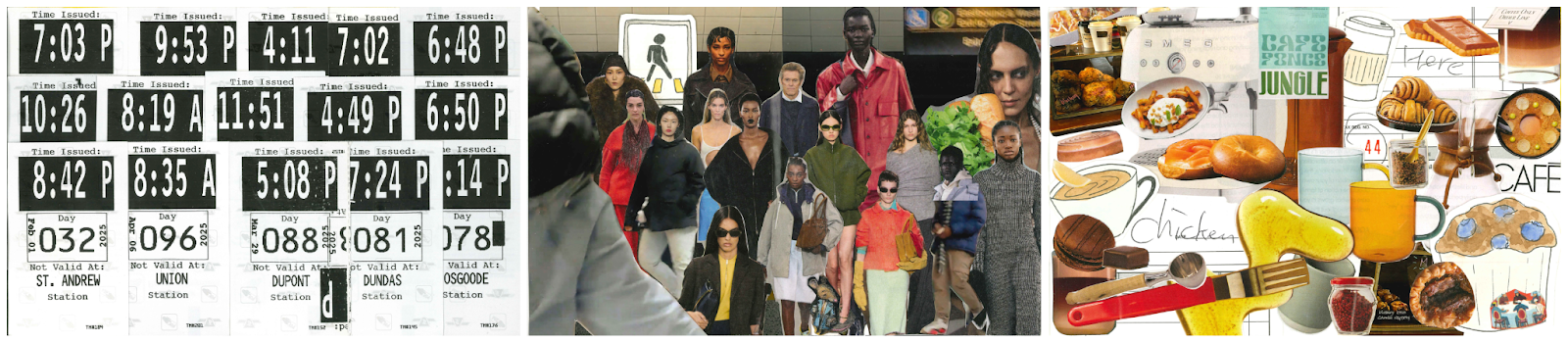
Together with the manifesto, Bus offers a meditation on what it means to arrive as a listener and embody this arrival within an urban setting, centering relationships of mobility, access, and technology. Thinking with social theorist de Certeau, city inhabitants create place and meaning through walking as a reimagining of the City, where spatial practices determine social conditions:
The moving about that the city multiplies and concentrates makes the city itself an immense social experience of lacking a place—an experience that is, to be sure, broken up into countless tiny deportations (displacements and walks), compensated for by the relationships and intersections of these exoduses that intertwine and create an urban fabric, and placed under the sign of what ought to be, ultimately, the place but is only a name, the City (2021, 235).
For BEEP zine, listening to urban sound in the city becomes another mode of this embodied mobility. As urban sociologist Rowland Atkinson (2007) also explores, a city’s acoustics, including music, are temporal and spatial territories that carry their own social functions and mobility.
Wearing headphones intersects with these dynamics. According to urban sociologist Jean-Paul Thibaud (2003), listeners with headphones engage in a process of derealization of urban space, in a sonic universe that is both private and public. This listening can act as “sonic bridge” between places that are private and public through “phonic deterritorialization” where “the walking listener neutralizes the sonic delimitations between domestic and public spaces by establishing a continual listening between the two spaces” (ibid, 5). Or, in adjusting the volume to listen to both the outside urban environment and the sound coming through the headphones, a “sonic reterritorialization” that recomposes the urban soundscape (ibid, 6). Driving in cars down city streets and sitting in traffic, human geographers Waitt et al (2017) have also theorized how listening to music while driving intersects with mobility, affect, embodiment, and identity.
Removing headphones and becoming present in the acoustic territories that surround us enters listeners into new relationships and approaches valuable questions about accessibility in cities. Numerous studies have examined the way in which urban soundscapes impact psychological health, particularly for vulnerable communities (Kou et al, 2021; Merlino et al, 2023). Listening to a city’s acoustics can also enable acts of mobility justice in other ways. In cultural historian and theorist Robert Stock’s (2025) study of the acoustic dimensions of electronic vehicles, the presence or absence of motor sound from these technologies complicates the urban soundscape. If absent, they reduce the “noise pollution” of cities. If present, they represent an extension of capitalist marketing strategies. Engaging with critical disability studies, this absence of sound is also the absence of an acoustic cue that is essential for blind mobility in the city, as well as sighted mobility in a soundscape filled with competing sound. Thus, the presence of sound also signifies safety and independence.
As an action of arriving through listening to and creating embodied meaning in the presence of urban soundscapes, Bus calls us to ask:
- What technologies do you use that filter your listening in the city? Explore how places sound with and without these technologies.
- What is your relationship to soundmaking when wearing these devices?
- What is your relationship to soundmaking when wearing these devices?
-
Does your environment sound differently when you listen to the city through an embodied presence?
PARK is attuning
PARK is eavesdropping on birds from neighbouring trees.
PARK is lilting above the hum of urban traffic.
PARK is watching the crocuses bloom but not knowing their name.
PARK is anticipating what’s next — bus, wind, snow, show.
PARK is walking through Riverdale on your way to work, like it’s inconvenient.
PARK is rushing to the car to be stuck behind the dump truck.
PARK is waiting in place while being at your destination.
PARK is holding on for 17 years to scream at the top of your lungs for 6 weeks.
PARK is the echoes of laughter from the swing set.
PARK is finding the perfect spot for a picnic.
PARK is the rhythm of wind passing through the leaves.
PARK is barking dogs watching the squirrels leap between the trees.
PARK is wanting to kiss your crush during a Christie Pits sunset.
PARK is the final step before reaching home.
PARK is staying a little longer than is necessary.
Park offers a listening modality through attunement, particularly in the relations that emerge between human and nonhuman citizens through listening. Listening as a modality of attunement supports an extended reflection on relationships between human and non-human ecologies through a grounded practice of listening in situ. Unlike Bus's mobility, Park's listening modality approaches new sonic citizenship through deliberate, situated, and slow listening. As media scholar David Cechetto describes in Listening to the Afterlife of Data (2022):
For better and worse, becoming agential through distributed attunement is a key strategy for addressing the unvisualizably immense and minute scales that subtend so many of our contemporary experiences. [...] Listening is a dynamic process of learning and self-development where sense resounds beyond significance, and aurality encompasses practices that make literal use of sound but also extends to listening itself as a comportment toward attunement (85).
Park in BEEP zine listens to soundscapes of parks as outdoor green spaces, parking lots, and people parked waiting along subway platforms.
Park begins with a busy green space: cicadas and children collectively scream for joy as they celebrate a sunny morning. The neighbourhood splash pad pulses streams of water and conversations lilt above the roars of the city bus. Screams intensify as the children run through sprinklers and jump off of swings...
The second soundscape begins with waves of traffic. We move inside a vehicle, pulling into a garage. We adjust our position by backing up the vehicle, turning the wheel, and pulling into a small parking space. Venturing back outside, we hear a garbage truck picking up a dumpster to empty its contents...
The last soundscape introduces the listener to a subway platform – waiting. The sounds of subways passing in the distance slowly fill the acoustic profile. A signal alerts that the subway has arrived. The doors to the subway close with a familiar chime; transported to a foyer at a music hall, we listen to people parked, waiting...
The collages are assembled through strips of paper and colour. The first spread explores the seasons of urban parks through images of changing leaves and sunsets, and overlapping magazine-sourced flowers. The second spread thematically explores parked vehicles with images of traffic, stacked cars, parking garages, and cartoon city workers. The final collage spread addresses parked people in the visual context of travelling, fashion shows, and a graphic representation of earth (notably disappointed at the moon).
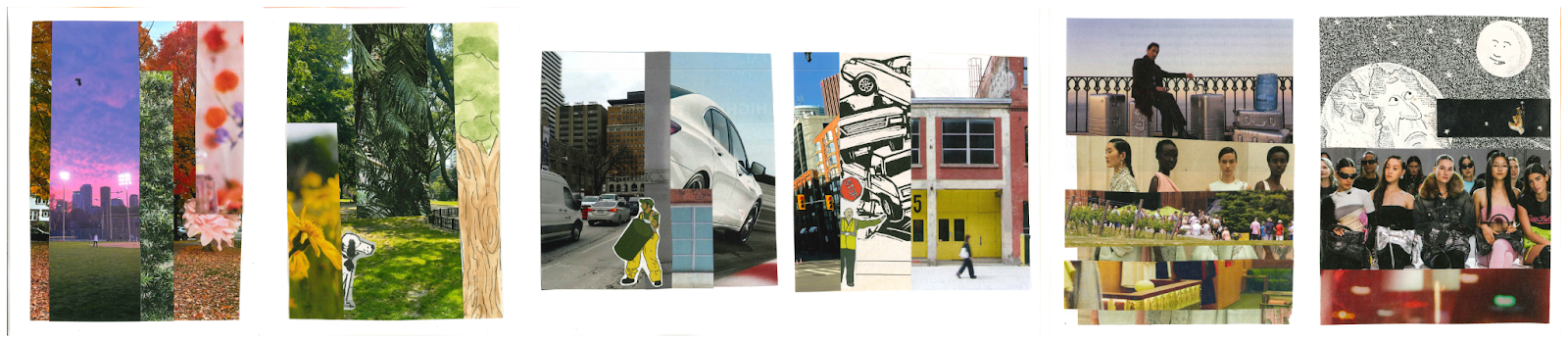
Listening to variations of park – green areas in cities, vehicles, people – centers the process of attuning to the relations of human and nonhuman actors that negotiate urban spaces. Park calls for listeners to engage in deep listening (Oliveros, 2005) practice in line with the possibilities of attending to acoustic ecologies. Deep listening and acoustic ecology emerge from similar concerns put forth by composers. Pauline Oliveros describes deep listening as:
Deep has to do with complexity and boundaries, or edges beyond ordinary or habitual understandings… A “deep one” defies stereotypical knowing and may take either a long time, or never to understand or get to know. Deep coupled with Listening or Deep Listening for me is learning to expand the perception of sounds to include the whole space/time continuum of sound— encountering the vastness and complexities as much as possible… Such expansion means that one is connected to the whole of the environment and beyond (2005, p. 14).
Attunement is inherently a deep process strengthened temporally. Listening to one’s environment repeatedly and regularly enables a close relation to these modes of connection. In a similar vein, we consider attunement and presence particularly as it pertains to multi-species listening within the context of acoustic ecology. We examine acoustic ecology through previous research by R. Murray Schafer and the World Soundscape Project (WSP), offering an interdisciplinary method through which to understand sonic relations and environmental changes through listening within the context of a rapidly industrial world: “The electric revolution has this given us new tonal centres of prime unity against which all other sounds are now balanced. [...] to relate all sounds to one that is continuously sounding is a special way of listening” (Schafer, 1977, p. 99). Though its origins have been notably anti-urban, a point which we will further discuss in the edition of Pool, its foundations of listening practices have sparked the emergence of understanding place, environment, socio-cultural relations, and urban communities through sound (Droumeva and Jordan, 2019). Sonic researcher David George Haskell describes listening to environments and ecologies as a “sensory lesson in kinship” (2022, p. 363). Through sonic attunement to nonhuman citizens of urban spaces, we can “discover not endings [or concerns of an ecologically precarious future] but connection and creativity in the present” (Haskell, 2022, p. 377), reflecting on our own listening filters (Robinson, 2020) as they shape our relationship to place, community, and ecologies.
Merging these possibilities in Park, this edition acts as an invitation towards slow, parked, and deep attunement as a listening modality: attuning to an imagined Toronto through collage and remix and, for international listeners, to non-human relations, commons, and ecological (im)balances within their habitual environment. Urban citizenship extends beyond human inhabitants and Park suggests that attuning to this presence is an important part of accounting for urban citizenship in carefully situated acts of listening:
- What forms of sonic interaction can you hear between human and non-human species?
-
In what ways can you hear yourself creating space in the soundscape? How does this alter the soundings of non-human citizens?
BAR is assembling
BAR is dreaming of what could be.
BAR is celebrating, despite everything.
BAR is singing in the shower and on the stage.
BAR is taking to the streets.
BAR is conversations with a stranger sitting two stools away.
BAR is talking again, once things have settled down.
BAR is talking again, when everything is on fire.
BAR is going on a date, to anywhere.
BAR is asking your friends for help.
BAR is a surprise – stirred, shaken, on the rocks – with or without a recipe.
BAR is forced silence and sonic rebellion.
BAR is call and response.
BAR is slurping your drink through the ice.
BAR is finding the cracks in what feels unbreakable.
BAR is practicing to tune in, together.
The listening modality of assembling is proposed by Bar in the way it represents a bringing together of people from across communities within the city towards new sonic narratives of celebration, protest, and relation. These acoustic communities of sonic citizens collaboratively imagine and reimagine urban soundscapes as assemblages of listenings. Following the work of scholar Leslie Dema (2007) on inorganic life, these assemblages are "animated by coding and decoding, deterritorializations, and lines of flight [...] it is the striking up of a rapport".
BEEP zine's Bar offers soundscapes that explore "bar" as a cocktail bar, an orchestral performance as bars of music, and voices in protest of counter-barring.
Bar’s first soundscape is a jaunty tune and a mixed drink: clinking ice and pouring liquid, conversations in English and other languages, the shake of a cocktail, slurping through a straw until the twinkling sounds of only ice left...
Bar’s second soundscape is an onslaught of sound: conversations overlapping while an orchestra tunes before a performance, instruments almost indistinguishable. The voice of an opera singer practicing an aria battles for the foreground against a flute and conversations nearby: “I’m very excited to hear this guy. Did you look him up?”. The cacophony suddenly lessens, apart from a stray cough and conversation lingering: “Welcome to this Toronto Symphony Orchestra concert. We are delighted you can join us. As a courtesy to the orchestra and your fellow patrons, please turn off and put away your cellphones and electronic devices at this time. Audio recording, photography and videography are prohibited during the performance. Photographs can be taken when the performance is not in progress. Thank you.” A round of applause…
The final soundscape of Bar is a single audio track of protesters: chanting, wind gusts, the beep of the crosswalk, the sound of footsteps, call and response, “Free Tibet”, “Tibet is not/A part of China”, “What do we want?/We want freedom”...
In tune with Bar’s theme of gathering across differences, Bar’s collages are designed as reversible so that the collage is never upside-down and that someone (or multiple people) can look at the zine from either side. These collages include line-ups of glasses, cocktails, bottles, and canned drinks; skateboarders dropping in from the edges of music bars; and images of people – some showing the middle finger – behind the bars of a transport vehicle, with words overlaid: progress, participation, revolution, community, ceasefire, negotiations, justice, talk to them, resistance.
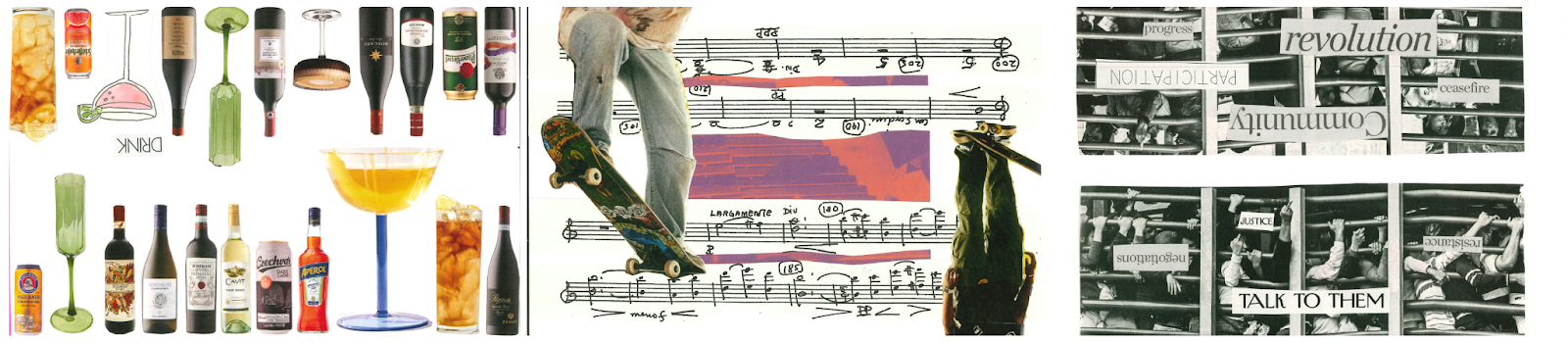
Assembling is a modality that brings people together through listening. These assemblages open up possibilities for what Schafer (1977) calls acoustic communities: groups of people defined by specific acoustic signals and sonic relationships, sometimes in tension with spatial communities and infrastructures. An example Schafer offers of this is church bells, whose range of sound signifies the extent of its parish, now muffled by competing sounds within a city. Composer and soundscape scholar Barry Truax (2017) deepens this definition by extending that: “an information-rich, balanced soundscape contributes to the sense of an acoustic community, one where sound plays a formative role in the definition and life of a group of people, no matter how their commonality is defined” (258). Further:
Such an acoustically defined community will likely exhibit a large variety of sounds, many of which are interpreted by locals with a complexity of contextual information, and the resulting layering of sounds is balanced by a variety of spatial, temporal, and social forces that make it functional. Sound will also define what is the boundary of the community, whether the scale is small or large, by distinguishing between what is “local” from what comes from the “outside” (ibid).
For Truax, these communities are contingent upon the exchange of sonic information; what limits these exchanges limits the potential of community. What happens when we reshape our listening and belonging in sonic communities to reconsider our exchange and redefine what is “local” and what is “outside”?
In the project Narratives in Space+Time Society, media scholar M.E. Luka (2018) and collaborators led a series of public and research walks in Halifax, Nova Scotia, to reflect on the centennial anniversary of the Halifax explosion, through walking, shared stories, song, performance, models, and found objects. For Luka, these walks create choreographies of assembly through the “social co-collection, co-analysis, and co-presentation of alternative and missing stories—including Mi’kmaq and African Nova Scotian perspectives—the performative and mediated iterations of the research respectfully articulated historical and present-day social tensions and potential resolutions” (2018, 44). In a similar way, BEEP zine, through Bar’s invitation, creates a sonic gathering point through which choreographies of assembled stories, memories, legacies, and histories shape community against the alienation of the city, negotiating new urban narratives of gender, race, class, ability, and mobility.
Through collective assembling, Bar prompts up to listen to:
- How do you take part in networks and relationships with others through sound?
- Which acoustic communities do you belong to, challenge, or create through your listening?
POOL is adapting
POOL is a 7-day forecast for rain.
POOL is hot tub jets.
POOL is dripping water from a leaky faucet.
POOL is wet clothes when you’ve forgotten an umbrella.
POOL is getting lost in the Eaton Centre.
POOL is lane swimming at 8am because it’s the only time slot available.
POOL is finding a place to rest.
POOL is calling dibs on an empty table in the food court.
POOL is going with the flow.
POOL is water in your goggles.
POOL is the rhythm in the waves.
POOL is bubbling, dripping, gurgling, swishing… drop!
POOL is spotting your friend in the crowd.
POOL is your beach body, just as you are.
POOL is sinking the 8-ball, on purpose.
As a listening modality, Pool centers the ways in which sonic citizens adapt how they move, sound, and exist within urban spaces; or in other words, how they ‘go with flow’ or not. This listening modality of adapting is embedded into the navigation of pooling people, sounds, and water, where we adapt and adjust to one another's sonic and physical presence. As queer feminist scholar Sara Ahmed (2014) writes, "adjusting to this world means given [sic] up certain words and concepts, which get in the way of just inhabiting or occupying space" but can also be a site of intervention or solution: "Don’t adjust to injustices. Stay maladjusted!"
In its soundscapes, BEEP zine's Pool encounters splashing in hot tubs and swimming pools, pooling people in malls, and a pool hall.
The soundscape begins with gurgling drains, bubbles, and splashing. A microphone is placed underwater so the listener is immersed below the surface. Music fades into a public pool lane swim; overlapping hot tub jets deepen the aquatic surface of this soundscape...
In the second soundscape, the crowds of the Eaton Centre move through busy pathways and congregate in larger halls. Conversations pierce through a general hum – “my hair is a saturated colour” – and multi-lingual conversations converge. Rain slowly pours into the auditory field, accompanied by thunder; raindrops rapidly splatter on the pavement…
The third soundscape opens with disco music and a pool player opening with a break shot. Sirens pass as players quietly move through a pool game, tapping the cue against the balls; ricocheting pool balls sink into the plastic pockets...
In its collage format, Pool is a distinct edition. Designed with the intention of being viewed vertically (while all others are meant to be read horizontally), the first spread outlines lane swimming time slots and blue aquatic textures. The second spread features a central photo of the Eaton Centre in Toronto, Canada; overlapping receipts and clippings from newspaper forecasts line the edge of the page. The final collage situates the listener in a pool hall with images, watercolour examples, pearls, and legs standing on bathroom sinks.
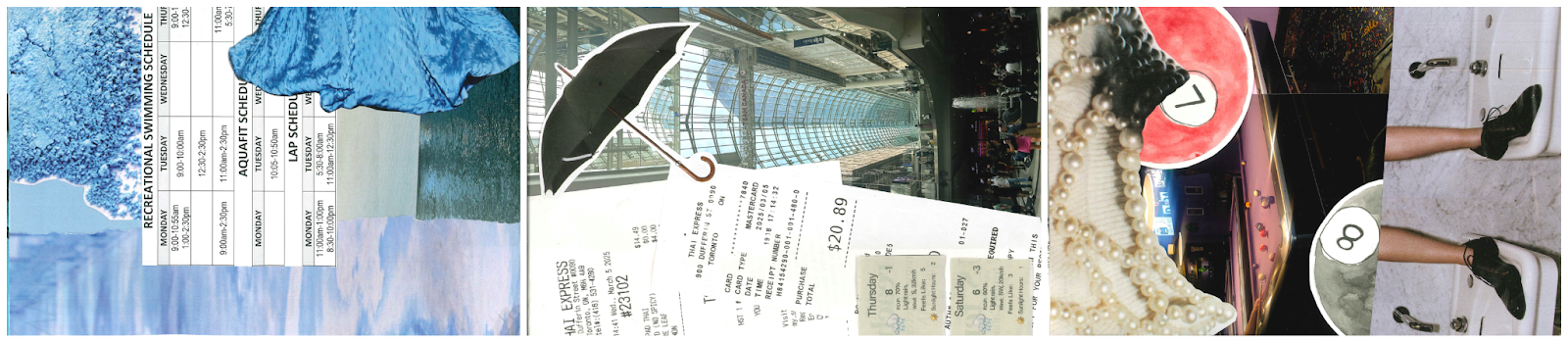
Listening and flowing are adaptive forms of engagement that Pool invites through soundscape composition, manifesto, and collage. In the context of urban soundscapes in particular, citizens are regularly confronted with unwanted or undesirable sonic inclusions. Defining Toronto as our setting, in 2024 the municipality received “10,173 complaints about noise and 7,898 complaints about amplified sound” (Freeman, 2025) – these range from vehicle noise, animal noise, construction noise, stationary / air condition noise, to a vague definition of persistent noise. In sum, urban populations develop adaptive techniques and interactions in order to flow within busy urban spaces. Droumeva et al. (2022) address these conditions in the context of livability. To make sounds livable, “cities have an obligation to deliberately create quiet spaces and quiet hours and manage sound propagation in public space with more consideration. There is also a logical extension to soundscape considerations in the areas of urban architecture, building codes, and community zoning” (2022, p.128); however, citizens adapt to noise pollution or excessive sound by means of personal soundscaping devices and wearable modes of “quiet comfort” (Hagood, 2019).
In the context of BEEP zine, our invitation towards adapting as a listening modality is a call to become attentively aware of urban soundscapes and enact what composer and soundscape scholar Hildegard Westerkamp (2019) terms “disruptive listening”. Disruptive listening challenges the ways in which we resist attending to our soundscapes, encouraging mindful awareness which in turn can spur change:
If we open our ears to this experience of sound unfolding as a continuous now, it inevitably includes an opening to surprises, to the unexpected, to the difficult and uncomfortable, to noise or potential discomforts with silence. It means staying with the sensations for a time no matter what reactions it may elicit in us (Westerkamp, 2019, p. 45).
If we become more aware of the ways in which we self-adjust, move “with the flow”, and find moments of respite, we can become more conscious sonic citizens who are not only conscious of the ways in which the city shapes our actions, but who simultaneously can demand change in moments of undesirable adjustments.
Pool offers an invitation to listening possibilities by asking:
- In what ways do we adapt as urban citizens? What do we learn about our own forms of adaptation in attentive listening practice?
- What might it mean to “go with the flow”? Relatedly, what can a disruptive listening framework enable in your city?
Critical listeners as sonic citizens
As we have noted throughout the paper, listening to BEEP zine itself enables a particular form of citizenship, a citizen of BEEP zine’s Toronto. Through close listening practice, collage viewing, and manifesto reading, the listeners of our zine are invited into self-contained representations, but their sonic affordances are limited through module activations. However, the four listening modalities we offer deepen these possibilities by prompting individual reflection on what it means to be a citizen in one’s own sonic environment. Through arriving (Bus), attuning (Park), assembling (Bar), and adapting (Pool), these listening modalities allow listeners to deeply engage with their urban sonic environment, and to take part in acoustic relationships with all members of the city. If sonic citizenship is a configuration of relational and dynamic communities continuously finding attunement (Højlund et al, 2024) then BEEP zine’s modalities drive listeners and sound makers towards investigating their relations.
We envision listeners activating the four modalities through the sets of questions offered throughout this paper as provocations through which to perform soundwalks (Westerkamp, 2006) and deep listening meditations (Oliveros, 2005). As listening prompts, these questions aim to be inquisitive frameworks for listening developed with the intention of amplifying and centering the networks, nodes, and relational communities in local soundscapes. BEEP zine’s modalities and site-specific listening prompts are spaces within which a critical listening ear can be focused and honed towards informed and transformative sonic citizenship. Starting with a question allows a listener to hone their ear towards a particular, focused thematic “without expectations, assumptions or judgement, to listen without the compulsion to change things or to act immediately” (Westerkamp, 2023). Thus, these questions are not offered from a standpoint of expected outcomes or desires; rather, they encourage all urban inhabitants – community members, artists, youth, academics, city planners – to deepen their listening practice in favour of sonic relations. In completing these exercises, listeners will encounter, enter, uncover, and deepen pre-existing sonic relationships: “a soundwalk does not only reveal relationships within the acoustic environment but perhaps more importantly, makes relationships conscious between listeners’ experiences and their acoustic - social environment” (Westerkamp, 2023). Before you begin, we ask you to consider:
- How might you arrive, attune, assemble, and adapt in your own sonic environments?
- In what ways can listening extend beyond awareness towards worldbuilding that enables sensory belonging and socio-techno-ecological relations?
- How can we activate listening modalities that enable us to transform into the sonic citizens we want to become?
These listening modalities (arriving, attuning, assembling, adapting) reengage sonic citizens as critical listeners. They are invitations to guide and challenge listening practices across the urban spaces we inhabit, traverse, and negotiate. The modality-specific listening prompts we have included in this paper are meant to be activated and applied on formal soundwalks and in everyday life. In the day-to-day, this could take the form of considering your embodied, technologically-mediated presence next time you arrive on the bus. When you pass by a park, take a moment to sit and attune to the ecological relationships around you. In a bar, order a drink and listen to the assembling of networks and communities (perhaps your own). When visiting your local pool, listen to the ways in which water flows around lane swimmers and conversations poolside collectively adapt. Guided by each modality’s questions, what do you notice in these focused moments of critical listening? What is excluded? What is your relationship as a listener?
While emerging from specific locations (Bus, Park, Bar, Pool), these modalities are not exclusively situated and listened within these spaces. We encourage readers to practice, extend, and reconfigure these modalities to break up their “habitual attunements” (Højlund et al, 2024) in favour of alternative sonic futures: to arrive, listen to the sounds of mobilities mediated with/out technology; to attune, listen to ecological relationships; to assemble, listen for sonic markers of community and collective action; and to adapt, listen in favour of change and adjustment. Through focused critical listening, each modality can also be swapped and used in tandem, to reveal different or overlapping relationships to an urban soundscape even if listening to a familiar location: What do you listen to when you attune poolside? Or when you arrive at a bar? We also invite the application of these modalities in different spaces, in the locations where BEEP zine has yet to venture: offices, restaurants, farms, schools, walking trails, concert halls, movie theatres, lobbies, and gas stations. Beyond BEEP zine, these questions ask listeners to reflect on the position from which they listen to critically examine their situated ears while deepening urban acoustic relationships. These modalities (arriving, attuning, assembling, adapting) reposition critical listening as sonic citizenship to amplify sonic worlds continually unfolding.
Keywords
Bibliography
Ahmed, S. (2014). "The Problem of Perception". [online] feministkilljoys. Available at: https://feministkilljoys.com/2014/02/17/the-problem-of-perception/
Arkette, S. (2004). "Sounds Like City". In Theory, Culture & Society, 21(1), pp. 159–168. doi: doi.org/10.1177/0263276404040486
Atkinson, R. (2007). "Ecology of sound: The sonic order of urban space". In Urban Studies, 44(10), pp. 1905–1917. doi: doi.org/10.1080/00420980701471901
Cecchetto, D. (2022). Listening in the Afterlife of Data: Aesthetics, Pragmatics, and Incommunication. Durham: Duke University Press.
Chrysagis, E., & Kompatsiaris, P. (2022). "Introduction: manifestos of the contemporary". In Culture Theory and Critique, 63(2–3), pp. 119–124. doi: doi.org/10.1080/14735784.2023.2247192
Cowan, T.L. (2012) "GLITTERfesto: An Open Call in Trinity Formation for a Revolutionary Movement of Activist Performance Based on the Premise That Social Justice is Fabulous". In Canadian Theatre Review, 150, pp. 17–21. doi: doi.org/10.3138/ctr.150.17
Cowan, T. L., & Rault, J. (2024). Heavy processing. Santa Barbara: Punctum books.
de Certeau, M. (2021). "Spatial Practices: Walking in the city". In S. Low, W. Mangold, S. Saegert, C. Katz, & J. J. Gieseking (Eds.), Public Space Reader. New York: Routledge, pp. 232–236
Dema, L. (2007). ""Inorganic, Yet Alive": How Can Deleuze and Guattari Deal With the Accusation of Vitalism?" Rhizomes, 15. Available at: https://www.rhizomes.net/issue15/dema.html#_ftnref1
Droumeva, M., Copeland, S. and Ashleigh, B. (2022). "What Does the Livable City Sound Like? Analyzing Public Communication in Vancouver, Canada". In Canadian Journal of Communication, 47(1), pp. 125–145. doi: doi.org/10.22230/cjc.2022v47n1a3841
Droumeva, M. and Jordan, R. (eds.) (2019). Sound, Media, Ecology. New York: Palgrave Macmillan.
Franklin, A. (2017). "The more-than-human city". In The Sociological Review, 65(2), pp. 202–217. doi: doi.org/10.1111/1467-954X.12396
Freeman, J. (2025). "Too noisy? These are some of the sounds that drive Toronto residents up the wall. [online] CTVNews". Available at: https://www.ctvnews.ca/toronto/article/too-noisy-these-are-some-of-the-sounds-that-drive-toronto-residents-up-the-wall/ [Accessed: 20 August 2025].
Hagood, M. (2019). Hush: media and sonic self-control. Durham: Duke University Press.
Haskell, D.G. (2022). Sounds Wild and Broken: Sonic Marvels, Evolution’s Creativity, and the Crisis of Sensory Extinction. New York: Viking.
Højlund, M., Vandsø, A., & Breinbjerg, M. (2024). "Sonic Citizenship: About the Messy and Fragile Negotiations With and Through Sound". Journal of Sonic Studies, 26(26). doi: doi.org/10.22501/jss.3032038
Kou, L., Kwan, M.-P., & Chai, Y. (2021). "Living with urban sounds: Understanding the effects of human mobilities on individual sound exposure and psychological health". Geoforum: Journal of Physical, Human, and Regional Geosciences, 126, pp. 13–25. doi: doi.org/10.1016/j.geoforum.2021.07.011
Luka, M. E. (2018). "Assembling collaboration in the Debris Field: From psychogeography to choreographies of assembly". In Canadian Theatre Review, 176, pp. 41–47. doi: doi.org/10.3138/ctr.176.007
Mbembe, A. (2022). The Earthly Community: Reflections on the Last Utopia. Rotterdam: V2 Publishing.
Merlino, S., Mondada, L., & Söderström, O. (2023). "Walking through the city soundscape: an audio-visual analysis of sensory experience for people with psychosis". Visual Communication, 22(1), pp. 71–95. doi: 10.1177/14703572211052638
Myers, N. (2020). "Anthropologist as Transducer in a Field of Affects". In N. Loveless (ed.), Knowings and Knots: Methodologies and ecologies in research-creation. Edmonton: University of Alberta Press, pp. 97-126.
Oliveros, P. (2005). Deep listening: A composer’s sound practice. New York: iUniverse.
Oliveros, P. (2021). Deep Listening. [online] "The Center For Deep Listening". Available at: https://www.deeplistening.rpi.edu/deep-listening/ [Accessed: 24 August 2025].
Robinson, D. (2020). Hungry listening: resonant theory for indigenous sound studies. Minneapolis: University of Minnesota Press.
Schafer, R.M. (1977). The soundscape: our sonic environment and the tuning of the world. Rochester: Destiny Books.
Schafer, R.M. (1992). A sound education: 100 exercises in listening and sound-making. Culver City: Arcana Editions.
Stock, R. (2025). "Sonic e-mobility: traffic noise, sound-producing electric vehicles, and blind pedestrians". Mobilities, pp. 1–17. doi: doi.org/10.1080/17450101.2024.2436897
Thibaud, J.-P. (2003). "The sonic composition of the city". In M. Bull & L. Back (eds.), The auditory culture reader. Amsterdam: Berg, pp. 329–341.
Waitt, G., T. Harada, and M. Duffy. (2017). "‘Let’s Have Some Music’: Sound, Gender and Car Mobility". Mobilities, 12(3), pp. 324-342. doi: doi.org/10.1080/17450101.2015.1076628
Westerkamp, H. (2023). "Soundwalking as Ecological Practice". [online]. Available at: https://hildegardwesterkamp.ca/writings/writings-by/?post_id=14&title=%E2%80%8Bsoundwalking-as-ecological-practice---2023-update:-spanish-translations-published---2-publicaciones-en-espanol [Accessed: 3 November 2025]
Westerkamp, H. (2019). "The Disruptive Nature of Listening: Today, Yesterday, Tomorrow". In M. Droumeva and R. Jordan (eds.), Sound, Media, Ecology. New York: Palgrave Macmillan, pp. 45–63.