



Singing citizenship?





Abstract
During Denmark’s COVID-19 lockdowns, communal singing (fællessang) was widely framed in public discourse as a benign and unifying expression of national belonging. Media coverage overwhelmingly centered on the Danish Broadcasting Corporation’s (DR) televised singalongs, which invited viewers to sing “together – while apart” and implicitly aligned participation with civic responsibility and trust in governmental restrictions. This institutionalized, heritage-based version of communal singing came to stand as the unproblematic face of Danish belonging. Simultaneously, however, collective singing also formed part of street protests organized by the activist group Men in Black Denmark, where demonstrators chanted, marched, and sang protest songs – most notably the adaptation “Mette Ciao,” based on the Italian resistance anthem “Bella Ciao” – to challenge Prime Minister Mette Frederiksen and the legitimacy of lockdown measures. Yet while DR’s broadcasts were celebrated as exemplary fællessang, protest singing was rarely recognized as communal singing at all. Drawing on the concept of sonic citizenship – citizenship enacted through participatory sound production – we compare these mobilizations to show how both generated in-group cohesion while simultaneously producing exclusion. Based on case studies of broadcasts and protests, a nationally representative survey (n=2,031), and ethnographic interviews (2023–2024), we argue that communal singing operates as a contingent social technology, capable of reinforcing institutional trust or articulating dissent while negotiating the boundaries of belonging in democratic societies.
Introduction: Singing as Sonic Citizenship
Communal singing has long been regarded as a powerful means of cultivating social cohesion, cultural identity, and collective belonging (Borčak 2020). Yet singing is not intrinsically unifying – it can equally serve as a vehicle for exclusion, protest, and resistance. This ambivalence became strikingly visible during the COVID-19 pandemic in Denmark, where communal singing (fællessang, i. e. the act of informal group singing) was mobilized for opposing political purposes. While the Danish national broadcaster DR launched daily singalong programs that invoked national unity and trust in government restrictions by encouraging people to sing “together – while apart” (Sammen – hver for sig), the activist group Men in Black Denmark repurposed communal singing as protest against those same restrictions. Their adaptation of the Italian anti-fascist resistance song “Bella Ciao” into “Mette Ciao” – a direct critique of Prime Minister Mette Frederiksen – exemplified how singing can function as an act of defiance rather than compliance. Yet while DR’s programs were widely celebrated in Danish media as a unique and powerful expression of national culture, the fact that Men in Black demonstrators actually sang during their protests was rarely remarked upon. This absence is telling: singing mobilized to express mistrust in governmental authority remained largely invisible in public discourse, obscured by dominant narratives that position fællessang exclusively as unifying the nation. Instead, the examples show how communal singing functions to establish in-group trust, while expressing both trust and mistrust in authority.
This article examines these contrasting mobilizations of communal singing during Denmark’s COVID-19 lockdowns to challenge narratives of fællessang as a “social superglue” capable of uniting all Danes regardless of background or political stance (Borčak 2025). We demonstrate that both DR’s televised singalongs and Men in Black’s street protests generated social cohesion among participants while simultaneously producing exclusion – but with a crucial difference. In Men in Black’s protests, exclusion is explicit and visible. In DR’s programs, by contrast, exclusion is obscured by universalizing rhetoric that claims to unite “all Danes," suppressing those who feel alienated from institutionalized communal singing.
To analyze how communal singing negotiates inclusion and exclusion, trust and mistrust, we employ the concept of sonic citizenship – the performative act of belonging and political participation enacted through active (in our case, vocal) sound production (Phelan 2018; Turino 2008). Sonic citizenship provides a valuable analytical lens for understanding how both DR’s programs and Men in Black’s protests constitute legitimate ways of enacting citizenship through sound, despite their opposing political orientations. Both use collective singing to create in-group solidarity, but toward different ends: one to reinforce institutional trust, the other to challenge it.
Our central argument is that communal singing operates as a powerful social technology that can be deployed for various, even contradictory, political purposes. By revealing how universalizing narratives about communal singing obscure patterns of exclusion and coercion, particularly in cases where singing is mobilized to reinforce institutional trust, this article contributes to scholarship that questions music’s inherently unifying nature (Cloonan 2009; O’Connell & Castelo-Branco 2010; Kertz-Welzel 2016; Boeskov 2018). Understanding Denmark’s status as a high-trust society is crucial to our analysis, as it heightens the significance of both protest singing (which openly challenges institutional trust) and hidden exclusion (which contradicts narratives of universal social cohesion).
To substantiate this argument, we draw on two pandemic-era case studies analyzed through observation of public broadcasts and media coverage, supplemented by a 2022 national survey (n=2,031) and ethnographic interviews (2023-2024). The article proceeds by: (1) establishing our theoretical framework of sonic citizenship and contextualizing Danish trust culture and singing traditions; (2) analyzing DR’s programs and Men in Black’s protests as contrasting expressions of sonic citizenship; (3) presenting survey and ethnographic findings that contextualize these cases within broader patterns of Danish attitudes toward communal singing.
Communal Singing as an expression of Sonic Citizenship
This article examines communal singing through the lens of sonic citizenship – the performative enactment of belonging and political participation through active sound production. While citizenship is traditionally understood as formal legal status within a nation-state, recent scholarship has expanded this concept to encompass sensory and embodied dimensions of political and social life (Trnka, Dureau & Park 2013).
Helen Phelan’s (2018) work with asylum-seeking communities in Ireland provides a foundational theorization of sonic citizenship. She demonstrates how ritual singing created “sung belonging” – a rites-based form of citizenship grounded in collective sound production rather than legal rights. For asylum seekers denied formal status, communal singing generated a phenomenological experience of belonging through embodied participation. Crucially, Phelan’s conceptualization emphasizes active engagement: sonic citizenship is enacted through singing together, not merely listening.
Since Phelan’s foundational work, sonic citizenship has been applied across diverse contexts, revealing both its unifying and divisive potentials. Eun-Sung Kim’s (2016) study of apartment floor noise conflicts in Korea demonstrates how sonic citizenship operates in everyday domestic disputes, where competing claims to acoustic space generate tensions between neighbors. Vincent Andrisani’s (2017) research on sound and space in Havana explores how sonic practices construct urban citizenship through street music and public soundscapes. More recently, Højlund, Vandsø, and Breinbjerg (2024) have examined sonic citizenship in relation to pandemic-era soundscape transformations, showing how sonic practices negotiated shifting relationships between citizens, communities, and the state. Together, these studies reveal that sonic citizenship is not limited to formalized or celebratory practices but encompasses mundane, contested, and conflictual sonic negotiations of belonging.
This emphasis on participatory sound production resonates with ethnomusicologist Thomas Turino’s (2008) distinction between participatory and presentational music-making. Turino defines participatory performance as “actively contributing to the sound and motion of a musical event through dancing, singing, clapping, and playing musical instruments when each of these activities is considered integral to the performance” (Turino 2008, p. 98). In contrast, presentational performance establishes a clear division between performers and audience. Turino critiques how Western musical culture privileges presentational forms, thereby obscuring the social and political significance of participatory practices. This critique is particularly relevant to understanding sonic citizenship: when music-making becomes presentational, the participatory dimension essential to enacting citizenship – the active contribution to collective sound – is diminished or lost. While sonic citizenship could encompass listening, we follow Phelan and Turino in emphasizing active sound production. Sonic citizenship takes different forms: it may involve direct embodied engagement – singing, clapping, moving – where individuals contribute to collective sound, or it may operate through mediated performances that represent participation symbolically. These modes are not mutually exclusive, and their distinction becomes analytically important for understanding how sonic citizenship functions across different contexts.
Sonic citizenship operates as both a social and political phenomenon. Danish ethnographer Tine Damsholt (2008, pp. 56-65) captures this duality succinctly: “Citizenship is not just something that flows through the person passively and inclusively. It is also something you do." Building on Damsholt’s insight, we understand sonic citizenship as simultaneously addressing horizontal relationships among citizens (creating belonging or exclusion) and vertical relationships between citizens and the state (encompassing rights, restrictions, and duties). These dimensions intertwine: for instance, cultivating collective belonging can reinforce compliance with state authority, while sonic expressions of dissent simultaneously forge alternative solidarities.
Ethnomusicologist Kay Kaufman Shelemay (2011) provides a valuable framework for understanding how sonic citizenship operates through different types of musical communities. Shelemay distinguishes between communities of descent and communities of dissent. Communities of descent are characterized by stability, tradition, and continuity, where music reinforces existing identity markers such as nationality, ethnicity, or religion, often providing an anchor in times of crisis. Communities of dissent, by contrast, arise from rupture and contestation, leveraging music as a mobilizing force during conflict and opposition. While descent communities rely on established repertoires and familiar practices to reinforce social cohesion and institutional trust, dissent communities emerge through challenges to authority and shared grievances, often articulating institutional mistrust. This distinction becomes particularly valuable for analyzing how the same cultural practice – communal singing – can be mobilized to express both trust and mistrust in state authority, as our pandemic-era Danish cases demonstrate.
Context: Communal Singing in Denmark
Denmark, together with the other Nordic countries, is renowned for its high-trust culture. Danes invest more trust in fellow citizens, public authorities, and the state than virtually any other population in the world. This encompasses both generalized social trust – trust in one’s fellow citizens at large – and institutional trust in government, police, and the judiciary (Svendsen & Svendsen 2016; Stopa & Svendsen 2020). Recent decades have seen trust emerge as a central object of inquiry across disciplines including sociology, economics, political theory, psychology, and anthropology (Frevert 2013; Hardin 2006; Misztal 1998). These fields converge in recognizing trust as fundamental to interpersonal relationships at all levels of society. Influential theorists such as Putnam (1993) and Fukuyama (1995) characterize trust as a form of social capital that facilitates coordinated action, combats corruption, and creates social cohesion. Trust-based communities such as Denmark exhibit high degrees of social coherence, stronger economies with more equal distribution of goods, low corruption, and happier citizens.
The tradition of fællessang emerged in the nineteenth century and seems to have played a role in the establishment and sustainment of Danish trust culture during the period of nation building and democratic development. Fællessang typically involves groups of people – ranging from dozens to thousands – singing together from shared songbooks, often while seated, led by a pianist or song leader. The practice occurs in diverse settings: schools, folk high schools, public gatherings, political meetings, and family celebrations. Participants sing in unison rather than harmony, and the repertoire draws primarily from the Højskolesangbogen, which contains patriotic songs, folk songs, hymns, and popular melodies familiar to most Danes. The emergence of this distinctively Danish tradition was closely tied to national romanticism and the formation of a cohesive Danish identity (Kirkegaard et al. in press 2027). While church hymnals had long provided shared repertoire within liturgical contexts, the development of Højskolesangbogen (Folk High School Songbook, published for the first time in 1894) institutionalized a parallel practice of communal singing outside religious settings. This collection reinforced shared cultural values and historical consciousness, with patriotic songs intended to function as emotional bonds linking individuals to a collective national identity (Kuhn 1990). The practice of fællessang became deeply integrated into educational institutions, social gatherings, and public ceremonies.
In moments of crisis, singing has served to reaffirm national solidarity while simultaneously revealing tensions within the national community. During World War II, the Alsang movement – large gatherings of Danes singing patriotic songs – became an act of subtle defiance against German occupation (Elmstrøm 2011). This historical precedent provides a striking parallel to the COVID-19 lockdowns, where singing was again mobilized both to express trust in state authority and to articulate opposition to it. More recently, the 2020s have witnessed both a resurgence of interest in fællessang and intensified debates about its politics of inclusion and exclusion.
“Controversies over songs such as Den danske sang er en ung blond pige [The Danish Song is a Young Blond Girl] illustrate how communal singing can function to expel certain groups from the national community. This song, which personifies Danish song itself as a young, blonde girl, sparked debate when a university lecturer objected to its performance at a public event, arguing that it racially codes Danishness and excludes non-white Danes from the national ‘we’” (Maach 2018).
Throughout its history, fællessang has thus served a dual function: while fostering solidarity and social trust, it has simultaneously enforced social hierarchies and boundaries of belonging. National anthems and patriotic songs celebrated unity while marginalizing those who did not conform to dominant narratives (Baunvig 2025). The love of nation expressed through song was not always inclusive – singing rituals delineated who belonged and who did not, simultaneously creating in-groups and out-groups. This juxtaposition of love and exclusion, of unity and violence, has been evident in nationalist singing traditions that equated love of country with willingness to sacrifice for it. The connection between singing, nationalism, and both cohesion and conflict extends into contemporary contexts, making communal singing a particularly revealing site for examining sonic citizenship.
When the COVID-19 pandemic struck Denmark in 2020, both social and institutional trust became sites of sonic negotiation through communal singing. The Danish Broadcasting Corporation (DR) invoked the tradition of fællessang, positioning it as a means of sustaining national cohesion and social trust during a crisis, which challenged trust in other people, since they might be carriers of the virus. Moreover, these televised programs can be understood as attempts to reinforce institutional trust: state-affiliated media deploying song vertically to strengthen citizens’ trust in governmental authority and, thus, indirectly, COVID-19 restrictions. At the same time, activist groups repurposed communal singing as a vehicle for voicing their protest against those same restrictions. These street protests exemplify the cultivation of social trust horizontally among dissenters – building solidarity and cohesion within an oppositional community through shared sonic practice.
Case Study I: DR’s Televised Singalongs – Sonic Citizenship Expressing Institutional Trust
On March 27, 2020, just weeks after Denmark’s COVID-19 lockdown began on March 11, the Danish Broadcasting Corporation (DR) launched Fællessang – hver for sig (“Singing Together – While Apart”), broadcast Friday evenings at 8 pm on DR1. DR also launched Morgensang med Phillip Faber (“Morning Song with Phillip Faber”), a daily program airing weekdays at 9 AM, where Phillip Faber, chefdirigent for DR Pigekoret (DR Girls’ Choir), led viewers through vocal warm-ups and familiar songs. The format reflected the lockdown conditions: Danish artists and personalities performed songs from their own homes, interspersed with footage of ordinary Danes singing from their living rooms, balconies, and gardens. The song selections drew heavily from what DR promotional materials called “the shared Danish song treasury” (sangskat) – familiar melodies from Højskolesangbogen alongside popular Danish hits. The programs rapidly became cultural phenomena. Fællessang – hver for sig attracted 1.05 million viewers for its first broadcast, with subsequent Friday evening broadcasts averaging over 1.1 million viewers, while Morgensang med Phillip Faber averaged 274,000 viewers each morning (Polack 2020).
DR’s programs fostered a community of descent (Shelemay 2011). The selection of songs emphasized cultural heritage and continuity, invoking themes of solidarity, perseverance, and national identity. This repertoire choice aimed to unite audiences and reinforce social and institutional trust through what promotional materials described as “all the songs we know and love.” By emphasizing continuity and familiarity, DR’s shows aligned with a long-standing tradition in Danish song culture – the principle that songs should evoke a Schein des Bekannten (semblance of familiarity), an aesthetic ideal traceable to the eighteenth century composer J. A. P. Schulz (Høgel 2020; Bak 2018).
The programs were widely promoted as expressions of national unity, with frequent references to the historical Alsang movement during Nazi occupation. This framing positioned the pandemic as another historical moment in which singing could sustain national solidarity, reinforcing Denmark’s identity as a high-trust society where citizens cooperate with state authority during crises. From a sonic citizenship perspective, DR’s televised programs represent an attempt to reinforce social and institutional trust through participatory sound production. The vertical relationship between state-affiliated media and citizens was mobilized to strengthen trust in governmental authority and COVID-19 restrictions. By invoking the familiar repertoire and format of traditional fællessang, DR sought to position compliance with lockdown measures as continuous with Danish cultural values and historical precedent. The act of singing together – even while physically apart – was framed as a performance of civic responsibility and collective resilience, sonically enacting citizenship through participation in a state-sanctioned ritual.
However, the reality proved more complex than DR’s promotional rhetoric suggested. Empirical studies challenge the assumption that the programs significantly strengthened social bonds or active participation. According to surveys, only few viewers reported actually singing along during televised or virtual singing events (Baunvig et al. 2025), suggesting that the programs functioned more as viewership than as genuine sonic citizenship in Turino’s participatory sense. Similarly, research by Sørensen et al. (2021) found that participation in televised communal singing did not correlate with increased feelings of social connectedness among viewers.
Further, the TV medium itself shaped this limited participation. Danish sound studies scholars Højlund, Vandsø, and Breinbjerg (2024) note how TV-mediated communal singing fundamentally differs from physical gatherings because there is not necessarily any actual sound production on the part of participants. Media scholar Henry Jenkins’ (2006, p. 137) distinction between interactivity (a property of media technology) and participation (a property of culture) illuminates this gap. While DR’s programs were designed to be interactive – engaging viewers across the country in singing – this technological affordance did not necessarily result in participatory cultural engagement. Without the reciprocal listening, synchronization, and collective sound production that characterize embodied communal singing, DR’s broadcasts may have functioned more as an auto-communicative performance (Sørensen et al. 2021) – a ritualized act that generated community primarily at a symbolic level by reinforcing narratives of collective endurance, while lacking the embodied, reciprocal sound production through which sonic citizenship is most fully enacted.
This interpretation is supported by the programs’ performative aesthetics. Led by professional musicians and accompanied by piano, the broadcasts promoted a controlled vocal aesthetic aligned with the classical bel canto tradition. Each daily session began with vocal warm-ups, and songs were delivered with careful attention to pitch and phrasing. The result was what could be characterized as a “compliant” performative style: orderly, disciplined, and closely aligned with institutional authority. This aesthetic contrasts sharply with the unregulated, spontaneous vocal expression that characterizes many forms of participatory singing, reinforcing the programs’ function as expressions of institutional trust and civic compliance.
The exclusionary dimensions of DR’s approach were highlighted by Danish artist Niels Lyhne Løkkegaard’s artwork Sing Along! (you’re either with us or against us) (2020), which featured Højskolesangbogen vacuum-packed in plastic. Løkkegaard’s intervention underscored what he described as the programs’ creation of “a saturated community bubble” for some viewers, while others experienced them as a claustrophobic vacuum. This artistic critique anticipated a broader tension: while DR framed its singalongs as a unifying national ritual, the programs simultaneously marked boundaries between those who belonged to the “singing nation” and those who did not – whether by choice, cultural background, or aesthetic preference.
Ultimately, DR’s televised communal singing functioned as sonic citizenship primarily at the level of symbolic performance rather than embodied participation. The programs enacted institutional trust through the familiar codes of Danish communal singing, positioning compliance with state authority as continuous with national tradition and cultural identity. Yet the limited actual sound production among viewers suggests that this sonic citizenship remained largely mediated and one-directional – a vertical performance of trust that did not necessarily generate the horizontal social bonds it rhetorically invoked. As we will see in the following case study, a very different mode of sonic citizenship emerged simultaneously on the streets of Copenhagen, where singing became a vehicle for expressing institutional mistrust while generating strong horizontal trust among protesters.
Case Study II: Men in Black’s Protest Singing – Sonic Citizenship Expressing Institutional Mistrust
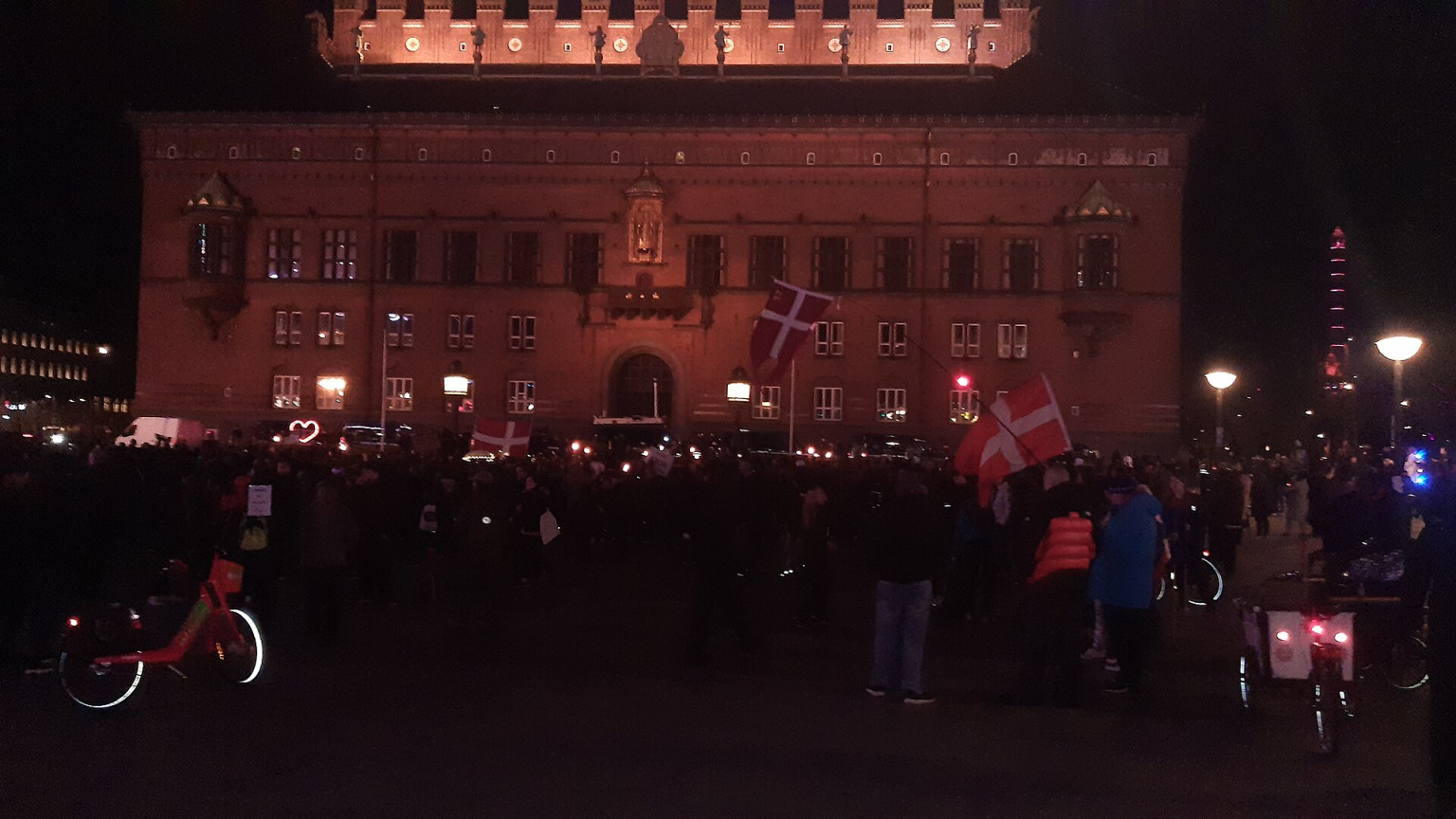
In December 2020, as Denmark entered a second wave of COVID-19 restrictions, an anonymous activist group calling itself Men in Black Denmark emerged as a Facebook group and quickly grew into the most vocal opposition movement against government lockdown measures. Beginning in January 2021, the group organized regular street demonstrations in three of Denmark’s largest cities with the most intensive protest activity occurring between January and March 2021 (Sørensen & Christiansen 2022). The demonstrations typically drew between 600 and 1,000 participants and were characterized by torch-lit marches through city centers, accompanied by drums, fireworks, and amplified sound systems (DR 2021). Protesters chanted slogans and, most prominently, sang “Mette Ciao” – a protest song created by Danish rapper Rozenberg (Danny Rosenberg) that adapted the melody of the Italian anti-fascist resistance song “Bella Ciao” to critique Prime Minister Mette Frederiksen directly (SE og HØR 2021).
As established in the previous case study, these protests exemplify Shelemay’s concept of communities of dissent – musical communities that arise from rupture and contestation, leveraging music as a mobilizing force during conflict. Where DR’s programs relied on established repertoires to reinforce stability and tradition, Men in Black’s singing emerged from political grievance and opposition to state authority. Their mobilization of song represented a fundamentally different mode of sonic citizenship: one grounded in embodied, participatory performance on the streets rather than mediated consumption at home, and one expressing institutional mistrust rather than reinforcing it.
“Mette Ciao” became the sonic centerpiece of these protests. Rozenberg composed the song in late January 2021 (SE og HØR 2021). The chorus captured the movement’s defiant stance:
Vi marcherer, vi protesterer
Mette ciao, Mette ciao, Mette ciao ciao ciao
Når det brænder, når det synger
Så er det os fra Men In Black
[We march, we protest / Mette ciao, Mette ciao, Mette ciao ciao ciao / When it burns, when it sings / Then it’s us from Men In Black]
The choice of “Bella Ciao” as the melodic foundation was particularly significant. Rozenberg himself claimed the choice was purely aesthetic – he “went with Bella Ciao, and it was completely random... it just fit well” (Lerche 2021). Yet regardless of the composer’s stated intentions, “Bella Ciao”’s historical associations with anti-fascist resistance inevitably imbued “Mette Ciao” with symbolic weight. As an internationally recognized anthem of opposition to authoritarian power, “Bella Ciao”’s melody carried connotations of struggle, defiance, and resistance that resonated beyond the specific Danish context, positioning the protesters’ grievances within a broader narrative of citizens resisting state overreach.
From a sonic citizenship perspective, Men in Black’s protest singing represents the negotiation of citizenship through expressions of institutional mistrust while simultaneously generating strong social trust among participants. Where DR’s programs sought to reinforce vertical trust relationships between citizens and state institutions, Men in Black’s protests articulated institutional mistrust – a fundamental questioning of governmental authority and the legitimacy of COVID-19 restrictions. Yet this expression of mistrust seemed to simultaneously strengthen horizontal trust relationships among protesters themselves. As anthropologist Ellen Dissanayake (2005) observes, even when ritual acts serve as expressions of revolt, their ultimate function remains social cohesion among participants. Men in Black’s singing and marching through Copenhagen’s streets created strong internal bonds precisely through external opposition. By challenging (vertical) institutional trust in government restrictions, participants reinforced (horizontal) social trust among dissenters, forging solidarity through shared grievance and collective sound production.
The sonic and performative aesthetics of Men in Black’s protests stood in stark contrast to DR’s controlled, disciplined broadcasts. Where DR’s programs emphasized orderly compliance – seated participants, piano accompaniment, bel canto vocal technique, and careful adherence to pitch and phrasing – Men in Black’s singing was loud, raw, and unrestrained. Accompanied by drums, fireworks, and portable sound systems, the protests embodied what might be characterized as a defiant performative style. The vocal delivery was less singing in a traditional sense than shouting or chanting – rough, impassioned, and unconcerned with musical refinement. This aesthetic of sonic disobedience mirrored the political content of the protests, sonically enacting resistance through a refusal of the very vocal discipline and institutional compliance that characterized DR’s programs.
Crucially, Men in Black’s protest singing exemplifies sonic citizenship as genuine participatory performance in Turino’s sense. Unlike DR’s viewers, who largely watched rather than sang, Men in Black’s participants actively produced sound together in physical proximity. They marched, chanted, drummed, and sang “Mette Ciao” collectively, creating the reciprocal listening, synchronization, and embodied engagement that characterizes participatory music-making. This was not mediated performance consumed from living rooms but direct, unmediated sonic action in public space – a claiming of both acoustic and political territory through collective sound production.
Communal singing as a contingent technology of sonic citizenship
This contrast between DR’s mediated programs and Men in Black’s embodied protests also illuminates competing definitions of fællessang in Danish discourse. As mentioned, a narrow, institutionalized definition has come to dominate, such that more informal or spontaneous instances of collective singing are often not recognized as fællessang at all (Baunvig et al. 2025).
Men in Black’s protests trouble this definitional boundary. Their singing was undeniably collective and communal, yet it bore none of the institutional markers of traditional Danish communal singing. There were no songbooks, no pianos, no seated rows, no connection to the shared cultural song repertoire. Instead, participants stood, marched, shouted, and banged drums while singing a protest song set to an Italian melody. This absence of institutional markers helps explain the pattern noted in the introduction: while DR’s programs were consistently celebrated as traditional fællessang and positioned as exemplary of Danish singing culture, Men in Black’s singing was recognized as protest but not as fællessang – rendered conceptually invisible by the narrow definitional framework that dominates Danish discourse. Yet from the perspective of sonic citizenship, both practices merit equal consideration.
Both DR’s broadcasts and Men in Black’s protests represent ways in which citizens negotiated their relationships to state authority, collective identity, and political community through sound. Both generated forms of social cohesion and marked boundaries of belonging, though toward opposing political ends. The key difference lies not in the social dynamics of singing but in its political valence: DR’s singing expressed trust and compliance, while Men in Black’s singing expressed mistrust and resistance. Both are legitimate modes of sonic citizenship – ways of “doing” citizenship through active sound production, staking claims to belonging and political voice through collective vocal performance.
These contrasting cases reveal communal singing as what we term a contingent technology of sonic citizenship. Singing does not inherently promote unity, trust, or compliance; nor does it inherently generate division, mistrust, or resistance. Rather, its political function depends on who mobilizes it, in what context, with what repertoire, and toward what ends. During Denmark’s COVID-19 lockdowns, the same cultural practice – communal singing – simultaneously reinforced institutional trust through state-affiliated media and articulated institutional mistrust through street protests. Both modes generated social trust among their respective participants, creating in-groups bonded through shared sonic experience while marking out-groups who did not participate. The two cases thus demonstrate that sonic citizenship is actively negotiated and contested through sound production, revealing singing as a powerful but culturally and politically malleable tool for expressing competing visions of citizenship, community, and collective identity in democratic societies.
Contextualizing Sonic Citizenship: The Politics of Defining Communal Singing
The two cases examined above demonstrate communal singing’s adaptability as a tool for encouraging both institutional trust and political resistance. However, survey data reveals that a substantial minority of Danes report disliking communal singing (Baunvig et al. 2025). How do we reconcile this with our argument about singing as a contingent technology? The answer lies in understanding how the concept of communal singing itself has become ideologically loaded in Danish discourse, pointing to the need for distinguishing between narrow and broad definitions of communal singing.
As discussed, recent scholarship distinguishes between broad and narrow definitions of fællessang (Borčak & Marstal 2022; Kirkegaard et al., in press 2027). In its broadest sense, fællessang encompasses any act of collective singing – including DR’s televised programs and Men in Black’s protest chants. However, in Danish public discourse, a narrower definition has become dominant: fællessang refers specifically to formalized practices characterized by particular conventions (singing while seated, using songbooks, piano accompaniment, repertoire from the Danish sangskat) and closely associated with institutional settings (schools, folk high schools, national celebrations). This narrow definition carries strong connotations of cultural heritage, national identity, and – crucially – institutional trust.
The dominance of this narrow definition has profound consequences for how Danes experience and articulate their relationship to communal singing. When survey respondents or interview participants report disliking communal singing, their reasons vary – from ideological and ethical critiques to embodied experiences of discomfort. Yet resistance consistently targets the institutionalized form rather than collective singing broadly conceived. This semantic colonization makes it difficult for many Danes to recognize Men in Black’s protest singing as communal singing at all, even though it clearly involves collective vocal performance.
Our empirical material confirms this narrow understanding. In 2022, we conducted a national survey of 2.031 adult Danes asking about their attitudes toward singing together with others, and between June 2023 and September 2024, as part of a larger research project on Danish communal singing, we carried out ethnographic interviews with participants selected to represent contrasting attitudes toward communal singing. Survey respondents were selected to be nationally representative across age, gender, geography, and socioeconomic background. Interviews were conducted with two distinct groups: those who explicitly reported disliking communal singing, and those who regularly and enthusiastically participated in communal singing events. Because disliking communal singing is socially disapproved of in Denmark and seldom articulated publicly, recruiting such participants required social media campaigns, snowball sampling, and other targeted measures, treating them as a kind of “hidden population” (Ellard-Gray et al. 2015). In contrast, enthusiastic participants could be recruited more straightforwardly through singing networks and at singing events.
The survey results reveal significant variation. While 60% of respondents agreed that singing conveys feelings of community, and 57% preferred singing familiar songs, a substantial minority – 22% – reported that they do not like singing with others (Baunvig et al. 2025). Moreover, only 10% reported actually singing along during televised or virtual singing events during the pandemic, suggesting that even among those who view communal singing positively, active sonic participation was limited. These findings underscore the distinction between sonic citizenship as embodied participation and as mediated consumption.
The ethnographic interviews reveal how grounds for resistance vary. Some interviewees articulated explicit ideological critiques. Mike, a schoolteacher, characterized communal singing as “a trick to lead people into the idea of a community that, to the best of my knowledge, does not exist," adding that “the song imposes on you that you are a member of a community you might not wish to belong to. And that is exactly what they use in every good dictatorship, when they need propaganda training.” Troels, a former boarding school educator, framed it as “normality pressure”: ”if you do not join in, you do violence to the community.” For him, it could even amount to “an auditory assault” where “you have to put on a big smile not to end up in the labor camp.”
Other interviewees experienced resistance as embodied discomfort. Joan spoke of church singing producing “white knuckles” and “a strong hostility inside me.” Anastasia described suffering from “hymn nausea,” explaining that certain songs made her feel she would “rather throw up.” None of these interviewees rejected singing as such, but rather its mobilization in institutionalized settings as a technology of compliance and conformity.
Enthusiastic participants likewise embraced the narrow definition and its associations with institutional trust and cultural heritage, but viewed positively. Irene, a 68-year-old retiree, expressed pride: “I mean, I can be proud that we have such a good thing in Denmark. That we’ve got this communal singing happening all over the place, and you could even say shared across the country---because, I mean, during COVID-19, you could see how many people all over Denmark tuned in, right?” Michael, a 54-year-old principal of a folk high school, saw fællessang as the epitome of Danish culture:
What is Danish culture? Well, it’s what binds us together. What is it that binds us together? Well, it’s our language. It’s our common history. It’s the seasons. It’s the landscape. It’s our cultural-Christian background, and so forth. All that is collected in Højskolesangbogen. So, when we sing from »Højskolesangbogen« – indeed, every time we sing during the week – well, then it’s also a way of communicating this life-enlightenment and folk enlightenment in another form than just talking about it.
Yet even among enthusiasts, ambivalence emerged. Uma felt great love for communal singing except when it became explicitly nationalist. Ben, a 16-year-old boarding school student, observed: ”Sometimes, we’re just a bunch of nationalists here in Denmark, right?” Sarah worried that participants were not representative: “We mostly see... well, white people, and that’s a problem.”
These accounts reveal that when Danes refer to communal singing, they often embrace precisely its narrow, institutionalized form celebrating Danish national identity and cultural heritage – not collective singing as a broadly defined social practice, let alone its mobilization for disruptive or oppositional purposes.
Together, these findings contextualize our pandemic-era case studies, revealing a spectrum of attitudes – from enthusiastic embrace to ideological critique to embodied discomfort to opting out entirely – all shaped by how the narrow definition of fællessang has become ideologically loaded in Danish discourse.
Conclusion: A More Nuanced View of Singing Citizenship
This article has examined communal singing during Denmark’s COVID-19 lockdowns to challenge dominant narratives of fællessang as a “social superglue” that unifies all Danes regardless of background or political stance. By analyzing two contrasting mobilizations of communal singing – DR’s televised singalongs and Men in Black’s street protests – we reveal how the same cultural practice negotiates opposing responses to state authority while producing inclusion and exclusion in both cases.
A crucial insight emerges from comparing these cases: both generate social cohesion and trust among participants while simultaneously excluding others, yet this dynamic operates very differently. In Men in Black’s protests, exclusion is explicit and visible – a protestor minority deliberately positioning itself against the majority and state authority. The boundary between “us” and “them” is openly performed through oppositional singing. In DR’s programs, by contrast, exclusion is obscured by universalizing rhetoric that claims to unite “all Danes” through shared cultural heritage and familiar repertoire. This narrative of universal inclusion obscures the substantial minority – 22% in our survey – who report disliking communal singing.
Our ethnographic interviews reveal the stakes of this hidden exclusion. Interviewees who oppose communal singing describe feeling coerced by it, characterizing it as “propaganda training” and “normality pressure” that imposes membership in a community they experience as false or non-existent. Yet these critical voices are systematically marginalized by the “social superglue” narrative, which posits communal singing as inherently inclusive and universally beloved. This renders the exclusion more insidious than in the protest case: where Men in Black’s singing openly performs conflict, DR’s singing claims consensus while suppressing dissent.
The dominance of the narrow definition of communal singing – tied to institutionalized settings, national heritage, and cultural conformity – reinforces this dynamic by making alternative mobilizations of communal singing conceptually invisible. Our analysis demonstrates that communal singing operates not as inherently unifying social glue but as a powerful social technology that can be deployed for various political ends. Whether mobilized to reinforce institutional trust through cultural participation or to articulate mistrust through political protest, communal singing simultaneously generates inclusion and exclusion. The critical difference lies in whether this exclusion is acknowledged or obscured.
By revealing how universalizing narratives about communal singing obscure patterns of exclusion and coercion, this article contributes to more critical understandings of how collective musical practices mediate citizenship, belonging, and power in democratic societies. Recognizing that even practices framed as culturally unifying produce hidden costs allows us to move beyond celebratory narratives toward more honest engagements with both the democratic potential and the exclusionary risks inherent in collective vocal performance.
Keywords
Bibliography
Agersnap, A. 2025 “Fællessang – et selvfølgeligt eller et særegent ritual?” In Når vi synger: En antologi om sangens betydning, eds. E. G. Nielsen, M. J. Elbeck & L. W. Borčak. Herning: Sangens Hus, pp. 145–157.
Agersnap, A., Schmidt, L., Eriksen, R., Bønding, E., Kirkegaard, T., Borčak, L. W. & Baunvig, K. 2025 “The Human Touch: Leveraging HITL for Quantitative Close Reading.” In Proceedings of the 9th Digital Humanities in the Nordic and Baltic Countries Conference (DHNB 2025). Forthcoming
Bak, K. S. 2005 “Fællessang og danskhed.” In Musik og danskhed, ed. H. Koudal. Copenhagen: C. A. Reitzels Forlag, pp. 100–123.
Bak, K. S. 2018 “Fællessangstraditioner i Danmark ca. 1780–1960.” In Fællessang og fællesskab. Herning: Videncenter for sang, pp. 15–49.
Baunvig, K. 2025 “Love in Politics.” In A Cultural History of Love in the Age of Empire, ed. S. Lipsett-Rivera. London: Bloomsbury Academic, pp. 127–148.
Boeskov, K. 2018 “Moving Beyond Orthodoxy: Reconsidering Notions of Music and Social Transformation.” Action, Criticism, and Theory for Music Education, vol 17, no. 2, pp. 92–117. doi:10.22176/act17.2.92.
Borčak, L. W. 2020 “Community as a discursive construct in contemporary Danish singing culture.” SoundEffects – An Interdisciplinary Journal of Sound and Sound Experience, vol 9, no 1, pp. 81–97. https://doi.org/10.7146/se.v9i1.113023
Borčak, L. W. 2025 ”’Godhedsdiskurs’” og eksklusion i dansk fællessangskultur.” In Når vi synger: En antologi om sangens betydning. Herning: Sangens Hus, pp. 159–170.
Borčak, L. W. & Marstal, H. 2022 Fællessang – fælles sag? En bog om sang som kollektiv handling. Copenhagen: Forlaget Højskolerne.
Butler, J. & Spivak, G. C. 2007 Who Sings the Nation-State? Language, Politics, Belonging. London & New York: Seagull Books.
Cloonan, M. 2009 Dark Side of the Tune: Popular Music and Violence. London: Routledge. doi:10.4324/9781315095127.
Dissanayake, E. 2005 "Rituals and Ritualization: Musical Means of Conveying and Shaping Emotion in Humans and Other Animals". In Music and Manipulation, eds S. Brown & U. Volgsten. Oxford: Berghahn, pp. 31–57.
Duncan, G. 2018 The Problem of Political Trust: A Conceptual Reformulation. London: Routledge.
Elmstrøm Nielsen, P. 2011. “Alsangen 1940.” Passage, vol. 26, no. 65, doi: doi.org/10.7146/pas.v26i65.6389.
Fink, L. K., Warrenburg, L. A., Howlin, C., Randall, W. M., Hansen, N. C. & Wald-Fuhrmann, M. 2021. “Viral Tunes: Changes in Musical Behaviours and Interest in Coronamusic Predict Socio-emotional Coping During COVID-19 Lockdown.” Humanities and Social Sciences Communications, vol. 8. doi: 10.1057/s41599-021-00858-y.
Frevert, U. 2013 Vertrauensfragen: Eine Obsession der Moderne. München: C. H. Beck.
Fukuyama, F. 1995 Trust: The Social Virtues and the Creation of Prosperity. New York: Free Press.
Hansen, N. C. 2023. “Music for Hedonia and Eudaimonia: During Pandemic Social Isolation.” In Arts and Mindfulness Education for Human Flourishing. London: Routledge, pp. 89–105. doi:10.4324/9781003158790-8.
Hardin, R. 2006 Trust: Key Concepts in the Social Sciences. Cambridge: Polity Press.
Høgel, S. 2020 Johann Abraham Schulz – den folkelige fællessangs far. Copenhagen: Multivers.
Jacobsen, B. A., Kühle, L. & Christensen, H. R. 2021. “Tillid under COVID-19: Religion og Samfund.” Religionsvidenskabeligt Tidsskrift, vol. 72, pp. 137–156.
Jenkins, H. 2006 Convergence Culture: Where Old and New Media Collide. New York: New York University Press.
Kaufman Shelemay, K. 2011. “Musical Communities: Rethinking the Collective in Music.” Journal of the American Musicological Society, vol. 64, no. 2, pp. 349–390.
Kertz-Welzel, A. 2016. “Daring to Question: A Philosophical Critique of Community Music.” Philosophy of Music Education Review, vol. 24, no. 2, pp. 113–130.
Kirkegaard, T. H., Born, G., Agersnap, A., Baunvig, K. F. & Borčak, L. W. (in press 2027) “Conceptualizing Communal Singing in Denmark: Towards A New Theoretical Framework.” Journal of the Royal Musical Association, vol. 152. no 1.
Kuhn, H. 1990 Defining a Nation in Song: Danish Patriotic Songs in Songbooks of the Period, 1832–1870, vol. 1. Copenhagen: C. A. Reitzels Forlag.
Lerche, K. 2021. “Rapper om Mette Ciao-protest: ’Jeg kender inderkredsen af Men In Black’”, B. T., 11 January. https://www.bt.dk/samfund/rapper-om-mette-ciao-protest-jeg-kender-inderkredsen-af-men-in-black.
Maach, M. L. 2018. “Underviser på CBS følte sig krænket over ’Den danske sang er en ung blond pige’”, DR.dk, 19 December. https://www.dr.dk/nyheder/indland/underviser-paa-cbs-foelte-sig-kraenke….
Misztal, B. A. 1998 Trust in Modern Societies. Cambridge: Polity Press.
Nicolaisen, C. B. 2025. “Cyklistforbundet på gaden.” CYKLISTER: Medlemsmagasin for Cyklistforbundet, vol. 3, pp. 15–16. https://www.cyklistforbundet.dk/media/hjvfvoee/6k_1098499-cyk2025-03_fi….
O‘Connell, J. M. & Castelo-Branco, S. E. (eds.). 2010. Music and Conflict. Urbana and Chicago: University of Illinois Press.
Phelan, H. 2018. “Sonic Citizenship: Rights and Rites of Belonging in Ireland.” In Making Congregational Music Local in Christian Communities Worldwide, eds. M. S. Reigersberg, Z. C. Sherinian & M. M. Ingalls. London & New York: Taylor and Francis, pp. 247–261.
Putnam, R. D. 1993 Making Democracy Work: Civic Traditions in Modern Italy. Princeton: Princeton University Press.
Rishøj, L. 2024. “Den danske sangskat – hvad er det? Kanonisering af dansk folkelig sang,” SANG, vol. 5, pp. 1–19. https://doi.org/10.7146/sang.v5i.138144.
Stopa, S. E. M. & Svendsen, G. T. (eds.). 2020 “Trust and Protestantism: Symposium Issue of Journal of Historical Sociology.” Journal of Historical Sociology, vol. 33, no. 4.
Sørensen, J., Andersen, P. B. & Baunvig, K. 2021. “Håndvask og fællessang: Ritualer og ritualiserede handlinger i Coronaens tid.” Religionsvidenskabeligt Tidsskrift, vol. 72, pp. 116–136.
Svendsen, G. T. & Svendsen, G. L. H. 2016 Trust, Social Capital and the Scandinavian Welfare State: Explaining the Flight of the Bumblebee. Cheltenham: Edward Elgar Publishing.