
In brief
08.02.2023

Paradisisk bedjævlet kontrabas

Bára Gísladóttir: »Silva«
© Anna Maggý
© Anna Maggý

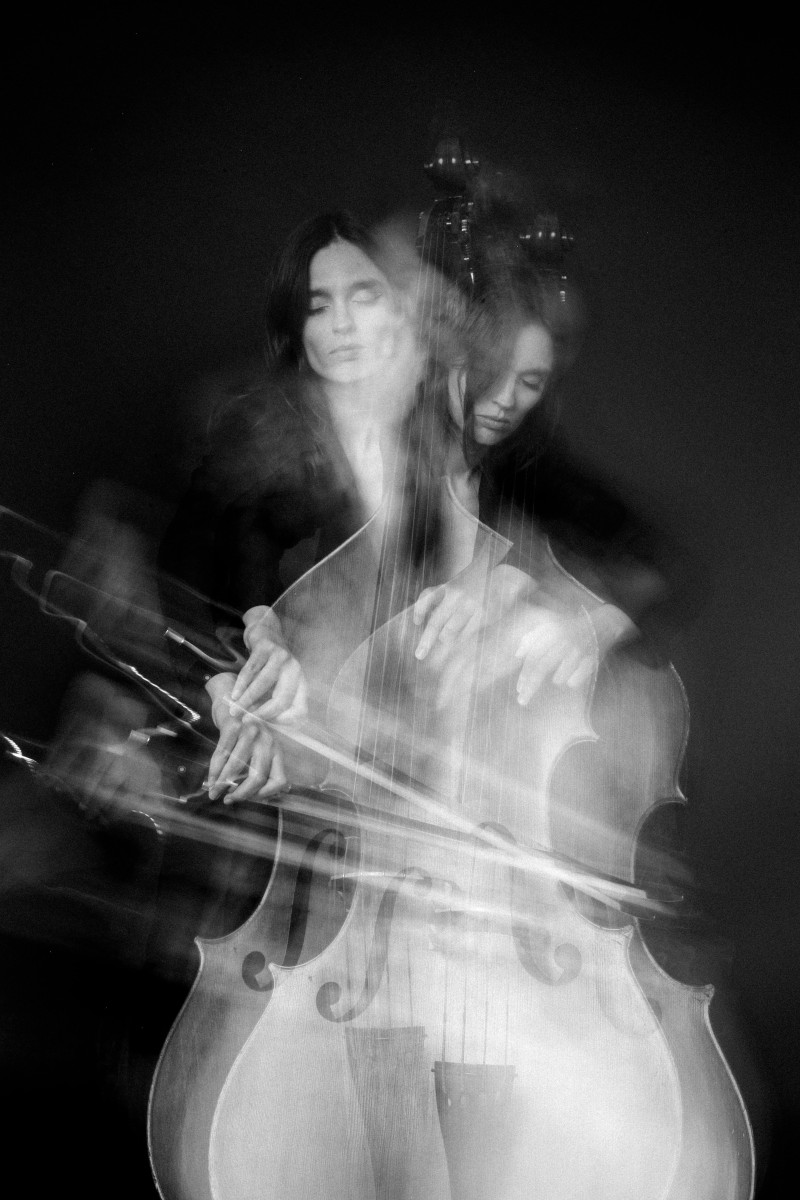
Gennem en ond, mørk skov slæber man sig i første del af Bára Gísladóttirs farligt suggererende og luksuriøst klingende meditation for bedjævlet kontrabas, det timelange rodværk Silva (2022). Lukker man øjnene, begynder verden at bølge om en.

Dybe glidninger på strengene lyder som et uhyre i smerte, omgivet af en let dis af overtoner. Et mulmende rum, som to støjkorn løsriver sig fra, og mens dybet under dem bliver til et valsende stempel af tunge tryk, cirkler kornene synthsvirrende rundt og kaster fra den underjordiske slyngverden en line ud efter lys.

Og jo, minsandten: Mørket flænges af lysglimt. En skinnende tone sniger sig ind, mangedobles til et skurrende hyl og følges op af hæse dursignaler. Det dybe stempel sætter sig fast i en hård rille, mens Gísladóttir begynder at file rundt i et lyst register med ren instrumentklang.

Værket spjætter, søger at trænge igennem en hinde til et lysere sted. Til sidst, efter alt omkring den ensomt søgende er fortæret af en rasende ild, lander Silva i et limbo af fjerne overtoner, klange, der får lov at rinde ud.

Vi har nået overfladen, nu lyder en klar, lys drone og den fineste dæmpede støj som et svagt, men insisterende ekko af, at livet buldrer videre i underskoven. Bedre mindes jeg ikke at have hørt Bára Gísladóttir: så fokuseret og alligevel hengiven, fri; tilmed i en overrumplende optagelse, der indfanger dybets tonerigdom.

Så kan man godt finde årslisterne frem.

In brieflive
20.03

The Power of Trance: A Journey from Indonesia to Roskilde

Andreas Johnsen: »Cosmic Balance«
© PR
© PR

In 2022, the Indonesian group Juarta Putra turned the Roskilde Festival upside down and captivated a large audience with a trance dance called reak. In the documentary Cosmic Balance, director Andreas Johnsen takes us back to the time just before, to Putra's hometown of Cinunuk in West Java, Indonesia. Through 24-year-old Anggi Nugraha, we are introduced to reak and how both the young and the old, to the sound of booming drums, distorted tarompet (a reed wind instrument resembling an oboe), and reciting song, surrender to the ancestors who visit them in their wild trances. Anggi himself, who has just become the leader of the reak group, is haunted by his stern grandfather, who orders that traditions must be preserved and upheld.

However, Anggi is unsure about his new role. He is not of the bloodline of the predecessor Abah or any of the other members in the group, but he grew up in the village among the musicians after his parents, for unknown reasons, left him there. We also meet Anggi's girlfriend, whom he wants to marry, but whom he has not received his parents' approval to marry for the same reason. Anggi is a sensitive and sympathetic young man, whom one can only wish the best for. He himself seeks help from a fortune-teller, who gives him the strength to travel to Denmark and to marry his chosen one. How the marriage will turn out is unknown, but the journey to Roskilde is a clear success. 

The film's soundtrack works predominantly well with field recordings and the group's own music. Less fitting are the passages with lyrical piano and strings accompanying the trance scenes from Cinunuk, which come across as unnecessarily staged. This does not change the fact that Cosmic Balance gives a sympathetic and fascinating portrait of music that, on the one hand, fits perfectly with the global and diverse profile of the Roskilde Festival, but which also comes from a world so distant from the inferno of Roskilde that one can hardly see where the ends meet. But they do, that night at Roskilde.

English translation: Andreo Michaelo Mielczarek

In briefrelease
14.03

Community in Collapse

Nausia: »Finding a Circle«
©Astrid Lemmike

The transcendent takes the front seat on Copenhagen-based Nausia’s latest album, Finding a Circle. Slow builds and intense demolitions form the band’s basic structure, and a web of saxophone harmonies floats through a tight and daring interplay. Not every band manages to preserve the intense feeling of a live concert on a recording. But on Finding a Circle, Nausia succeeds in hammering the gap between stage and studio down to an irrelevant trifle, through a phenomenal and remarkably great-sounding ensemble performance.

There is something about the physical conditions of the saxophone that makes it easy to sense the musician’s presence. The clatter of the keys and the intense breathing make it effortless to form an inner image of the human behind the brass. On the track »E.D Interlude«, the saxophones’ airy exhalations and mechanical flapping ensure that, as a listener, I behave with the same quiet reverence as I would at a concert. So when the next track, »Eco Death«, kicks the door in on the silence, it is hard not to feel almost physically exhilarated by the album’s intense contrasts between presence and destruction.

Titles such as »flowers grow through concrete too« and »Eco Death« cast the wordless album in a bleak light of climate collapse. Finding a sense of community in a chaotic world – whether at a concert, on an album, or elsewhere – is essential to life in a time of crisis. Finding a Circle is a fine example of exactly that.

In briefrelease
14.03

Caught Between Too Much and Too Little

Amphior: »Disappearing«
Amphior. © Rikke Broholm

Electronic musician Amphior, aka Mathias Hammerstrøm, opens on a positive note: »Under the Stars« exudes a Twin Peaks–like melancholic romanticism infused with an unsettling timbre that raises expectations. By the second track, however, it becomes clear that the listening experience will not be quite as positive as one might initially have hoped.

»Time Is a Thief« simply does not impress in the same way. On top of the clichéd ticking clock in the background, neither the piano melody nor the atmospheric elements make much of an impact, stuck in the nondescript middle ground between too much and too little. Unfortunately, this alternation between compelling tracks and more filler-like pieces comes to characterize the release as a whole.

Both »Healing« and »Disappearing« feature strong melodies with a delicate, ethereal, bittersweet melancholy. Like »Time Is a Thief«, »Bloom« also employs a ticking clock as a background element, but to far better effect, as the music above it is much more captivating – not least thanks to Stine Benjaminsen’s (aka Recorder Recorder) clipped vocal samples, which lend the track a welcome sense of strangeness. The release does, however, contain a number of tracks that never manage to leave a lasting impression, no matter how many times one listens. A melody that simply needed a bit more life. An effect that could have benefited from being turned up. It is a shame, because on roughly half of the tracks Hammerstrøm demonstrates that he is capable of creating truly beautiful music.

© PR

»How comforting, after so much menial self-investigation, to finally be told exactly what it is that you need. The delirious British post-punk outfit The Fall, in their song on the very subject, will have you convinced it’s a bit of Iggy Stooge, a reduced smoking habit, sex without having it, slippery shoes for your horrible feet; to that solid list, I’ll append an injunction to hear out a few minutes of other music, specifically chosen to corrupt your personal spacetime. And sure, drink water, wash your face, go outside – like that’s doing anything.« 

Jennifer Gersten is a violinist and writer from New York City. Her feature reporting, essays, and music criticism appear in The New York Times, The New Yorker, Bloomberg, Rolling Stone and Seismograf, among other publications. A former tenured tutti violinist with Helsingborg Symfoniorkester (Sweden), Jennifer pursues solo and collaborative projects in new and improvised music in the US and Scandinavia, some of which earned her an honorable mention for Darmstadt Ferienkurse’s 2023 Kranichsteiner Musikpreis. 

© Samantha Riott
© Samantha Riott

So dextrous a musician is the flutist Laura Cocks that, at shows, their instrument occurs to the eye as merely another limb. A powerhouse New York-based collaborator and interpreter within new classical and experimental music, notably as director of the leading-edge new music group TAK Ensemble, Cocks now releases their first solo statement of improvised compositions with FATHM, an acrobatic intertwining of flute and voice that nods to strange and fleeting visions: among them, birds, string, seeds between the teeth. On FATHM, Cocks applies all the facility of their work as an interpreter of commissioned works – on extensive display in their last solo venture, 2022’s field anatomies – towards the development of an uninhibited, yet highly focused musical language. 

If the album’s mysterious tracklist reads as a sort of cryptogram, then listening to FATHM evokes a process of decoding, parsing the bounds between vocalization and instrument. The album’s opening track, »A thread held between your fingers«, finds Cocks as their own flickering shadow, simultaneously playing the flute and squealing in tones just slightly removed in pitch. »Illinois« is then reclaimed from Sufjan Stevens’ relentless grip as a furious mumble of half-blown notes with underlying trickles of voice. Cocks experiments further with these hoarse timbres on the three infinitive tracks: »To beget« and its later variations »To outstretch« and concluding track »To fly«, which trace the evolution of a dancelike triplet motif. »FAVN«, apparently a faithful depiction of an elephant with severe sleep apnea, may reconcile itself to the sensitive listener through its sheer commitment to the grotesque, while »A seed sucked between your teeth«, orbiting languidly around a major ninth, invites more celestial considerations. »A marsh wren« might take the titular bird as a point of departure, but it quickly imagines a species of its own, singing a song of bustle and snaps and smacks. On »YARN«, Cocks suggests another sort of animal song by making a counterpoint of mews and growls. The flutist’s skill with balancing these peculiar hybrids ultimately distinguishes FATHM as much as Cocks’ ferocious energy; this is an album as happy to shout as it is to slither.