in briefrelease
13.03

Cello Among Cows and a Love of Music

Katrine Philp: »A Classical Life«
© Carsten Snejbjerg
© Carsten Snejbjerg

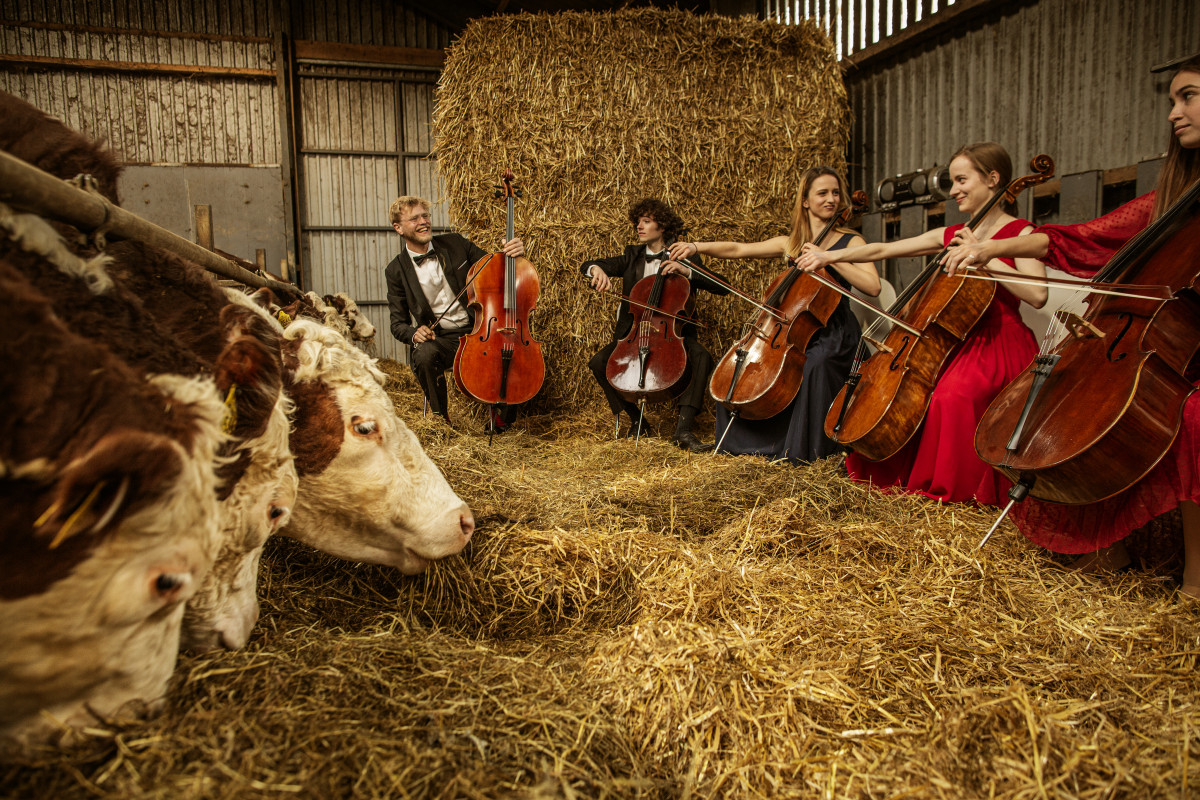
A farm near Rødvig on the Stevns peninsula, home to both pigs and cows, also houses an elite music school for cellists, the Scandinavian Cello School. The school was founded by the British cellist and professor Jacob Shaw, who is also a farmer and lives here with his family. It is a place where the young people in residence are expected to take part in the work on the farm as in a collective, when they are not working on their musical projects.

According to Shaw, this is very much an innovation. In one of the many scenes featuring the thoughtful, idealistic and selfless mentor, he remarks that the classical music world places great emphasis on competition and perhaps on musical development, but only rarely concerns itself with something as essential as well-being.

It is fascinating to follow not only the teaching and competitions on Stevns and elsewhere, but also to listen to the young musicians’ accounts of playing, alongside the many uncommented sequences in which large amounts of music – especially from the classical cello repertoire – are performed. Among them is an outdoor scene where the musicians have attracted a group of cows, who appear to be listening when they are not mooing.

This is a film about self-realisation through discipline, but also about discipline through self-realisation. The film continually circles around the human effort to become better at something, and it does so in a way that consistently places the participants’ love of music at the centre. This also applies to Shaw himself, whose previous serious illness, briefly referred to, forms a kind of counterpoint to the lightness that otherwise characterises the film.

Katrine Philp’s documentary A Classical Life is therefore warmly recommended – not only to parents of musically inclined children, but to anyone interested in music. Classical music? No. Music.

CPH:DOX, 14, 17 and 21 March

in briefrelease
27.04

Wanderwelle drukner verden i smuk apati

Wanderwelle: »Ghosts Beneath the Brine«

Havet som Cape Lonesome, som en kirkegård hvor det mytiske, det virkelige og det truede ved midnat rejser sig fra de døde: det er det soniske landskab på Ghosts Beneath the Brine, det nye album fra den Amsterdam-baserede eksperimenterende duo Wanderwelle.

Gennem otte numre, der balancerer mellem elegi og requiem, navigerer albummet i klimakrisens og artsudryddelsens realiteter, samtidig med at det fremkalder mytologien om havets skabninger. For at give krisen lyd valgte Wanderwelle ikke at optage smeltende isbjerge eller rasende skovbrande. I stedet sænkede de bækkener – små, skålformede metalplader brugt siden oldtidens ritualer – ned i saltvand i længere perioder. Efterhånden som metallet nedbrødes, blev lyden mørkere, mere skrøbelig og mere ustabil og frigav spøgelsesagtige overtoner.

Disse toner driver gennem albummet som den kritisk truede albatros – som sjette nummer er dedikeret til – der med sit vingefang på tre og en halv meter glider som et genfærd gennem enorme, ligeglade himmelrum. Lag på lag af rumklang og lyde, der minder om klagende, klynkende dyrestemmer, ledsager numre med titler, der væver myte og økologisk virkelighed sammen: »The Seabishop’s Sermon« (opkaldt efter et væsen, der angiveligt blev fanget i Østersøen i 1513), »Empty Net or Dissolving Souls«. Budskabet er klart: hajer og østers risikerer at blive lige så mytiske som fortidens havuhyrer, hvis ødelæggelserne fortsætter.

Og alligevel er det netop her, albummets skønhed bliver dets begrænsning. Ghosts Beneath the Brine er hjemsøgende smukt – men som det sublime syn af et skibsvrag betragtet fra sikker afstand inviterer det os til at gyse snarere end at handle. Mere spøgelsestog end alarmklokke tilbyder det katharsis i et øjeblik, der kalder på handling.

in briefrelease
26.04

Let Us Sing of Cycles

Adrianna Kubica-Cypek, ÆTLA & Barbara Agertoft: »Månen«
© Saba Lykke Oehlenschlæger

The moon is a fundamental poetic motif. Its cycle pulls at both the tides and at us – within bodies and fluids alike. Composer Adrianna Kubica-Cypek and the vocal ensemble ÆTLA interpret this motif from Barbara Agertoft’s poem »Månen«. The composition is divided into »Månen« I, II, III and IV. It is a successful EP with a clear sense of purpose: the strong textual foundation establishes a distinct compositional direction without digressions, yet musically it cannot stand on its own.

The moon’s power to connect the inner and the outer emerges strongly in Agertoft’s poem: »and we stretched ourselves out, the inner in the outer all that we / bled into.« How better to convey this fundamental mood than through a vocal ensemble – individual bodies that bleed into an external, shared sound? Kubica-Cypek’s interpretation is dynamic, full of contrast and undulating, like flood and ebb. It begins with a piercing timbre of female voices, unfolding into crossing glissandi supported by deep, monotonously chanting male voices. At times, the sounds converge into harmonic chords; more often, the voices move in diverging directions in both volume and pitch, or insist on remaining in dissonance and repetition.

»Månen IV« concludes as an inversion of the sharp opening of »Månen I«, with subdued and dark sonorities that feel partially unresolved – as if the work is meant to be heard again from the beginning. In its form, the choral arrangement is cyclical, bringing out something understated in Agertoft’s poem. It demonstrates the quality of mutual interpretation: the art forms add something to one another.

»Musik er for os en sammensmeltning af forskellige bevidstheder i ét fælles fokuspunkt.«

Bandet Selvhenter blev grundlagt i 2010 af trombonist Maria Bertel, saxofonist Sonja LaBianca, violinist Maria Diekmann og trommeslagerne Jaleh Negari og Anja Jacobsen. I 2017 forlod Maria Diekmann gruppen, og Selvhenter fortsatte som kvartet.

Selvhenters lyd udgøres af en kæmpe fascination af klanglige teksturer, rytmiske forskydelser og polyrytmer, akustiske og elektroniske melodier, hårdtslående kompositoriske valg, improviseret skønhed og ren og skær glæde ved at skabe og spille musik. Selvhenter har spillet koncerter i ind- og udland. Selvhenter er også omdrejningspunkt for kunstnerkollektivet Eget Værelse, der huser medlemmernes soloprojekter, og samarbejder som Valby Vokalgruppe, SOLW, Nina Garcia & Maria Bertel og G.E.K.
 

in brieflive
22.04

The Voice in My Head

MØR Collective: »Vildnis – der vokser græs ud af min hovedskal«
© PR
© PR

»Is your head also filled with voices that aren’t your own?« the young man asks. The question forms the central theme of Vildnis (Wilderness], a performance by the theatre group MØR collective, and most people would probably answer yes. But whose voices are they, and where do they come from?

In the introduction, Vildnis is described as »a journey into the engine room of theatre.« Playwright Abelone Koppel has written 80 short texts, and each evening a selection is activated by two performers who do not know in advance which texts they will receive through their earpieces. In a back room, a prompter reads the texts aloud, which the actors immediately translate into movement and voice on stage. It could easily have gone wrong. It doesn’t – and much of the credit goes to the two performers, whose work makes the concept function so well.

Also present on stage is composer Mika Forsling, who, through electronic means and abundant percussion, follows the mood unfolding between the performers – but unfortunately not much more than that. I actually found it somewhat difficult to hear what was going on and, at times, forgot about it altogether, as it felt relatively insignificant. It would have been an obvious choice to use the voice itself as an instrument in a performance centered on inner voices, and it is hard to understand why this opportunity is missed.

One should not see Vildnis for the music alone, even if it becomes more prominent towards the end, when the roles are reversed and Forsling’s rhythms seem to guide the performers’ movements. Nevertheless, Vildnis emerges as a cohesive and engaging experience, despite the unpredictability of the experiment.

English translation: Andreo Michaelo Mielczarek

© Mads Skarsteen, CPF

»Music for me is the fifth dimension of life, connecting all the others.«

For the past 10 years, Maja Dyrehauge Gregersen has been at the helm of the Copenhagen Photo Festival – the largest photography festival in the Nordic region. The Copenhagen Photo Festival is an international platform with over 1000 annual applicants from all over the world – and a clearly curated level that attracts world names and has lifted the festival out of its original, more local and open form.