in briefrelease
09.03

Everything a Snare Drum Can Do

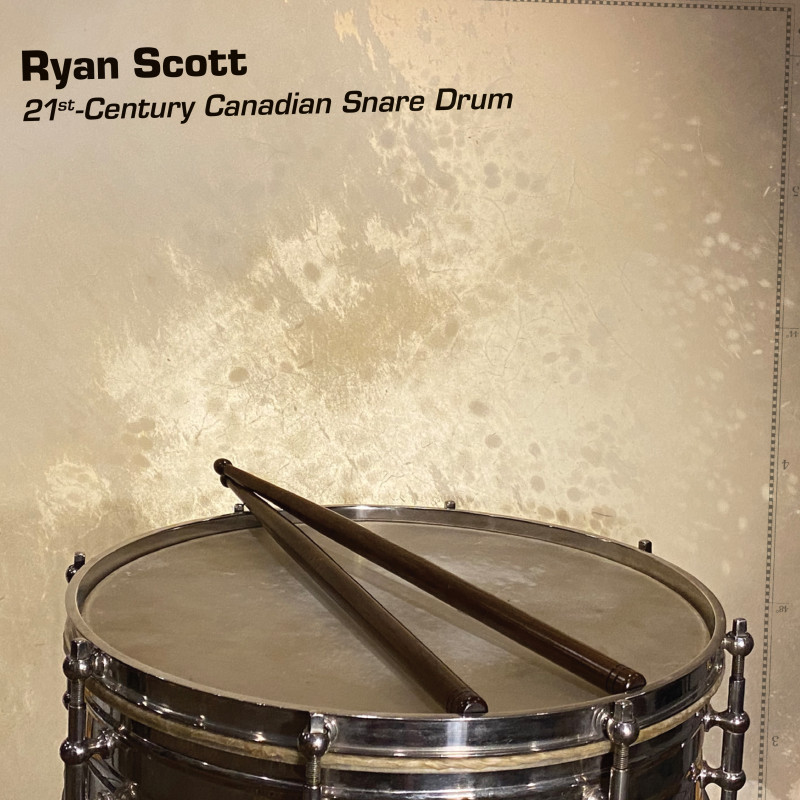
Ryan Scott: »21th-Century Canadian Snare Drum«
© PR
© PR

Let’s be honest: when you think of composed music for solo instruments, the snare drum is probably not the first thing that comes to mind. It may be the noisiest member of the percussion family and has been setting the volume level in everything from classical music to pop for decades. That’s why I pricked up my ears when the Canadian percussionist Ryan Scott announced an entire album of works for snare drum – written by 14 different composers. A full hour and a half of music, no less. And yes, that sounds like a lot for a record that mainly consists of a single drum. But there is definitely something to discover here.

The opening, Andrew Staniland's »ANTIGRAVITYDRUM«, blends free jazz with inspired use of percussive vibraphone, while Beka Shapps’ »Skinscape IV« sends the drum strokes through ring modulation and extensive sound processing, bringing us close to musique concrète. Christina Volpini’s »only ghost« slips into horror territory with march-drum-inspired bursts and ghostly use of the snare drum’s high register, while Amy Brandon’s »Time and Effort« almost becomes a demonstration of the instrument’s technical possibilities.

Fourteen works over ninety minutes is a substantial mouthful. The snare drum’s limited tonal vocabulary means that you occasionally lose focus, even after several listens, and the contrast between drum strokes and silence is repeated a little too often. That said, Ryan Scott and the composers get just about as much out of what is essentially a glorified marching drum as one could hope for. I was both entertained and intrigued along the way. As an experiment, the idea is strong – but in the long run also a bit too insistent for me to return to often. Still, one should not underestimate the versatility of a good old-fashioned snare drum.

English translation: Andreo Michaelo Mielczarek


© PR

Phil Battiekh (Basel, Switzerland) has been a Mahraganat  DJ and producer for over a decade. He is one of the first to dedicate himself to Mahraganat outside of Egypt. In addition to his most popular Mahraganat mixes on Soundcloud (over 450K streams worldwide),  he released the acclaimed Cairo Concepts compilation in 2019. Featuring DJ Plead, DJ Haram, Alaa Fifty, Nustaliga and others, Cairo Concepts contextualises the impact and developments of the Mahraganat scene and examines the way certain artists have appropriated Mahraganat for club scenarios.  

Mahraganat (Egyptian Arabic: مهرجانات( , which literally means »festivals«, is a mix of Egyptian Shaabi, electronic dance music, rap and trap. It is characterized by percussion-heavy rhythms,  massive bass and loads of autotune. Phil Battiekh is curating the SWANA night – a joint event by pantropical, turkis, and Volume Village, which takes place at the latter in Aarhus. Next to his own set, Phil will  also have a role as Wezza Montaser's DJ. 

Bill Frisell. © Carole D'Inverno

»I like when it's impossible to tell at first if something is black or white, or country or blues, or whatever.«

Bill Frisell’s career as a guitarist and composer has spanned more than 40 years and many celebrated recordings. From Aaron Copeland and Charles Ives to Bob Dylan and Madonna. Born in Baltimore, Bill Frisell played clarinet throughout his childhood in Denver, Colorado. His interest in guitar began with his exposure to pop music on the radio.

© PR

»Music has been a healing balm for me.«

John William Grant is an American singer, musician, and songwriter holding both American and Icelandic citizenship. He first came to prominence as a co-founder, lead vocalist, pianist, and primary songwriter of the alternative rock band The Czars. After releasing six albums between 1994 and 2006, the band disbanded, and Grant withdrew from music for four years before embarking on a solo career.

He returned in April 2010 with a critically acclaimed debut album recorded in collaboration with Midlake. Queen of Denmark was named Album of the Year 2010 by Mojo magazine and was also selected as one of the ten best albums of 2010 by The Guardian’s music critics and writers.

© Malthe Folke Ivarsson

»In his music, composer Allan Gravgaard Madsen tries to create a better version of himself.« 

Allan Gravgaard Madsen is a Danish composer based in Copenhagen. His most recent works include Träume nicht and Nachtmusik. He tries to create a better version of himself in his music – where his personality tends to be restless, chatty and has an active inner life, his music is controlled, simple and merciless in its expression. He is the recipient of the Carl Nielsen & Anne Marie Carl-Nielsens Hæderspris 2022.

in briefrelease
23.01.2022

Finnish Space Travel

Tomutonttu: »Hoshi«
© Tomutonttu: »Hoshi«

The Finnish multimedia artist Jan Anderzén has, with the album Hoshi, released under the solo moniker Tomutonttu, created a true little star. Not only because »hoshi« literally means »star« in Japanese, but above all due to the music itself. There is something cosmic, yet infinitely minute, about the sonic worlds Anderzén conjures—like a galaxy reflected in a puddle, or a space journey in a rocket carved from a hollow tree trunk. Synths emit busy, warm blips and bloops, while ultra-short vocal and instrumental samples create a recognizable blur. At once artificial and organic – soft, rounded, jagged, crackling.

Anderzén approaches sound with a playfulness I simply adore. His music is strange in an incredibly comforting way. It places me in a kind of colorful, trance-like state, only interrupted when, several times over the course of the album, I find myself smiling in delight at a particularly great sound. The synths on »Katse osuu sähköön!« The choral samples on »Kesä oli äkkiä ohi!« Milo Linnovaara’s flute on »Malta lausua ‘AH’!« And many more. Hoshi is an album packed with microscopic moments that together form a frayed, exploding, radiant, idiosyncratic whole—a stellar moment of just under 38 minutes.