in brieflive
17.04

The Kids Are Alright

Ligeti Quartet: »Workshop concert«
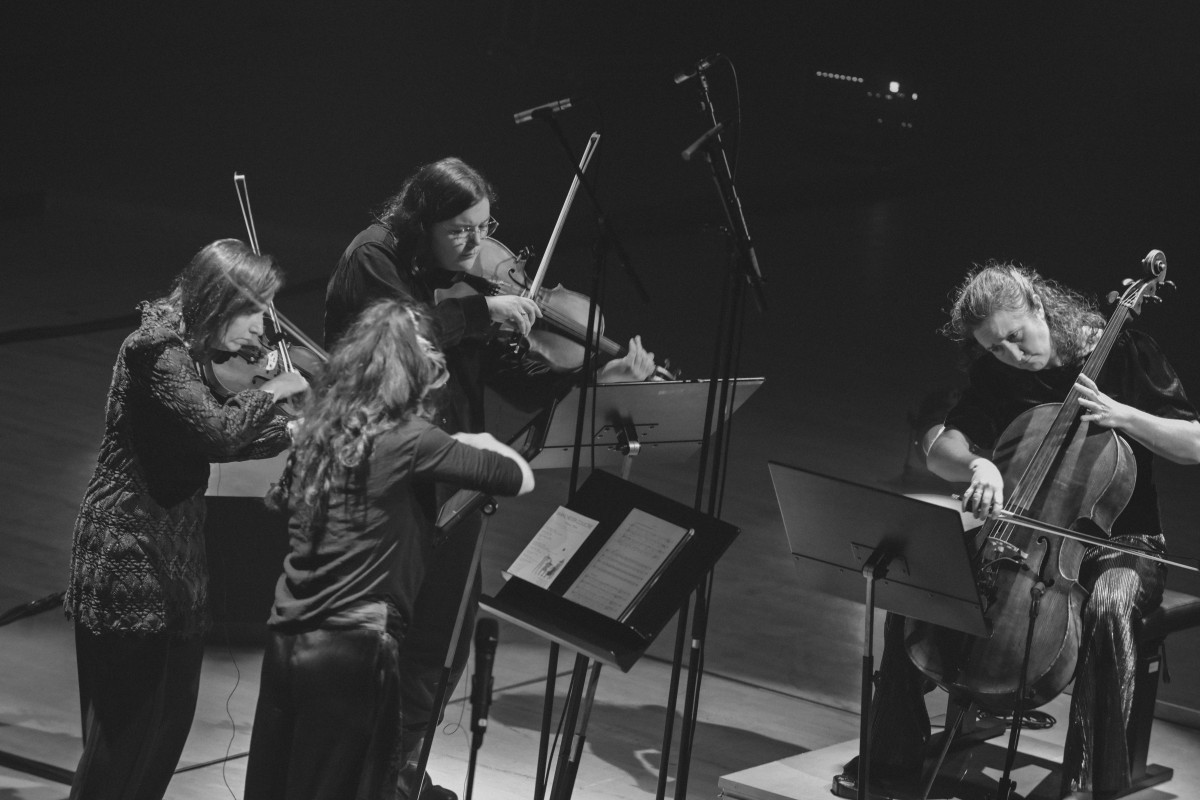
Ligeti Quartet. © Louise Mason

I know, I know. A workshop concert at the conservatory: yawn. And no, hardly anyone showed up – apart from Bent Sørensen. Fair enough. But yes, you missed out. Especially on young Albert Laubel, who did exactly what you hope someone will do at this kind of concert: suddenly step forward, make a mark, and promise something for the future.

It was the English Ligeti Quartet visiting the Royal Danish Academy of Music for the seventh time to work with the students. And they did so with both commitment and precision. (Someone should really give them a prize one day – say, someone sitting on a fortune they clearly don’t know what to do with.)

Lucas Fagervik’s Bells & Canons set up stark oppositions, as composers tend to do in exercises of style: a bright, slightly fractured minor chord set against gentle baroque pastiche in increasingly rapid alternations. Then a movement with brutal – almost banal – glissandi, another with heavy bow strokes, and a final one in which the strings took turns trying to keep a single tone alive. A beautiful, constructive, and Jürg Frey–porous landing.

A different kind of circus instinct drove Yifan Shao’s ultra-short Dreams Evaporated Too Soon, which sounded like abused sounds dragged across a floor. The ending was ultra-theatrical: the quartet froze mid-air for a moment before scraping the last traces of life out of the strings.

»I can make this even more mannered,« Jonas Wiinblad must have thought, opening his String Trio with Viola – not a quartet, of course! – with silent playing. But cliché turned into quiet poetry as small, innocent intervals slowly emerged in tight patterns. When the viola was finally allowed to join, it went against the grain: a virtuosic solo cadenza with falling bow strokes, shimmering overtones, and temperament. Boom! A striking contrast. Less convincing was the piece’s apparent need for a final, unnecessary layer of electronic distortion. Still, points for mannerism.

What remained was Albert Laubel’s String Quartet as the most fully realized work of the concert. Not overthought, just a seamless movement between dynamic extremes. Distinctive trills were elegantly disarmed by inserted snaps, glissandi sounded like part of an internal logic rather than mere effect, and the sound world shifted with calm dramatic overview. Substance and maturity in 2026 – well, well.

English translation: Andreo Michaelo Mielczarek

© Lou Mouw

»For me, music is a non-figurative process that cannot be definitively categorised.«

Kristoffer Raasted graduated as a visual artist from the Media School at the Royal Danish Academy of Fine Arts in 2018 and is currently completing a PhD in practice-based and artistic research. Raasted has been an artist in residence at the Danish Institute in Rome and a visiting researcher at UdK Sound Studies in Berlin as part of his PhD.

© Iain Forbes

»When I search for new music, I search for sound that evokes images in my mind. It is fuel, a gateway to emotion, and my most important writing companion. When inspiration lapses, music is the tool that always jumpstarts it.«

Iain Forbes is a Scottish/Norwegian film director based in Oslo. He has studied film directing at Nordland College of Art and Film and the Norwegian Film School. His graduation film Revisited won a Student Academy Award in 2023. He has previously directed short films such as Snowman (2015) and Semper Fi (2017). His latest short After Dark won Best International Short Film at the Oscar-qualifying Foyle Film Festival in 2024

Nikolaj Nørlund. © Agnete Schlichtkrull

»Music, to me, is a companion through life, a premise, an excuse, a mystery, an explanation, a point of departure. It is old ideas, overlooked treasure chests, new angles, long concerts, doubt and conviction. It is words, tones, cracked voices, different points of departure, bass in the diaphragm, falsetto in the hair, challenges, rewards, and love.«

Nikolaj Nørlund made his solo debut with Navnløs (1996), an interpretation of poems by Michael Strunge, and released Nye Optagelser (1997) the following year, his first Danish-language singer-songwriter album. He has since worked broadly across music and poetry and is behind around 20 releases, both solo and in various band constellations. Nørlund’s projects range from collaborations with Copenhagen Phil on two orchestral albums, created together with author Naja Marie Aidt. His most recent release is the single »Englenes Park (nu ikke saa dark)«, the forerunner to the album Himlen skiftet ud, due for release at the end of November. In addition to his own work, Nørlund has, through the record label Auditorium, produced and released a number of Danish artists, including Niels Skousen, Ulige Numre, Jens Unmack, I Got You On Tape, and Martin Ryum. He was previously a member of Trains And Boats And Planes and periodically works with the English-language project Rhonda Harris. Nørlund has received a Danish Music Award (2003) and a Steppeulv (2006), both as Producer of the Year, as well as the Niels Mathiassen Cultural Award (2012).

© Mari Liis

»Music and sound for me is a language, the most present and fleeting one. It’s something that passes through your heart and becomes the past in a second. Music amplifies every emotion, love, happiness, anger, sadness a thousand times over, making me feel everything more deeply and sensitively.«

Sophia Sagaradze is a sound artist, composer, and performer from Georgia, based in Denmark. She experiments with space, multichannel electronics and audio-visual installations. Sagaradze is interested in creating works that explore the boundary between external and internal experiences of space. She holds a bachelor’s degree in classical composition from Tbilisi State Conservatory and a master’s degree in electronic composition from DIEM Royal Academy of Music, Aarhus/Aalborg. In 2022, she received the Carl Nielsen and Anne Marie Carl-Nielsen Foundation’s Talent Award in Composition. Sagaradze has performed in several countries, received commissioned works for ensembles, performed live and created audio-visual installations. She is a founder and artistic director of Aarhus Sound Association (Aarhus Lydforening), Project leader at ROSA  and a lecturer at the Royal Academy of Music, Aarhus/Aalborg.

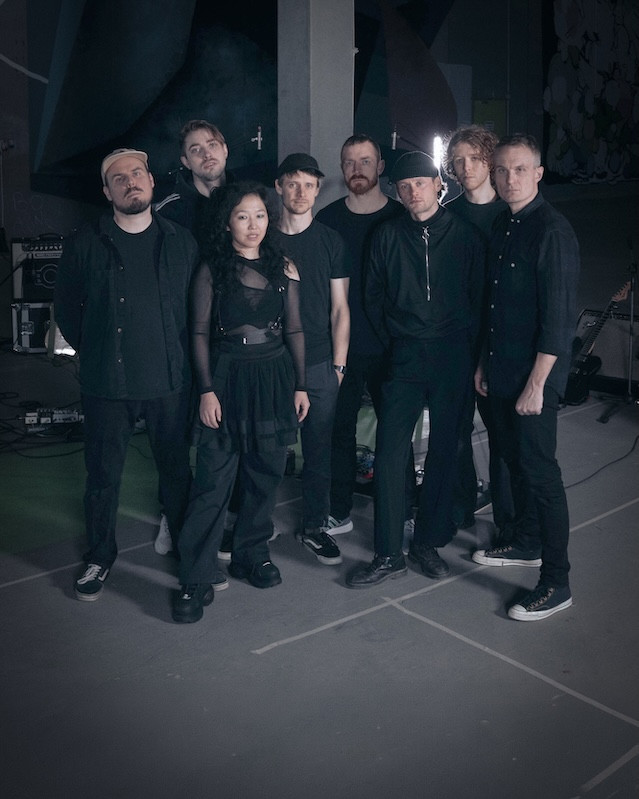
»Like all art, music is a language for emotions, dreams, and the search for meaning—but for us it is just as crucial that music is a path to community.«

Girls in Airports is a Danish instrumental band with a palette that draws in particular on jazz, electronic music, and sounds from distant horizons. Since their debut album in 2010, they have created a sonic universe in which saxophones, synths, and pulsating grooves meet in a collective and dreamlike expression. Recently, the band has focused on artistic collaborations with, among others, Teitur and Aarhus Jazz Orchestra, and they are now on their way with a new album created in collaboration with the string trio Halvcirkel.