in brieflive
22.04

The Voice in My Head

MØR Collective: »Vildnis – der vokser græs ud af min hovedskal«
© PR
© PR

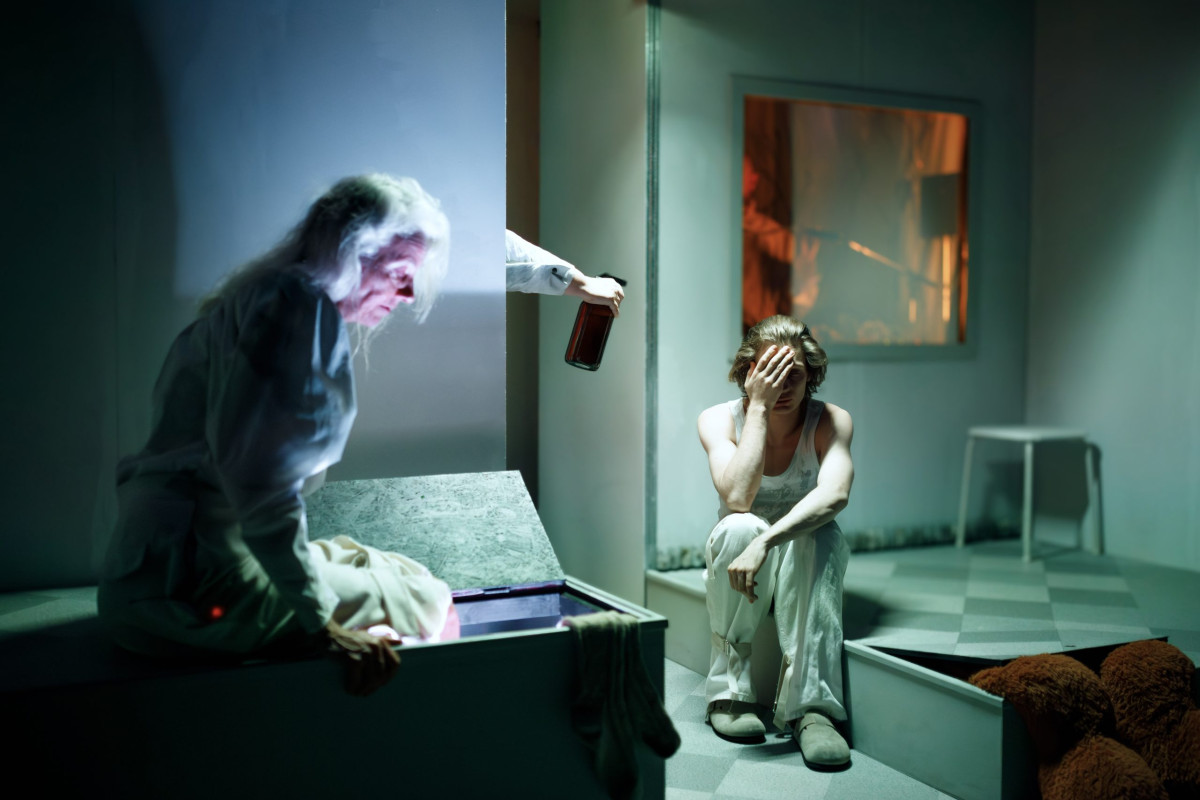
»Is your head also filled with voices that aren’t your own?« the young man asks. The question forms the central theme of Vildnis (Wilderness], a performance by the theatre group MØR collective, and most people would probably answer yes. But whose voices are they, and where do they come from?

In the introduction, Vildnis is described as »a journey into the engine room of theatre.« Playwright Abelone Koppel has written 80 short texts, and each evening a selection is activated by two performers who do not know in advance which texts they will receive through their earpieces. In a back room, a prompter reads the texts aloud, which the actors immediately translate into movement and voice on stage. It could easily have gone wrong. It doesn’t – and much of the credit goes to the two performers, whose work makes the concept function so well.

Also present on stage is composer Mika Forsling, who, through electronic means and abundant percussion, follows the mood unfolding between the performers – but unfortunately not much more than that. I actually found it somewhat difficult to hear what was going on and, at times, forgot about it altogether, as it felt relatively insignificant. It would have been an obvious choice to use the voice itself as an instrument in a performance centered on inner voices, and it is hard to understand why this opportunity is missed.

One should not see Vildnis for the music alone, even if it becomes more prominent towards the end, when the roles are reversed and Forsling’s rhythms seem to guide the performers’ movements. Nevertheless, Vildnis emerges as a cohesive and engaging experience, despite the unpredictability of the experiment.

English translation: Andreo Michaelo Mielczarek

© Henry Detweiler

»For me, music is work and a way to escape it. Music is the fanciest way of communication and therefore the most delicious food for analysis. It is what prolongs your feeling for longer than you can physically hold. Music is something after which you say: 'I’m glad you didn’t use words'. After all, it’s something that makes your commute or chores shorter, and this time-controlling function is the very first and foremost mystery I love about it.«

Liza Sirenko is a music theorist and music critic from Kharkiv, Ukraine. She is a co-founder and board member of the Ukrainian media about classical music The Claquers. She is a former Fulbright Visiting Scholar at the Graduate Center, CUNY (New York, USA), and a graduate of National Music Academy of Ukraine (Kyiv, Ukraine). Her current interests include processes in the classical music industry, contemporary opera in Ukraine, and a role of postcolonial moves in these. Liza is a former PR Director of the Kyiv Symphony Orchestra, currently working as a Program Officer at the Goethe-Institut Ukraine.

in brieflive
13.04.2025

»Is He Going to Play Three Pianos?«

August Rosenbaum: Klaverkoncert
© Josefine Seifert
© Josefine Seifert

»Is he going to play three pianos?« a boy asks. »Maybe he’s learned to play with his feet?« says an adult man. The audience on their way into the DR Concert Hall’s main auditorium comment on the setup for August Rosenbaum’s piano concert. Three Steinway grand pianos lined up is truly peculiar – actually comical.

When the concert began, I imagined I could hear differences between the instruments, though I would probably fail a blind test. Apart from a bit of playing with staccato on one piano and pedal on another, the setup was, frankly, underused. The piano playing was lacking, dominated by a single approach: pedal pressed all the way down, an active right hand primarily in the middle register, a left hand with a muted accompaniment, and a great deal of repetitive technique.

It felt like a gravity Rosenbaum could not escape. No idea or direction could break free; one always returned to the same place.

When there are two grand pianos for a concert, one of them is usually prepared. Rosenbaum had three (!) without using a single screw, coin, or ping-pong ball. Shouldn’t that be a criminal offense? Nor were any extended techniques employed, such as clusters or playing with the back of the hand.

The light show was charming, at times impressive. Still, it takes more goodwill than I possess to call the evening an audiovisual concert, as the program text told me it was. On the way out, I heard another man say, »It was actually quite exciting to hear him play.« I didn’t think so.

English translation: Andreo Michaelo Mielczarek

in briefrelease
12.04.2025

Bumblebees Come With Punk

Smag På Dig Selv: »SPDS«
© PR
© PR

Smag På Dig is pretty punk. True, the instruments most commonly associated with the genre have been replaced by saxophones, and yes, the music sounds markedly different from what one would normally link with punk. Nevertheless, with their debut release SPDS, tenor saxophonist Oliver Lauridsen, baritone and bass saxophonist Thorbjørn Øllgaard, and drummer Albert Holberg have created a bona fide, high-energy punk album – packed with fun, mischief, seriousness, and anger.

The style is established from the very first track. The trio plays catchy, often pop-inflected melodies built on Øllgaard’s thunderously deep saxophones, Holberg’s tight drumming, and Lauridsen’s high-energy, lyrical tenor sax. Particularly effective is »Middelklassen avler kun skeletter«, which has a comparatively darker tone, a bass sax buzzing like a fat, murderous bumblebee, and a stronger focus on atmosphere than many of the other tracks – without sacrificing melody.

At the other end of the spectrum are tracks like »PGO HOT 50«, with its stomping tempo, cowbells, and an epic sax guyfrom hell, and »Negirî«, which, with Luna Ersahin on vocals and saz in the eleventh hour, lets the horns step into the background – not to mention Thorbjørn’s angry poems, addressing everything from globalization, climate change, and war to the art academy and one’s own worth as a human being. Impressively, it all hangs together; everything works in its diversity. And it convincingly illustrates the age-old punk dictum that you can be angry and still have fun at the same time.

in brieflive
12.04.2025

Feel Yourself Becoming Nature Again

Cecilia Fiona, Sophie Søs Meyer: »Ghost Flower Ritual« 
© Farzad Soleimani
© Farzad Soleimani

Frozen human bodies and faces shaped and painted like ceramics are meticulously carried around by flower sculptures that have abandoned their static nature. The roles are reversed. Nature becomes the living environment that grants the clay humans small, temporary lives in Ghost Flower Ritual at Copenhagen Contemporary.

The piece is a live installation with musicians and performers, where 34-year-old composer Sophie Søs Meyer has collaborated with visual artist Cecilia Fiona, who is of the same age. It’s a sensorially overwhelming, yet dramatically subdued ritual. Over the course of forty-five minutes, we sit together beneath a giant flower and sense the performers’ meticulous, slow movements. Meanwhile, soundscapes and small pulsating figures from four string players and a flute shape a landscape of colors, tones, and movements that melt together – filling the high-ceilinged room with auditory and visual presence. We are part of a whole.

I love the wild costumes that descend strangely from the sky. I love being part of the ritual that heals our forgotten connection to nature, which is the very foundation of our lives. I love the sound of stroked, plucked, and blown wood from Athelas’ musicians. Culture is nature. The human animals and the flowers are part of the greater consciousness. It’s all a hyper-complex mechanism. Cecilia Fiona possesses an extraordinary visual and creative abundance in her intricate details, and Sophie Søs Meyer is precise and intriguing in her swaying tonal figures that change slowly and meticulously. Until one flower blows into the large conch shell. Then the ritual is over.

English translation: Andreo Michaelo Mielczarek 

in brieflive
09.04.2025

Beneath the Restless Canopies

Ask Kjærgaard, Jens Albinus, Rasmus Kjær, LiveStrings: »Store træers grønne mørke«
© PR
© PR

An inner soundscape characterises being in love. You walk through the city with a new rhythm, a different melody. The same is true of depression, though here major gives way to minor. Yet the early phases of love, too, can contain moments of doubt and dark foreboding. In composer and guitarist Ask Kjærgaard’s musical staging of Naja Marie Aidt’s 2006 short story Store træers grønne mørke (The Green Darkness of Large Trees), released as an LP last year, this same interplay is palpable as the music moves us from gentle strokes through melancholy to a rougher sound. The recording features the trio LiveStrings – cello, violin and viola – with actor Jens Albinus as the first-person narrator.

In the concert version of Kjærgaard’s work in Aarhus, featuring Rasmus Kjær on keyboards, Albinus’s voice appeared even more exposed. The piece introduces us to a depressed man who, wandering through a park, finds moments of calm beneath the trees—and at times up in them. For when despair causes you to fall out of the system’s sky, through sickness benefits and social assistance, only to land at the roots of the trees, perhaps there is only one thing to do: climb into the treetops? But then our anti-hero meets a woman in the park, and the drama begins. Can infatuation lift him out of depression, or will it end up short-circuiting him?

At first, the music crept in quietly. Kjærgaard’s ability to support the flow of the text revealed his experience as a film composer, particularly in his blending of classical music, meditative new age, and piercing guitar. Words and music carried the narrative together. When Albinus fell silent, the music became the voice of the inner landscape. The strings, in particular, delivered the dreamlike tones of infatuation, but when the gloom returned with renewed force, it was Kjærgaard who, with a roaring guitar, sprawled across the emotional abyss. It was beautiful and brutal.

English translation: Andreo Michaelo Mielczarek