



in brief
04.06.2021

Til rave med Teletubbies

Klang Festival: Alexandra Hallén & Krumbuktus
Alexandra Hallén og Krumbuktus. © Alexander Banck-Petersen
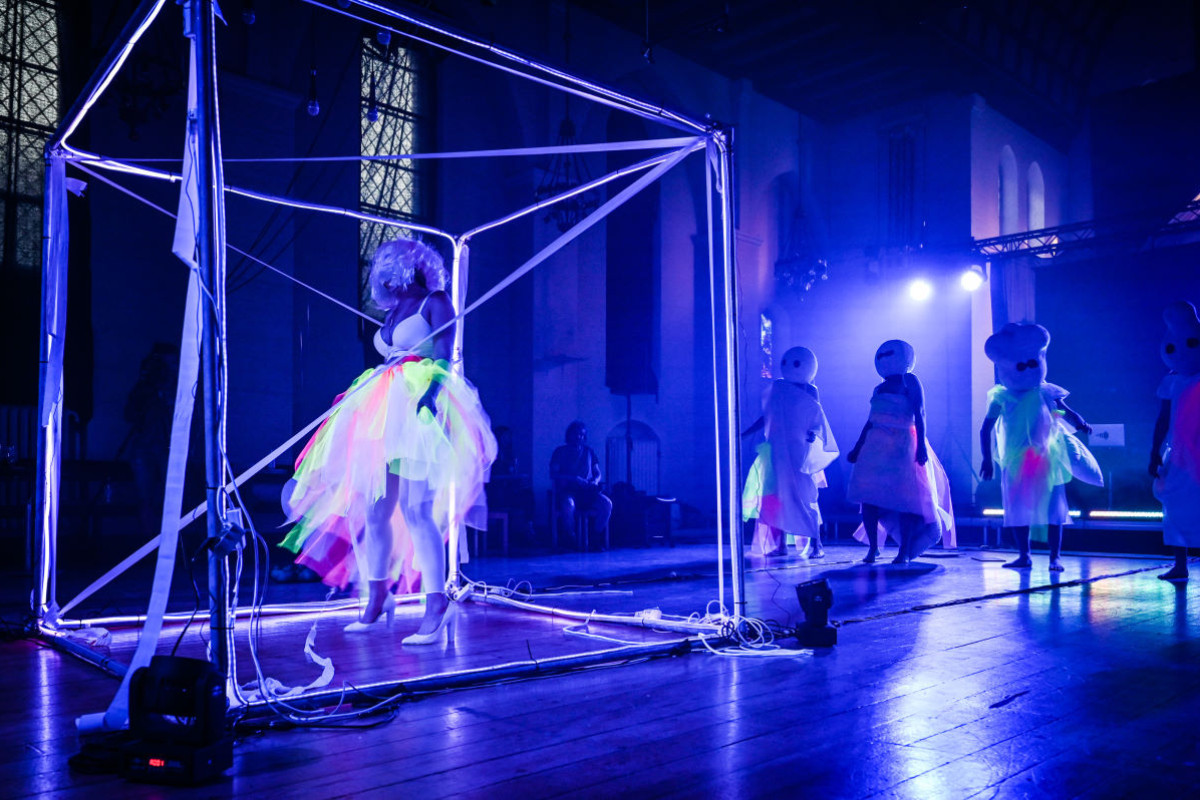
Alexandra Hallén og Krumbuktus opførte en række værker under overskriften »Alexandras Spectacle«. © Alexander Banck-Petersen

»Nu kan alt ske, lige om lidt kommer Alexandra flyvende gennem ruden.« Jeg overhørte denne kommentar, mens vi ventede på at blive lukket ind i Koncertkirken. Døren gik op, og fire væsener med kæmpe papmachéhoveder og tylskørt lukkede os ind. Til en scenografi, der bestod af et bur bygget af neonrør. Oh yes, alt kan ske nu, tænkte jeg og trådte ind i en verden af tyl, pap, neon og teletubbier fra mine dybeste mareridt.

Koncerten vekslede mellem kropsligt performanceteater, hvor lyden kom fra de mange mikrofoner, der var sat i neonburet, og ravemusik af den type, man går til klokken tre om natten på Roskilde. Fire sortklædte mænd i helt hvide høje hæle udførte to forskellige, velkoreograferede serier med hælene som percussion. Senere så vi fire hvidklædte kvinder, bundet sammen i et stort stykke stof, binde snore på kryds og tværs af buret for herved at skabe musik, når de kastede sig mod stoffet og kun blev holdt af de andre. Jeg sad på kanten af mit sæde, hver gang en af performerne var ved at falde, hvilken intensitet!

Men mest fascinerende var kontrasten, da ravemusikken begyndte at spille og de fire stagehands tilfældigt, men effektivt fjernede alle paprørene fra neonburet. Ravets uplanlagte koreografi af kroppe, der intuitivt vidste, hvor de skulle hen, til de elektroniske og prædefinerede rytmer, rundede fint aftenen af, da de nu otte mareridts-teletubbier dansede rundet i salen. Jeg er stadig ikke sikker på, hvad der skete – men nøj!

in brieflive
13.03

Jeg er et tomt højhus, hvor smerten sidder i alle vægge

Ensemble Lydenskab, Martin Ottosen, Ulla Bendixen, Gerd Laugesen & beboere fra det socialpsykiatriske botilbud Sønderparken: »Alle sætter spor«
© Phillip Jørgensen
© Phillip Jørgensen

Det er både svært og urimeligt at forholde sig kritisk til koncerten Alle sætter spor. Det handler om rigtige mennesker med noget på spil og hjerte, nemlig beboere på det socialpsykiatriske botilbud Sønderparken. De lagde deres indre liv i hænderne på seks kunstnere og blev således medskabere af i alt ni sange, som fik premiere på Museum Ovartaci.

Projektet Musikalske Alliancer er både kunst, forskning og lindring. En samskabelse, der vil give stemme til mennesker i psykiatrien. Resultatet var sange med banjopræget galopleg, smertelige violinstik, tomme huse fyldt af utrøstelig gråd, afrevne torsoer og dybe lange strøg, men også håb, omsorg og bløde kanter. Som medier for livserfaringerne optrådte digter Gerd Laugesen, tre musikere fra ensemblet Lydenskab på cello, violin og guitar foruden pianist Martin Ottosen og vokalist Ulla Bendixen fra elektrofolk-bandet Sorten Muld. 

Det var en kompetent flok, der leverede et højt musikalsk niveau. Alligevel virkede det, som om dette vigtige projekt lykkedes med samskabelsen og samtalen, men måske ikke helt med sit kunstneriske udtryk. Var det fordi teksterne var fyldt af klichéer? Eller snarere fordi hele opsætningen oplevedes lidt intern – nærmest som en skolekoncert? På trods af Bendixens vidunderligt luftige og udtryksfulde vokal, stod koncerten stærkest i de få indslag præget af digtoplæsning. Dog måtte jeg ad omveje erfare, at digtene var bearbejdninger, mens sangteksterne var beboernes egne ord. Og det var jo de stemmer, jeg skulle lære at lytte til. 

in briefrelease
13.03

When Joik Meets Drill

Zak Norman & Charlie Miller: »Takkuuk«
© PR
© PR

The Greenlandic word Takkuuk means »attention«, and it is the slightly ironic title of one of the more chaotic projects at this year’s CPH:DOX. The film is a collaboration between visual artist Zak Norman, film director Charlie Miller, and the Belfast-based electronic duo BICEP, and it also features seven musicians from Kalaallit Nunaat and Sápmi. In other words, a multitude of voices and agendas are at play, and the project clearly bears the marks of that.

The process leading up to the film sounds more interesting than the work itself. Norman and Miller travelled around the Arctic, seeking out musicians and researchers while filming glaciers and ice. The film’s seven young musicians then entered the studio with BICEP to create a shared soundtrack: a kind of club-oriented remix of seven very different practices, ranging from drill and heavy metal to joik, throat singing and drum dance. It might have been fascinating to follow those encounters, but instead the film takes us in another direction.

The editing shifts between a documentary strand of interviews and a surreal music-video aesthetic, where specially built cameras pan across the surface of the ice, bathing it in coloured filters referencing the northern lights and club lighting. In the interview track, the participants are allowed to steer the conversation themselves, which sends it in many directions. We touch on the spiritual undertones of traditional musical expressions, and here one would have liked the film to linger longer. One intriguing sequence explains how drum dance relates to the performer’s heartbeat, and how that rhythm is almost the same as the pulse of drill. More of that, please.

In a subsequent talk, the filmmakers explained that the work was originally produced as an audiovisual installation for five screens. That makes sense and might have worked better. Considered as a documentary film, Takkuuk is fragmentary, chaotic and directionless, which is a shame, because the young musicians seem to have much more to offer.

»Takkuuk«, Zak Norman & Charlie Miller (UK), 2025 (67 min). Screenings: 12, 17 and 19 March

in briefrelease
13.03

Cello Among Cows and a Love of Music

Katrine Philp: »A Classical Life«
© Carsten Snejbjerg
© Carsten Snejbjerg

A farm near Rødvig on the Stevns peninsula, home to both pigs and cows, also houses an elite music school for cellists, the Scandinavian Cello School. The school was founded by the British cellist and professor Jacob Shaw, who is also a farmer and lives here with his family. It is a place where the young people in residence are expected to take part in the work on the farm as in a collective, when they are not working on their musical projects.

According to Shaw, this is very much an innovation. In one of the many scenes featuring the thoughtful, idealistic and selfless mentor, he remarks that the classical music world places great emphasis on competition and perhaps on musical development, but only rarely concerns itself with something as essential as well-being.

It is fascinating to follow not only the teaching and competitions on Stevns and elsewhere, but also to listen to the young musicians’ accounts of playing, alongside the many uncommented sequences in which large amounts of music – especially from the classical cello repertoire – are performed. Among them is an outdoor scene where the musicians have attracted a group of cows, who appear to be listening when they are not mooing.

This is a film about self-realisation through discipline, but also about discipline through self-realisation. The film continually circles around the human effort to become better at something, and it does so in a way that consistently places the participants’ love of music at the centre. This also applies to Shaw himself, whose previous serious illness, briefly referred to, forms a kind of counterpoint to the lightness that otherwise characterises the film.

Katrine Philp’s documentary A Classical Life is therefore warmly recommended – not only to parents of musically inclined children, but to anyone interested in music. Classical music? No. Music.

CPH:DOX, 14, 17 and 21 March

in briefrelease
12.03

Do Whales Actually Want to Listen to Us?

Valentin Paoli: »The Musician and The Whale / La Baleine et le Musicien«
© PR
© PR

The French electronic musician Rone finds it difficult to express emotions verbally. In Valentin Paoli’s rather touching documentary The Musician and The Whale, he reflects on music’s ability to create connections and convey moods to an audience – whether human or interspecies.

One day, Rone receives a video from a sailor who is playing his music at sea. Whales gather around the boat, seemingly drawn to the sounds, and this becomes the starting point for an exploration of whether the musician might be able to communicate with the animals through sound. Rone seeks out an expert in whale vocalizations, who points to certain high-pitched synth elements in his EDM compositions that resemble whale song. He then has a girls’ choir record the whale sounds with human voices and travels to Réunion to play the sounds back to the whales.

At first, the attempt proves futile: the whales appear indifferent to the girls’ choir. Quoting Johann Wolfgang von Goethe, Rone realizes that if one wishes to move others, one must begin with what moves oneself. It is a Disney-like insight in a slightly sentimental film that speaks to the human desire to communicate with animals.

But are we actually sure that animals want to communicate with us? As the film’s central figure, Rone briefly reflects on a few ethical questions concerning animals, yet his infectious enthusiasm for the sounds of whales prevents him from asking the most fundamental questions about the relationship between humans and animals. Instead, we get a portrait of the musician that is almost as polished and warm-hearted as his music. The whale, wisely, remains beneath the surface of the sea.

»The Musician and The Whale« / »La Baleine et le Musicien« (83 min.)
Valentin Paoli (FR), 2026. Screening at CPH:DOX, March 11, 12 and 20

© Cecilie Frost

»Music is for me a silent but powerful weapon. It is crucial for preserving identity and culture. Throughout history, dominant powers have often tried to suppress people by wiping out their language, their traditions and their art. But in places where this failed, it was precisely the survival of art that preserved the soul and pride of the people.« 

Anastasia is a Danish indie artist with glamour in her eyes and punk in her blood. Together with her all-female band, she creates a sound universe carried by raw energy, bittersweet rock melodies and cheeky, flirtatious lyrics about love, loss and everything chaotic in between. She debuted in 2022 with a series of charity concerts in support of Ukraine and has since taken over stages across the country – from Debutfest in Copenhagen to SPOT Festival in Aarhus. All songs are written and produced by Anastasia herself and take their final form in a close and intense interaction with the band, where personal expression meets collective power.