In brief
18.08.2022

Med harpen i drypstenshulen

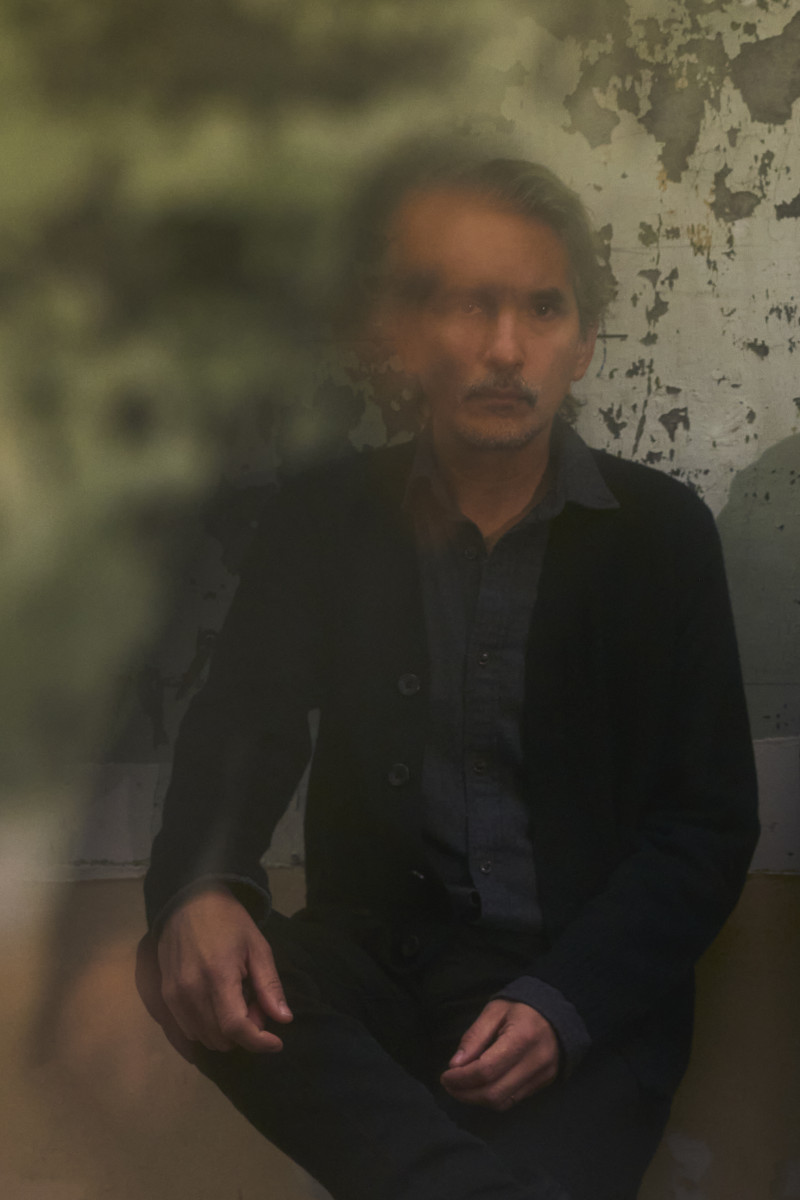
Martin Stauning: »Harp Concerto«
© PR
© PR

Det er simpelthen et henrivende aparte stykke musik, Martin Stauning har bikset sammen her. Et opgør med ideen om, at harper er noget, der tryller folk i søvn – Zachary Hatcher river og flår til tider i instrumentet – men samtidig også et værk, der har en fundamentalt drømmende karakter.

Første sats genstarter sig selv to gange og lader distinkt opmålte instrumentgrupper gennemleve en slags urolig drøm: små, diskret hektiske fragmenter, måske fra musik, de engang har spillet, som nu hjemsøger dem. Det er et spindelvæv af strengespil, pludselige bjælder, pizzicato som minutur og brogede, udstrakte klange – små drømmemaskiner, der peger i hver sin retning, men ender med at finde hvile.

Omvendt med andensatsen, der går ind i roen og lader den udvikle sig. Først i en drypstenshule af træblokke, vandrende harpe og DR Symfoniorkestret som en fjern tåge. Siden stille dansende til en maracas-tango næsten uden bevægelse, en genfærdsballet. Ekstremt nøgne, men forførende klangrum.

Er vi vågne, eller sover vi? Tredjesatsen lyder af et vågent mareridt med sinistre alarmbølger og et omklamrende orkester. Og så, for første gang, harpen som blid, men også drilsk drømmebebuder. Lykkes det den at bryde ud af rædslen? Hvem ved, for i samme nu er værket ovre.

Martin Stauning sætter ikke punktummer, lader ikke forløsning give sig ud for sandhed. Han lader os skimte en hemmelig lydverden og abstrakte situationer, som nok skal hjemsøge os tilstrækkeligt. Formidabelt! 

»Music is like an ancient mineral, containing a history of wisdom reaching over centuries, stratifying and evolving into new forms. It is like a black hole, wrapping around us and allowing us to temporarily escape the noise of the world.
An emotional safe zone, a place for solace, a bringer of light, a unifying factor. It is us.«
 
NEKO3 is a Copenhagen-based experimental music group consisting of: Fei Nie, Lorenzo Colombo and Kalle Hakosalo. The group is working towards the creation of a new musical language, flexibly moving between various performance media and artistic expressions. Continuously collaborating with composers and other creators of art, it seeks to integrate music and other forms of art into one conceptual whole.

NEKO3 has performed at Festival Internacional de la Imagen, SONICA Glasgow, cresc... Biennale, Time Of Music, Rondò, MINU festival, Copenhagen Light Festival, Unerhörte Musik and Spor Festival. They have been featured as soloists with the Danish National Symphony Orchestra and the Aarhus Sinfonietta, and given workshops and presentations at ie. Standford University, the Royal Danish Academy of Music, Hochschule für Musik und Theater Hamburg, University of California San Diego and Kungliga Musikhögskolan (SE). The ensemble has recorded multiple EP’s and released their first full length album Angel Death Traps in collaboration with Alexander Schubert in 2024.
In briefrelease
23.03

New Central American Tales

Xenia Xamanek: »Germinate [Imprint] Wilt [Stay]«
© PR
© PR

There is plenty of space around the many different sounds and voices narrating Central American horror stories on Honduran-Danish artist Xenia Xamanek’s album Germinate. The words »germinate« and »wilt« appear in the title, serving as fitting markers for the blossoming, bubbling, futuristic, and slightly eerie soundscape. A handful of voices fill the ears with mechanical, intense connections, swirling impressions of nature and language into the brain.

The album is a rare reinvention of the oratorio, the 18th-century religious opera genre featuring sung text fragments and wordless music. A significant departure from the dance floors Xamanek used to curate. Here, singers and an electro-acoustic soundscape tell stories through two simple, word-heavy recitatives, two arias with chanting narration, and electronic soundscapes.

There’s a calmness in Xenia Xamanek’s approach that can become utterly addictive. The material from their ancestral storytelling – and perhaps even the chanting narrative style – sets a scene that feels both warm and familiar. Yet at the same time, it turns original and alien as the calm of the words is challenged by dense patterns of simple sonic elements interacting with each other.

Oratorios in the 18th century lasted three hours and can easily feel distant and irrelevant today. But Xamanek’s album, rooted in the cuentos y leyendas de Honduras they heard in their childhood, offers three-quarters of an hour of presence – one that unexpectedly points forward.

© Emilia Jasmin
© Emilia Jasmin

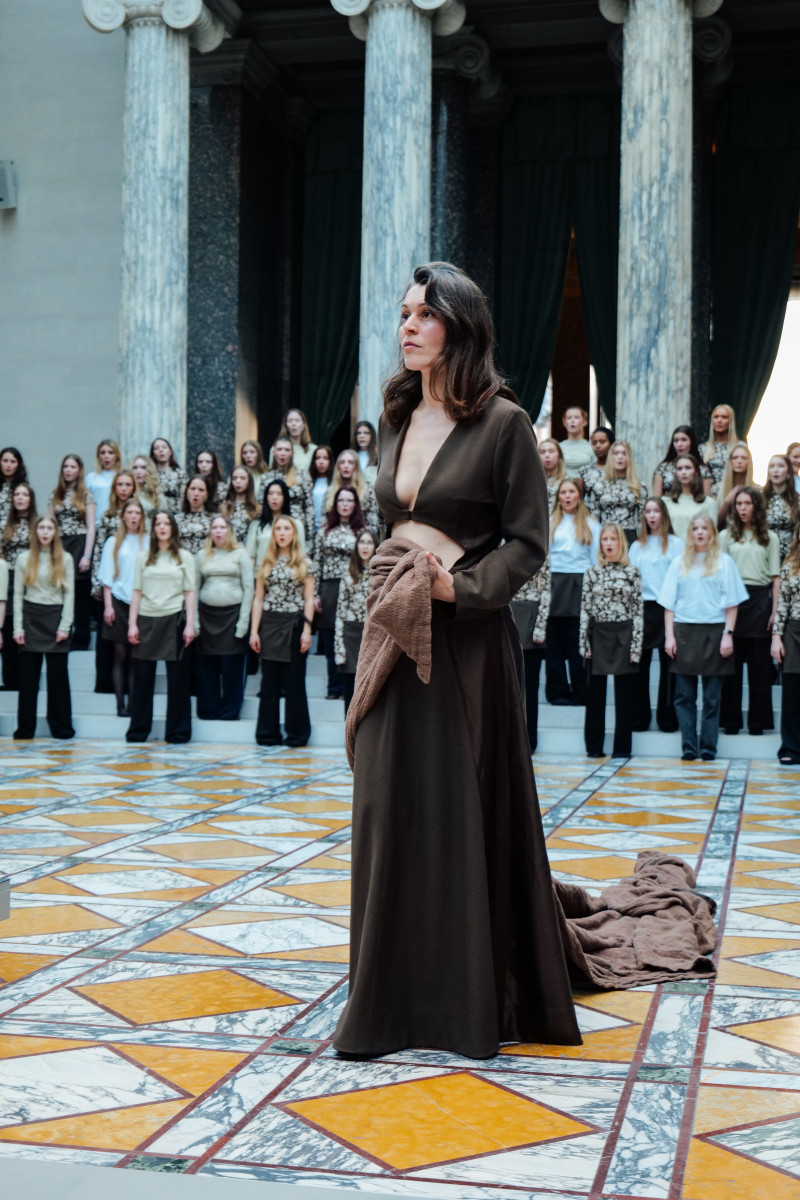
Saturday night at Huset’s Xenon stage was a true laboratory of sound, body, and technology. Two vastly different artists explored the expressive possibilities within sound and performance art. First, the Icelandic composer Sól Ey presented her performance Hreyfð («she is moved« in Islandic) wearing a suit equipped with microphones, speakers, and gyroscopes, her movements were transformed into sound. Through slow, deliberate motions, Ey tuned into different frequencies. Each gesture created a new auditory universe – ranging from soft, ethereal tones with the finest textures to distorted and aggressive noises, from cosmic whispers to fragmented radio signals that reminded me of NASA’s Voyager recordings. In complete silence, the audience observed Ey as she explored the sounds of outer space.

Afterward, the Japanese drummer Ryosuke Kiyasu stepped forward like a sonic warrior. With nothing but a snare drum, a table, and a microphone, he unleashed a relentless 30-minute sonic assault. He screamed, pounded, and perspired. He used both his own body and drumsticks. The audience held their breath as Kiyasu attacked his snare drum like a man determined to break through the limits of sound from within. And when he finally collapsed onto the floor, the room erupted in cheers.

While Sól Ey wove an intricate dialogue between technology and movement, Ryosuke Kiyasu launched a frontal attack on the material’s resistance. Both confronted the boundaries of sound with uncompromising dedication, demonstrating that sound art is not just about playing – but about transformation.

In brieflive
20.03

The Power of Trance: A Journey from Indonesia to Roskilde

Andreas Johnsen: »Cosmic Balance«
© PR
© PR

In 2022, the Indonesian group Juarta Putra turned the Roskilde Festival upside down and captivated a large audience with a trance dance called reak. In the documentary Cosmic Balance, director Andreas Johnsen takes us back to the time just before, to Putra's hometown of Cinunuk in West Java, Indonesia. Through 24-year-old Anggi Nugraha, we are introduced to reak and how both the young and the old, to the sound of booming drums, distorted tarompet (a reed wind instrument resembling an oboe), and reciting song, surrender to the ancestors who visit them in their wild trances. Anggi himself, who has just become the leader of the reak group, is haunted by his stern grandfather, who orders that traditions must be preserved and upheld.

However, Anggi is unsure about his new role. He is not of the bloodline of the predecessor Abah or any of the other members in the group, but he grew up in the village among the musicians after his parents, for unknown reasons, left him there. We also meet Anggi's girlfriend, whom he wants to marry, but whom he has not received his parents' approval to marry for the same reason. Anggi is a sensitive and sympathetic young man, whom one can only wish the best for. He himself seeks help from a fortune-teller, who gives him the strength to travel to Denmark and to marry his chosen one. How the marriage will turn out is unknown, but the journey to Roskilde is a clear success. 

The film's soundtrack works predominantly well with field recordings and the group's own music. Less fitting are the passages with lyrical piano and strings accompanying the trance scenes from Cinunuk, which come across as unnecessarily staged. This does not change the fact that Cosmic Balance gives a sympathetic and fascinating portrait of music that, on the one hand, fits perfectly with the global and diverse profile of the Roskilde Festival, but which also comes from a world so distant from the inferno of Roskilde that one can hardly see where the ends meet. But they do, that night at Roskilde.

English translation: Andreo Michaelo Mielczarek

In briefrelease
14.03

Community in Collapse

Nausia: »Finding a Circle«
©Astrid Lemmike

The transcendent takes the front seat on Copenhagen-based Nausia’s latest album, Finding a Circle. Slow builds and intense demolitions form the band’s basic structure, and a web of saxophone harmonies floats through a tight and daring interplay. Not every band manages to preserve the intense feeling of a live concert on a recording. But on Finding a Circle, Nausia succeeds in hammering the gap between stage and studio down to an irrelevant trifle, through a phenomenal and remarkably great-sounding ensemble performance.

There is something about the physical conditions of the saxophone that makes it easy to sense the musician’s presence. The clatter of the keys and the intense breathing make it effortless to form an inner image of the human behind the brass. On the track »E.D Interlude«, the saxophones’ airy exhalations and mechanical flapping ensure that, as a listener, I behave with the same quiet reverence as I would at a concert. So when the next track, »Eco Death«, kicks the door in on the silence, it is hard not to feel almost physically exhilarated by the album’s intense contrasts between presence and destruction.

Titles such as »flowers grow through concrete too« and »Eco Death« cast the wordless album in a bleak light of climate collapse. Finding a sense of community in a chaotic world – whether at a concert, on an album, or elsewhere – is essential to life in a time of crisis. Finding a Circle is a fine example of exactly that.