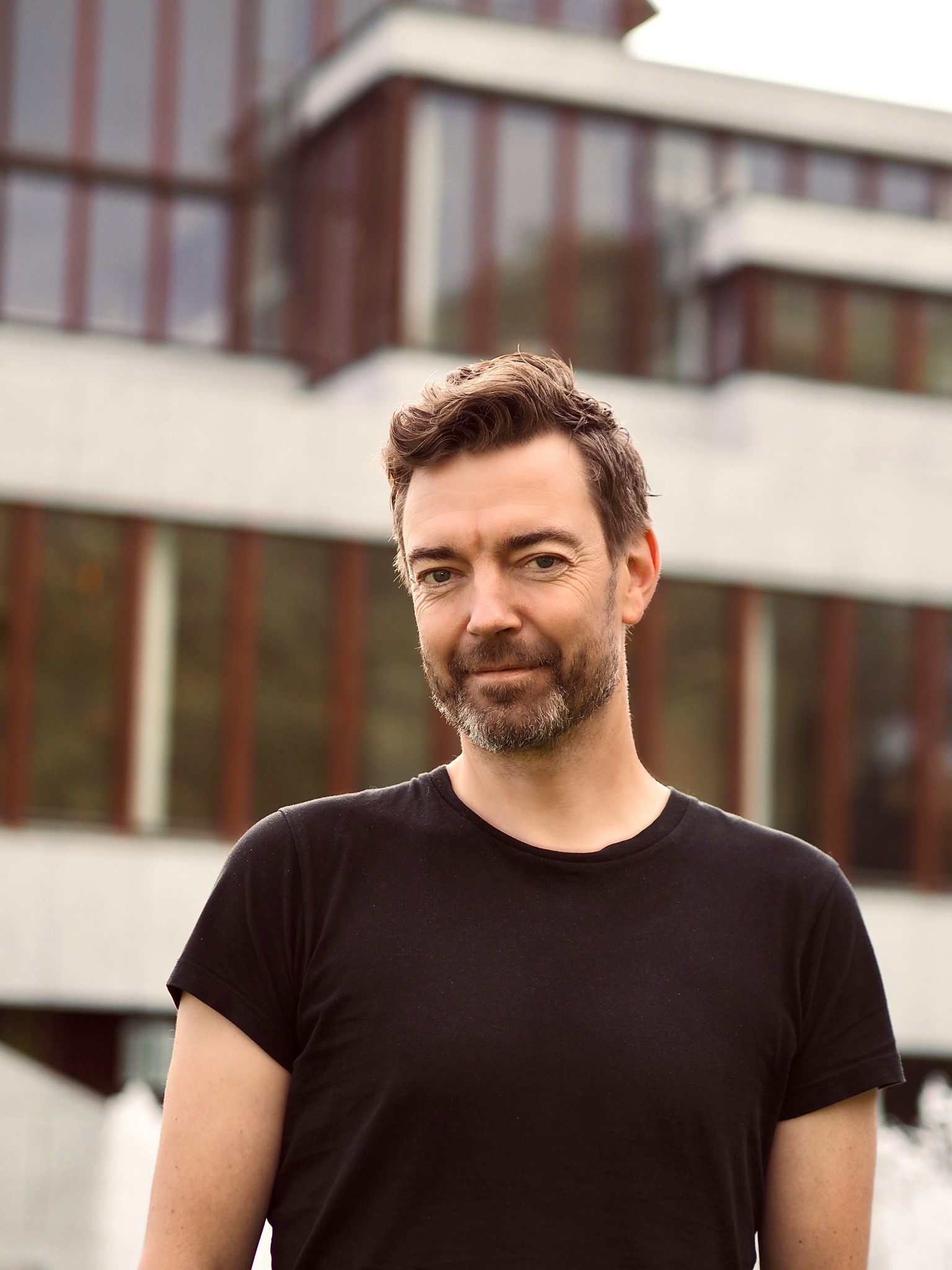
»Musik rammer mig stærkest, når den vækker længsel. Når jeg mærker den som et stik i maven, kan jeg begynde at tro på en oprigtighed i verden.«

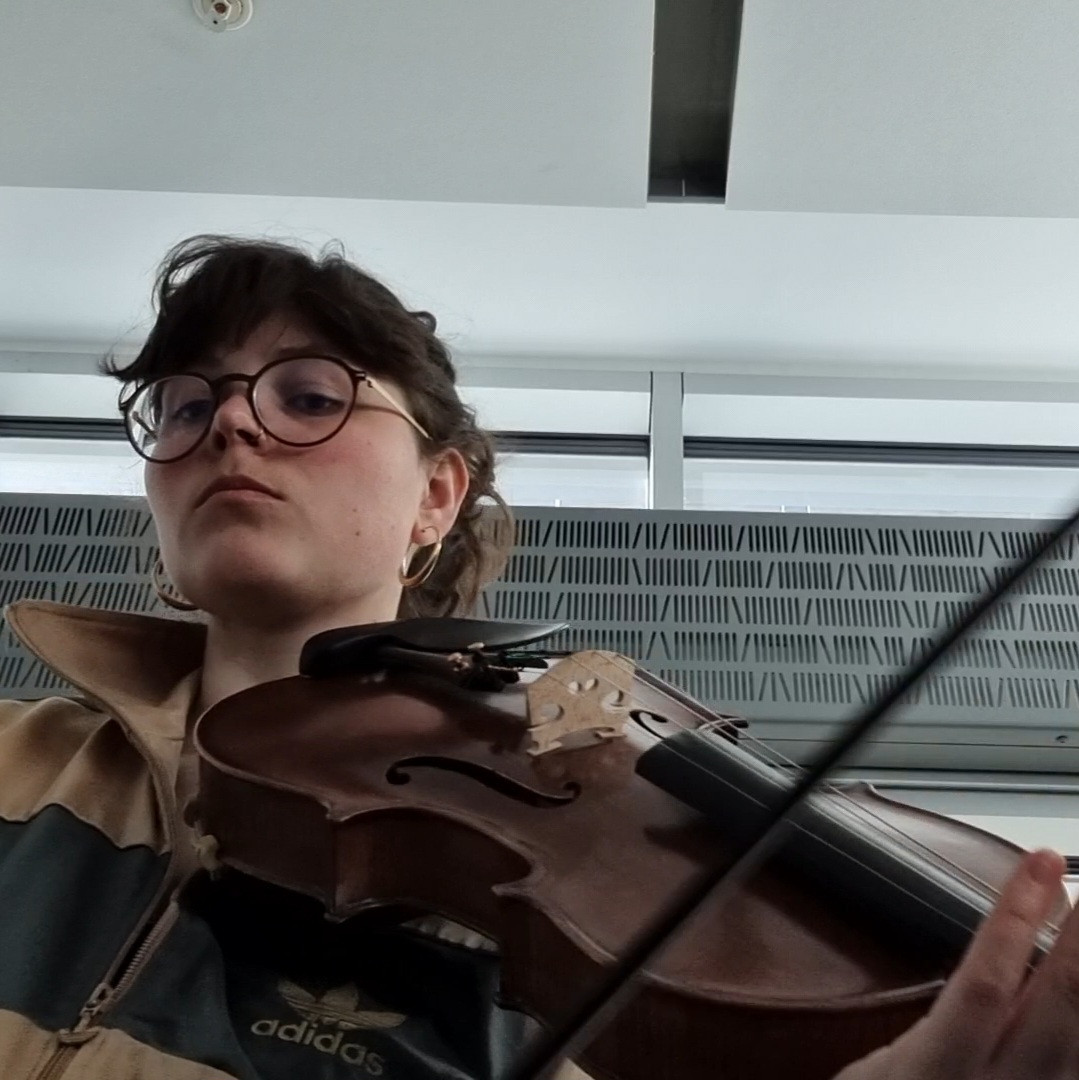
Marta Bo er 24 år, bratschist på fritidsbasis og bachelorstuderende i musikvidenskab på Københavns Universitet. Hun er netop startet som praktikant i Seismograf.

In brieflive
12.04

Feel Yourself Becoming Nature Again

Cecilia Fiona, Sophie Søs Meyer: »Ghost Flower Ritual« 
© Farzad Soleimani
© Farzad Soleimani

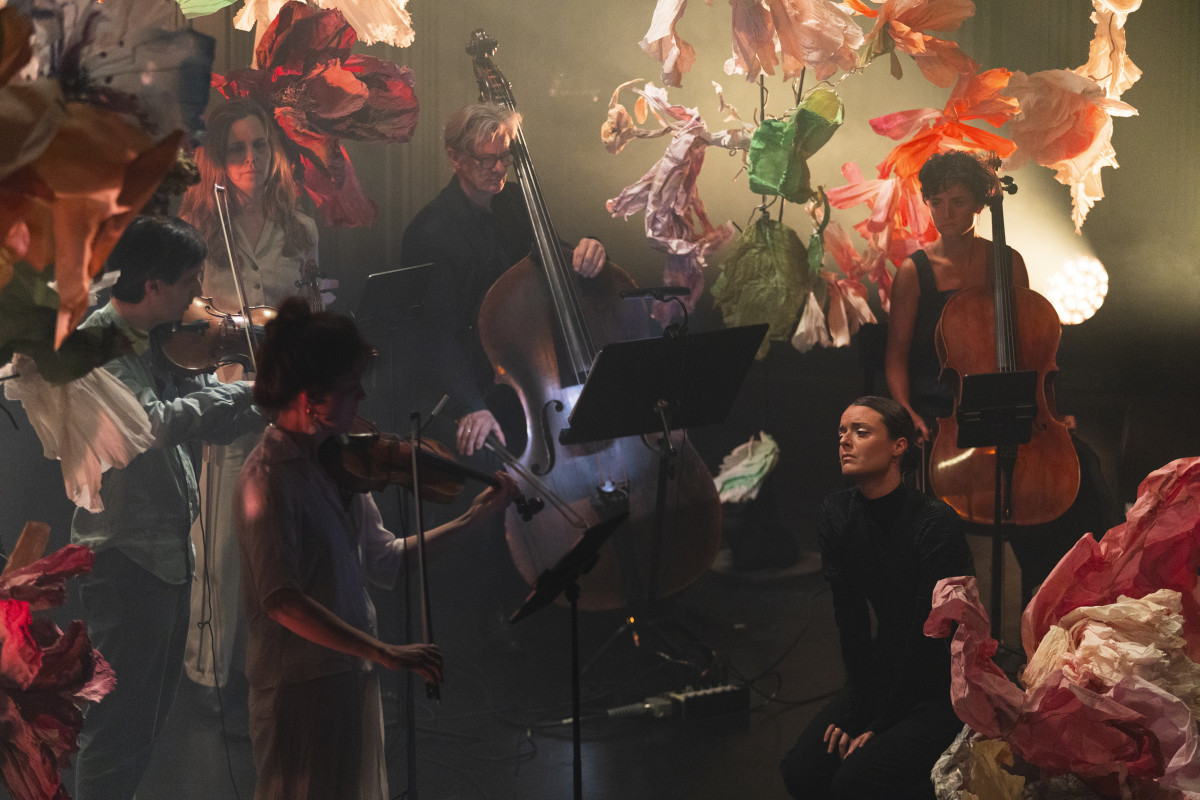
Frozen human bodies and faces shaped and painted like ceramics are meticulously carried around by flower sculptures that have abandoned their static nature. The roles are reversed. Nature becomes the living environment that grants the clay humans small, temporary lives in Ghost Flower Ritual at Copenhagen Contemporary.

The piece is a live installation with musicians and performers, where 34-year-old composer Sophie Søs Meyer has collaborated with visual artist Cecilia Fiona, who is of the same age. It’s a sensorially overwhelming, yet dramatically subdued ritual. Over the course of forty-five minutes, we sit together beneath a giant flower and sense the performers’ meticulous, slow movements. Meanwhile, soundscapes and small pulsating figures from four string players and a flute shape a landscape of colors, tones, and movements that melt together – filling the high-ceilinged room with auditory and visual presence. We are part of a whole.

I love the wild costumes that descend strangely from the sky. I love being part of the ritual that heals our forgotten connection to nature, which is the very foundation of our lives. I love the sound of stroked, plucked, and blown wood from Athelas’ musicians. Culture is nature. The human animals and the flowers are part of the greater consciousness. It’s all a hyper-complex mechanism. Cecilia Fiona possesses an extraordinary visual and creative abundance in her intricate details, and Sophie Søs Meyer is precise and intriguing in her swaying tonal figures that change slowly and meticulously. Until one flower blows into the large conch shell. Then the ritual is over.

English translation: Andreo Michaelo Mielczarek 

In brieflive
09.04

Beneath the Restless Canopies

Ask Kjærgaard, Jens Albinus, Rasmus Kjær, LiveStrings: »Store træers grønne mørke«
© PR
© PR

An inner soundscape characterises being in love. You walk through the city with a new rhythm, a different melody. The same is true of depression, though here major gives way to minor. Yet the early phases of love, too, can contain moments of doubt and dark foreboding. In composer and guitarist Ask Kjærgaard’s musical staging of Naja Marie Aidt’s 2006 short story Store træers grønne mørke (The Green Darkness of Large Trees), released as an LP last year, this same interplay is palpable as the music moves us from gentle strokes through melancholy to a rougher sound. The recording features the trio LiveStrings – cello, violin and viola – with actor Jens Albinus as the first-person narrator.

In the concert version of Kjærgaard’s work in Aarhus, featuring Rasmus Kjær on keyboards, Albinus’s voice appeared even more exposed. The piece introduces us to a depressed man who, wandering through a park, finds moments of calm beneath the trees—and at times up in them. For when despair causes you to fall out of the system’s sky, through sickness benefits and social assistance, only to land at the roots of the trees, perhaps there is only one thing to do: climb into the treetops? But then our anti-hero meets a woman in the park, and the drama begins. Can infatuation lift him out of depression, or will it end up short-circuiting him?

At first, the music crept in quietly. Kjærgaard’s ability to support the flow of the text revealed his experience as a film composer, particularly in his blending of classical music, meditative new age, and piercing guitar. Words and music carried the narrative together. When Albinus fell silent, the music became the voice of the inner landscape. The strings, in particular, delivered the dreamlike tones of infatuation, but when the gloom returned with renewed force, it was Kjærgaard who, with a roaring guitar, sprawled across the emotional abyss. It was beautiful and brutal.

English translation: Andreo Michaelo Mielczarek

In briefrelease
04.04

Explosive Jazz Builds Up and Burns Down

Amalie Dahl: »Breaking/Building Habits«
© Margit Rønning Omholt

From the very first downbeat, I sense a special energy – saxophonist and composer Amalie Dahl, in interplay with vibraphonist Viktoria Søndergaard, guitarist Viktor Bomstad, and drummer Tore Ljøkelsøy, unfolds a unique balance between calm and restrained wildness. Take, for instance, the album’s second track, which opens at a lingering tempo with a duet between Søndergaard’s vibraphone and Dahl’s saxophone. At times their playing merges into harmonic dialogue; at others, the interaction is disrupted by contrasting movements. Like a conversation, the instruments alternate between gentle suggestions and lively outbursts. It is a joy to listen to music that flows so effortlessly. Halfway through, Bomstad suddenly kicks the door open with his guitar, hurling himself into the conversation with explosive force. Where moments earlier I was savouring the finely tuned interplay between Søndergaard and Dahl, I am now overwhelmed by the flaming, noise-rock chaos Bomstad ignites – and I love every second of it.

All three tracks on the album are thus imbued with sheer joy of playing, confident compositions, and impressively free excursions. The listener is kept on the edge of their seat, knowing that at any moment the four musicians can cause an otherwise cosy passage to detonate. With Breaking/Building Habits, Dahl and her collaborators exemplify the unique vitality of partially composed, partially improvised jazz. They build up and burn down, again and again – and as a listener, there is nothing to do but surrender to their compelling show of force.

English translation: Andreo Michaelo Mielczarek

In briefrelease
30.03

Mathias Reumert Group Masters the Art of Playing with Sound

Mathias Reumert Group feat. Anna Caroline Olesen & Hsiao-Tung Yuan
© PR
© PR

Mathias Reumert Group is a playful and tightly knit percussion ensemble. This was already evident upon entering KoncertKirken: the long side of the hall was densely packed with an impressive arsenal of percussion instruments, ready to bring the space to life. The programme opened with a delightful performance of György Ligeti’s Síppal, Dobbal, Nádihegedüvel featuring soprano Anna Caroline Olesen. A work driven by humour and constantly shifting yet precisely placed sounds – harmonica, referee whistles, marimba, tubular bells, and much more. We were even fortunate enough to hear the final movement twice.

The early encore loosened up the otherwise somewhat conventional concert format – one piece followed by the next, and so on. In new-music ensembles, one increasingly encounters curatorial and conceptual frameworks for concerts. Perhaps this is a development from which this curious ensemble could benefit?

The concert concluded with Chiung-Ying Chang’s Solar Myth – a piece of music theatre rooted in Taiwanese culture, where prop and instrument became one. Three masked beings played softly on a bass drum, initiating what felt like a ritual. But the ritual was abruptly disrupted when a fourth percussionist stepped forward, offering resistance through the tones of a marimba. The three beings responded with sharp, piercing cracks from their bright red fans – but the marimba did not yield. What followed was an explosive soundscape of metallic percussion, bright, clattering, and dancing. The dramaturgy seemed shaped by a deep understanding of the nature of music itself. Enchanting. One left KoncertKirken a little taller, happier, and more playful.

English translation: Andreo Michaelo Mielczarek

In briefrelease
27.03

The Cello Within the Comfort Zone

Josefine Opsahl: »Cytropia«
© Lis Kasper Bang
© Lis Kasper Bang

There are twelve tracks on Josefine Opsahl’s album Cytropia, each with the duration of a rock song. Remarkably, there is a straight line from the first to the last – both in timbre, rhythm, melody, atmosphere, and playing. The ears are embraced by a gentle melancholy created by small cello figures in long sequences, with a slow-moving cello melody on top. Some parts in minor, others more open.

She is receiving quite a lot of praise these days for her many projects – an opera and a ballet – alongside her work as a cellist-composer, and it must almost be due to the highly accessible, cohesive, and dreamy sound she consistently delivers. I must admit that I have become somewhat skeptical along the way. Both as a musician and as a composer, I wish she would challenge herself with new approaches and new visions for the stories her music should tell. On Cytropia, we approach a constant state of uniform sound, evoking thoughts of the deliberate inertia of New Age composers.

There are quite beautiful moments along the way. The track »Cyborg« is crystal-clear in its surface. A piece like »Leaverecalls«, in its mechanics, the American minimalism of Philip Glass. But once again, one misses displacements and rhythmic additions that could challenge the static soundscape. The last hundred years of experimentation have expanded the battlefield of cello playing. Opsahl draws on some of these experiences to create her own small mechanical accompaniments for herself. Yet, the setup with a sequencer and a cello seems limiting in allowing Opsahl to explore timbres and ideas where the gravity of melancholy can truly be felt.