Det tværkunstneriske og ofte konceptuelle ensemble SCENATET opfører i weekenden for første gang i Danmark det operalignende værk ”Infinito Nero” af den italienske komponist Salvatore Sciarrino.

I alt fire gange i løbet af tre dage lægger den gamle Polyteknisk Læreanstalts Maskinhal ved Botanisk Have rammer til opførelsen af denne ”ekstase i et akt” fra 1998, der bl.a. udmærker sig ved en meget sagte progression og ved kun at have én sanger på rollelisten.

”Det er en meget vigtig prioritering for mig, at SCENATET bidrager til dansk musikliv ved at præsentere væsentlige udenlandske hovedværker. Sciarrino har med sin autodidakte og nærmest jomfruelige tilgang til både teknik og tradition åbnet op for en helt ny klangverden bestående af en særlig form for indrammet stilhed kombineret med et repeterende og overjordisk gennemstrålende klangunivers, som har dannet skole i de sidste årtier”, siger SCENATETs kunstneriske leder Anna Berit Asp Christensen.

Som undertitlen antyder, baserer stykket sig på ytringer frembragt af renæssance‐mystikeren Maria Maddalena de' Pazzi, der måtte have hele otte nonner til at gentage og nedskrive de ord, hun spyttede og hakkede ud under sine ekstaser.

”Infinito Nero udfolder på fantastisk vis Sciarrinos univers som er både kontrolleret og vildt, befriende og pirrende med sin hvæsen og sukken. Man kan næsten ikke selv få luft når man lytter til det værk”.

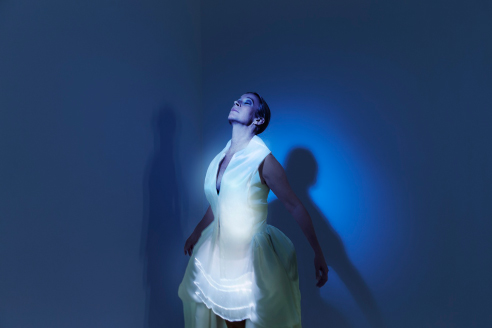
Iscenesættelsen står den britiske instruktør og mezzosopran Loré Lixenberg for. Hun har arbejdet med SCENATET siden 2007 og har til denne forestilling skabt scenografi og kostumer i samarbejde med lysdesigner Mikkel Jensen, videokunstner Casper Øbro samt tøjdesigneren Mea Andresen.

"Loré og jeg så begge et stort potentiale for at lave en spændende iscenesættelse og for at arbejde med en scenisk version, der kunne involvere både musikere og værkets solosanger. Mens mange opsætninger fremstiller hovedrollen som sindsforvirret, præsenterer Lixenberg hende som en genial kvinde, og det er stærkt og meget vedkommende efter min mening", afrunder Anna Berit Asp Christensen.

Spilletider:
13. november kl. 20
14. november kl. 17 og 20
15. november kl. 17

Sted: Maskinhallen, Øster Farimagsgade 2D, København K

Billetterne koster 120 kr. (60 for studerende) og kan købes via Billetto.

in brieflive
18.10

One Tone, Eight Breaths, and the Sound of Waiting

Elisa Kragerup, Louise Alenius, Vokalensemblet ÆTLA and others: »The Emperor of Portugalia«
© PR
© PR

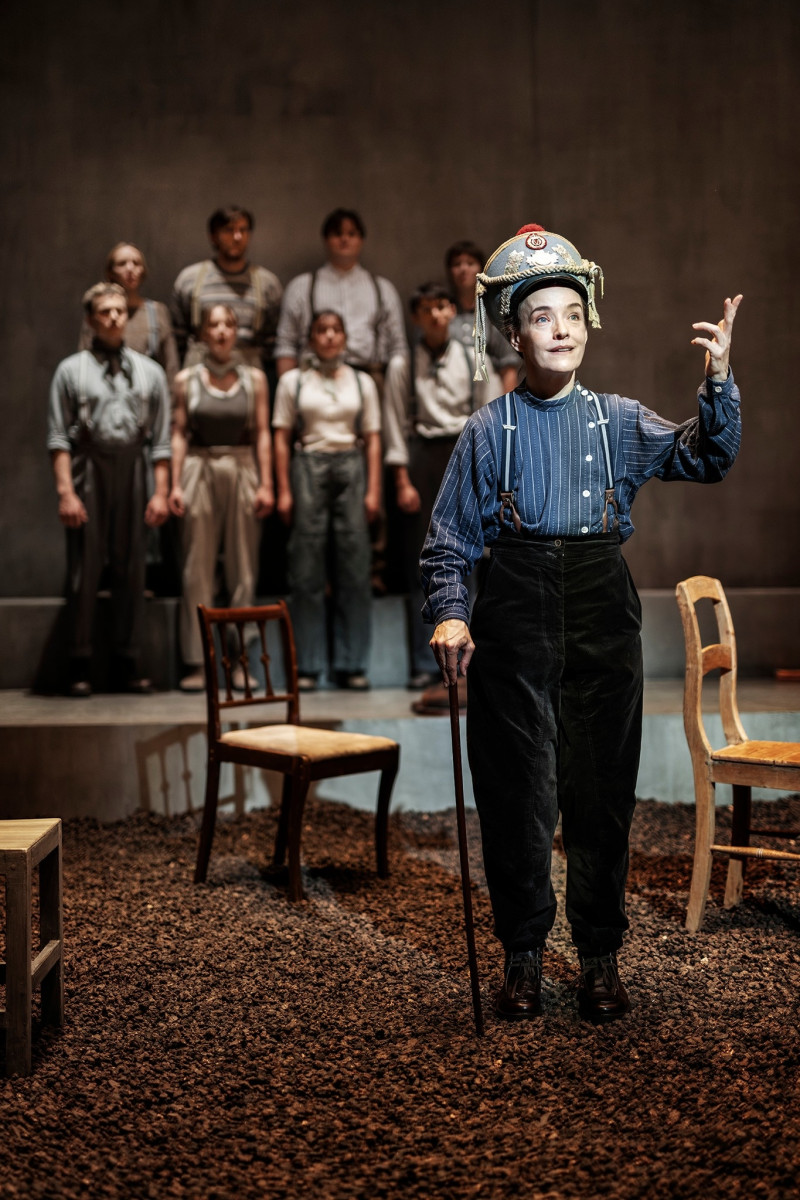
Only one actor appears on stage in The Emperor of Portugalia – surrounded by eight singers. In Elisa Kragerup’s tightly choreographed staging, Louise Alenius’ a cappella composition becomes a physical experience where breath and movement merge into one. The acoustic soundscape interacts eerily quietly with the deafening, mechanical noises that arise when, for instance, beams of light are raised and lowered on stage. It feels as if the relentlessness of existence here briefly finds a sonic expression that captures Selma Lagerlöf’s intentions.

The sparse – or rather ascetic – soundscape, together with the humble peasant costumes, reflects the harsh, monotonous life of a Swedish village before the world turned modern. And the plot? A poor farmer worships his daughter, but when she leaves for Stockholm as a young woman and never returns, his years of yearning drive him, in a Don Quixote-like fashion, to believe himself emperor of the imaginary land of Portugalia, with his daughter naturally imagined as its ruler. The father’s longing borders on madness, while the daughter’s neglect or thoughtlessness ultimately turns against her: in a Godot-like manner, he waits and waits for her – just as she, after his drowning, waits for him, unable to find his body.

The piece is carried by an almost unbroken drone in the choir (produced through collective breathing) – a single sustained tone that, as an artistic device, illustrates how music in theatre can be so minimal that sound itself becomes the message, and the absence of a musical narrative becomes the point. »One tone played beautifully is enough,« Arvo Pärt once said. Except that here, the tone is sung – and in this work, his statement is affirmed in the most radical way: a maximal expression achieved through minimal means, realised with striking precision by Vokalensemblet ÆTLA.

English translation: Andreo Michaelo Mielczarek

in briefrelease
16.10

A Microphone In the Nervous System

IKI: »BODY«
© Julie Montauk
© Julie Montauk

It sounds as if someone has placed a microphone directly inside the nervous system’s electrical impulses. The Nordic electroacoustic vocal ensemble IKI explores the boundaries between body and technology on their fifth, self-produced album BODY, where the five singers’ bodies merge into one large, organic rhythm box.

The tracks change form as the body breathes, dances, awakens, runs, wanders – in the imperative mood. The harmonically unison ripple of »Float« is countered by flickering modem-like sounds in »Regenerate«. Everything is framed by the recurring theme »Circuit«, which ultimately gathers the fragments into a single linguistic statement: »Are you gone when your body is not breathing?«

BODY demands concentration. IKI claims that all sounds on the album are created with the voice – a counterpoint to the electrically manipulated, a kind of reversed version of synthesizer sounds that imitate the human voice. It’s an incomprehensible mystery one keeps listening for: how can the voice produce the accordion-like sound on »Breath«, panned all the way to the left and slowly taking over the entire soundscape? Of course, it can’t do so on its own. The recording itself is an electronic mediation. The technological tools act as a microscope for vocal expression. It’s powerful because it asks about the transitions between human and machine, between life and afterlife. Yet the premise holds a paradox that never fully resolves.

English translation: Andreo Michaelo Mielczarek

Bjarke Niemann. © Frederik Barasinski

»Music is everything that can only be described far more poorly with words.«

Bjarke Niemann is the lead singer, songwriter, and producer of the Danish band Spleen United. The group broke through with Godspeed Into The Mainstream in 2005 and has performed at, among other places, Roskilde Festival and the Copenhagen Opera House. Bjarke Niemann has also composed and developed music for TV and video games – including the international game series Hitman – and has produced albums with artists such as Soleima, Statisk, Afskum, and Hugorm.

© Motis Necrojam

»Music is the pursuit of original failure...« 

Motis Necrojam is the singer and collager with the Noseflutes and The Clicking Stick, a pair of combos from the old English Birmingham times, adorned with new-times dedication to derailment, approved by Sir John Peel, via their four live sessions for his mighty BBC Radio programme, occasional treaders of the boards, musicians with alias obsessions. One thing Necrojam has is a digit on the diminishing pulse. 

Katrine Muff. © Ditte Capion

»Music, to me, is the key to – and an extension of – my vocabulary. If I struggle to put ‘spoken words’ to something inside, or if I need release in the form of a proper cry, the right song can put me in the right gear immediately. It can be the lyrics, the melody, or both that give direct access to my emotions, where the brain can simply be put into neutral and carried away.«

Katrine Muff, born in 1985, is a composer and singer. She has set music to texts by, among others, Stine Pilgaard and Suzanne Brøgger, and in 2021 she received the Folk Song Prize (Den Folkelige Sangs Pris). Together with Lone Hørslev, she is currently releasing the album Jeg ønsker mig and working as a songwriter on the theatre concert STOLT (Folketeateret).