




Knausgaard’s Apocalypse as Opera

Another year, another brand-new, full-scale opera set in Bergen. Sure, Norway’s former capital has a certain magic at the best of times but in the 666-pages of Karl Ove Knausgård’s The Morning Star things reach a whole new level. A priest presides over the funeral of a man who’s been dead for a week, even though he was on a flight with her the previous day. A carer for psychiatric patients ventures into the woods adjacent to her clinic where she encounters a large bird with reptilian scales and a human face.
Sure, Norway’s former capital has a certain magic at the best of times
Most significantly, all nine narrators in Knausgård’s novel become aware of a huge new celestial entity in the sky. All this apparently allows them to see the dreadful truths that are corroding their private lives and ask themselves why they even exist.
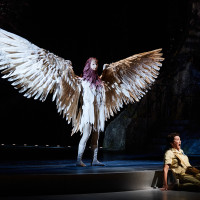
But this is Knausgård, so the vast majority of the book is concerned with making coffee, going shopping, exchanging banal texts with family members and imbibing mid-priced alcohol. The Morning Star is Søren Kirkegaard meets Stranger Things. The domestic drudgery is made compelling in that very Knausgård way but not even he can enliven the book’s heavy theological wrangling, which can prove incongruous, convoluted and eventually a little wearing. Sometimes it’s framed as conversation but in the most obvious case it’s presented as an »essay« by one of the protagonists – the bar-room-philosopher Egil, who lives off his father’s fortune while trying to evade contact with his pre-teen son Viktor.
Conceiving all this as an opera can’t have been easy.
From the novel’s introspection to the logic of the operatic stage
Conceiving all this as an opera can’t have been easy. Distilling it into sung words and music must have been harder still. The narrative frequently relies on backstory and introspection while the actual »events« – an attempted suicide, a car accident, a seduction, the returning to life of a hospital patient already declared dead – are subsidiary; less about moving a story on, more concerned with symbolism and opportunities for questioning.
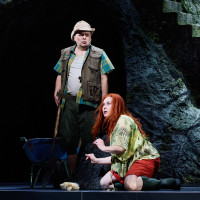
People don’t break into song at Bergen Airport just as they don’t encounter swarms of giant crabs while driving home from it
Yet in a sense, The Morning Star is wholly operatic in its combination of logical storytelling and the complete suspension of disbelief. People don’t break into song at Bergen Airport just as they don’t encounter swarms of giant crabs while driving home from it. As Egil asks in Knausgård’s text: »If we stand at the boundary of the logical, what is there beyond?« One answer might be »opera«.
Betrayal instead of theology
Gunilla Hemming, the librettist for Morgonstjärnan, the new opera with music by Finnish composer Sebastian Fagerlund, quotes the playwright David Mamet in her essay in the programme book: »All drama is basically about betrayal.« This is what makes her libretto function. She jettisons theology from her text almost entirely, allowing theatrical gesture and symbolism to do the existentialist heavy lifting (the giant star and an opera chorus help, naturally). In Morgonstjärnan we meet not nine protagonists but six and are sucked rapidly and effectively into the wreckage of their personal lives and the ensuing dilemmas. Three of them dominate: the lecherous hack Jostein, the emotionally stilted A&E nurse Solveig and the confused priest Kathrine.
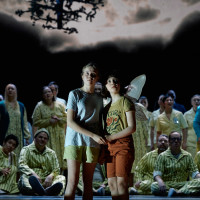
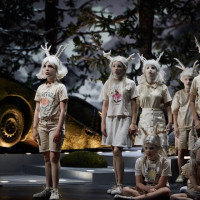
Hemming’s primary job may have been to cut. But her Swedish-language libretto includes one striking act of spotlighting by letting the children have the last word. In the novel the children are subordinate – the victims of their guardian’s general self-absorption. But they are nearly ever-present in the opera and bear witnesses to the most disturbing tragedy of all: the cycles of neglect that created these despicable adult characters in the first place. »Here we are«, their offspring sing as the curtain falls, emotional devastating but curiously optimistic.
There are other, similarly powerful moments in Morgonstjärnan, which proves itself a highly effective piece of theatre and a very respectable stab at a twenty-first century opera. As in his previous full-scale opera Autumn Sonata, Fagerlund lets the orchestra carry much of the psychodramatic weight. Even as the prologue dumps us into the procedural banalities of Bergen Airport the orchestra is signalling bigger things underneath – an emotional whirlpool, churning, brooding and roaring.
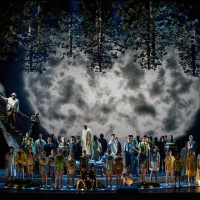
Fagerlund’s skilful handling of instruments and voices in chorus is a strong suit in the score. We already knew he was highly adept at twisting the orchestral kaleidoscope but the appearance and brightening of the star allows for incandescent orchestration and some striking set-pieces in which the chorus stand dazzled by what they see in the sky. It acts as a vivid musical and theatrical picture of a society in the grip of something physically extraordinary and maybe even metaphysically transformative. At the same time, everything in the score sounds musically integral, even as textures devolve down to a single violin. Fagerlund’s principal sonic domain is orchestral harmony, lyricism, long lines, creaking and bending pedal notes – beguiling and highly theatrical, even if there are a few too many instances of a big crescendo snapping into sudden quietness or silence, a gesture that threatens to become a cliché.
To some extent, all this eclipses Fagerlund’s solo vocal writing, which can be forgettable and unspectacular. Perhaps that was the point. The libretto prioritizes situations and doesn’t give us much in terms of character, which leaves the broader musical apparatus to fill in some gaps. It does so well, evocatively painting the frenetic claustrophobia of the care worker Turid’s mind (with chorus as well as orchestra), or showing us the extent of the theologian Egil’s intellectual separation from his son, as he appears constrained inside the musical logic of Lutheran chorales.
What we might miss in individual character, from text and music, is recompensed to some degree in the music’s capturing of societal breadth and crisis – the bigger picture. This is where you feel this new opera’s considerable theatrical and emotional power and where it gets closest to the heavy existential angst of Knausgård’s book – in the score’s impressive layers of coalescing polyphony bringing us from individual experience to collective crisis or awakening (we never quite know which – not a cop-out from the creators, but actually the boldest of gestures).
»All drama is basically about betrayal.«
Kudos to the Finnish National Opera for getting this Norwegian-sourced, Swedish-language opera onto the stage in an effective production by its own artistic director, Thomas de Mallet Burgess. Leslie Travers’s designs made effective but subtle use of the stage revolve, solving logistical problems in a fast-paced opera, while his forest of gradually-descending upside-down trees provide a striking visual counterpoint to the steadily-increasing nuclear power of the star, especially when bathed in Matthew Marshall’s beautiful lighting. More baffling are Tracy Grant Lord’s costumes. Having the literature professor Arne resemble a Florida tourist, the bipolar artist Tove a kindergarten teacher and the grubby journalist Jostein a Gentofte wedding guest certainly didn’t aid our already hard-come-by perceptions of character.
A major achievement
The best solo singing comes from Helena Juntunen and Johan Reuter – though once again, there proves to be so much default nobility in the latter’s voice that it can be hard to reconcile his character’s sickening behaviour with the warm sounds coming out of his mouth. Juntunen’s voice has that classic Finnish combination of acute focus and apparent lightness that doesn’t preclude power. Her moments of self-examination feel like some the most personally authentic in the show, as do those of Jenny Carlstedt’s Kathrine, whose reconciliation with her husband Gaute also provides one of the opera’s dramatic high points, daring to step back from the metaphysical precipice and indulge in some good old-fashioned operatic love and longing. The scene is stylishly and richly sung by Carlstedt and her on-stage husband Nicholas Söderlund.
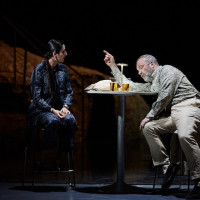
But this is an ensemble piece, just as Knausgård’s novel is a filtering of the communal through the personal; the all-embracing through the incidental. The chorus and orchestra of the Finnish National Opera sound as though they have internalized almost every note of Fagerlund’s ferociously detailed new score, no mean feat at the opening of a brand-new work.
He shows us what a rich operatic creation this is
Conductor Hannu Lintu holds the big moments skillfully in the air but is also alive to the many lyrical and contrapuntal details in the score – a cantabile horn line here, the seed of a new rhythmic agenda there. He shows us what a rich operatic creation this is – one that advances the musical language of the art form within the specific and resonant schematics of Fagerlund’s post-Lindberg aesthetic. Unlike a lot of other new operas that cling to the orchestra as a means of storytelling, this one also functions powerfully as a piece of theatre.
»Morgonstjärnan«, Finnish National Opera, Helsinki, 30.01-03.03 (world premiere)