In briefrelease
14.01

70 Minutes Confined to a Creaking Construction Site

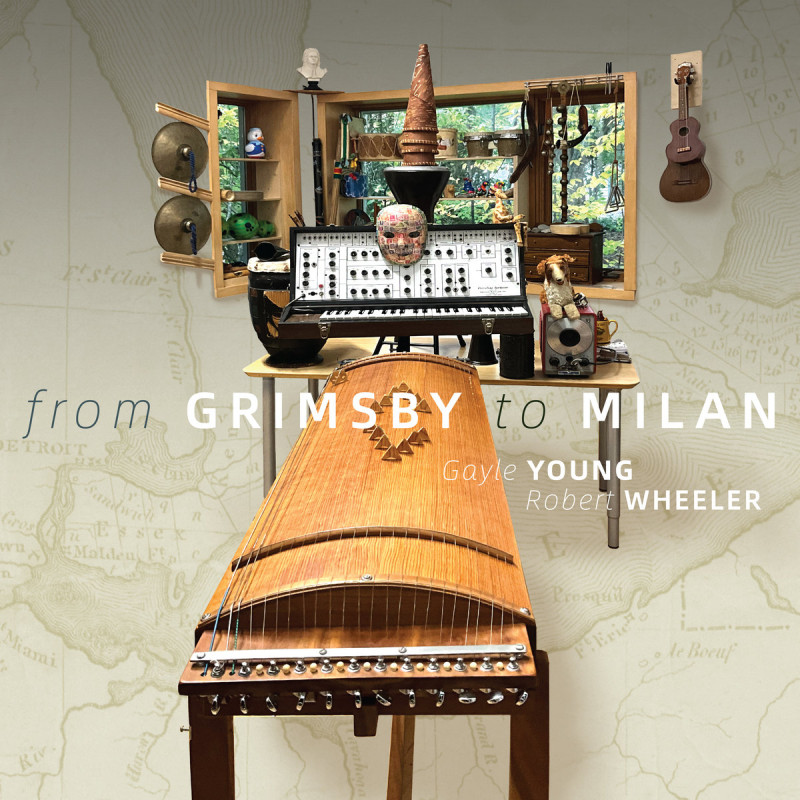
Gayle Young & Robert Wheeler: »From Grimsby to Milan«
© PR
© PR

The Amranthen is a peculiar string instrument, invented and built by Canadian instrument maker Gayle Young. It consists of a wooden box fitted with 21 steel strings and three bass strings, and its unique, organic timbre unfolds on From Grimsby to Milan, where Young improvises alongside American musician Robert Wheeler on synthesizer. The recordings from Grant Avenue Studios capture the encounter between the acoustic and the electronic in a loosely shaped, raw musical flow.

Across nearly 70 minutes divided into six parts, the listener is kept in a state of constant uncertainty. The sonic landscape resembles a noisy, dystopian construction site: on »Seaweed Slowly Shifting«, bows are drawn with a saw-like rasp, fingers scratch, machines whirr, and sharp electronic zaps flash like warning lights. Later, bells and pulse-like rhythms enter on »Mariana Trench«, while »Consonant Harmony« slows the pace, settling into a subdued, crackling atmosphere where sparse melodic gestures suggest a momentary lull in the turmoil.

The construction-site metaphor fits well, for the most compelling version of this project would likely be to experience Young’s handmade instruments live, in direct dialogue with Wheeler’s electronics. As an audio recording, however, the project remains closed-off and somewhat insular. And although From Grimsby to Milan contains a wealth of fine detail, the journey – from Grimsby in Canada to Milan in Ohio – ultimately feels long and monotonous, without ever offering the listener the key to unlock its dystopian worksite.

English translation: Andreo Michaelo Mielczarek

In briefrelease
24.10

JASSS Tears the Cellophane Off Electronic Music

JASSS: »Eager Buyers«
© PR
© PR

The sound of Eager Buyers is as intense as crackling cellophane – and just as revealing. It’s as if all musical labels have been stripped away, leaving behind a raw, unfiltered sonic world where genres dissolve and everything becomes possible. The Berlin-based Spanish producer JASSS forges her sound in a punkish alloy of electronic music, industrial, EDM, and rock-inspired guitar riffs.

Her third album is a rebellion against conformity and expectation. To label JASSS is nearly impossible – unless the label is cool. In the complex rhythmic compositions, where traces of bitcrush are balanced by melancholic harmonies and subtle hints of medieval-core on the track »Sand Wrists«, we enter a universe that is at once nostalgic and adventurous – and at the same time simmering with the energy of Berlin’s nightlife.

Eager Buyers is magnetic – even for listeners who don’t normally inhabit the electronic realm. The album carries a clear narrative, driven by a dark, almost theatrical energy. JASSS turns toward a world she perceives as »malnourishing« – as she phrases it through song titles like »Hollow« and »The Mob Expects Malnutrition«. Yet the melodrama has a tinge of irony: there’s something disarmingly sarcastic about it all, as if Eager Buyers is ultimately about the disillusioned modern human.

JASSS rattles the cellophane of the musical packaging we usually call genres, reminding us that music, too, is a product to be sold and bought. Eager Buyers is an album that refuses to be wrapped up – and precisely for that reason, it’s worth buying.

English translation: Andreo Michaelo Mielczarek

»Music, to me, is true luxury and has always been an opening into a language without constricting categories, with room for both intimacy and impact. I don’t have a single tone in life, but I wish I did. When I work, music is a warm room I can barricade myself in, an ally that keeps me on track—not least in a time as destructive as the one we are in now. It can be a connection to difficult emotions, but also an excuse for a kitchen dance that makes me forget the world and myself. I actually constantly long for a new soundtrack (and more dancing), but if I’m completely honest, I’m also quite happy to take off the headphones and listen—not least to the non-human world’s differently calming compositions: all the other voices that we must include in the choir if there is to be human song and music in the future.«

C.Y. Frostholm (b. 1963) is a writer and visual artist who has published poetry and prose since 1985 and worked visually since 1991, including with photography, digital, and visual poetry. Together with composer Hans Sydow, he released the album Mellem stationerne back in 2000. Earlier this year, he took part in the exhibition Hybris! at Galleri Image in Aarhus, based on his latest book, Til den ven jeg aldrig har kendt (2023).

In brieflive
18.10

One Tone, Eight Breaths, and the Sound of Waiting

Elisa Kragerup, Louise Alenius, Vokalensemblet ÆTLA and others: »The Emperor of Portugalia«
© PR
© PR

Only one actor appears on stage in The Emperor of Portugalia – surrounded by eight singers. In Elisa Kragerup’s tightly choreographed staging, Louise Alenius’ a cappella composition becomes a physical experience where breath and movement merge into one. The acoustic soundscape interacts eerily quietly with the deafening, mechanical noises that arise when, for instance, beams of light are raised and lowered on stage. It feels as if the relentlessness of existence here briefly finds a sonic expression that captures Selma Lagerlöf’s intentions.

The sparse – or rather ascetic – soundscape, together with the humble peasant costumes, reflects the harsh, monotonous life of a Swedish village before the world turned modern. And the plot? A poor farmer worships his daughter, but when she leaves for Stockholm as a young woman and never returns, his years of yearning drive him, in a Don Quixote-like fashion, to believe himself emperor of the imaginary land of Portugalia, with his daughter naturally imagined as its ruler. The father’s longing borders on madness, while the daughter’s neglect or thoughtlessness ultimately turns against her: in a Godot-like manner, he waits and waits for her – just as she, after his drowning, waits for him, unable to find his body.

The piece is carried by an almost unbroken drone in the choir (produced through collective breathing) – a single sustained tone that, as an artistic device, illustrates how music in theatre can be so minimal that sound itself becomes the message, and the absence of a musical narrative becomes the point. »One tone played beautifully is enough,« Arvo Pärt once said. Except that here, the tone is sung – and in this work, his statement is affirmed in the most radical way: a maximal expression achieved through minimal means, realised with striking precision by Vokalensemblet ÆTLA.

English translation: Andreo Michaelo Mielczarek

In briefrelease
16.10

A Microphone In the Nervous System

IKI: »BODY«
© Julie Montauk
© Julie Montauk

It sounds as if someone has placed a microphone directly inside the nervous system’s electrical impulses. The Nordic electroacoustic vocal ensemble IKI explores the boundaries between body and technology on their fifth, self-produced album BODY, where the five singers’ bodies merge into one large, organic rhythm box.

The tracks change form as the body breathes, dances, awakens, runs, wanders – in the imperative mood. The harmonically unison ripple of »Float« is countered by flickering modem-like sounds in »Regenerate«. Everything is framed by the recurring theme »Circuit«, which ultimately gathers the fragments into a single linguistic statement: »Are you gone when your body is not breathing?«

BODY demands concentration. IKI claims that all sounds on the album are created with the voice – a counterpoint to the electrically manipulated, a kind of reversed version of synthesizer sounds that imitate the human voice. It’s an incomprehensible mystery one keeps listening for: how can the voice produce the accordion-like sound on »Breath«, panned all the way to the left and slowly taking over the entire soundscape? Of course, it can’t do so on its own. The recording itself is an electronic mediation. The technological tools act as a microscope for vocal expression. It’s powerful because it asks about the transitions between human and machine, between life and afterlife. Yet the premise holds a paradox that never fully resolves.

English translation: Andreo Michaelo Mielczarek

Bjarke Niemann. © Frederik Barasinski

»Music is everything that can only be described far more poorly with words.«

Bjarke Niemann is the lead singer, songwriter, and producer of the Danish band Spleen United. The group broke through with Godspeed Into The Mainstream in 2005 and has performed at, among other places, Roskilde Festival and the Copenhagen Opera House. Bjarke Niemann has also composed and developed music for TV and video games – including the international game series Hitman – and has produced albums with artists such as Soleima, Statisk, Afskum, and Hugorm.