in briefrelease
12.03

Do Whales Actually Want to Listen to Us?

Valentin Paoli: »The Musician and The Whale / La Baleine et le Musicien«
© PR
© PR

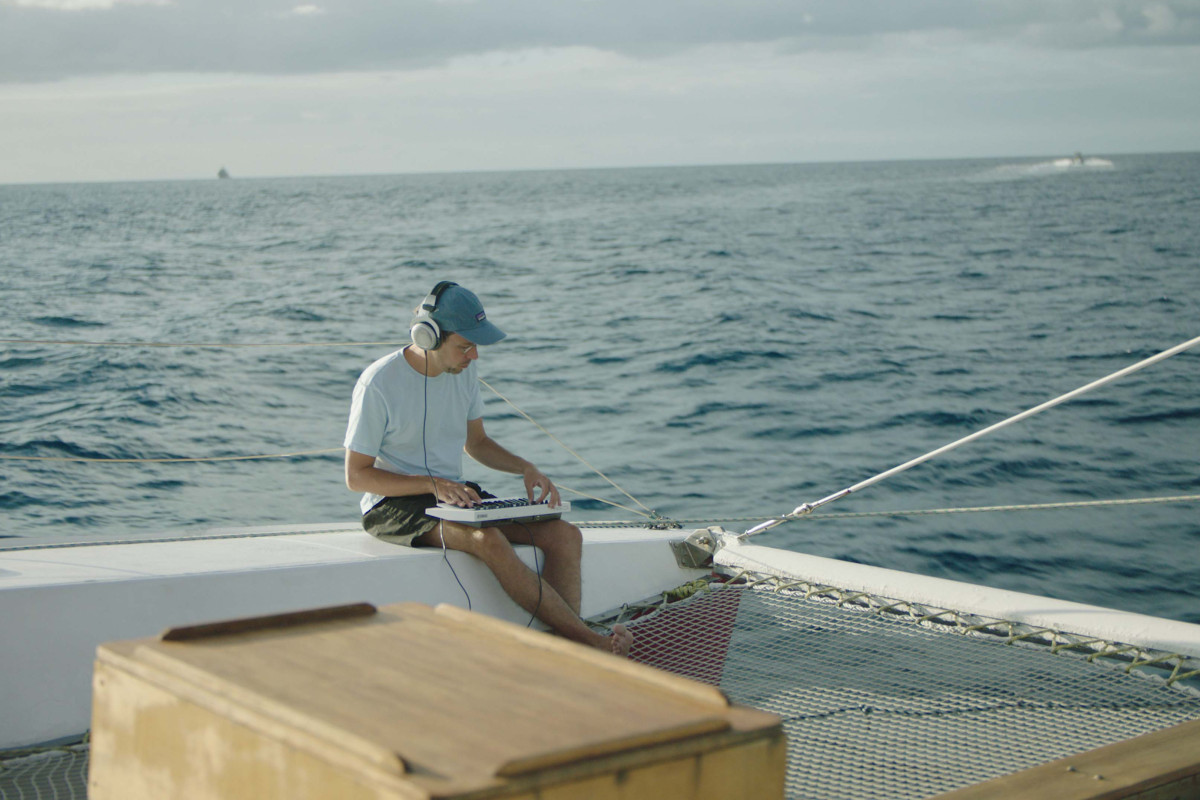
The French electronic musician Rone finds it difficult to express emotions verbally. In Valentin Paoli’s rather touching documentary The Musician and The Whale, he reflects on music’s ability to create connections and convey moods to an audience – whether human or interspecies.

One day, Rone receives a video from a sailor who is playing his music at sea. Whales gather around the boat, seemingly drawn to the sounds, and this becomes the starting point for an exploration of whether the musician might be able to communicate with the animals through sound. Rone seeks out an expert in whale vocalizations, who points to certain high-pitched synth elements in his EDM compositions that resemble whale song. He then has a girls’ choir record the whale sounds with human voices and travels to Réunion to play the sounds back to the whales.

At first, the attempt proves futile: the whales appear indifferent to the girls’ choir. Quoting Johann Wolfgang von Goethe, Rone realizes that if one wishes to move others, one must begin with what moves oneself. It is a Disney-like insight in a slightly sentimental film that speaks to the human desire to communicate with animals.

But are we actually sure that animals want to communicate with us? As the film’s central figure, Rone briefly reflects on a few ethical questions concerning animals, yet his infectious enthusiasm for the sounds of whales prevents him from asking the most fundamental questions about the relationship between humans and animals. Instead, we get a portrait of the musician that is almost as polished and warm-hearted as his music. The whale, wisely, remains beneath the surface of the sea.

»The Musician and The Whale« / »La Baleine et le Musicien« (83 min.)
Valentin Paoli (FR), 2026. Screening at CPH:DOX, March 11, 12 and 20

Soli City. © Bruno Modesto Leal

Electronic duo Vanessa Amara are riding a wave of success at the moment. Last year, their caustic take on Gudmundsen-Holmgreen’s organ music earned them credits on Rosalía’s much-hyped Duolingo album LUX, and this summer Birk Gjerlufsen and Sebastián Santillana – both former volunteers at Koncertkirken – will appear at Roskilde Festival.

But on Thursday night at Christianshavns Beboerhus, they were overshadowed by RMC alumnus Harald Bjørn, who opened under the alias Soli City. He too placed a classical instrument, the cello, at the centre of his electronic music, and his masterstroke was to make it shimmer like a beautiful, lost memory amid a restless abundance of chopped-up hyperpop aesthetics and melancholic spoken-word poetry.

The cello, played on electric keyboard, was synthetic yet human: an intentionally sloppy fragment that set the tone for half an hour of dissolution. Even when Soli City reached for life with an urgent handclap beat in a vast sonic space, it was staged like a chance pause during a flickering radio scan, while relaxed piano chords sustained an ambient sadness. Impressive.

It was refreshing when Vanessa Amara followed with a different, ecstatic take on the atomised information society. At their best – and they were at their best in the beginning – the duo combined, with Kanye West-inspired genre agnosticism, distorted pop samples and polytonal church organ until the 21st century seemed ready to come apart at the seams. It was sublime, simply put.

But instead of delving deeper into the forces they unleashed, the duo quickly moved between tracks and veered far too early into dull, therapeutic deep house, a mode they never left again. We barely had time to lose our footing before we were handed a group hug – and frankly, I’d rather do without.

in briefrelease
10.04

Squarepusher in a Straitjacket Among Strings

Squarepusher: »Kammerkonzert«
© PR
© PR

With Kammerkonzert, British electronic composer Tom Jenkinson, better known as Squarepusher, places himself within the braindance tradition of the 1990s and 2000s, when electronic artists flirted with classical music – from Aphex Twin’s collaborations with Philip Glass to Venetian Snares’ Rossz Csillag Alatt Született, where baroque patterns were folded into mechanical rhythms and the melancholy of strings torn apart by breakbeats.

Squarepusher is no stranger to the acoustic: his hyperactive bass guitar – often sounding as if in flight from its own virtuosity – has been central to his music since Music Is Rotted One Note (1998). Here, too, it takes a leading role. On »K2 Central«, a looped, faintly anxious bass figure drives the music forward while strings swell in and shift its harmonic function. The effect is not without merit, but the execution is strikingly conventional. The MIDI-generated strings move in neat chord blocks with an almost overly reverent sense of decorum. The classical tradition is not challenged but merely cited, and the arrangements are so polished that the orchestra’s presence feels barely justified.

The compositions also hover awkwardly between the slick functionality of elevator jazz and something exaggerated, almost circus-like, as if unable to decide whether they want to be serious or ironic – and end up being neither. »K4 Fairlands« stands out by pairing string quartet with the busy breakbeats that are Squarepusher’s trademark. Here, a friction emerges between the rigid and the fluid that briefly opens the album up, suggesting how two otherwise incompatible systems might coexist.

Overall, Kammerkonzert comes across as artistically cautious, marked by a peculiar restraint. What remains is the sense of something only half realised. One wishes Squarepusher had either ventured further into the orchestral realm or trusted more in what he actually excels at, giving the electronics freer rein. Preferably both.

© Aske Jørgensen

»Music for us is the perfect language that we love to speak. A language where it is the individual's feelings and imagination that determine what is right and wrong. Everyone can speak the language. You don't have to be able to write or understand, but just listen. Some music requires that you listen carefully and maybe hear it several times. A bit like when you talk to someone from Norway or Sweden, you also have to listen a little extra.«

DØGNKIOSK is a Danish punk band consisting of four middle-aged musicians with roots in the Central Jutland underground. The band plays a raw and energetic form of punk, where a naked and explosive sound is accompanied by lyrics that are significantly prominent in the soundscape. Their expression is inspired by 1980s punk and characterized by a punk poetic approach, delivered with a clear dialect. In April, DØGNKIOSK will release the album Tæt på kanten. The band's music generally revolves around challenging fixed patterns and insisting on personal freedom.

in brieflive
07.04

PowerPoint Against the Dark

Laurie Anderson with Sexmob: »Republic of Love«
© Ebru Yildiz
© Ebru Yildiz

With her characteristic curiosity, Laurie Anderson opened Sunday’s concert in DR’s concert hall with a political statement and the remark, »Thank you for your attention to this matter.« The theme of the evening was a heavy political climate, to which Anderson – like a professor emerita of the avant-garde – offered a musical framing narrative of music, slideshow, and quotes from thinkers and artists who, each in their own way, nuance an increasingly dark world. A framework in which every piece of music had a clear purpose: to evaporate any residue of convention.

Slide by slide, the audience was guided through curious glimpses of the totalitarian and the conventional. The long list of words deleted from government documents by the Trump administration, for instance, served as an introduction to »Language Is a Virus«, inspired by writer William Burroughs, who also appeared on the screen behind Anderson and the band Sexmob. So did Lou Reed, Anderson’s late husband. Dressed in a glittering jacket that, like a kind of magical Kraftwerk, triggered sounds of drums, foghorns, and cash registers, Anderson shared the couple’s three life lessons while playfully dancing and narrating.

I don’t think I’ve ever attended a concert where the entire production team – both on and off stage – was credited with rolling end titles. Yet it felt like a completely natural conclusion to Anderson’s slightly dry and remarkably hopeful PowerPoint concert. A performance that, as a delightfully deconstructive reminder, united the experimental and the concrete in a hands-on first aid kit against tyranny and oppression.

© Peter Gannushkin

»Music for me is a world full of sound that you can explore, juggle with, systematize, be inspired by and form a starting point for meetings between people across cultures and generations.«  

Håkon Berre (b. 1980) has made his mark as a central figure on the Danish improvised music scene. His practice is characterized by an expanded approach to percussion, where both traditional instruments and everyday objects – such as doorbells, tin plates, chains and kitchen utensils – are included in a nuanced and often unpredictable sonic expression. He has performed at clubs and festivals internationally and collaborated with a wide range of notable musicians, including Peter Brötzmann, Phil Minton, Axel Dörner, John Tchicai, Jamie Branch and Otomo Yoshihide. Berre contributes to an extensive discography with more than 40 releases, many of which on the artist-run label Barefoot Records, which he co-founded. He has also composed and arranged music for theatre and exhibitions, and worked on interactive sound installations shown in museums in Denmark and Germany. He is active in a number of ensembles and collaborations, including Ytterlandet, TEETH, VÍÍK and Mirror Matter, as well as in various duo and quartet constellations.