In briefrelease
29.09

Drums of Dissent

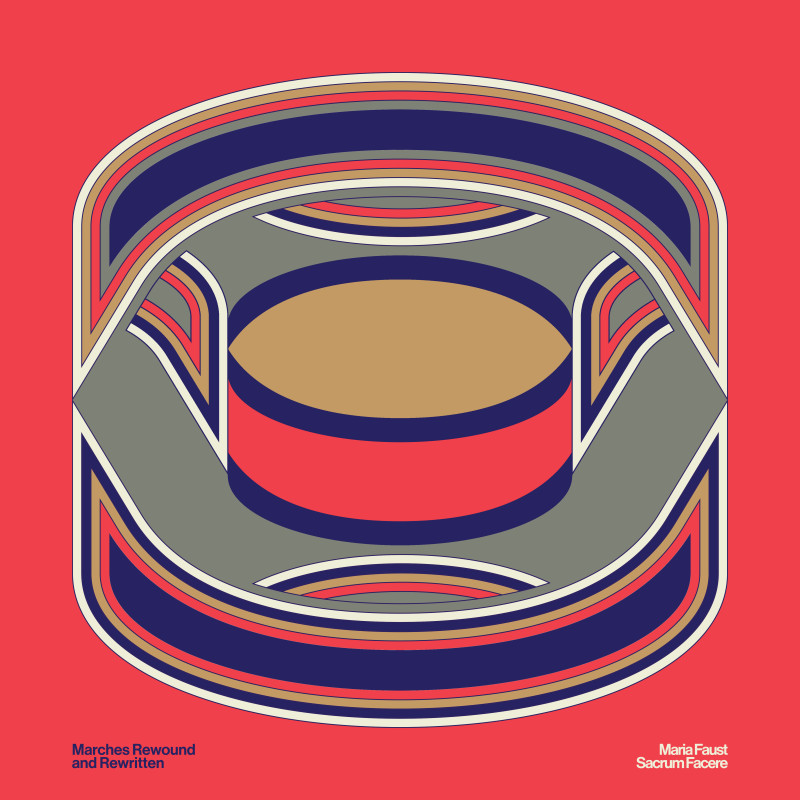
Maria Faust Sacrum Facere: »Marches Rewound and Rewritten«
© PR

With her latest album, saxofonist and composer Maria Faust has put the political at the center of jazz, in the long tradition of Ornette Coleman, Miles Davis, Charlie Haden, Fred Frith and Tom Cora, just to name a few. What is surprising is her choice of genre, marches, which is not a per se a traditional jazz form. If Charles Mingus, for instance, payed his tribute to New Orleans marching bands, Faust’s choice is definitely antagonistic. The marches she manipulates and destroys from the inside are not of the entertaining sort, unless you’re a general, as they are of the military and nationalistic kind.

Faust’s score would be a perfect fit for plays like Alphonse Allais’s Père Ubu and Bertold Brecht’s The Resistible Ascension of Arturo Ui, in its use of the grotesque as a creative driving force. Faust’s genius however doesn’t lie in turning these marches into farcical circus fanfares, but in creating a truly threatening space within the music, through chaos but also heart-breaking dissonances, which could be heard as a reminiscence of the wailers mourning their dead fallen in the war. Her fairly large ensemble – seven musicians, plus herself – which is composed of six horns and two drums/percussion creates a perfect harmony-disharmony universe, as if Charles Mingus and Sun Ra had worked together.

Marches Rewound and Rewritten is a seminal and important album which shines darkly in these difficult times and reminds us that everything is political – especially music.

In brieflive
05.07.2024

A World of Contrasts – and a Touch of Smurf Vocals

Roskilde Festival: Slauson Malone 1
© PR

The cello is everywhere at this year’s Roskilde Festival. Some use it as just about anything else – hey, now it’s an electric bass, or how about a keyboard drowned in effects – but in American Jasper Marsalis’ Marcela Lucatelli-worthy bomb project Slauson Malone 1, the cello was actually used as, well, a cello.

Marsalis himself handled vocals and electric guitar on the open Platform stage, while Nicholas Wetherell opened the concert with a motor-race assault on his amplified cello, then pivoted into plucked meditations, to which Marsalis contributed overtone playing on guitar. Sensitive jazz guys? Nope – suddenly: synchronized noise sprints, intimacy splintered, and before long Marsalis threw himself into the seated audience with a somersault – and a scream.

Meanwhile, Wetherell played tender vibratos. Because contrasts thrive at Roskilde – and, after all, seem to be driving the world forward these days. And so it was the world itself that came into focus in the music: through violent shifts between 8-bit Smurf vocals, ambient gnawing solo cello, intimate indie layered over a one-second sample of Cher – culminating in a wistful lullaby veiled in digital theremin.

In many ways, it was peak hipster era. But it was also intensely moving – something like following Mahler out on the edge of the abyss as he tried to sketch the whole world into his scores. The only difference: the easel looks a bit different today.

© Pavlos Fysakis

»Music involves a mix of noise, of existing or fabricated instruments, of alternative worlds that the sounds and voices assemble. Some are gentle, some less so. We shift gears with music, it shifts intensity, we shift with it. I listen when I can.«

Jussi Parikka is a Finnish cultural historian and writer who works at Aarhus University as professor of Digital Aesthetics and Culture. After some 15 years in the UK, he continues in Denmark his work on how ecology, digital culture, art and design, and philosophy intersect. He has written on visual culture and history and archaeology of media, including the recent books Operational Images (2023) and Living Surfaces: Images, Plants, and Environments of Media (2024) which is co-authored with the Madrid-based artist Abelardo Gil-Fournier. Besides his writing and work as educator, he has been active as a curator including the recent show Climate Engines at Laboral, in Gijon (Spain) that was co-curated with Daphne Dragona as well as his involvement in the curatorial team of Helsinki Biennial 2023.

In brieflive
09.04.2024

Ballet’s New Power Duo

Josefine Opsahl: »Passengers of Passing Moments« (Koreorama nr. 01)
© Henrik Stenberg
© Henrik Stenberg

Josefine Opsahl herself sits on stage in the Australian-Danish choreographer Tara Schaufuss’s ballet Passengers of Passing Moments, for which Opsahl has composed the music. In fact, she almost steals all the attention from the ten dancers, as it is fascinating to watch the 32-year-old cellist’s theatrical immersion and her very active use of her right leg to control the loop and effects box.

The nearly half-hour ballet score is inspired by Bach, but also conveys a highland-like sense of drama through sampled breathing, stabbing subdivisions, and pronounced reverberation. It begins with delicate, bright major-key tones, but quickly moves into the depths, finding throbbing bass and timpani-like resonance. Emotions rush through every bow stroke.

The theme of the ballet is time. In fleeting moments, the dancers are caught in Opsahl’s small, mechanical loops; later, a dark, melancholic space is established, in which a young woman sinks into a memory. Extended sounds and overtones signal a time put out of joint; a faint wind is heard, a ticking fades in, and suddenly she has dreamed her beloved into being.

The woman moves like a ghost among the other bodies as Opsahl intensifies her playing, shifting between triple and quadruple meter. At one point, it is as if she disappears entirely into the violent temperament of the music; her dramatic flair turns Bach into an Avenger-like hero, and this suits Schaufuss’s focus on the force of emotions remarkably well. It is saturated, direct, and seemingly made for a grippingly intense choreography. A powerful partnership on the grand stage.

© Sebastian Gudmand-Høyer

»Music is a full bodied, raw and physical exchange. It’s an absorption that is overwhelming, that sometimes grants you relief. Music is interactive, and depends on you as a listener.« 

Alexander Tillegreen is a composer and artist who operates both visually, sonically and spatially. He works in a plurality of formats including multichannel sound installations & performances, interactive listening sessions, paintings, prints, light and concerts as well as exhibitions, commissioned works, and releases. In 2023, he presented a cycle of new commissioned sound works for the Darmstädter Internationale Ferienkurse für Neue Musik. Same year, he released his debut album in words on the acclaimed German electronic music label rastermedia. 

Alexander Tillegreen’s work has been the subject of numerous institutional solo and group exhibitions including: A Bruit Secret – Hearing in Art at Museum Tinguely in Basel (2023), O-Overgaden Institute for Contemporary Art in Copenhagen (2022), FuturDome Museum in Milano (2022), Kunstverein Göttingen (2022), Kunstforeningen GL Strand (2023), Museum für Moderne Kunst in Frankfurt (2017), and The National Gallery of Art in Copenhagen (2008). He has presented his music at many festivals and venues including STRØM Festival, Roskilde Festival, and CTM Festival. 

His most recent work investigates the relationship between psychoacoustic sonic phenomena and their potential to reflect and awaken the listener’s own linguistic and cultural embeddedness and co-creative embodied, interaction as a listener. 

He has been conducting artistic research at the Max Planck Institute for Empirical Aesthetics. This research centers on aspects of attention, spatial sound, voice, gender, identity, embodied co-creation, and language perception in relation to the phantom word illusion – a language-based psychoacoustic phenomenon, that triggers the illusory sensation of hearing inner streams of words that are not necessarily acoustically present.

In 2024, Alexander Tillegreen will represent Denmark at the ISCM World New Music Days on the Faroe Islands.

In briefrelease
12.03.2024

Music for Lovers, but Not for Me

Samuel Rohrer: »Music for Lovers« 
© PR
© PR

With Music for Lovers, the Swiss drummer and electronic musician Samuel Rohrer does many things right. The sound design and mix are luxurious, and the album overflows with an abundance of delicious synth sounds. Precisely for that reason, the absence of the most essential ingredient – the songwriting – feels all the more disappointing.

The opening track, »The Parish Bell«, exemplifies how the songwriting fails to unite the otherwise quite strong individual elements into a satisfying whole. Analog drums play interesting patterns, while synths bubble and sparkle – cold as needle points and soft as cotton swabs. Yet nothing really develops, and the track ends up feeling like a snapshot stretched over seven minutes. This is the case for nearly all seven tracks on the release, plus the eighth bonus track. It feels like a soundtrack lacking the listener’s emotional connection to the medium it is meant to underscore. Here the music stands alone, and it often struggles to carry that weight.

There are highlights: Nils Petter Molvær’s ever-compelling trumpet guesting on »The Gift«, the sublimely sounding space-ambient intro to »Celestial Body«, and the motorik drums that emerge halfway through »Schizophonia«, which, as a rare occurrence, tear the music out of its narrow comfort zone. But still, the songwriting falters, and so while it may be music for lovers, it is unfortunately not music for me.