in brieflive
17.04

The Kids Are Alright

Ligeti Quartet: »Workshop concert«
Ligeti Quartet. © Louise Mason

I know, I know. A workshop concert at the conservatory: yawn. And no, hardly anyone showed up – apart from Bent Sørensen. Fair enough. But yes, you missed out. Especially on young Albert Laubel, who did exactly what you hope someone will do at this kind of concert: suddenly step forward, make a mark, and promise something for the future.

It was the English Ligeti Quartet visiting the Royal Danish Academy of Music for the seventh time to work with the students. And they did so with both commitment and precision. (Someone should really give them a prize one day – say, someone sitting on a fortune they clearly don’t know what to do with.)

Lucas Fagervik’s Bells & Canons set up stark oppositions, as composers tend to do in exercises of style: a bright, slightly fractured minor chord set against gentle baroque pastiche in increasingly rapid alternations. Then a movement with brutal – almost banal – glissandi, another with heavy bow strokes, and a final one in which the strings took turns trying to keep a single tone alive. A beautiful, constructive, and Jürg Frey–porous landing.

A different kind of circus instinct drove Yifan Shao’s ultra-short Dreams Evaporated Too Soon, which sounded like abused sounds dragged across a floor. The ending was ultra-theatrical: the quartet froze mid-air for a moment before scraping the last traces of life out of the strings.

»I can make this even more mannered,« Jonas Wiinblad must have thought, opening his String Trio with Viola – not a quartet, of course! – with silent playing. But cliché turned into quiet poetry as small, innocent intervals slowly emerged in tight patterns. When the viola was finally allowed to join, it went against the grain: a virtuosic solo cadenza with falling bow strokes, shimmering overtones, and temperament. Boom! A striking contrast. Less convincing was the piece’s apparent need for a final, unnecessary layer of electronic distortion. Still, points for mannerism.

What remained was Albert Laubel’s String Quartet as the most fully realized work of the concert. Not overthought, just a seamless movement between dynamic extremes. Distinctive trills were elegantly disarmed by inserted snaps, glissandi sounded like part of an internal logic rather than mere effect, and the sound world shifted with calm dramatic overview. Substance and maturity in 2026 – well, well.

English translation: Andreo Michaelo Mielczarek

© Ida Sofie Skov Larsen

»Music for us is a way to create a connection and community with other people.« 

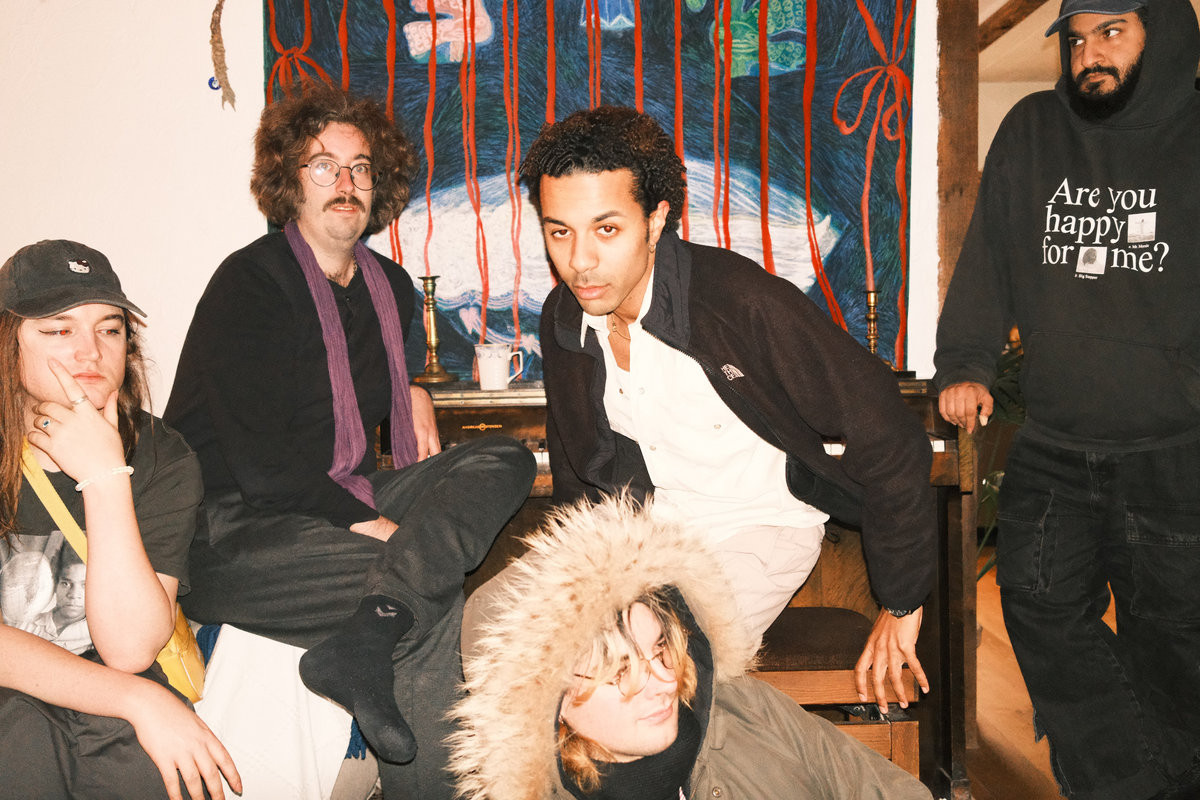
Although Schæfer has only released three singles so far, the band has already made a mark on the Danish music scene. The duo and their friends, Anna Skov (vocals) and Emil Mors (keyboards), write socially relevant, subtle and humorous songs that point fingers at both the outside world and themselves.

in brieflive
13.03

I Am an Empty High-rise, Where the Pain Sits in Every Wall

Ensemble Lydenskab, Martin Ottosen, Ulla Bendixen, Gerd Laugesen & residents at the social-psychiatric housing facility Sønderparken: »Everyone Leaves Traces«
© Phillip Jørgensen
© Phillip Jørgensen

It is both difficult and unfair to approach the concert Alle sætter spor (»Everyone Leaves Traces«) with a critical mindset. It concerns real people with something at stake and with their hearts invested: residents at the social-psychiatric housing facility Sønderparken. They placed their inner lives in the hands of six artists and thus became co-creators of a total of nine songs, which premiered at Museum Ovartaci.

The project Musikalske alliancer (»Musical Alliances«) is simultaneously art, research, and relief. A co-creative endeavour intended to give a voice to people within psychiatry. The result was songs marked by banjo-tinged gallops, painful violin stabs, empty houses filled with inconsolable crying, torn torsos and deep, lingering bow strokes – but also hope, care, and softened edges. Acting as mediators of these life experiences were the poet Gerd Laugesen, three musicians from the ensemble Lydenskab on cello, violin and guitar, as well as pianist Martin Ottosen and vocalist Ulla Bendixen from the electro-folk band Sorten Muld.

It was a capable group that delivered a high musical standard. Even so, it seemed as if this important project succeeded with its co-creation and its conversations, but perhaps not entirely with its artistic expression. Was it because the lyrics were filled with clichés? Or rather because the entire staging felt somewhat inward-looking – almost like a school concert? Despite Bendixen’s wonderfully airy and expressive vocal, the performance felt strongest in the few segments shaped by poetry readings. Yet I had to learn, by indirect means, that the poems were adaptations, while the song lyrics were the residents’ own words. And those were the voices I was meant to learn to listen to.

in briefrelease
13.03

When Joik Meets Drill

Zak Norman & Charlie Miller: »Takkuuk«
© PR
© PR

The Greenlandic word Takkuuk means »attention«, and it is the slightly ironic title of one of the more chaotic projects at this year’s CPH:DOX. The film is a collaboration between visual artist Zak Norman, film director Charlie Miller, and the Belfast-based electronic duo BICEP, and it also features seven musicians from Kalaallit Nunaat and Sápmi. In other words, a multitude of voices and agendas are at play, and the project clearly bears the marks of that.

The process leading up to the film sounds more interesting than the work itself. Norman and Miller travelled around the Arctic, seeking out musicians and researchers while filming glaciers and ice. The film’s seven young musicians then entered the studio with BICEP to create a shared soundtrack: a kind of club-oriented remix of seven very different practices, ranging from drill and heavy metal to joik, throat singing and drum dance. It might have been fascinating to follow those encounters, but instead the film takes us in another direction.

The editing shifts between a documentary strand of interviews and a surreal music-video aesthetic, where specially built cameras pan across the surface of the ice, bathing it in coloured filters referencing the northern lights and club lighting. In the interview track, the participants are allowed to steer the conversation themselves, which sends it in many directions. We touch on the spiritual undertones of traditional musical expressions, and here one would have liked the film to linger longer. One intriguing sequence explains how drum dance relates to the performer’s heartbeat, and how that rhythm is almost the same as the pulse of drill. More of that, please.

In a subsequent talk, the filmmakers explained that the work was originally produced as an audiovisual installation for five screens. That makes sense and might have worked better. Considered as a documentary film, Takkuuk is fragmentary, chaotic and directionless, which is a shame, because the young musicians seem to have much more to offer.

»Takkuuk«, Zak Norman & Charlie Miller (UK), 2025 (67 min). Screenings: 12, 17 and 19 March

in briefrelease
13.03

Cello Among Cows and a Love of Music

Katrine Philp: »A Classical Life«
© Carsten Snejbjerg
© Carsten Snejbjerg

A farm near Rødvig on the Stevns peninsula, home to both pigs and cows, also houses an elite music school for cellists, the Scandinavian Cello School. The school was founded by the British cellist and professor Jacob Shaw, who is also a farmer and lives here with his family. It is a place where the young people in residence are expected to take part in the work on the farm as in a collective, when they are not working on their musical projects.

According to Shaw, this is very much an innovation. In one of the many scenes featuring the thoughtful, idealistic and selfless mentor, he remarks that the classical music world places great emphasis on competition and perhaps on musical development, but only rarely concerns itself with something as essential as well-being.

It is fascinating to follow not only the teaching and competitions on Stevns and elsewhere, but also to listen to the young musicians’ accounts of playing, alongside the many uncommented sequences in which large amounts of music – especially from the classical cello repertoire – are performed. Among them is an outdoor scene where the musicians have attracted a group of cows, who appear to be listening when they are not mooing.

This is a film about self-realisation through discipline, but also about discipline through self-realisation. The film continually circles around the human effort to become better at something, and it does so in a way that consistently places the participants’ love of music at the centre. This also applies to Shaw himself, whose previous serious illness, briefly referred to, forms a kind of counterpoint to the lightness that otherwise characterises the film.

Katrine Philp’s documentary A Classical Life is therefore warmly recommended – not only to parents of musically inclined children, but to anyone interested in music. Classical music? No. Music.

CPH:DOX, 14, 17 and 21 March

in briefrelease
12.03

Do Whales Actually Want to Listen to Us?

Valentin Paoli: »The Musician and The Whale / La Baleine et le Musicien«
© PR
© PR

The French electronic musician Rone finds it difficult to express emotions verbally. In Valentin Paoli’s rather touching documentary The Musician and The Whale, he reflects on music’s ability to create connections and convey moods to an audience – whether human or interspecies.

One day, Rone receives a video from a sailor who is playing his music at sea. Whales gather around the boat, seemingly drawn to the sounds, and this becomes the starting point for an exploration of whether the musician might be able to communicate with the animals through sound. Rone seeks out an expert in whale vocalizations, who points to certain high-pitched synth elements in his EDM compositions that resemble whale song. He then has a girls’ choir record the whale sounds with human voices and travels to Réunion to play the sounds back to the whales.

At first, the attempt proves futile: the whales appear indifferent to the girls’ choir. Quoting Johann Wolfgang von Goethe, Rone realizes that if one wishes to move others, one must begin with what moves oneself. It is a Disney-like insight in a slightly sentimental film that speaks to the human desire to communicate with animals.

But are we actually sure that animals want to communicate with us? As the film’s central figure, Rone briefly reflects on a few ethical questions concerning animals, yet his infectious enthusiasm for the sounds of whales prevents him from asking the most fundamental questions about the relationship between humans and animals. Instead, we get a portrait of the musician that is almost as polished and warm-hearted as his music. The whale, wisely, remains beneath the surface of the sea.

»The Musician and The Whale« / »La Baleine et le Musicien« (83 min.)
Valentin Paoli (FR), 2026. Screening at CPH:DOX, March 11, 12 and 20