
in brieflive
28.03

Opera or Exam Preparation?

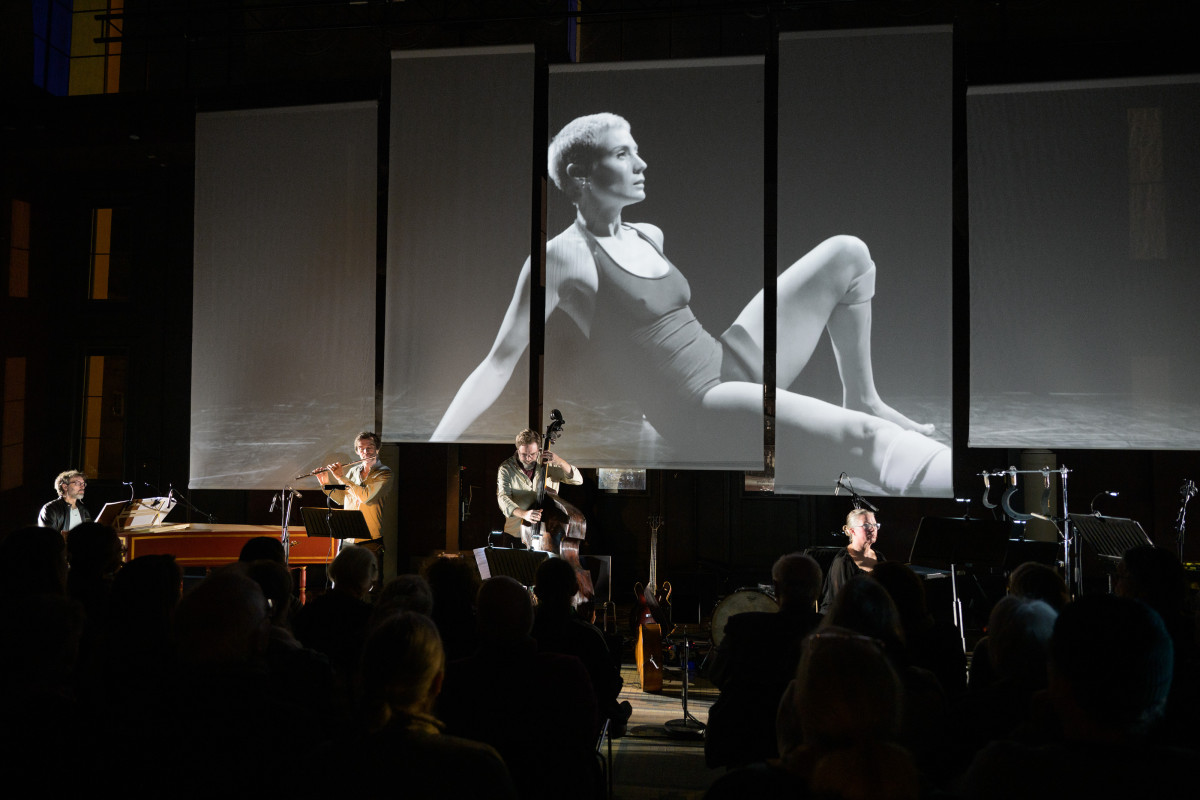
Mauro Patricelli, Signe Asmussen, Matias Seibæk, Anders Banke, Thommy Andersson, Jessica Lyall et al.: »Tarantula«
© Søren Meisner
© Søren Meisner

Tarantula is presented as a »documentary opera«, a genre created by Mauro Patricelli. The work takes its starting point in tarantism – the myth of the spider’s bite, which triggers madness and the ecstatic dance that heals – and intertwines it with A Doll’s House and Napoli by August Bournonville. The ambition is clear: to reflect female experiences of mania, oppression, and interpretation throughout history. The scenography reinforces the documentary approach. Five suspended screens display text, archival material, a dancer, and a professor character who didactically explains the work’s sources. At the same time, four musicians and the soprano Signe Asmussen stand in a row.

The music alternates between long, bare lines and repetitive, rhythmically complex figures clearly inspired by the tarantella. Yet this very complexity becomes a drawback: the reliance on click-track and sheet music lends a mechanical quality that clashes with the work’s purportedly demonic and physical energy. The main issue is the balance between explanation and interpretation. The professor figure constantly dictates the reading, undermining the work’s own critical ambitions – not least when it simultaneously critiques a »male lens«. The engagement with Ibsen also feels simplified, almost misread, functioning more as illustration than genuine interpretation.

The libretto – largely composed of historical sources and academic language – weighs heavily on the dramaturgy. When a letter about Ibsen’s knowledge of tarantism is elevated to a dramatic climax, it becomes difficult to grasp what is truly at stake. That the text is sung, projected, and handed out in libretto form only intensifies the sense of redundancy. In the end, one is left with the feeling of having attended a lecture rather than an opera. My final note before the curtain fell: Will this be on the test?

English translation: Andreo Michaelo Mielczarek

in brief
29.09

High to Fly, Ice-Cold to Crash

Jacob Kirkegaard: »Snowblind«
© Nils Strindberg
© Nils Strindberg

On his new album, Snowblind, Jacob Kirkegaard shifts his focus away from revealing the hidden sounds of our surroundings to instead depict a psychological drama. The inspiration: The Swedish polar explorer Salomon August Andrée, who in 1897 set course for the North Pole in a hot air balloon – a reckless journey that cost him and two others their lives, blinded by snow and the pursuit of fame.

Through 11 icy tableaus, Kirkegaard paints a portrait of the anxiety and doubt Andrée must have felt when the balloon crashed onto the pack ice east of Svalbard. For two months, the three men continued on foot until they reached the desolate island of Kvitøya – where they died a few weeks later, possibly poisoned by undercooked polar bear meat. By then, nature had long since revealed its hostility.

You hear all this on Snowblind. First, the balloon takes off in an air current that elegantly balances on the edge of suffocating dark synths and a heartbeat rhythm, while a metallic screech – reminiscent of a heroic electric guitar – subtly signals doubt: Was Andrée a hero or a villain? Shortly after, we land in a vast nothingness of scraped metal. The shockwave transforms into mischievous, squelchy synth footsteps as desperation and hallucinations grow: Was that a ship's horn I heard? A lifeline?

But no. Silence wins. The icy water rattles like a hungry beast. The hardboiled psychological drama leaves no room for hope, only a chance to stare at your end right in the face. Had Kirkegaard been a truly ruthless portraitist, we might have descended even further into darkness and disorientation, but his weightless ambience still leaves its marks in the snow.

English translation: Andreo Michaelo Mielczarek

in brief
29.09

Welcome to the Afterlife

Julian Charrière: »Solarstalgia«
»An Invitation to Disappear« - Bengkulu, 2018. Copyright The Artist, VG Bild Kunst Bonn Germany

We wander through a garden: it's dark, with palms and ferns everywhere, illuminated by infrared light and equipped with sensors, causing the plants to create crackling noise. Red blinking lights above resemble drones. Welcome to the end of the world. And the beginning of the world. We’re not entirely sure. Perhaps it’s a serious rave party that has come to a halt. Just like the techno in the film An Invitation to Disappear, set in a Southeast Asian oil plantation, blurring night and day – making the senses lulled, vulnerable, and compliant.

In the '90s, Erik Satie’s sad piano music always played in broadcasts about climate disasters. Here – at the beginning of a new chaotic year – you can disappear into the exhibition Solarstalgia created by the French-Swiss artist (and Olafur Eliasson student) Julian Charrière. Experience life in an apocalyptic afterworld with all its ominous sounds, in a fully immersive and enveloping way – as this might be how we can learn a bit about the geological forces and changes in nature around us today.

At the end of Arken's long exhibition space, the eye is drawn to an onyx boulder emitting light (the work Vertigo). When approaching something with light, one becomes greedy. The pig-like sounds you hear come from volcanoes in Ethiopia and Iceland. A devouring sound. Just like the entire exhibition, it elegantly addresses both the eyes and techno-loving ears.

in brieflive
29.09

The Art of Decay

August Rosenbaum: »Opløsninger«
© Flemming Bo Jensen

It's seriously clammy as you step down into the Cisterns beneath Søndermarken – humid, with brick columns dripping with condensation and chalk stalactites hanging down. A piano has been left down here for five months, slowly deteriorating. I was skeptical about Opløsninger: yet another Annea Lockwood-inspired work, simply inflicting violence on a poor instrument? And if not, is a composer like August Rosenbaum, who works with short, vibe-friendly piano pieces, the right person to elevate the idea into something greater? Yes, as it turns out, fortunately.

Together with visual artist Ea Verdoner, Rosenbaum has created an installation piece that spans three chambers, and in the first, you indeed see the decayed piano with centimeter-thick mold patches on the keys. As you shuffle along to the second chamber, Rosenbaum sits in the dark in front of a better-preserved grand piano. His playing is both minimalist and grandiose, but it’s the breaks in the composition that truly captivate me. Half motifs, repeated triplets, tritone-like intervals. Rosenbaum loops a captured sound from the decayed piano on a sequencer, gets up, and walks away briskly. He returns and turns up the industrial rumble of a gong, as if he were Trent Reznor in the studio. Combined with choreography about duality, a voice-over about life and birth, and a video about the body and decay, it becomes an exciting and reasonably new depiction of the raw, cold, and arbitrary nature of decomposition.

in briefrelease
29.09

The Perfect Storm

Yanling: »Cymatic«
© PR
© PR

It is rare for an album to be complimented for lulling someone to sleep. But after a month with the album Cymatic by the Swiss-resident, Hong Kong-born Natalja Romine, I have often found myself slipping into dreamland – something I rarely consider a good thing. In the case of Cymatic, however, it is a clear strength. Yanling comes from the world of art music, and the work has already been presented in that context. Still, it stands strong as a piece of cinematic sci-fi ambient. Names like Jean-Michel Jarre, Brian Eno, and Hans Zimmer haunt the album, as modular noise clouds, female vocals, and mysterious electronic pulses and sine waves blend together to create a harmonious tapestry. It is not groundbreaking, and the tracks can be difficult to distinguish from one another. Nevertheless, the captivating piano riffs on »Transmuted« and the gurgling bass synths on »Nebula« stand out. On »Fallen Tempest«, choirs, chords, and reverb coalesce into a higher unity, and on the album's pinnacle, »Aura Nova«, sudden synth stabs threaten to wake one from the dream.

Cymatic is not a masterpiece and can appear on gray days as disposable ambient for a Hollywood blockbuster no one wants to watch. But over time, it grows into a brilliant piece of contemporary art, only suffering from slightly too perfect production and somewhat grandiose gestures. Why get upset over the storm in your teacup if it storms in the right way?

English translation: Andreo Michaelo Mielczarek

in brieflive
29.09

If John Malkovich Could Sing, It Would be Devilish Singing

John Malkovich, Michael Sturminger, Marie Arnet, Theodora Raftis, Martin Haselböck, Orchester Wiener Akademie: »The Infernal Comedy: Confessions of a Serial Killer« 
© Anders Hede/Musikhuset

»Please, conductor play and give me some fucking peace«. The mass murderer – and now a writer, as he became one in prison – Jack Unterweger (John Malkovich) demands more »old fashioned music« as he talks about his barbaric actions in the forests of Vienna. We are at Unterweger's book reception. The baroque orchestra Orchester Wiener Akademie sits on stage as witnesses, while Malkovich strangles sopranos Marie Arnet and Theodora Raftis with their underwear to arias by Mozart, Vivaldi and Haydn. Yes, opera is often about men hitting on women.

»I don't usually like this kind of music, it makes me nervous«. Yes, of course, because the baroque music played on period instruments is not just lame background music, but an active narrator which »disrupts« the sales pitch of a monologue, and the repulsive truth that Malkovich wants to share with us – the murder of nine prostitutes. He would rather be a murderer than nothing, he says. But the two singers also make him roll on the ground like a child; he gasps, becomes uncomfortable in his white suit. These moments elevate The Infernal Comedy to more than a clever concept (well-known actor, ok well-known orchestra, authentic murder story). The women gain a glimmer of dignity, while Malkovich's Unterweger loses it. Now what is he without Dandy sunglasses?

The Infernal Comedy was created for Malkovich in 2008, his joker face, his swaying, yes über musical voice. We want to buy his books because evil sells. As a super simple chamber music piece it works. If Malkovich suddenly announced that he now wanted to sing opera, we would also buy a ticket. But how would this story of misogyny sound with the baroque music of 2024?