© PR
© PR

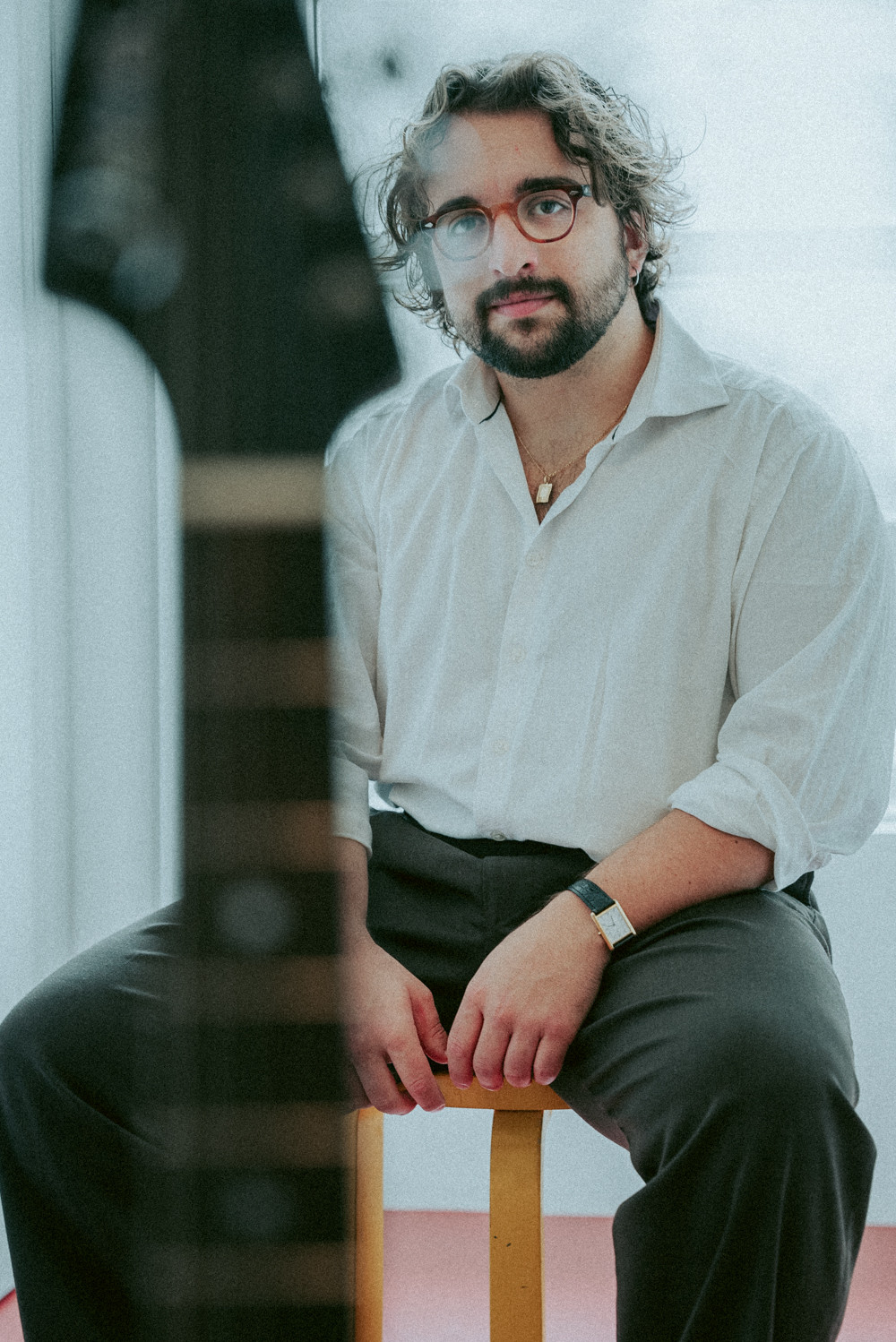
The theme has been revisited countless times in music history, but ELECTRIO (Francesco Rista, Simone Giordano and Sandra Lind Þorsteinsdóttir) attempt to give Stabat Mater a new expression, combining guitar, vocals and electronics with Latin texts, Monteverdi fragments and songs by Dowland. The ambition is clear, yet the result is uneven.

There are, however, two striking exceptions. The opening of Stabat Mater – recorded at the Royal Danish Academy of Music – is captivating in itself: a four-minute build-up that establishes a muted, hovering sense of expectation. But it lies so close to Pink Floyd’s »Shine On You Crazy Diamond« that one can almost hear the quotation shimmering underneath. The characteristic three guitar notes fall at exactly the same place, just before Sandra Þorsteinsdóttir’s voice enters. »Fac me Cruce« is shaped with attractive energy and dynamic form, making strong use of electronics, but ends abruptly before the music has truly begun to unfold. If only ELECTRIO had continued in this direction.

The harmonic foundations of the eight pieces are often predictable, as in »Sancta Mater«, in which the Holy Mother prays that the wounds of the crucified be imprinted upon her heart. The harshness of the text is entirely absent from the underlying feel-good guitar fingerpicking, which moves shamelessly through familiar chord progressions. No wounds. No suffering.

More generally, Þorsteinsdóttir rarely strays from conventional baroque phrasing or genuinely experiments with the genre. The result resembles a mirror version of Sting’s Dowland project from 2006: only inverted – here a classically oriented singer who keeps too respectful a distance to let the songs truly enter an experimental universe.

Why did the trio not instead draw inspiration from Pergolesi’s music for the same text and theme? His score brims with wild dissonances that a new interpretation could have explored to powerful effect – revealing more anguish and outward-turning sorrow.

English translation: Andreo Michaelo Mielczarek

© Kåre Viemose
© Kåre Viemose

Seismograf is heading off on summer break to check out the ocean's deep vibrations.  🌊🤿  See you in August. Have a great summer!

in brieflive
15.07

Noise in the White Cube

Aros: »Unruly – the Body in Punk«
© Karen Knorr & Olivier Richon, Vortex 6 from the Punks series, 1976 - 1977, gelatin silver print on paper,18,7 x 28,2 cm, Tate. Courtesy of the artists.

The first thing that hits you at Aros' Unruly – the Body in Punk isn't dog collars, leather jackets or fishnet stockings. It's the sound. It rumbles through the galleries. After all, what is punk doing in a museum? Punk was never made for museums. It's dirty, loud and ephemeral. It thrives on amateurism, mistakes and resistance. One might fear that the white cube would turn three-chord fury into cultural history and noise into background music. Curator Marie Arleth Skov has created an exhibition in which sound doesn't merely illustrate history – it propels it. Raw guitars, piercing saxophones, flickering Super 8 films and concert footage merge into a rush of noise, images and bodies.

Unruly is not a comprehensive history of punk but a sharply focused snapshot of a culture in which sound and the body were inseparable. Punk's godmothers appear alongside Danish bands such as Lost Kids, Pussy Punk and Sods in previously unseen footage from a legendary punk happening in Copenhagen. A leather drum kit by Käthe Kruse of Die Tödliche Doris stands as a sculpture bearing the dry title In Leder, while Cornelia Schleime's video reveals the vulnerability and poetry that also inhabited punk rebellion. The contrast with Erik Satie's stripped-back piano music is exquisite. Walking through the exhibition feels like stepping inside a three-dimensional fanzine. Everywhere, it celebrates misfits and those who never asked for permission. Leopard-print cushions, raw materials and tactile installations make you feel as if you could almost touch punk itself.

In art museums, sound is often reduced to atmosphere. Here, it becomes a material on equal footing with fabric, video and the body. Noise is treated as an artistic method rather than a soundtrack. Fifty-year-old noise still sounds astonishingly contemporary as it resonates with the exhibition's newer works. You feel it vibrating through your body. Instead of muting the world, the museum becomes an amplifier.

Can rebellion survive inside a museum? Unruly shows that punk's energy does not necessarily disappear when it enters an institution. Only two things are missing: the chance to experience the exhibition at four o'clock in the morning – and a lavish catalogue bound in latex.

English translation: Andreo Michaelo Mielczarek

© PR

»For us, music is the companion that stays with you through life’s highs, lows, benders, and shitty times. There isn’t a single emotion for which we don’t each have an internal soundtrack. It’s a wonderful, universal thing that music triggers moods and reinforces feelings.«

Barcode played a couple of hundred shows across Europe in the 90s and 2000s – touring with acts like Madball, Agnostic Front, and Hatebreed – and released five full-length albums. The Aarhus-based band will play its first concert in 18 years as the headliner at the Support Our Scene festival in Fredericia this August.

in brieflive
09.07

Two Singular Voices in Close Orbit

Lotte Anker & Fred Frith
© PR
© PR

On Wednesday evening at 5e, the audience witnessed a meeting between two musicians who, in terms of stage presence, did not immediately seem to have much in common. Lotte Anker sat upright in her chair with either alto or soprano saxophone resting on her lap, while Fred Frith leaned forward over his guitar, pedals and the many small objects he used to force all manner of sounds out of his instrument. Stoic calm versus frenetic tinkering. Outwardly, they seemed like opposites. Musically, however, they were closely connected.

They hardly looked at each other during the set, yet seemed completely absorbed in the sound they were creating together. At times, the music was knotty and difficult to penetrate: un-guitar-like tones, percussive attacks, almost rock-like passages, rapid saxophone runs, long sustained notes, noise and overtones. Like a riddle that had no desire to be solved. At other moments, Frith created clear drones over which Anker moved with melancholy grace, sensuous and beautiful. It sounded like a wordless tale of darkness, fear and uncertainty, but also of light, hope and togetherness. The essence of life distilled to the meeting point between two of jazz’s great singular voices.

The concert ended with the evening’s most direct gesture between the two. A gentle tone from Frith’s guitar rang out continuously until he suddenly brought his hand down on the fretboard with a resounding thud and sent Anker a mischievous smile. A brief acknowledgement of the intense ride they had just taken the audience through.

English translation: Andreo Michaelo Mielczarek

 

in brieflive
08.07

Pak Choi and Percussion at Table 12

Søren Kjærgaard & Kresten Osgood Duo + Christian Lillinger
© Kristoffer Møllegaard

Søren Kjærgaard at the piano, Kresten Osgood and Christian Lillinger each at half a drum kit, pak choi with shiitake mushrooms and rice. Free jazz and Chinese cuisine may not be the most obvious combination, but on Wednesday afternoon at CC Taste it proved its worth.

The French composer Erik Satie was reportedly frustrated that Parisian café audiences did not ignore his so-called furniture music to a sufficient degree. Kjærgaard, Osgood and Lillinger seemed unlikely to share such concerns on the second night of their five-day residency at the Chinese restaurant on Amagerbrogade. On the contrary, with pronounced showmanship they played not only drums and piano, but also a ceiling lamp, a radiator and Osgood’s shoes. There was shouting, laughter, and newspaper pages being torn to pieces.

Osgood and Kjærgaard, who are cousins, have played together all their lives, and it showed in the ease with which they threw themselves into the music. Together with Lillinger, they needed only seconds to find a shared level of intensity. It swayed, crashed and creaked in every direction. The music thundered ahead until it suddenly stopped and Kjærgaard’s piano stepped forward in calmer, more indeterminate passages. Then the surroundings reasserted themselves: cutlery against plates, the number 5C bus passing the windows on Amagerbrogade, an egg timer ringing in the kitchen.

Good food and good music have a great deal in common, but fortunately they did not dissolve into some mythical, rather uninteresting higher unity. Instead, the evening thrived on the friction between two separate sensory spaces: the concert and the restaurant, listening and eating, free improvisation and the everyday dinner scene. Satie might well have turned in his grave. I loved it.