In brieflive
18.02

Serious Creeps

Simon Toldam: »Insecta«
© Daniel Buchwald
© Daniel Buchwald

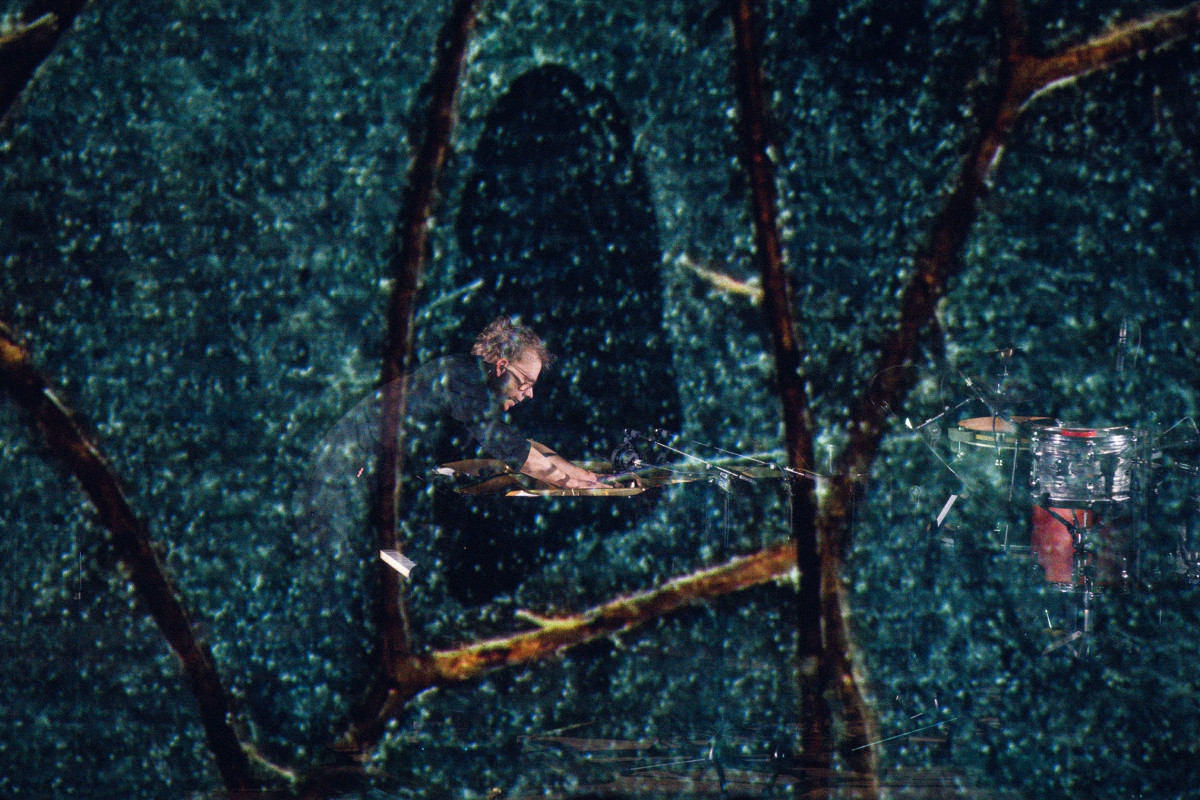
Some dream of discovering life in distant solar systems. Others – like Knud Viktor, Jacob Kirkegaard and now also Simon Toldam – turn the telescope around and uncover unknown life in the immediate yet hidden nature surrounding us. So what did Toldam, the 46-year-old pianist from the experimental jazz milieu, find last night when he turned his gaze toward English photographer Levon Biss’s ultra-close images of beetles, flies and grasshoppers in the world premiere of the hour-long audiovisual trio work Insecta?

First and foremost, he found a varied and inquisitive interpretation of insect life. Behind a transparent screen, Toldam transformed his prepared grand piano into a kind of gamelan instrument, while on either side of him sounds crept and hissed from saxophonist Torben Snekkestad and percussionist Peter Bruun. The production values were high, and the trio – collectively known as Loupe – moved deftly between the concrete and the spherical.

At times, however, there was something old-fashioned about the expression. As a yellow-brown grasshopper gradually took shape on the screen, nanometre by nanometre, the piano’s metallic cymbal-sounds placed it within an Eastern sonic realm. It resonated with exoticism, with old electronic EMS recordings steeped in atonal serialism, and soon Snekkestad let a plaintive Miles Davis-like trumpet drift through the soundscape.

Yet when, with dramatic flair, he blew air through the same instrument or attached a rubber hose and transformed it into a frothing bass monster – while Bruun stroked metal surfaces or pounded the drums in ritualistic patterns – we were out of the past again. And when Insecta finally leaned into the ambient, and Toldam began bending the gamelan tones with his hands inside the open piano, it was as if not only time but also the distance between oneself and the insects dissolved into a trembling dream image. At that point, it suddenly no longer mattered whether there is life on Mars.

English translation: Andreo Michaelo Mielczarek

In briefrelease
28.02

A Clammy Kawaii Crescendo

Keiichiro Shibuya: »ANDROID OPERA MIRROR«
© PR

If the Japanese composer and musician Keiichiro Shibuya’s new album ANDROID OPERA MIRROR were to be summed up in a single word, that word would be »bombastic«. From the very first track, »MIRROR«, the listener is bombarded with gliding synth violins, brass, and a robotic voice intoning existential questions – ironically written by an AI.

There is something charmingly awkward about Shibuya’s pop-oriented, over-the-top compositions and the android vocal’s cloying kawaii factor. But before the album is halfway through, the constant pomposity begins to wear thin. »On Certainty«, with its ever-present strings and densely packed arrangements, rarely gives the music – or the listener – room to breathe. Shibuya and his android voice are saying an awful lot all the time, and it is so overwhelming that very little of it actually carries weight. When everything feels like an epic crescendo or the expected release from one, the effect is lost.

Taken individually, several of the tracks are otherwise quite compelling: »Midnight Swan (Android Opera ver.)«, which sounds like the opening theme to a dark and romantic anime, and the closing track »Scary Beauty (Vocal and Piano ver.)«, which shines precisely by trimming away the excess and focusing on the emotional core of the composition – an impact made far stronger by the simpler instrumentation. When the listener is not constantly overwhelmed, the romance, melancholy, and existential questions are allowed to make an impression. Unfortunately, ANDROID OPERA MIRROR is a listening experience that frustrates through its lack of subtlety – something it would otherwise have benefited greatly from.

English translation: Andreo Michaelo Mielczarek

In brieflive
24.02

Dido and Doom

Vinterjazz: Alice: Slim0
© Slim0

Doom was in the air when Slim0 took the stage on Saturday night at a sold-out Alice. In October, the band released the 17-track album FORGIVENESS—an album that takes a slow step into the riff-laden terrain of stoner rock. For this evening’s occasion, the Slim0 trio had been expanded with a lineup featuring Agnete Hannibal on cello, Aase Nielsen on saxophone, and Johan Polder on bass.

The sound exists somewhere between the English singer Dido, the drone-metal band Earth, and the drill trio Shooter Gang from Trillegården – an abstract comparison that hardly does justice to the uniqueness of the songs, as Slim0’s long referential tentacles stretch far beyond the music’s sharp contrasts. With its sacral-sounding choir and heavy drum passages, the single »Trenches« fit perfectly into the live setting. The darkness and the shifts between the three vocalists – from shared harmonies to growl – intensified the theatrical metal expression.

In a similar way, a nostalgic sigh arose when Dido’s catchy vocal lines from the hit »Thank You« emerged in the double cover »I Have But One Heart.« The perhaps lesser-known instrumental part, consisting of Earth’s »Coda Maestro in F Flat Minor«, turned the piece into a prime example of Slim0’s referential swamp brew. Although the many contrasts made for a rather epic concert, they also left me feeling somewhat conflicted. Conflicted because I genuinely enjoy Slim0’s heavy and fragmented universe, yet the lack of voluminous weight left me craving a more bone-rattling sound that could carve the sharp contrasts even more deeply. Hunger for more doom is certainly not a bad feeling, and I look forward to hearing the epic expression grow louder and even heavier.

In brief
13.02.2025

Jeppe's Soundtrack

Christian Lollike: »Jeppe på bjerget«
© Rumle Skafte
© Rumle Skafte

During the opening blowjob – before anyone even says a word in the concrete ghetto—opera is heard. And when Jeppe (Thure Lindhardt), in dramatic fashion, settles accounts at the end during the Royal Couple’s Awards 2025, soprano Lina Valantiejute once again sings Purcell’s Dido’s Lament. Because a lament from around 1688 is about as authentic as it gets. Christian Lollike’s Holberg classic portrays the search for the genuine in a mendacious age. The PTSD-stricken war veteran Jeppe falls into the clutches of the Baron, a contemporary artist who subjects him to an art project – a »mental time journey« meant to transcend/heal him.

Sonically, Lollike is precise. The sounds amplify the reality-show-like ride Jeppe is trapped in: Mozart, Kingo, heavy metal, video-game sounds, hotel ambient music, and Aarhus Theatre’s Choir singing »I Danmark er jeg født« with emotions worn on their sleeves. The country songs in the final part of the play – set in a Western town in the 19th century – lend weight to the story of loser Jeppe. Lollike knows his reality-TV tricks (camera crews even film Jeppe leaving the theatre and heading to the nearest bar), and in a time when everything chimes and clamours, nothing feels more authentic than a real opera singer on stage and true songs from the prairie sung by genuine people in cowboy gear. It happens right before our eyes, live.

The sound design is sharp, just as in Lollike’s Orfeo (2023), where Monteverdi contributed to the atmosphere of doom. Jeppe on the Mountain is such a high (it also contains a good deal of humour) that one ends up thinking: if I woke up in a golden bed with a crowd of strangers around me, I would love to listen to the same soundtrack as Jeppe.

»Music is to me the subcutaneous holy matter. Finding each other in ourselves and ourselves in each other. The murk. The dust. The stars keep expanding. What is personal anyways? We’re all just touching each others’ faces and slowly speaking love poems in every action.«

Laura is the executive director and flutist of TAK ensemble. They are also a member of Talea Ensemble, and a frequent collaborator of musicians such as DoYeon Kim, Timothy Anguglo, yuniya edi kwon, Wendy Eisenberg, Lester St. Louis, Ryan Sawyer, Brandon Lopez, the International Contemporary Ensemble, Wet Ink Ensemble, and many others. Their recent solo album, field anatomies (Carrier Records), noted as one of Stereogum’s top-ten experimental releases of the year, charted in the Billboard top ten Classical Crossover releases Their duo with Weston Olencki, Music for Two Flutes, was released on Hideous Replica, and their upcoming solo release, FATHM, will come out on Out Of Your Head and Relative Pitch at the end of February. Laura can be heard on labels such as ECM, Denovali Records, Catalytic Sound, Pi Recordings TAK editions, Tripticks Tapes, and many others.

In briefrelease
07.02.2025

The Shadow of a Soundtrack

Søren Gemmer & Jessie Kleemann: »Lone Wolf Runner«
© PR
© PR

As is often the case with soundtracks, musician and composer Søren Gemmer and the Greenlandic-Danish visual artist Jessie Kleemann tread a fine line on Lone Wolf Runner, whose music was originally written as the soundtrack to Kleemann’s performances of the same name in 2023 at the National Museum. How much of the original purpose (here, Kleemann’s performances) can and should be taken out of the equation for an album release to make sense?

In the PR material, the album is presented, among other things, as a postcolonial critique and an exploration of transcultural questions, which at first glance seems highly compelling – not least in light of the current geopolitical situation in which Greenland suddenly finds itself at the center. On a purely musical level, however, the release is not as gripping as one might have hoped. It lacks a stronger anchoring in a sense of purpose behind the music. Without having experienced Kleemann’s original performance, my impression is that the absence of precisely this aspect has left gaps too large for the otherwise, in many ways, intriguing music to fill on its own. Lone Wolf Runner is filled with references and hints of drama and storytelling that never quite come into their own.

There are nevertheless many interesting and exciting moments: Kleemann’s poetic voice, shifting not only between Greenlandic and Danish, but also between heavily vocoder-processed and seemingly untreated vocals. The atonal, hesitant, yet beautiful piano melodies in, among others, »The Dancer« and »Marble«, which create calm moments infused with tension. The industrial »The Skin«, halfway through the album, plants doubt about which direction the music is leading the listener. But in the end, Lone Wolf Runner lacks precisely what was cut away in the album’s process of becoming: a performance that can bind it all together.