in brieflive
22.04

The Voice in My Head

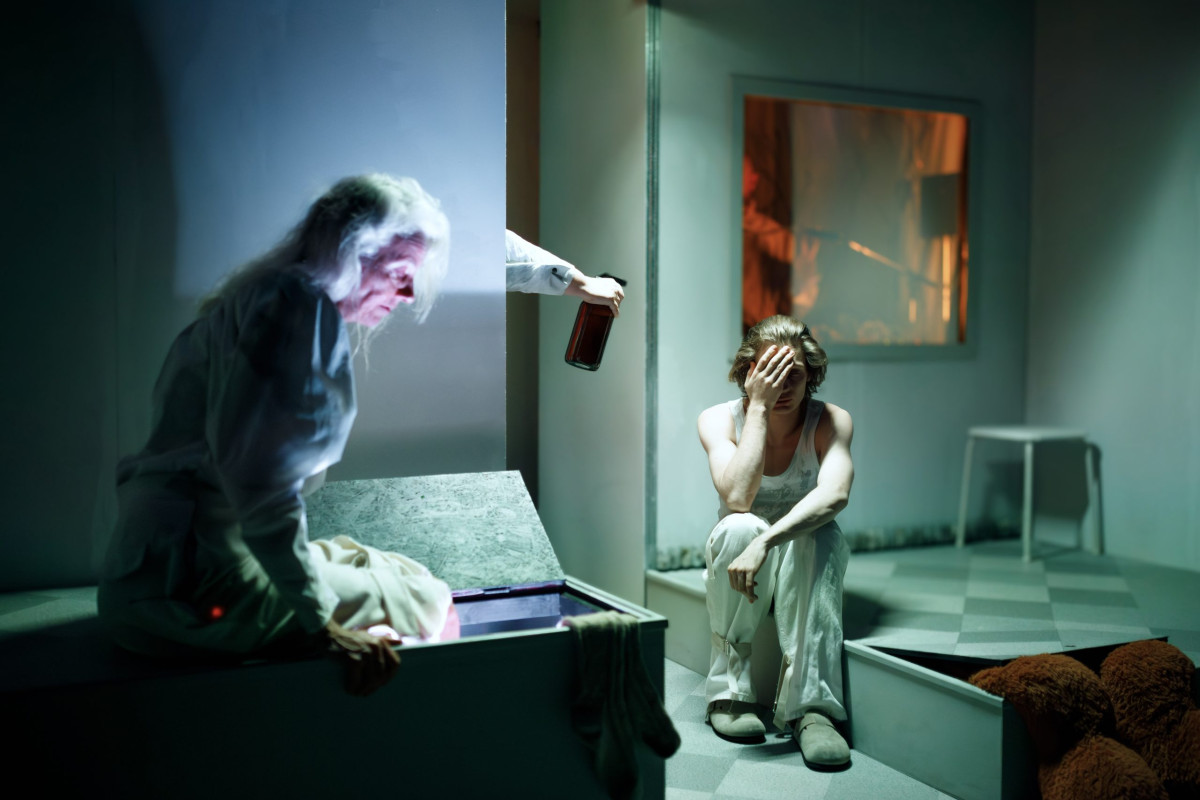
MØR Collective: »Vildnis – der vokser græs ud af min hovedskal«
© PR
© PR

»Is your head also filled with voices that aren’t your own?« the young man asks. The question forms the central theme of Vildnis (Wilderness], a performance by the theatre group MØR collective, and most people would probably answer yes. But whose voices are they, and where do they come from?

In the introduction, Vildnis is described as »a journey into the engine room of theatre.« Playwright Abelone Koppel has written 80 short texts, and each evening a selection is activated by two performers who do not know in advance which texts they will receive through their earpieces. In a back room, a prompter reads the texts aloud, which the actors immediately translate into movement and voice on stage. It could easily have gone wrong. It doesn’t – and much of the credit goes to the two performers, whose work makes the concept function so well.

Also present on stage is composer Mika Forsling, who, through electronic means and abundant percussion, follows the mood unfolding between the performers – but unfortunately not much more than that. I actually found it somewhat difficult to hear what was going on and, at times, forgot about it altogether, as it felt relatively insignificant. It would have been an obvious choice to use the voice itself as an instrument in a performance centered on inner voices, and it is hard to understand why this opportunity is missed.

One should not see Vildnis for the music alone, even if it becomes more prominent towards the end, when the roles are reversed and Forsling’s rhythms seem to guide the performers’ movements. Nevertheless, Vildnis emerges as a cohesive and engaging experience, despite the unpredictability of the experiment.

English translation: Andreo Michaelo Mielczarek

© Iain Forbes

»When I search for new music, I search for sound that evokes images in my mind. It is fuel, a gateway to emotion, and my most important writing companion. When inspiration lapses, music is the tool that always jumpstarts it.«

Iain Forbes is a Scottish/Norwegian film director based in Oslo. He has studied film directing at Nordland College of Art and Film and the Norwegian Film School. His graduation film Revisited won a Student Academy Award in 2023. He has previously directed short films such as Snowman (2015) and Semper Fi (2017). His latest short After Dark won Best International Short Film at the Oscar-qualifying Foyle Film Festival in 2024

Nikolaj Nørlund. © Agnete Schlichtkrull

»Music, to me, is a companion through life, a premise, an excuse, a mystery, an explanation, a point of departure. It is old ideas, overlooked treasure chests, new angles, long concerts, doubt and conviction. It is words, tones, cracked voices, different points of departure, bass in the diaphragm, falsetto in the hair, challenges, rewards, and love.«

Nikolaj Nørlund made his solo debut with Navnløs (1996), an interpretation of poems by Michael Strunge, and released Nye Optagelser (1997) the following year, his first Danish-language singer-songwriter album. He has since worked broadly across music and poetry and is behind around 20 releases, both solo and in various band constellations. Nørlund’s projects range from collaborations with Copenhagen Phil on two orchestral albums, created together with author Naja Marie Aidt. His most recent release is the single »Englenes Park (nu ikke saa dark)«, the forerunner to the album Himlen skiftet ud, due for release at the end of November. In addition to his own work, Nørlund has, through the record label Auditorium, produced and released a number of Danish artists, including Niels Skousen, Ulige Numre, Jens Unmack, I Got You On Tape, and Martin Ryum. He was previously a member of Trains And Boats And Planes and periodically works with the English-language project Rhonda Harris. Nørlund has received a Danish Music Award (2003) and a Steppeulv (2006), both as Producer of the Year, as well as the Niels Mathiassen Cultural Award (2012).

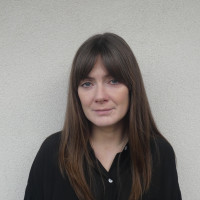
© Mari Liis

»Music and sound for me is a language, the most present and fleeting one. It’s something that passes through your heart and becomes the past in a second. Music amplifies every emotion, love, happiness, anger, sadness a thousand times over, making me feel everything more deeply and sensitively.«

Sophia Sagaradze is a sound artist, composer, and performer from Georgia, based in Denmark. She experiments with space, multichannel electronics and audio-visual installations. Sagaradze is interested in creating works that explore the boundary between external and internal experiences of space. She holds a bachelor’s degree in classical composition from Tbilisi State Conservatory and a master’s degree in electronic composition from DIEM Royal Academy of Music, Aarhus/Aalborg. In 2022, she received the Carl Nielsen and Anne Marie Carl-Nielsen Foundation’s Talent Award in Composition. Sagaradze has performed in several countries, received commissioned works for ensembles, performed live and created audio-visual installations. She is a founder and artistic director of Aarhus Sound Association (Aarhus Lydforening), Project leader at ROSA  and a lecturer at the Royal Academy of Music, Aarhus/Aalborg.

»Like all art, music is a language for emotions, dreams, and the search for meaning—but for us it is just as crucial that music is a path to community.«

Girls in Airports is a Danish instrumental band with a palette that draws in particular on jazz, electronic music, and sounds from distant horizons. Since their debut album in 2010, they have created a sonic universe in which saxophones, synths, and pulsating grooves meet in a collective and dreamlike expression. Recently, the band has focused on artistic collaborations with, among others, Teitur and Aarhus Jazz Orchestra, and they are now on their way with a new album created in collaboration with the string trio Halvcirkel.

© @joachimdabrowski

»Music, to me, is the lifeline to the world that more than anything else creates emotional resonance and fills my head with confetti of thought.«

Steen Andersen is a cultural entrepreneur, festival manager, and writer. He is a co-founder of Lost Farm Festival and has coordinated projects such as Copenhagen and Odden Sauna Festival, the collective workspace PB43, the cultural venue BYGN 5, and Prags Have. Over the years, he has written books and articles on urban activism, entrepreneurship, and culture, including Byen bliver til and Learning from Sierra Leone together with Architects Without Borders, which won the Danish Architectural Association’s Initiative Award. He is currently based in Ukraine, where he is coordinating Lost Farm Festival’s Art Exchange Program, and has just curated the exhibition HIDE and SEEK with young Ukrainian artists in Kyiv.