
in briefrelease
29.09

When Two Worlds Meet: Bro and Takada In Perfect Listening

Jakob Bro & Midori Takada: »あなたに出会うまで / Until I Met You«
© PR

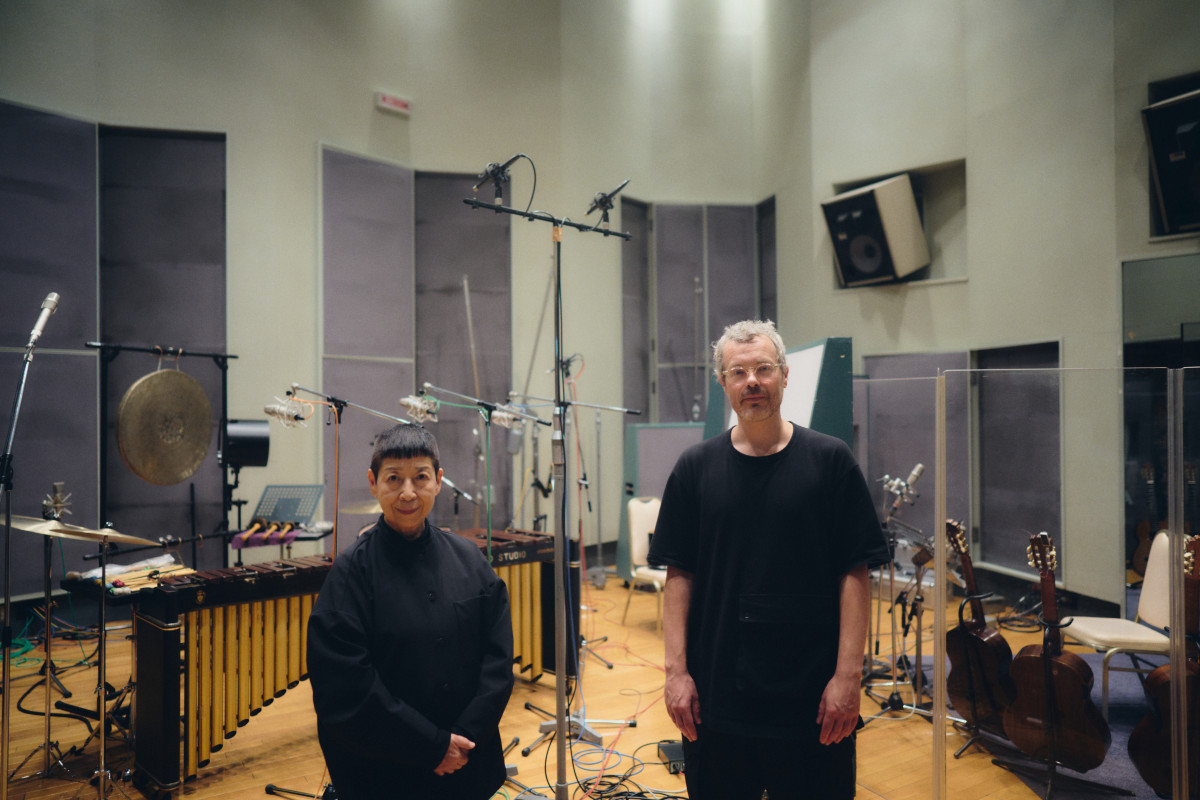
At last, three years after their concert at the Black Diamond, the collaboration between Danish guitarist Jakob Bro and Japanese percussionist Midori Takada has been released in album format – and it does not disappoint.

Their friendship may seem surprising at first, given their differences, but あなたに出会うまで / Until I Met You reveals how it rests on a shared ability to close their eyes and listen. They give each other space to do what they each do best: Bro’s simple yet refined melodies and Takada’s magical soundscapes. On the title track, Bro sketches the outlines with acoustic guitar and sparse notes, which Takada fills in with shimmering marimba and gong. On A Brief Rest of Sisyphosthe roles are reversed – here Takada sets the frame while Bro adds the details.

The sublime sister pieces Landscape II, Simplicity and Landscape I, Austerity are more abstract than the earlier works. Landscape II breathes hope and longing with resonant chimes and percussion, while a middle section unfolds in melodic harmony between guitar and piano. Landscape I carries the same sense of yearning, but with a more melancholic tone; a gently undulating marimba supports a beautifully moving guitar part. Both pieces radiate a clear sense of respect and tenderness between the musicians: Bro and Takada listen to each other with rare intimacy, and together they have created something truly unique.

English translation: Andreo Michaelo Mielczarek

© PR

»Music for me remembers.«

Håkon Guttormsen is a Norwegian composer and trumpeter living in Copenhagen. He is educated at the Royal Danish Academy of Music and the Royal Academy of Rhythmic Music. He primarily composes scores for ensembles as well as music drama and opera. He is currently working on a work for solo violin and electronics for ILK Music’s concert series during CPH Jazz 2026 and on his first symphonic work, which will premiere at the academy in 2027. He is a member of nyMusik’s composer group in Norway and a board member of UNM Denmark.

in brieflive
07.06

Deadly Serious Play at Louisiana

Simon Steen-Andersen, Håkon Stene, Tanja Orning: »Nye klange på Louisiana – Portrætkoncert med Simon Steen Andersen«
© Camilla Stephan
© Camilla Stephan

New Sounds at Louisiana is an initiative in which the Louisiana Museum of Modern Art has invited the record label Dacapo and the music publisher Edition S to curate concerts featuring living composers. Simon Steen-Andersen was the first composer in the series, and he seized the opportunity to assemble a programme that was not only overwhelming and exhilarating, but also deeply unsettling. Lasting an hour, the concert unfolded as a continuous sequence in which each work flowed seamlessly into the next, forming a single extended statement of at least part of the composer’s artistic practice and philosophy.

Combining video and live performance, the concert served as a manifestation of several of Steen-Andersen’s key artistic strategies. Central among them are techniques of estrangement and defamiliarisation, exemplified by Asthma (2017) for accordion, air pumps, and video, a work that explores and interrogates human breathing in all its positive and negative dimensions. Amid the many grotesque and humorous scenes – accompanied by Håkon Stene’s brilliant Foley-style soundtrack of air noises, sound effects, and spoken commentary – a brief clip of brutal police violence suddenly appears. In it, an officer methodically sprays pepper spray into the faces of handcuffed demonstrators. In that instant, everything else no longer seems quite so funny, and the crooked smile freezes.

The concert was a veritable sensory bombardment. Presenting all the works attacca undoubtedly created a powerful sense of flow, but it also left the audience almost saturated with impressions. Even so, the subsequent conversation between Simon Steen-Andersen and music critic and author Thomas Michelsen felt far too brief. Yet the composer succeeded in making his point: everything he does, he said, is a form of »deadly serious play.« Exactly.

© Simon Bendix Borregaard
»Music for me is a constant movement (in me). It is a constantly changing song in my head. Music can be calming and uplifting, and it can give me answers that I didn’t know existed. Music guides me through life – whether it is the biggest and best moments of my life, or difficult periods. Music is also a community where new thoughts and ideas can come to life. Community is not a competition, but a way to move forward together.« 
 
Troels H. Sørensen is the booking and program manager at the Skråen venue in North Jutland. He is a former manager at 1000Fryd. Together with Casper Clasen, he runs the Lasher Agency and is responsible for the Lasher Fest festival, among other things. Sørensen plays in the band Vægtløs and has previously been in various bands from the Aalborg underground and has released records through his cooperative record label 5FeetUnder Records.


© Clemens Schmiedbauer
»Music for me is osmotic refuge.«
 
Jungstötter is the solo project of Berlin-based songwriter and musician Fabian Altstötter, whose sounds linger in lyrical softness and formal fragmentation. Using voice as a centre point, as an axis that hinges off an assembly of instrumental experimentation, his work pulls together shifting lyric compositions with textured layering, and whispered moments of release. 
 
Jungstötter has released two albums on [PIAS], and has played shows across Europe, at renowned venues and festivals includingVolksbühne, Silent Green and the Zeiss Major Planetarium (all Berlin), Kampnagel (Hamburg), the Nuremberg State Museum of Art and Design, Palac Akropolis (Prague), Desertshore Festival (Vienna), and more. He’s supported acclaimed acts including Owen Pallett (Final Fantasy, Arcade Fire) and Petra Hermanova. 
in briefrelease
29.05

Gintė Preisaitė Turns Doubt into Music

Gintė Preisaitė: »Instruments of Forgetting and the Singing Bone«
© Lukas Mykolaitis
© Lukas Mykolaitis

You increasingly encounter Gintė Preisaitė in different contexts and under different names – solo as Baraboro and as part of the trio Treen. With Instruments of Forgetting and the Singing Bone, the Lithuanian-Danish composer releases her first album under her own name, and it certainly feels like her most personal work to date.

Above all, this is because Preisaitė sings on seven of the album’s eight tracks. She treats her voice as an instrument equal to all the others, and although the singing is lyrical, she primarily uses it to create texture, depth, and contrast. On »Summary Saint Mary«, for instance, layers of vocals in different registers intermingle with scraping background noise, rapid pulses, resonant bass, and a multitude of sounds of both digital and analog origin. It feels refreshingly fragmentary – a willingness to play with uncertainty. Not everything coheres, yet it is precisely this lack of cohesion that makes the music feel alive and compelling.

Only on »Nippon Dreams« – a dense collage of percussion, samples, and field recordings of Japanese voices – is Preisaitė’s vocal absent. And it is only then that one realizes how essential it has been as a point of orientation throughout the album. Its absence leaves a void that underscores the duality Preisaitė works with: the music feels both intimate and cool, present and distant.

Instruments of Forgetting and the Singing Bone does not provide many answers. Instead, it becomes yet another fascinating piece in the puzzle of Preisaitė’s singular oeuvre.