© Ultima
© Ultima

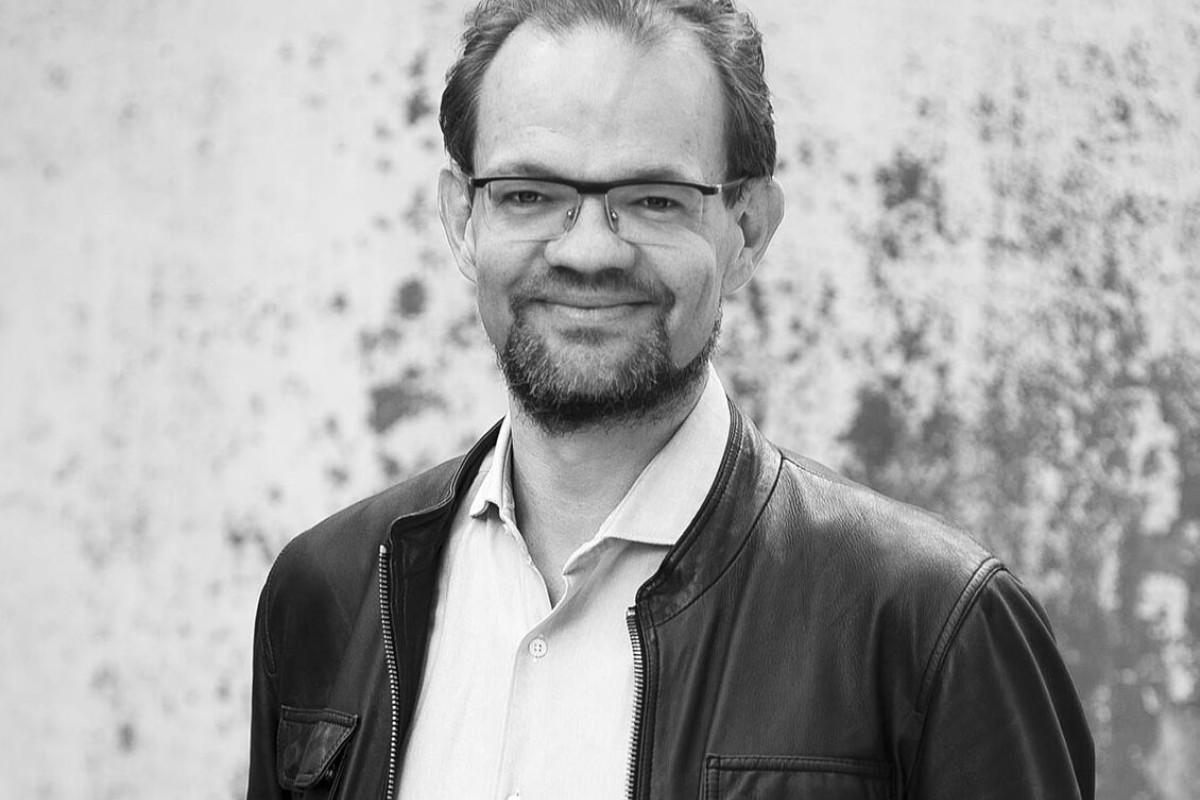
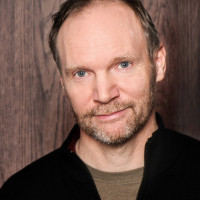
Thorbjørn Tønder Hansen has died. With Thorbjørn’s passing, the art music community has lost one of the Nordic region’s most significant producers, curators and cultural leaders.

For more than two decades, Thorbjørn worked at the intersection of contemporary music, sound art, festival management and Danish-Norwegian cultural cooperation. From 2000 to 2006, Thorbjørn was manager of the Norwegian Cikada Ensemble. In 2009, he became director of Art Music Denmark (then Snyk), a position he held until 2017, when he returned to the Norwegian cultural scene as director of the Ultima Festival. In the final years of his life, Thorbjørn served as a board member of the Foundation for Danish-Norwegian Cooperation.

Thorbjørn was a well-liked and visionary cultural leader who left an indelible mark on the music scene. I, like many other Danish artists, probably remember Thorbjørn best for his inspiring and courageous projects, such as the G((o))ng Tomorrow Festival (formerly Wundergrund). Thorbjørn was never afraid to give young and emerging artists a chance to perform, and I do not think it is an exaggeration to say that, for this reason alone, Thorbjørn had an impact on an entire generation of Danish artists.

I was still a young composition student when I first met Thorbjørn. It must have been around 2008. At the time, Thorbjørn was a project manager at Art Music Denmark, which was in the midst of developing G((o))ng Tomorrow. A festival that mixed genres and crossed artistic communities, Thorbjørn explained – a radical concept in Denmark at the time. The next thing I knew, I was standing on the G((o))ng stage at Råhuset with a group of wild young artists – musicians and composers, from both classical and rhythmic traditions, with vastly different artistic expressions and working methods. The concert that followed was hardly an artistic revelation, but the conversations, friendships and nights at the bar with a group of artists I would otherwise never have encountered opened my eyes to an entirely new way of collaborating – both artistically and in terms of cultural production.

Over the years, Thorbjørn developed many international friendships with artists and institutions from near and far. Thorbjørn and G((o))ng Tomorrow introduced countless exciting artists to Denmark while also opening new doors abroad for Danish artists. For many years, Thorbjørn was almost synonymous with Danish art music abroad and an exceptionally important link between artists, venues and festivals.

This is how I believe many people remember Thorbjørn: as an inspiring figure with forward-looking ideas, curious and courageous, and with a strong understanding of the value of international musical exchange.

The Danish music scene would not be the same without Thorbjørn. The same can be said of Art Music Denmark. Our small genre organisation has changed considerably since Thorbjørn was its director. Nevertheless, I am proud of the organisation I myself took over, and where the fundamental values from that time are still very much alive. An organisation that works to create new opportunities for artists. An organisation with a strong international network and a focus on international musical exchange. I do not believe this would have been possible without Thorbjørn’s immense and tireless groundwork.

Thorbjørn Tønder Hansen has died. He will be deeply missed, not only by artists and the cultural community across the Nordic region, but also by his many friends and collaborators around the world. Thorbjørn created connections, ideas and visions that continue to shape today’s cultural landscape. I have no doubt that his impact on the cultural life of the Nordic region will live on.

My warmest thoughts go out to Thorbjørn’s family and loved ones at this difficult time.

May Thorbjørn’s memory be honoured.

Regin Petersen
Director, Art Music Denmark

in briefrelease
14.03.2025

Community in Collapse

Nausia: »Finding a Circle«
©Astrid Lemmike

The transcendent takes the front seat on Copenhagen-based Nausia’s latest album, Finding a Circle. Slow builds and intense demolitions form the band’s basic structure, and a web of saxophone harmonies floats through a tight and daring interplay. Not every band manages to preserve the intense feeling of a live concert on a recording. But on Finding a Circle, Nausia succeeds in hammering the gap between stage and studio down to an irrelevant trifle, through a phenomenal and remarkably great-sounding ensemble performance.

There is something about the physical conditions of the saxophone that makes it easy to sense the musician’s presence. The clatter of the keys and the intense breathing make it effortless to form an inner image of the human behind the brass. On the track »E.D Interlude«, the saxophones’ airy exhalations and mechanical flapping ensure that, as a listener, I behave with the same quiet reverence as I would at a concert. So when the next track, »Eco Death«, kicks the door in on the silence, it is hard not to feel almost physically exhilarated by the album’s intense contrasts between presence and destruction.

Titles such as »flowers grow through concrete too« and »Eco Death« cast the wordless album in a bleak light of climate collapse. Finding a sense of community in a chaotic world – whether at a concert, on an album, or elsewhere – is essential to life in a time of crisis. Finding a Circle is a fine example of exactly that.

in briefrelease
14.03.2025

Caught Between Too Much and Too Little

Amphior: »Disappearing«
Amphior. © Rikke Broholm

Electronic musician Amphior, aka Mathias Hammerstrøm, opens on a positive note: »Under the Stars« exudes a Twin Peaks–like melancholic romanticism infused with an unsettling timbre that raises expectations. By the second track, however, it becomes clear that the listening experience will not be quite as positive as one might initially have hoped.

»Time Is a Thief« simply does not impress in the same way. On top of the clichéd ticking clock in the background, neither the piano melody nor the atmospheric elements make much of an impact, stuck in the nondescript middle ground between too much and too little. Unfortunately, this alternation between compelling tracks and more filler-like pieces comes to characterize the release as a whole.

Both »Healing« and »Disappearing« feature strong melodies with a delicate, ethereal, bittersweet melancholy. Like »Time Is a Thief«, »Bloom« also employs a ticking clock as a background element, but to far better effect, as the music above it is much more captivating – not least thanks to Stine Benjaminsen’s (aka Recorder Recorder) clipped vocal samples, which lend the track a welcome sense of strangeness. The release does, however, contain a number of tracks that never manage to leave a lasting impression, no matter how many times one listens. A melody that simply needed a bit more life. An effect that could have benefited from being turned up. It is a shame, because on roughly half of the tracks Hammerstrøm demonstrates that he is capable of creating truly beautiful music.

© PR

»How comforting, after so much menial self-investigation, to finally be told exactly what it is that you need. The delirious British post-punk outfit The Fall, in their song on the very subject, will have you convinced it’s a bit of Iggy Stooge, a reduced smoking habit, sex without having it, slippery shoes for your horrible feet; to that solid list, I’ll append an injunction to hear out a few minutes of other music, specifically chosen to corrupt your personal spacetime. And sure, drink water, wash your face, go outside – like that’s doing anything.« 

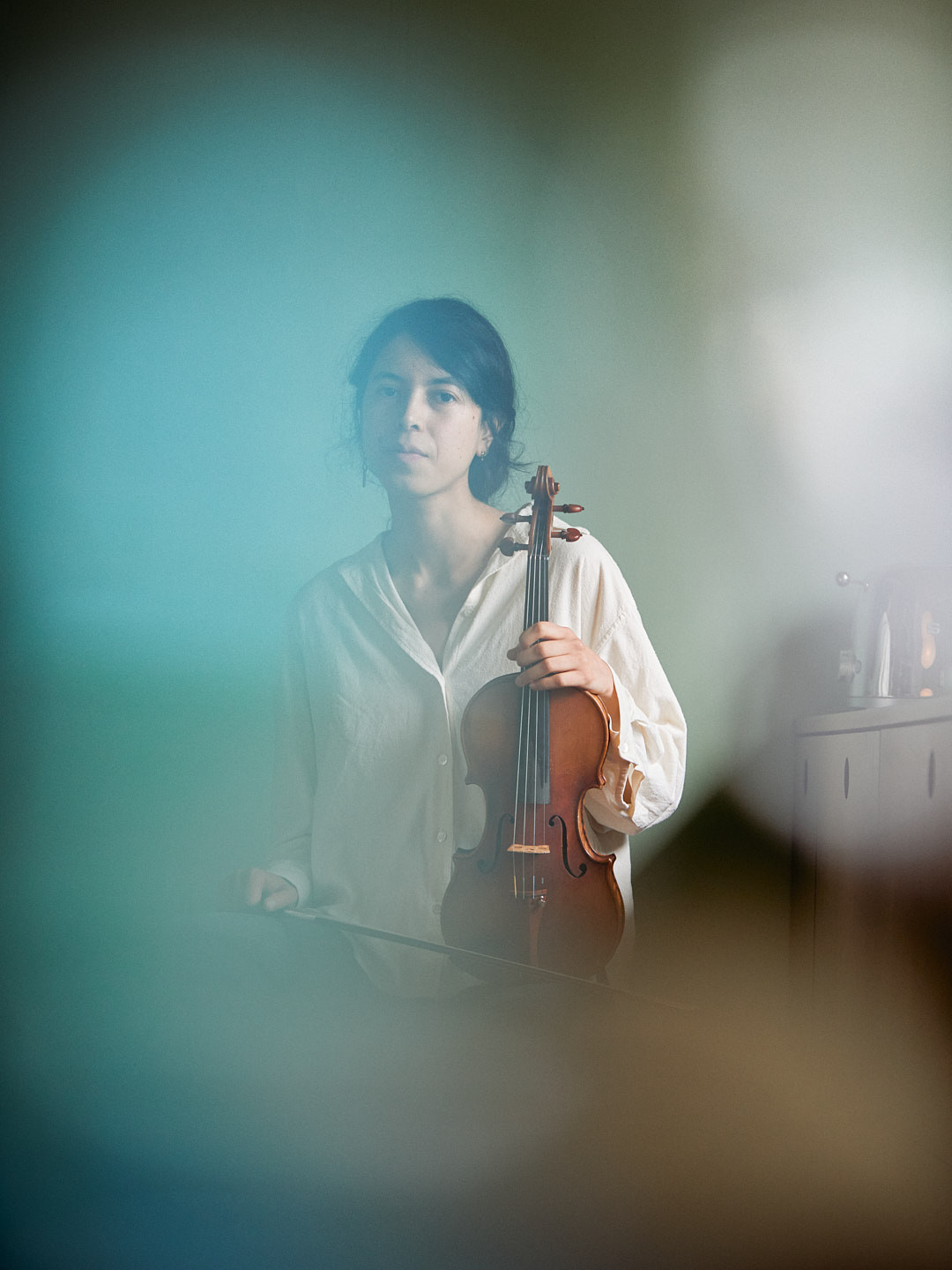
Jennifer Gersten is a violinist and writer from New York City. Her feature reporting, essays, and music criticism appear in The New York Times, The New Yorker, Bloomberg, Rolling Stone and Seismograf, among other publications. A former tenured tutti violinist with Helsingborg Symfoniorkester (Sweden), Jennifer pursues solo and collaborative projects in new and improvised music in the US and Scandinavia, some of which earned her an honorable mention for Darmstadt Ferienkurse’s 2023 Kranichsteiner Musikpreis. 

in briefrelease
07.03.2025

A Daring Vision of Flute and Voice

© Samantha Riott
© Samantha Riott

So dextrous a musician is the flutist Laura Cocks that, at shows, their instrument occurs to the eye as merely another limb. A powerhouse New York-based collaborator and interpreter within new classical and experimental music, notably as director of the leading-edge new music group TAK Ensemble, Cocks now releases their first solo statement of improvised compositions with FATHM, an acrobatic intertwining of flute and voice that nods to strange and fleeting visions: among them, birds, string, seeds between the teeth. On FATHM, Cocks applies all the facility of their work as an interpreter of commissioned works – on extensive display in their last solo venture, 2022’s field anatomies – towards the development of an uninhibited, yet highly focused musical language. 

If the album’s mysterious tracklist reads as a sort of cryptogram, then listening to FATHM evokes a process of decoding, parsing the bounds between vocalization and instrument. The album’s opening track, »A thread held between your fingers«, finds Cocks as their own flickering shadow, simultaneously playing the flute and squealing in tones just slightly removed in pitch. »Illinois« is then reclaimed from Sufjan Stevens’ relentless grip as a furious mumble of half-blown notes with underlying trickles of voice. Cocks experiments further with these hoarse timbres on the three infinitive tracks: »To beget« and its later variations »To outstretch« and concluding track »To fly«, which trace the evolution of a dancelike triplet motif. »FAVN«, apparently a faithful depiction of an elephant with severe sleep apnea, may reconcile itself to the sensitive listener through its sheer commitment to the grotesque, while »A seed sucked between your teeth«, orbiting languidly around a major ninth, invites more celestial considerations. »A marsh wren« might take the titular bird as a point of departure, but it quickly imagines a species of its own, singing a song of bustle and snaps and smacks. On »YARN«, Cocks suggests another sort of animal song by making a counterpoint of mews and growls. The flutist’s skill with balancing these peculiar hybrids ultimately distinguishes FATHM as much as Cocks’ ferocious energy; this is an album as happy to shout as it is to slither. 

in brieflive
03.03.2025

Cosmic Resonance

Satellite Synthesizer – Ørntoft/Anker/Osgood/Snöleoparden
© Mia Mathilde Andersson

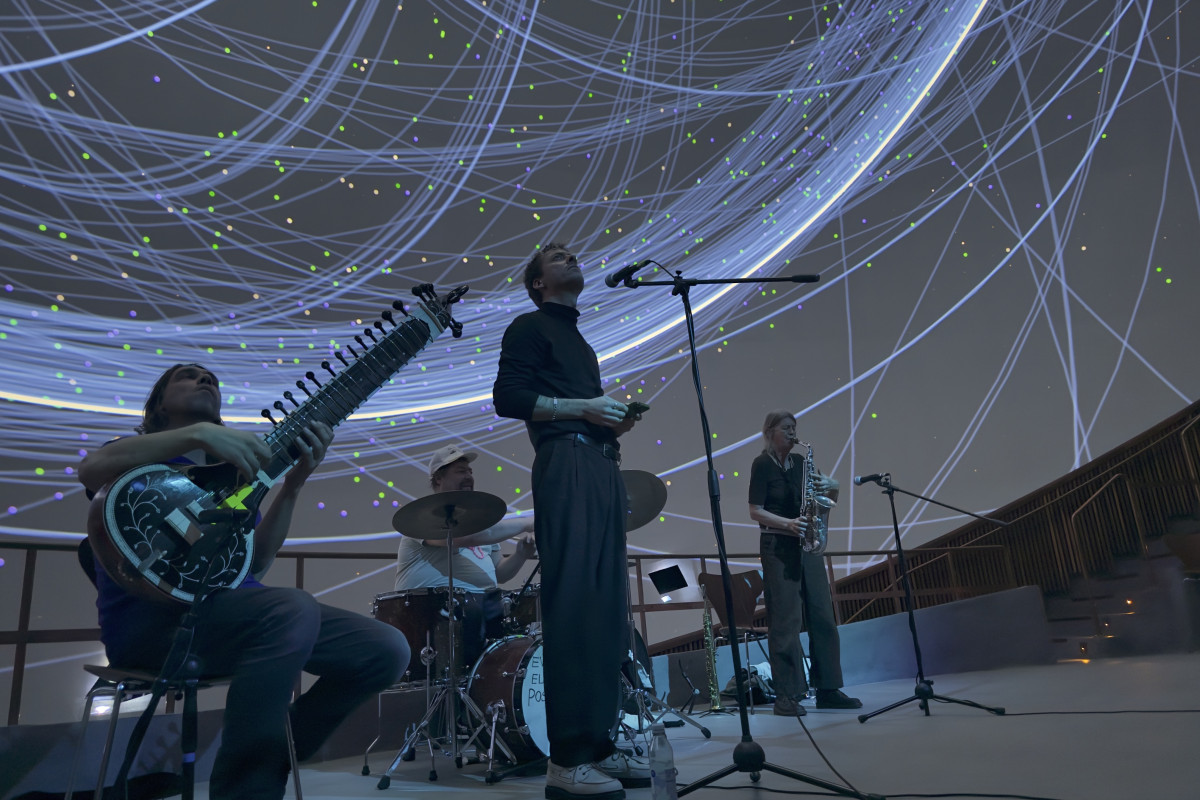
Against enemies in outer space, »music is the strongest weapon we have,« Mads Brügger recently stated here in Seismograf. Snöleopard and musical friends made this idea strikingly concrete by sending music directly from the Planetarium in Copenhagen out into space, targeting satellites between 500 and 35,000 kilometers away. The tones returned altered by delay, radio noise, and cosmic interference. On the large screen, the Earth’s surface – seen from a satellite – rolled by with all its illuminated cities, while Theis Ørntoft read from his forthcoming climate-conscious novel, delivering lines such as: »The day there is no more oil, the lights will go out in the world.« Meanwhile, we could see small green dots of confused satellites racing across the Earth’s beautiful curvature and hear Lotte Anker, Kresten Osgood, and Snöleopard free-jazzing on saxophone, drums, and sitar respectively.

The small crackling beep-sounds from the satellites’ resonance also generated music, but the most interesting moments came when the musicians received fragments of their own motifs back – thrown down from outer space – and a kind of internal interplay emerged. Is there something out there, or are we merely talking to ourselves?

Cosmic resonance filled the dome, but one could wish for more internal resonance. There is a beautiful trend in ensembles that include a poet, allowing many delightfully twisted formulations to surface, but the musicians must also interpret the words – enter into a musical exegesis, as they would with a traditional jazz singer – otherwise the music easily becomes background or secondary. As if each musician were a green satellite dot in their own orbital path. Many good ideas were in play – and music is not a weapon. But it does require internal resonance. Not only cosmic.

English translation: Andreo Michaelo Mielczarek