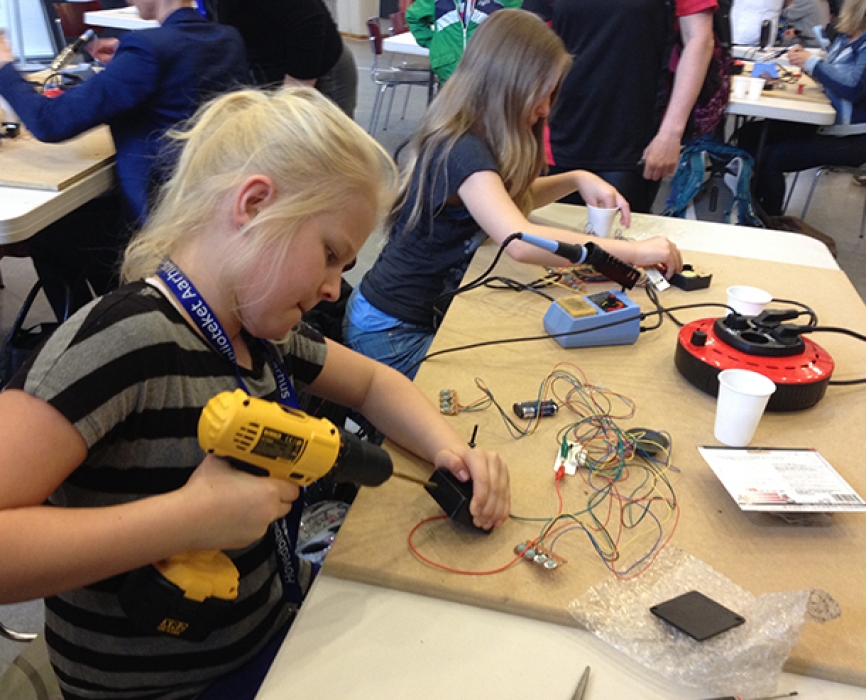
Aarhus Kunsthal lægger i efterårsferien hus til familieworkshoppen ’Byg dit eget instrument’. Torsdag d. 16. oktober 2014 kl. 11.00-16.00 kan børn og voksne medbringe elektronisk legetøj og gamle musikinstrumenter og få hjælp til lave dem om til helt nye instrumenter og skabe helt nye lyde. Processen kaldes circuit bending, og det handler om at arbejde kreativt og ’mishandle’ maskiners elektroniske kredsløb med det formål at frembringe et nyt udtryk. Familien kommer på den måde til at flirte med en eksperimenterende kunstform, samtidig med at de leger med musik, lyde, legetøj og instrumenter.

Kunstnerne Taina og John Alex Hvidlykke, der selv arbejder med circuit bending, står bag dette specialarrangement, der også foregår i dag, tirsdag d.14. oktober.
Arrangementet er gratis og kræver ingen forudsætninger, men pladsreservation er nødvendig. Det skal ske på mail comm-assistant@kunsthal.dk.

Se mere om workshoppen på eventens Facebookside.

Tid: Torsdag d. 16. oktober 2014.
Sted: Aarhus Kunsthal, J. M. Mørks Gade 13,  8000 Aarhus C

© Niklas Ottander

»Music is a deep, but not serious, spiritual practice, in which creator, collaborator, and consumer alike are their own personal pope.«

James Black (b. 1990) is a composer, performer, and artistic director of Klang Festival – Copenhagen Experimental Music. Originally from Bristol, England, they moved to Copenhagen in 2013. Black's works have attracted a large amount of attention both nationally and internationally for their signature combination of artistic courage and vulnerability, described by the Danish Arts Council as »a universe of real madness where everything goes«. Their work is a deep and personal exploration of topics such as religion, loss, and queer identity, that is unafraid to be stupid or serious in any direction.

© Christian Klintholm

»Music is just something for me.«

Christian Juncker is a Danish musician and songwriter who has released a number of Danish-language albums. He debuted in 1995 with the band Bloom. Together with his friend Jakob Groth Bastiansen, he formed the duo Juncker in 2002. He is also behind the Christmas carol »Luk julefreden ind« from 2024.

© PR

On May 29, the Aalborg-based collective Datahaven9000 takes over the venue Skråen, transforming its main hall into a concentrated one-day festival of electronic music. The event is part of the concert series Bystanders #3, where the stage is handed over to local scenes rather than the venue’s in-house programming.

© PR
© PR

Two of contemporary music’s most uncompromising material thinkers meet on Music for Intersecting Planes: the American organist Kali Malone and the French cellist Leila Bordreuil. Malone works with oversaturated blocks of sound and sonic mass as a sustained pressure, while Bordreuil seeks friction – her cello a recalcitrant organism that creaks and resists.

What they share is an ascetic attention to the specificity of their instruments. The organ and the cello are pushed to their outer limits, where recognizability dissolves and overtones emerge like hidden entities.

The title pieces, »Intersecting Planes I» and »II«, unfold as undulating ruptures of sound: animalistic, almost elephantine cries that surge forward and recede again. Only rarely can the sound be identified as organ or cello. (»Pilots in the Night« comes closest to a familiar balance between the organ’s gravity and the cello’s resistance.) Otherwise, the music moves within a field between the metallic and the electronic, as if the sound originates neither from strings nor pipes.

It is not mass that is being explored here, but rather a kind of hollowness: an airiness that is not light, but permeated by an indeterminate resonance – something ancient, almost ceremonial. The album holds something far more porous and open than Malone and Bordreuil’s earlier works. The sound appears as a concave form, bending inward, like an absence of material. The sonic landscape carries its own dissolution within it as an inherent delay – as if the music exists, first and foremost, as the erosion of something one thought one heard.

English translation: Andreo Michaelo Mielczarek

© Esben Aarup

»Music, for me, is the rhythm, the pulse, and the energy of my life. It’s what drives me and can always energize me or colour my day in exactly the way I need. In a very busy, confusing, and chaotic life like the one I find myself in right now, music can be almost the only thing that slows my pace down, gives me access to actually feeling my emotions, and creates space for reflection. Music is history – it remembers moments and moods. It reflects cultures and can become the voice of a generation or an entire group that struggles to break through the mainstream or challenge the status quo. For me, music is one of the primary ways I can influence the society I’m part of – whether by supporting important art that we can see ourselves in, or by bringing large groups of people together around something meaningful and communal. Music, to me, is freedom. Freedom to dance without inhibition, to let the tears flow freely, and the freedom to play air drums at full speed on my yellow racing bike as I ride down Mejlgade.«

Oscar O’Shea is a graduate of the Kaospilot programme, with a focus on innovation in the cultural and music industries. Through SPOT Festival, he works as project manager for the international initiative Live Incubator and the hyper-local event cSPOT at Bowlinghallen. Oscar is a documentary filmmaker and will graduate this summer as part of the first cohort of documentary producers from the independent film school DOKTRIN.

He recently founded the independent Aarhus-based agency Okay Management, which works with artist management, booking, film production, and music releases for a wide range of artists. Through the agency, the venue Okay is opening in the new Stenbro district near Nørreport in Aarhus. The space will showcase Aarhus talent, with a focus on bringing together the city’s emerging cultural scene and building a sustainable music industry from the ground up through knowledge sharing, transparency, and collaboration across the underground and grassroots levels.

In recent years, he has worked as a booker and programme curator for Sydhavns Festival, Gemini Festival, and a wide range of other events and initiatives. His heart beats for DIY and indie culture—for independence and collaboration rather than competition. And although Oscar has lived in many different countries and worked around the world, he always returns to Aarhus—precisely because of the sense of community and the city’s DIY spirit.