I samarbejde Goethe-Institut Dänemark, Københavns og Roskilde Universitet inviterer Seismograf/DMT til seminar tirsdag den 3. juni kl 16-18 Teater Repulique i forbindelse med Klangfestivalen 2014.

Ved seminaret " Modernisme, politik og det stedsspecifikke" har vi inviteret Dr. Kersten Glandien, Musikkritikeren Henrik Friis og komponisten Johannes Kreidler. Dr. Kersten Glandien fortæller om lydkunstscenerne i Berlin fra 1970erne og frem til i dag. Musikkritikeren Henrik Friis spørger, hvad der skete den radikale tyske modenisme efter Lachenmann og Spahlinger. Svarene søges bl.a. gennem en analyse af Spahlingers betydning for den danske komponist Simon Steen-Andersen. Den tyske komponist Johannes Kreidler taler om de sidste 15 års udvikling i tysk ny musik og præsenterer sin analyse af periodens æstetiske, tekniske og diskursive forandringer. 

Seminaret er arrangeret og ledes af Sanne Krogh Groth (RUC, Seismograf/DMT) og Søren Møller Sørensen (KU). Det afholdes på engelsk og er blevet til i samarbejde med Goethe-Institut Dänemark.

Abstracts:

Dr. Kersten Glandien (Senior Lecturer, University of Brighton, UK):
"… too wide a field - SoundArt in Berlin"

This comment on the human condition by Theodor Fontane came frequently to my mind while researching the various facets of SoundArt in Berlin. Far from encountering ‘a scene’, I found myself facing a vast labyrinth of activities, artists, works, places, events, organisers and institutions, stretching back several decades.

In my paper I will attempt to give an insight into the extent and hybridity of Berlin Sound Art - from its beginnings in the 1970s under the special conditions of cold-war West Berlin, through the landmark-festivals and lively activities of the post-Wall period, down to its ubiquity and acceptance today. I will examine the main players, institutions, organisers and initiatives, trace the unusual political and cultural conditions that set the agenda in both parts of the city, outline the exciting process of fusion that followed - and examine the very different approaches taken to SoundArt in the city today and the aesthetic clusters they form.

Henrik Friis (Music critique, Politiken, DK):
"What happened to modernism?"

What happened to the strong modernist position in German music after Lachenmann and Spahlinger? Well, maybe it is alive and kicking – living on, for instance, as impossible timbre made by young Danish composers. With a strong advocate in the Berlin resident and Spahlinger student Simon Steen-Andersen.

A place to start is the search for a useful framework for the term modernism. The Spanish philosopher Ortega Y Gasset addresses the modernist position in European Art and Music in 1925 in his essay ‘The Dehumanization of the Arts’. He claims that, opposed to earlier epochs in the history of the arts, modern music is not unpopular, as in ‘not popular yet, but outspoken anti-popular. A search for modernism is in that sense a search for traces of thoughts of intellectual anti-popularism and dehumanization. Helmut Lachenman and Matthias Spahlingers music from the early 1970’s and onwards show some of the same alienating and non-popular characteristics. For instance the ‘Musique Concrete Instrumentale’ focuses the ear at the noise of the music production and continuously stops the listener from forgetting that the musical experience is in fact a musical construction. Or the Spahlinger concept of the endless beginnings. These intellectual traces are pursued in the recent music of Simon Steen-Andersen, i.e. the cd of 2010 ‘Pretty Sound’.

Johannes Kreidler (Composer, DE):
"New Music in Germany in the last 15 years."

Having started to become a professional composer towards the end of the 1990s, not only personally I've made my artistic development, but also in general I can draw an overview now on a period of time of which I think has made quite a shift, aesthetically, technically, discursively.

Fakta
Seminar. Klangfestivalen
Tirsdag den 3. juni kl 16-18
Teater Repulique, Østerfælled Torv 37, 2100 København Ø


© PR
© PR

On Wednesday, 5 August 2026, it happened again: a chord in John Cage’s Organ2/ASLSP (As Slow as Possible) changed after two and a half years. Classic FM reports.

The work was written by the American avant-garde composer John Cage in the mid-1980s. The score consists of eight pages of music, and, as the title suggests, the instruction is to play it »as slow as possible.«

»What music is to me? Where have the great feelings gone?«.

Gellért Szabó is a composer, conductor and performer based in Leipzig, Germany. His work combines contemporary composition with influences from free improvisation, noise and the expressive richness of the late nineteenth century. He is the founder and artistic director of the 23-piece Ideal Orchestra, an ensemble dedicated to large-scale experimental music of sweeping emotional intensity. Alongside this work, Szabó performs internationally with his solo project Radical Radio Show, exploring symphonic textures and immersive sound worlds through a single electric guitar and live electronics. His music is driven by a search for intensity, vulnerability and uncompromising emotional expression.

© Christoffer Askman

From the Culture Yard in Helsingør, ships glide past Kronborg Castle through the narrow waters of the Øresund – a reminder of the trade routes that, for centuries, have carried goods, people and power between the Nordic region and the wider world. It is an apt point of departure for the Passage Festival, and for Marie Dahl's vocal work Silk. Sugar. Sand, which explores the intertwined histories of three materials.

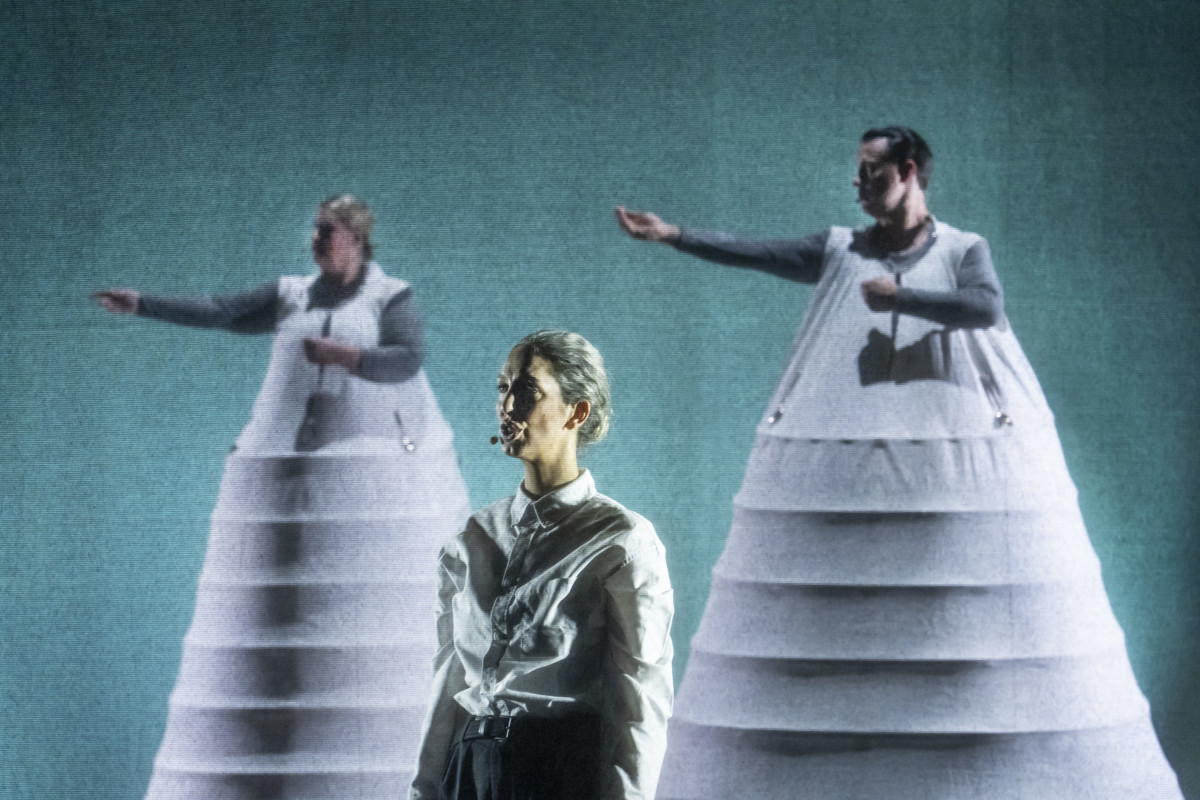
Silk. Sugar. Sand is a vocal performance in three acts tracing the historical journeys of these materials through colonialism, the global economy and geopolitics. Five singers from Ars Nova Copenhagen perform within a minimalist scenography consisting almost entirely of coloured light and three sets of costumes that transform throughout the performance: first silk dresses, then crinoline-like structures evoking sugar loaves, and finally grey stone-like forms suggesting accumulations of sand.

The work's central device is to translate the physical properties of these materials into vocal expression. At one moment, the elasticity of silk becomes soft, flowing polyphony; at the next, a cocoon-like electronic crackle. Sugar's crystalline structure is rendered as sharp vocal attacks – brief, whip-like cracks – as well as sweet, intimate whispers, while sand creaks and rustles, resonating with a libretto about economy and domination, violence and desire.

The performance has no conventional narrative, and the five singers portray no distinct characters, moving somewhat stiffly across the stage, as performers often do when their primary focus is on the voice. Comparisons with Hotel Pro Forma's Flammenwerfer are difficult to avoid. There, the production's rigorous aesthetic was counterbalanced by C.F. Hill's wildly expressive visual universe and Blixa Bargeld's deeply vulnerable stage presence. Those qualities are missing from Marie Dahl's carefully controlled staging, which could have benefited from more of the sensitivity and chaos that also form part of Kirsten Dehlholm's artistic legacy.

© PR

»To us, music is a primal, elemental force that allows us to shed our inhibitions.«

Leizure is a Copenhagen-based quintet operating at the intersection of post-punk, no wave, and experimental rock. The band’s sound is characterized by atonal vocals, piercing saxophone, hypnotic guitar riffs, and a rhythmic foundation that oscillates between tight precision and raw intensity. 

The band’s upcoming album, The Guillotine, explores themes such as societal decay, upheaval, and the challenging of established structures – all conveyed through a direct and high-energy musical style.

© Robin Skjoldborg
© Robin Skjoldborg

Danish musician, author, and artist Martin Hall has died at the age of 63. According to his family, he passed away from a heart attack at his home in Frederiksberg on Tuesday, 21 July.

Since the early 1980s, Hall left an indelible mark on Danish music and cultural life – first with Ballet Mécanique and Under For, and later through an extensive solo career that moved effortlessly between experimental music, electronic pop, poetry, performance, and literature. He leaves behind one of the most substantial discographies and bibliographies in Danish cultural history.