



The drum and the community




Abstract
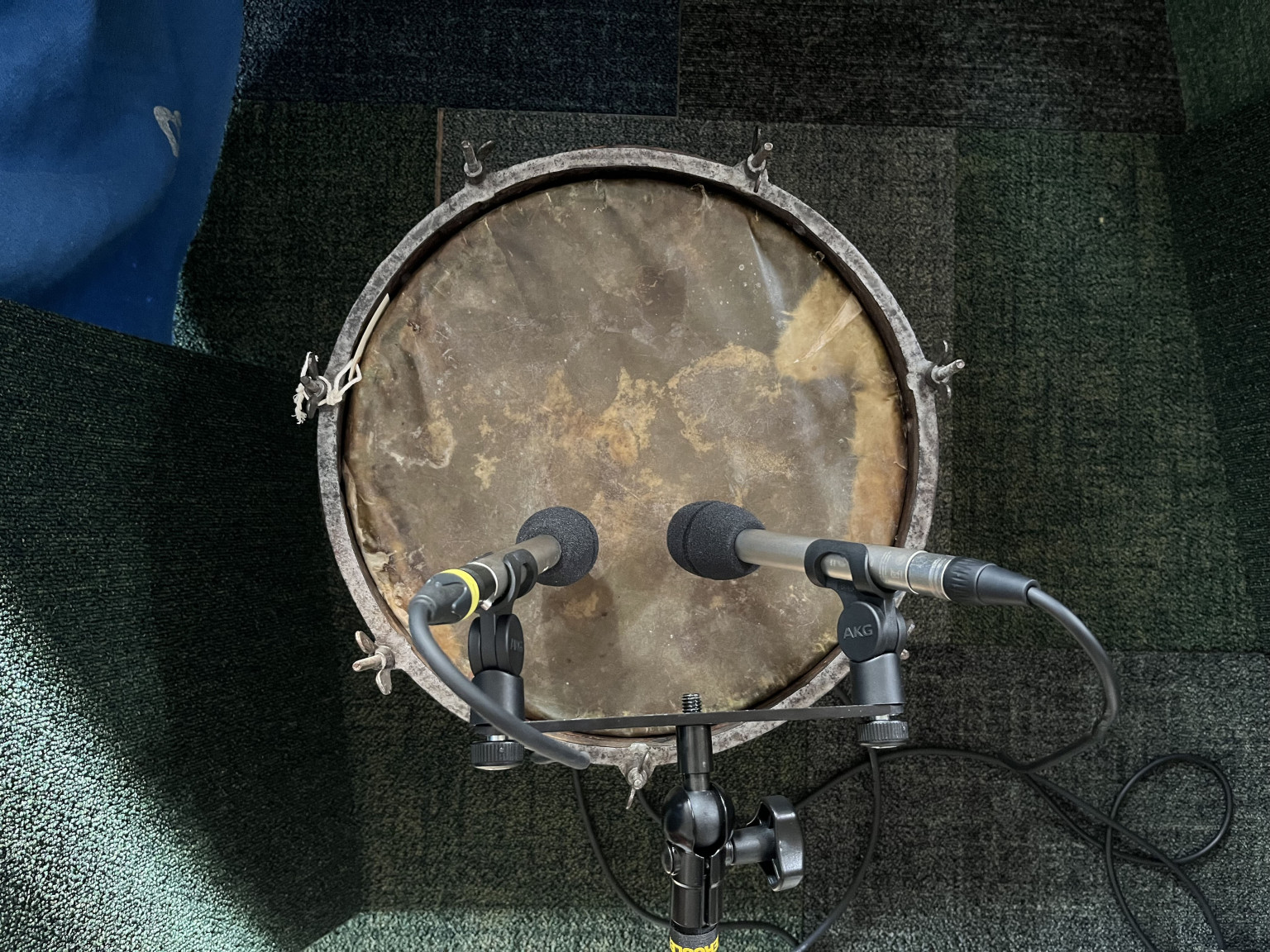
In this audio paper we will explore aspects of sonic citizenship as expressed through a cultural heritage object: the town drum. Town drums are central to Danish cultural history and have been used as tools for civic communication – to regulate, warn, gather, represent, built and connect communities. This audio paper focuses on one drum: the town drum used in Struer from mid 19th century to around 1930 – now part of Struer Museums collection.
Due to preservative measures the drum is now almost silent and can only be touched gently by the museum staff. The paper follows our investigation of the drum and its sonic properties and functions within the framework of sonic citizenship. Building on Ahmed’s notion of stickiness (2014), Riegel’s concept of age value (1982) and Højlund et al. (2024) we investigate the affective potential in interactions between sound, object and listener. Listening to the city drum through gentle physical interactions and readings of archival and published sources, we explore how the sound of the drum has circulated notions of authority, identity, and territoriality, and we ask how cultural heritage objects like this might serve as entrances to historical sound cultures.
Audio paper
Keywords
Bibliography
Ahmed, S. (2014) The Cultural Politics of Emotion. Second Edition. Edinburgh: University of Edinburgh Press.
Holstebro Avis, (1891) ”Branden i Struer.” 4. juni p. 3. Mediestream, accessed September 8, 2025, Mediestream - Holstebro Avis (1880-1895), 4. juni 1891 (statsbiblioteket.dk).
Holstebro Dagblad. (1894) ”Ildløs.” 18. november p. 5. Mediestream, accessed September 8, 2025 Mediestream - Holstebro Dagblad (1881-1983), 18. november 1894 (statsbiblioteket.dk).
Højlund et al. (2024) “Sonic Citizenship: About the Messy and Fragile Negotiations With and Through Sound.” In Journal of Sonic Studies 26(26), accessed September 8, 2025, https://www.researchcatalogue.net/view/3032038/3032039
Kreutzfeldt, J. (2009) Akustisk Territorialitet: Rumlige perspektiver i analysen af urbane lydmiljøer: R. Murray Schafer, J.-F. Augoyard, G. Deleuze & F. Guattari. PhD Thesis, Det Humanistiske Fakultet, Københavns Universitet.
Kullberg, M. (2016) Om at samle på hændelser: Bevaring og registrering af flygtige kunstformer. PhD Thesis, Det Humanistiske Fakultet, Københavns Universitet.
Riegl, A. (1982) “The Modern Cult of Monuments: Its Character and Its Origin”. Translated by Kurt W. Forster and Diane Ghirardo. In Oppositions 25: 21–51.
Sandfeld, G. (1982) Fra en helt anden tid: Struers udvikling fra næsten ingenting til næsten købstad, 1855-1900. Struer: Struer Museum.
Sandfeld, G. (1987) Nye Tider. Struer bliver købstad: 1900-1920. Struer: Dalhus.
Smith, L. (2014) “Intangible Heritage: A Challenge to the Authorised Heritage Discourse.” In Revista d’Etnologia de Catalunya 39: 12–22.
Søgaard, H. (1980) “H.C. Andersens O.T. som kulturhistorisk kilde.” Museum Odense https://museumodense.dk/artikler/h-c-andersens-o-t-som-kulturhistorisk-kilde/#reflist-1980-08-a16 (accessed September 8, 2025).
UNESCO (1972) Convention Concerning the Protection of the World Cultural and Natural Heritage. UNESCO, accessed September 8, 2025, https://whc.unesco.org/archive/convention-en.pdf
UNESCO (2003) Convention for the Safeguarding of the Intangible Cultural Heritage. https://ich.unesco.org/doc/src/15164-EN.pdf (accessed September 8, 2025)
Vejle Amts Folkeblad. 1940. ”Trommemanden – den lille By’s festlige Reklamevæsen”, 14. september p. 2.