



Mobile sonic citizenship


Abstract
Bruno Latour et al.’s Comment atterrir? argues that globalisation and the ecological crisis have eroded traditional understandings of citizenship, calling instead for new methods of “landing” grounded in sensorial inquiry and relational interdependencies. In this spirit, the Helsinki-based ExoSound project explores outdoor electronic co-sounding as a sensorial and participatory practice of landing through sound – listening, sounding, and relating with the environments. From this practice we develop the concept of mobile sonic citizenship: a form of citizenship that is performatively enacted through situated relational sonic practice and opens up “mobility” as a flow of identification, agentic expression, and relations-building through sound. We theorise mobile sonic citizenship as composed of four interrelated modalities – processuality, interactivity, performativity, and place-fullness – each made tangible through first-hand sonic fieldwork. Together, these modalities articulate how sonic practice fosters citizenship as linking humans, places, and environments in dynamic ways. Drawing on theories of place and space and artistic research, we argue that mobile sonic citizenship constitutes both a theoretical lens and a lived practice of nurturing connectivity and belonging in contemporary cities.
Introduction
In recent years, the question of citizenship has been revisited in light of ecological crises, technological transformations, and shifting forms of collectivity. Thinkers such as Amin (2012), Isin (2017), Morizot (2022), and Latour (2025) have stressed the need to understand citizenship beyond legal or institutional statuses as an embodied, relational, and performative practice. This processual view highlights how citizenship is enacted through sensorial and situated experiences, rather than simply bestowed from above.
The urge to rethink citizenship and the meaning of being a citizen is driven by the negative impacts of human activities on ecology and collective well-being in the era of the Urbanocene (Barak and De-Shalit, 2025). Moving beyond the urban growth machine, and conceptualising the citizen as more than a consumer or a user of efficient and functional urban infrastructures, requires alternative visions and sensory imaginaries of the “city”. Similarly, it requires a new understanding of the citizen, one that can adapt to the complex systematic challenges while expressing agency, subjectivity, and engagement with what is possible and within their reach.
Within this theoretical context, artistic practices interplaying with the sensorial offer fertile ground for rethinking citizens as well as citizenship in contemporary societies. Among artistic media, sound – being inherently relational and ephemeral – offers multiple affordances, understood as opportunities enacted through the direct perception and experience of the environment (Heft, 2010), to experiment with agencies and connections situated within the sonic environment it creates (Schafer, 1993).
In this paper we discuss the ExoSound research-creation project, based in Helsinki. ExoSound investigates outdoor electronic music-making as a participatory and non-staged practice that entangles human, non-human, and technological agents. By relocating electronic music from studios and concert halls to urban and periurban spaces, ExoSound creates conditions for listening, sounding, and coexisting with the environment. In doing this we need to rethink our technological apparatus, opting for lightweight devices that allow for mobility, connectivity and accessibility (Aavanranta et al., 2025). The practice thus constitutes a dispositif (Crano, 2020) that interlaces technology, environment, and collective agency into a socio-material arrangement.
The ExoSound framework serves as a case study to bring forth the concept of mobile sonic citizenship: an enacted mode of belonging and landing that arises through co-sounding in a variety of outdoor environments. We argue that sonic practices can foster sensorial forms of citizenry, producing a different experience of the city. The ephemeral but intense engagement with and through sound substantially differs from the instrumental forms of connectivity facilitated by efficiency-oriented urban regimes. Our aim is to promote knowledge in this area by proposing a detailed level of articulation of the modalities, affordances and challenges affecting and arising from mobile sonic citizenship. The central research question guiding this paper is: how do outdoor electronic sound practices enact mobile sonic citizenship in a sensorial and situated manner?
The paper is structured as follows. We first review theories of citizenship as processual, performative, place-based, and sensorial. We then articulate the ExoSound dispositif as well as our conceptual framework of mobile sonic citizenship, developed in dialogue with ritual & performative theory, and artistic research. The methodological section describes ExoSound’s practice-led research approach and methods of ethnographic and autoethnographic documentation of outdoor sonic practices. Drawing on fieldwork examples from Helsinki, we illustrate the emergence of the mobile sonic citizenship in different sonic actions and different settings. Further, we outline the socio-material affordances and challenges of ExoSound sonic practice for enacting mobile sonic citizenship, understood as opportunities or obstacles for action emerging during human-place interaction. We conclude by discussing the potential of the mobile sonic citizenship concept for further scholarship on sound and creative sonic practice addressing the crises of belonging and attachment in the Urbanocene era.
The experiential turn in citizenship studies
The concept of citizenship has traditionally been defined through legal, institutional, and political frameworks. However, contemporary scholarship increasingly challenges this narrow understanding by emphasizing citizenship as a dynamic and embodied practice. Scholars across political theory, sociology, and cultural studies argue that citizenship must be approached through lived experiences, situated practices, and relational forms of participation that exceed formal rights and duties. We sum up key scholarly positions in this approach to citizenship.
In Land of Strangers (2012), Ash Amin diagnoses the erosion of subjectivity in globalised urban contexts as a fundamental challenge for democracy, social solidarity, and ultimately for citizenship. Sustaining a vibrant public domain and social life requires people to relate to one another as involved subjects rather than as strangers. For this to occur, Amin argues, a specific “materiality of transactional environments” is necessary – settings that compel interaction and exchange, and that bind individuals together through contingent, shared experience. Building on this perspective, citizenship can be understood, first, as a processual phenomenon: it is continuously enacted through the making of relations, connections, and interdependencies. Second, it is inherently embodied: to become citizens in a substantive sense, individuals must engage in situated, bodily practices, acquire hands-on knowledge of places, and remain present within their materialities.
Isin (2017) has foregrounded the performative “face” of citizenship, understood not as the passive confirmation of rights or compliance with rules, but as the active and creative enactment of being a citizen in everyday life. Through practices of attaching meaning to rights, norms, and obligations, as well as contesting and reinterpreting them, individuals learn and feel their way into citizenship, often generating new forms of civic agency in the process. This notion resonates strongly with ritual and performative perspectives on the structuring of social relations in society. For instance, Collins (2004) highlights that micro-level practices – small acts of repetition and interaction – structure collective agency and social bonds within social groups. Scholarship on participatory, community, and socially engaged arts adds creative social practices can enact citizenship beyond its mere representation. Citizenship is not purely discursive but is an embodied and expressive practice (Rovisco, 2019). Taken together, these insights suggest that citizenship as a particular manifestation of sociation and social expression emerges dynamically in and through performative acts, where human beings enact, rehearse and transform their roles and relations.
Though not speaking directly about citizenship, Tuan (1974) has foregrounded the interpretation of human agency and subjectivity as deeply entwined with place and place-based lived experiences. Through what he terms topophilia, or the affective bond with places, individuals anchor their everyday activities and aspirations in concrete spheres of life. Places provide people, living collectively, with shared material and symbolic contexts where they can develop cultural orientations and personal attitudes towards the surrounding world. Places also enable social action affording different opportunities for agency and targets for transformation (Raymond et al., 2017). In this sense, places can be seen as active supports in the formation of citizens, shaping how civic roles are performed within specific milieus. Thus, acts of citizenship unfold in localities where local communities shape the material environment or create symbolic spaces which embody collective memory. The urban environment, in particular, foregrounds the connection between the communities and the places through civic acts: as a terrain of abundant possibility, it hosts tactical and imaginative practices creating shared spaces while as a context marked by power hierarchies and inequalities it is contested and reappropriated. The complexity of the urban environment contains a variety of venues to practice citizenship as an agency.
The debate on the contemporary eco-socially induced dissolution of citizenship emphasizes the role of sensoriality in finding the basic grounds for belonging and connecting. Indeed, the modern English noun and verb sense derives from Latin sensus “perception, feeling, undertaking, meaning," and is rooted in proto-Indo-European sent- “to go”, through an analogy between “finding one’s way” in the material world as well as in the affective-mental domain. Trinka et al. (2013) argue that feelings of belonging and exclusion emerge from associations with the olfactive, visual, haptic and auditive senses. The familiar and comforting sensory stimuli result in a generic sense of “home” while alien and alarming perceptions may call feelings of rejection and danger. Barthes (1985) famously referred to the ear as the organ of fear, a vehicle of animalistic alertness, scanning the environment for danger and serving an individual instinct of survival. In opposition, Damsholt (2008) argues for a socially generative role of aural cues, where citizenship is in part constructed through sound and soundscapes, such as the ceremonial use of sound in anthems, schools and recitations. Thus, seen through an etymological lens, sensorial practices are means of understanding, making sense and pointing out ways through complex situations. In this respect, sensoriality and the capacity to act constructively in the contemporary context are intimately linked, establishing the prospect of a sensorial citizenship (Trnka et al., 2013), and highlighting its potency of action.
Art, as an essentially sensorial activity, is widely seen as a crucial means of confronting unfolding social and environmental disintegration and of constructing more responsible and sustainable ways of being. Exploring the role of the sensorial in society in the final years of his life, and building on “Where to land” (Où atterrir?), Bruno Latour initiated a multi-year fieldwork project in rural France involving local “citizen-experts” and a collective of researchers and artists (Latour et al., 2025). The background of the initiative was an observed rupture of French civil society due to the effects of globalisation and the ecological crisis. With the startling question “What to do when there are no (more) citizens?”, the research collective developed a method of co-working with local communities based on a set of questions, exercises, discussions, and shared artistic practices, designed to experiment with ways of repairing broken societal ties and fostering a renewed sense of participation. In an interview, Latour refers to this process as ethnogenesis, arguing that for a nation to function it needs citizens who believe in a common body and in their own inclusion within it (Latour et al., 2025, p. 164). The method foregrounds essential interdependencies, encouraging to recognise that the contemporary context is marked by the impossibility to precisely describe the flows of materials, energy, food, or even ideas that make up our environment. As an antidote, the collective created a dispositif – a socio-artistic device – for “landing” anew into the local territory. Sensorial enquiry through the arts plays a key role in the process, as it enables “bodies that are capable of feeling and expressing” (Latour et al., 2025, p. 73).
Based on these scholarly ideas, we develop our own concept and definition of mobile sonic citizenship, which incorporates the understanding of citizenship as fluid, enacted, responsive, and sensorial, while focusing on the realm of the sound and agencies, connections, and spaces enabled by it under a certain dispositif.
Toward mobile sonic citizenship
Current scholarship on sonic citizenship shows that everyday sonic actions can constitute the publics, show the boundaries of social and political inclusion and exclusion, and shape the sense of belonging (Lacey, 2013). Sound can enable attunement and collective production of acoustic space and function as “civic infrastructure” that shapes public feelings and social participation in collective processes (Bosch, 2025).
The network of interconnected concepts we use to develop our approach to sonic citizenship includes a sonic citizen who can be understood as an agent who develops a sense of belonging to a local community and chooses to engage with it through sound. Such engagement unfolds during sonic practices (or sonic actions), when agents produce, arrange, apprehend, and experience both existing and created sounds within a shared environment. When multiple sonic agents participate in these practices, they co-create a shared sonic timespace – a “practiced emergent” soundscape (Droumeva, 2017) – that exists only in the here and now. Within this sensorial continuum, participants forge new interconnections, not only through sonic exchanges but also through multimodal sensorial relations. Through such embodied linkages with others and with the surrounding environment, sonic agents cultivate a form of relational intersubjectivity that is intensified by the affective and immersive qualities of sound (Lähdeoja and Montes de Oca, 2021). This intersubjectivity, embedded in memory and capable of recurring across different practices, constitutes the foundation of sonic citizenship.
Our vision of sonic citizenship builds on the attuning approach (e.g., Højlund et al., 2024), which emphasizes the situated adjustments between listener and environment. Remaining grounded in this perspective, we extend it by proposing a broader sociological view: sonic citizenship emerges from the dense web of interconnections among human and non-human agents, sound, and place. Crucially, disruptions in these interconnections – whether through inequalities, exclusions, or failed engagements with place – can compromise sonic practices and hinder the formation of a full sense of sonic citizenship. Thus, sonic citizenship should be understood not as a fixed state, but as a fragile, negotiated, and contingent condition of collective life.
We define mobile sonic citizenship as a mode of belonging that emerges through outdoor electronic co-sounding inseparable from movement, place, and collective attunement. We understand mobility as the dynamic quality of social life (Urry, 2007) and as the transgressive force that underpins transformation. Our concept of mobile sonic citizenship stems from and partakes in a wider artistic-discursive context where both the site of practice as well as its inherent relationalities emerge as the focal points of inquiry. The field is populated by kin concepts and approaches. For example, place attachment and place-based attunement (Lynch and Mannion, 2021) denote socio-environmental processes that explore the deep, sensory, and relational connections between individuals and their environments through arts of noticing (Tsing, 2015). While sharing a similar concern for the formation of a relational connection with the environment and its inhabitants, our approach forwards an agential, sonically active and practice-led stance. Our mobile sonic citizen is a musician, or a sounder, who works in an aural action-perception loop with their environment, just as an improvising musician would do with their co-sounders. This attitude is closely related to the term of sonic engagement (Woodland and Vachon, 2022), which designates forms of community-engaging audio practice. Also, Brandon LaBelle’s sonic agency (2018) comes close, with distinctively political and activistic undertones. While our experiments towards Mobile Sonic Citizenship are certainly community-oriented and political in essence, they encompass both anthropic and more-than-human dimensions and their political engagement is above all based on a sensorial, soft and dialogical stance, in contrast with activistic ethos towards explicit systemic change and resistance.
In ExoSound’s outdoor sessions, sonic mobility manifests in multiple registers. At the sensorial level, the acoustic regime of a place shifts as sounds are introduced, layered, and reinterpreted through interaction with material textures, surfaces, weather, and environmental resonances. Sonic practice presupposes movement – walking, listening, sounding – and produces sonic events that are inseparable from the specificity of place, while simultaneously reinterpreting and reanimating it. At the experiential level, sonic practices reconfigure places as dynamic and relational, opening up novel ways of dwelling and engaging in collective life.
Mobility also carries ritual and mobilizational dimensions. Ritual elements often emerge in sonic practices, whether through structured phases (beginnings, transitions, endings) or through symbolic gestures and recurring patterns. Such rituality, long associated with the maintenance of solidarities, acquires renewed importance in contemporary contexts marked by social fragmentation. At the same time, outdoor sonic practices function as sites of mobilisation: they activate the sonic senses, stimulate new affective and social connections, and reorient individuals from alienated urban dwellers into participants of shared sonic timespaces. Unlike conventional mobilisations that often arise around shared risks or grievances, sonic mobilisation operates with a positive valence – through the co-creation of sound, emotion, and beauty. In this way, outdoor electronic co-sounding sessions foster a mobile sonic citizenship that is collective, embodied, and generative of new forms of belonging.
ExoSound: a dispositif for enacting mobile sonic citizenship
At its outset, the ExoSound project is based on a simple gesture: transfer live-electronic music from studios and concert halls to the outdoors. At the current stage of mobile technologies, professional-grade digital sound engines and processors are readily available on app platforms and web browser applications. Wireless Bluetooth loudspeakers offer convincing, psychoacoustically adapted sound diffusion with very small sizes and weights, on top of being often weatherproof. Live-electronic (or electroacoustic) music practices, traditionally nested in sheltered studios, are at present readily deployed in exterior spaces. The shift towards lightness and mobility constitutes a larger societal and technological trend. For example, with the advancements in material science through modernity, architectural structures and vehicles have acquired plasticity and aeriality (Ménard, 2025). Small-scale solar and wind power has appeared, and battery technology is evolving fast. Ubiquitous computing and internet connectivity shape work, leisure and relationalities. Musical cultures are bound to evolve in sync with this larger movement, acquiring new mobile forms enabled by emerging technological affordances.
The term dispositif offers an effective theoretical lens to examine the ExoSound outdoor electronic music practices with their inherent socio-material entanglements.
Stemming from Michel Foucault and Jean-François Lyotard, the vernacular French term designates a purposeful arrangement, ordering, or plan. Possible anglophone translations include “device,” “plan,” “deployment,” “setup,” and “apparatus”, but in this text, the French original is maintained to mark theoretical continuity. Foucault has used dispositif to designate a “heterogeneous network of discourses, practices, sites, and screens” (Crano, 2020), while for Lyotard, “dispositifs function like psychic traps; that is, the means of channeling, blocking, or otherwise conducting libidinal energies and drives (what one could also call affects or even dispositions). Among these dispositifs are narrative structure, painting technique, psychiatric knowledge, capitalist markets, and even language itself” (Crano, 2020). What makes dispositif appealing for our case is its capacity to encapsulate the multidimensionality of the ExoSound sonic practice, where sound technology is understood as a “socio-material arrangement” (Suchman, 2007), an interlacing of material and social actions, employed towards intersubjective connectivity, place-making, as well as sensorial and aesthetic goals. The environment is constituent of this arrangement, with its inherent ethical and ecological imperatives.
With the simple recontextualisation of electronic music practices to the outdoors, a number of phenomena affecting core elements of the artform are set in motion. A first shift occurs with the aesthetics. Loudspeaker-based music has been obsessed with creating idealised listening conditions, deploying electronics, material and architectural technologies to create virtual auditory spaces, sweet spots, 3D spatialisation illusions and maximal signal-to-noise ratios. Moving outdoors with light sound equipment reconfigures this regime and its aesthetico-scientific ideals. The outdoor environment is inherently full of sounds, and unless the goal is to override the sonic environment with festival-like decibel levels, the only reasonable option is to embrace them. Instead of interference and nuisance, environmental sounds become parts of a practice of sounding, listening, attuning to the environment and the fellow sounders who might be human or man-made, such as machines or city hum; or non-human such as animals, natural elements of wind, water and snow. For a musician accustomed to playing in bands or ensembles, the outdoor electroacoustic improvisational situation is very familiar: jamming! Only that the co-sounders are not necessarily human musicians, but sounds emanating from a range of sources without predetermined hierarchy. From an aesthetic ideal of purity, one moves towards aesthetics of compromise and negotiation, and possibly of respect and understanding as well.
A second shift emerges on the plane of relations. Where musicking is readily recognised as a vehicle of anthropic bonding, an outdoor sonic practice situates its participants attentively within an environmental complexity and in a sensorial relation of exchanges with it. Beyond sound itself, the outdoors are pregnant with sensorial affordances. The immediate physical environment is supplemented and entangled with cultural-historical and non-human dimensions and agencies. The space is of an infinite complexity that human attention and sensory system can only partially apprehend at any given moment. Moving outdoors to different urban, periurban or rural locations, the relational dimensions of sounding grow to encompass abundant multisensorilities and imaginaries that are more complex than those in more traditional indoor settings. Through mobile sonic citizenship, sites and spaces become places with agency that feeds into the sounding practice. Temporal sonic communities emerge between the human and non-human sonic agents, characterised simultaneously by place-making and transitoriness. The practice occupies and reclaims a place as a sensorial one, in difference to its habitual pragmatic or utilitarian uses. The “altered state” of place-making lasts for the time of the practice, after which the place returns to its everyday role. Transitoriness and mobility contribute to the emergence of a fine line between place-making and place-consumption, according to the degree of integration and sense of placefulness that is achieved. Also, the formation of a temporal sonic community automatically produces a line of separation between those who are included within it and those who are excluded. Co-sounding in an outdoor location with by-passers is a situation where the group of practitioners shares a “secret”, unknown and alien to the other occupants of the place, and to which they react, for example, by curiosity, dismissal, or neutrality.
ExoSound research framework
Following its dispositif, the methodological framework of the ExoSound project is grounded in principles of qualitative action research (Chevalier and Buckles, 2013) and research-creation approaches (Aavanranta and Bédard-Goulet, 2025). Accordingly, the methodological framework enacted so far consists of two main components: (1) action – experimental outdoor sonic sessions conducted by the interdisciplinary ExoSound team; and (2) research – multi-component ethnographic documentation combined with collective and individual autoethnographic reflection on the sonic practice. Action (creation) and research components cross-inform each other. Though the ExoSound team has differentiated skills and background knowledge of musicians and researchers, during sonic sessions it acts as a one collective body.
Experimental sonic sessions of ExoSound are mobile (move through different places and environments in Helsinki), socially and technologically open-ended (comprise a different composition of ExoSound team participants, different sonic equipment, apps and tools), and sonically diverse (encompass different sounds, sonic features). Therefore they result in a rich diversity of various forms of sonic practice in different outdoor environments.
All sessions are audio, photo and video documented (public archive of ExoSound sessions is available on Vimeo: https://vimeo.com/exosound). The archive of this audio and visual data serves as ethnographic material for further procedures of qualitative inquiry: coding of environmental, social, technological, and sonic features; exploration of hidden patterns and dependencies across different aspects of the sonic practice; interpretation of some aspects of the sonic practice through the others; selection of highlights; and similar ones. Ethnographic material serves as an objective and contextual foundation for a more subjective autoethnographic reflection.
Autoethnographic approach justifies the value of tacit knowledge and intuitions informed by the personal experience of a researcher or a participant of a certain practice (Denshire, 2014). As suggested by Ellis and Bochner (2000), our ExoSound team reflects on personal feelings, emotions and thoughts occurring during the sonic sessions. Autoethnographic reflection methods include: post-session individual diary entries and post-session intragroup discussion of the sonic session. In our autoethnographic reflection and diary keeping we follow the principles of “thick description” as formulated by C. Geertz (1973). We describe in a detailed manner different aspects of the session, with an explicit focus on a) place (environment), b) connections between human members of the team and with non-human agents, c) technological setup, d) sound and different sonic features.
All in all, data produced and collected during action and research components of the project comprises a) visual data, b) sonic data, and c) narrative data. Since the project is evolving, the analytical concepts and frameworks evolve with it. The qualitative processing of empirics, described above, aims at creating valuable analytical lenses as informed and rooted in rich subjective-objective data and creative sonic experience. We follow the grounded theory approach (Strauss and Corbin, 1990) with inductive and iterative data collection and analysis which are intertwined and continuously inform each other. In the same manner we have approached our data to construct our interpretation of the sonic citizenship for this paper.
In ExoSound practice-led research, data collection, processing, and analysis we stress on the ethical principles of respect, minimizing harm, and justice especially towards places (environments), non-human species and human participants other than members of the team. Inside the team we follow principles of equality, equity, inclusivity, trust, and care for each other.
Helsinki as a context for outdoors electronic co-sounding
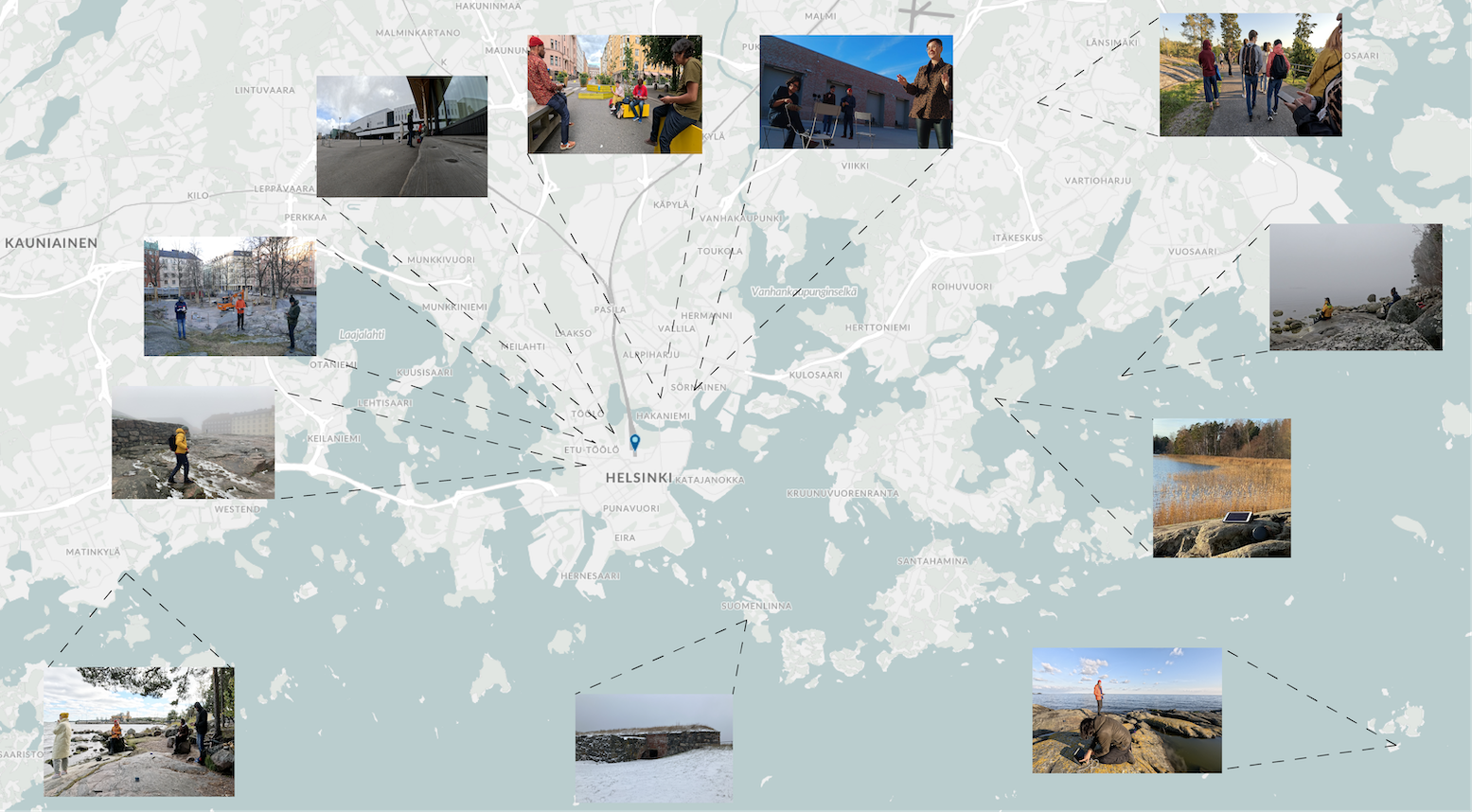
Helsinki, the Finnish capital, is ExoSound’s main context, with 14 field trips conducted between August 2024 and September 2025; 5 more sonic actions took place beyond the Helsinki area. The practice-led enquiry is embedded within Helsinki’s social and environmental geography, which constitute determinant factors in the work’s unfolding.
As the ExoSound project investigates outdoor music, it also investigates specific places in Helsinki. The mobile nature of the dispositif allows for a wide range of settings to be experimented with, from forested or maritime to urban and sub-urban places. A first rationale in place selection has been variety: to test the practice in multiple, very different environmental and socio-geographical settings, as well as in all seasons. A second step in refining selection criteria has been to emphasise topophilia. Each group member has chosen one place of special affective value in the Helsinki area, which then becomes an anchoring point for repeated sounding sessions, as well as for closer study of its cultural history, environmental specificities, architecture, sociology, leading to detailed discussions on its affect-value. The focus on topophilia also reflects an interest in dynamics of integration into Finland, as three of the four working group members have settled in Finland at a later stage in their life. The underlying working hypothesis is that through shared outdoor sonic practices, it is possible to forge a sense of environmental and social belonging in the northern, sometimes inhospitable, territory.
Grounding mobile sonic citizenship in Helsinki data
Following a grounded theory approach, we inductively constructed the concepts describing subjectively meaningful socio-ecological exchanges with place during on-site sonic practice. We examined all 14 cases of ExoSound outdoor improvisations, deeply and interpretatively reading and analysing cross-sections of ethnographic and narrative data. Each team member individually worked with different corpora of data, including written diaries, photographs, and video recordings, taking notes. These notes were subsequently discussed collectively, allowing us to identify recurring themes and consolidate them into a common analytical framework. In the end, we arrived at the conceptual triangle of sonic agencies, sonic practices, and sonic timespaces as a pattern re-occurring in our diaries as well as in revision of the field recordings.
The sonic agencies appearing during the ExoSound sessions are of different types and configurations, not only manifested by us four, but also by those encountered and interacted with in each context – human and non-human agents entering our aesthetic attention through sound. These different agencies undertake various sonic actions, whether intentional or incidental, and define the features of the case-specific sonic timespaces as they emerged in presence. The sonic timespaces are different in variety, salience, and dispersion of sonic agencies and actions, as well as their perceived or imagined socio-ecological effects.
Interpreting the interconnections of sonic agencies, actions, and timespaces further through data, and guided by our practice-led knowledge and intuition in the search for their deeper implications for human-place and human-environment interactions, we arrived at the concept of mobile sonic citizenship, introduced above. We traced how it is enacted in ethnographic detail, taking different forms in different settings. For example, ExoSound outings in urban nature settings of non-central Helsinki islands prompted an inward attentional shift among us four, characterised by prolonged listening, silencing, and embodied attunement – described by one of us as “feeling like a tree.” These contexts gave more space to hear and sonically interact with non-human sonic agencies, for instance, the trees, the birds, the wind, and their sounds. This fostered soft co-sounding practices and shaped meditative, rhythmically slow sonic timespaces where a deeper engagement with the natural landscape became possible. This kind of setting and practice brought forward the sense of human belonging to natural environments and gently attuned us to their sonic rhythms and intensities, mobilising our natural instincts and discouraging anthropocentric assumptions. By contrast, ExoSound sessions in urban public spaces of central Helsinki – with their functional infrastructures and exposure to diverse publics – generated more active sonic rhythms, higher noise levels, and denser encounters with human agencies, activities, and regulatory frameworks. We tended to engage in more “pro-active” sonic actions, sometimes at higher sound levels than in quieter settings, sonically interacting (e.g., by touching and recording) with human-made surfaces and objects. Interaction with the preestablished, designed, functional materialities of the public spaces – which often felt as something either normalised or alienated from our agency – was enabled with sound. As one team member put it, “sounding the space and its forms” through our sonic actions made it ours, here and now.
Through comparative analysis, we arrived at an understanding that the “mobile,” the “sonic,” and the “citizen” components of mobile sonic citizenship manifest through different regimes, or modalities as we termed them. Each ExoSound outing revealed distinct forms and intensities of movement, interaction, connection and transition onto the place and the context, as well as attributes of practice that could become ritualised or symbolically charged, even when deliberately framed as non-performance.
Overall, the analytical process foregrounded individual and collective interpretative reverberations of our four-member research team, while voices of anthropomorphic sonic Others, non-team participants, entered the analysis in only two sessions. We acknowledge that this limits the diversity, equity, and inclusivity of meanings represented in the field data and, consequently, in the interpretations developed. This limitation, however, does not undermine the core principles of our dispositif which is open to accommodate multiple agencies and an expanding network of relations between them and the place. Yet with more participatory sonic sessions in future, richer ethnographic details and deeper insights into the durability, accessibility, and relevance of mobile sonic citizenship can be expected.
The following sections displaying the results are organised as follows. First, we introduce four modalities of mobile sonic citizenship identified through the analysis, each illustrated by a specific ExoSound case and highlighting particular aspects of socio-ecological attunement and senses of belonging. Second, we examine the affordances and challenges of ExoSound sonic practice for enacting mobile sonic citizenship, considered through the prism of these four modalities.
Modalities of mobile sonic citizenship in practice
Outdoor electronic co-sounding practices within ExoSound make tangible the ways in which sonic citizenship unfolds through multiple modalities. These modalities are not discrete categories but interwoven dimensions that reveal how sonic belonging is enacted in situ, through sound, interaction, and environment. In what follows, we discuss four key modalities – processual, interactive, performative, and place-based – each illustrated with examples from our fieldwork.
Firstly, we consider mobile sonic citizenship to be processual. Becoming a mobile sonic citizen is a matter of here-and-now involvement with other members of the urban environments and places through the medium of sound. Unlike institutional or legal frameworks where citizenship is acquired as a status, sonic citizenship emerges dynamically as agents open up, listen, and connect in order to remain part of a sensorial continuum. This process activates responsibility and attentiveness toward others and toward the environment, but it is by nature temporary: focus and heightened awareness fade with the end of practice. Repetition reactivates the process, taking up from where it was left off. Sound itself reinforces this dynamic, as it resists stasis and closure, always in movement and transformation. Through this process, participants perceive the city as an “open text” written by many overlapping and marginal processes.
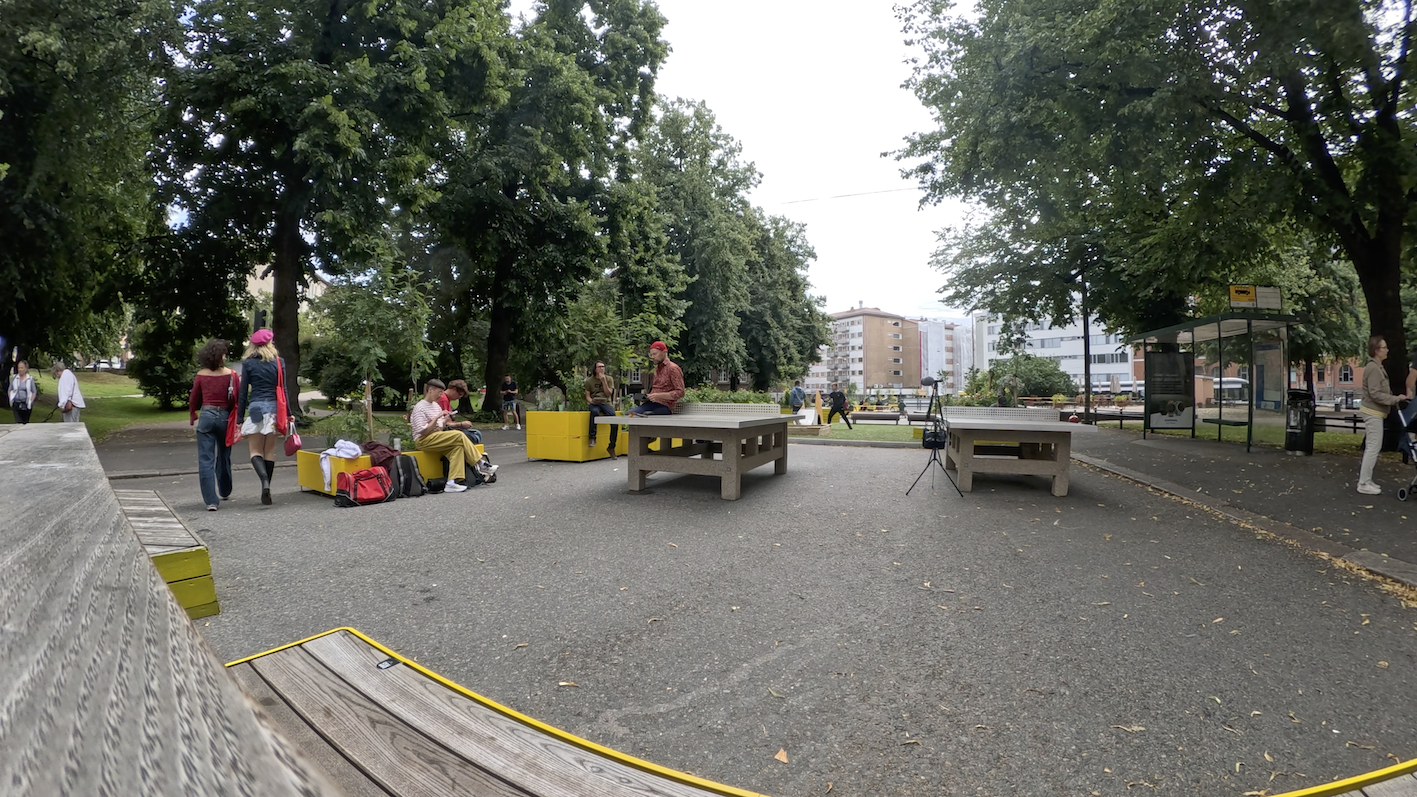
A case example of processuality may be provided by an outdoor sounding in August 2025 in Helsinki’s Kallio district - an ex-working-class neighbourhood that has grown into an indie culture hub. For the summer 2025, Kallio’s “Karhupuisto” park was turned into a common living room by the installation of furniture, flowerbeds, playgrounds and ping-pong tables. The sounding session started by playing ping-pong, a recreational activity that made participants engage with ease and lightness. Eventually, the ping-pong sounds were sampled and broadcasted on top of the game, creating a humoristic sonic dedoubling of the game (snippet of the video documentation: https://vimeo.com/1120045204). A note from the field diary highlights the casual nature of the practice:
The beginning of the practice was very chill, D. and I started just playing ping pong while O. and S. started doing some sounds and documenting the session. O. recorded the ping pong sound and started playing with it. (Excerpt from the field note diary)
The sound work went on into textural materials conversing with city noises and ultimately electronica-like beats. The casual afternoon sounding stirred bypassers’ interest, amused comments, and perhaps suspicion. It weaved a layer of unexpectedness to the situation, an aural equivalent of an exotic scent, enabling the emergence of a “sonic possible world” (Voegelin, 2021) in an everyday context.
Secondly, sonic citizenship is interactive. Agents connect listening to and sounding together, creating structures of sociation and/or hierarchy. Importantly, sonic interactions are not confined to humans: they may extend to non-human agents. Dialogical practices of sounding have been attempted, for example, by David Rothenberg (2006) with birds and whales. The actual level and meaning of the interaction is, however, a matter of ethology and speculation. During sonic practice a human agent can build and experience connections with different agents as well as in general a connection to what’s around. A sense of sonic connectedness, as being able to sonically influence and be influenced back, resides within a more general sense of community and revives it. The interactive character of sonic connections resonates with awareness of the possibility to structure and orchestrate links with the others.
An emblematic moment of interactivity in our line of research came up with a connectivity experiment in central Helsinki, where the audio feed from a single microphone was used as the sound source for three simultaneous sounding processes, and where the sounders could also tap the signals of their peers. Field notes from the session point out the loss of individual control and ownership:
First time with a live mic feed open to all of us... Getting into it as usual – and then something lively, uncontrolled starts to happen. Feedback, strange sound behaviour, out of control – but still manageable, not getting too loud. This is interesting! Exchanging some looks and smiles with peers. (Excerpt from field note diary)
This distributed signal matrix gave rise to a sense of shared plasticity of the sonic material, as if sculpting a single instance of elastic material, where ownership and authorship did not appear as relevant categories (snippet of the video documentation: https://vimeo.com/1059730907).
Thirdly, sonic citizenship is a performative practice, since it is brought into being only through the embodied act of sounding. To become a sonic citizen is not to hold a stable identity, but to participate in practices that require enactment, repetition, and eventual closure. Sounding together is thus a mode of doing: it has to be undertaken, shaped, and lived out in a particular moment. The performativity of sonic citizenship exceeds the sonic medium itself, as it extends to bodily gestures, social interactions, and frames of conduct that situate the practice. Co-sounding is not simply an exchange of sounds but a multi-layered performance of sociality, group formation, and potentially of solidarity, and presence. However, improvisational sonic practices, especially those entering closed and solidified urban contexts, can also create preconditions for partial segregation or even exclusion.
The complexities of performativity were brought forward when ExoSound was invited to present a sounding walk at the Kontula Electronic festival, an experimentally-oriented electronic music festival in a tenement housing suburb of eastern Helsinki (snippet of the video documentation: https://vimeo.com/1120069654). In this iteration of the practice, the sonic agency was distributed to participants via a website hosting pre-composed soundscapes, and the participants were encouraged to play sound sequences from the website on their personal mobile devices. Some Bluetooth speakers were also provided for more audible sound diffusion levels. A sounding walk was then conducted with circa 15 participants, through the rundown 70’s concrete mall and its immediate environment. A first emergence was a collective empowerment, amusement and wonder, as intricately crafted sounds started bouncing off the concrete walls, mingling with the festival crowd and local bypassers. A few encounters with ad hoc street performers took place, enabling improbable and joyful aesthetic moments to arise, but also clashes of sonic territories and intentions:
There were some performance artists doing their show, a group of people moving around with a very powerful loudspeaker and I saw the student that chose that location for her sound composition with a not very happy face. (Excerpt from field note diary)
Moving further from the festival to the suburb, a sense of a sonic bubble started to emerge. Locals stared at the group of sounders with amusement, bewilderment, or suspicion, as if some UFO had landed on their backyard. “Are you tourists?”, a local came to ask. Thus, in this particular location the practice’s performativity created groups, identities, inclusion and exclusion. The fault lines of sonic territories were drawn along socio-economic class divisions, with U.S. university-educated artist-researchers landing our sonic starship on the daily life of a marginalised and racialised working-class suburb. One has to be careful while working with the socio-material complex of the ExoSound dispositif, as its performativity is potent, and needs careful tending to not produce adverse effects.
Finally, sonic citizenship is place-based. A sonic citizen engages in sonic practice in situ, forging connections with the place and environment through sound. In doing so, they cultivate sonic relations with diverse others who are likewise situated in that locale. The place itself enriches the practice with its atmosphere and sensorial palette, while also framing it materially, socially, and structurally, as sonic agents encounter the resources, constraints, and routines embedded in the site. In this sense, sonic citizenship is fundamentally place-full: it is shaped by, related to, and informed through place. Because of the inherent qualities of the sonic medium, the portability of sound into any environment is coupled with a deeper, situated connectivity. Yet the immediacy of sound-in-the-moment, as it unfolds in outdoor improvisation, is only one facet of this relation. Beyond the here and now, outdoor sonic practice generates multidimensional linkages between human and non-human agents within the environment, producing a form of relationality that is at once ecological, social, and affective.
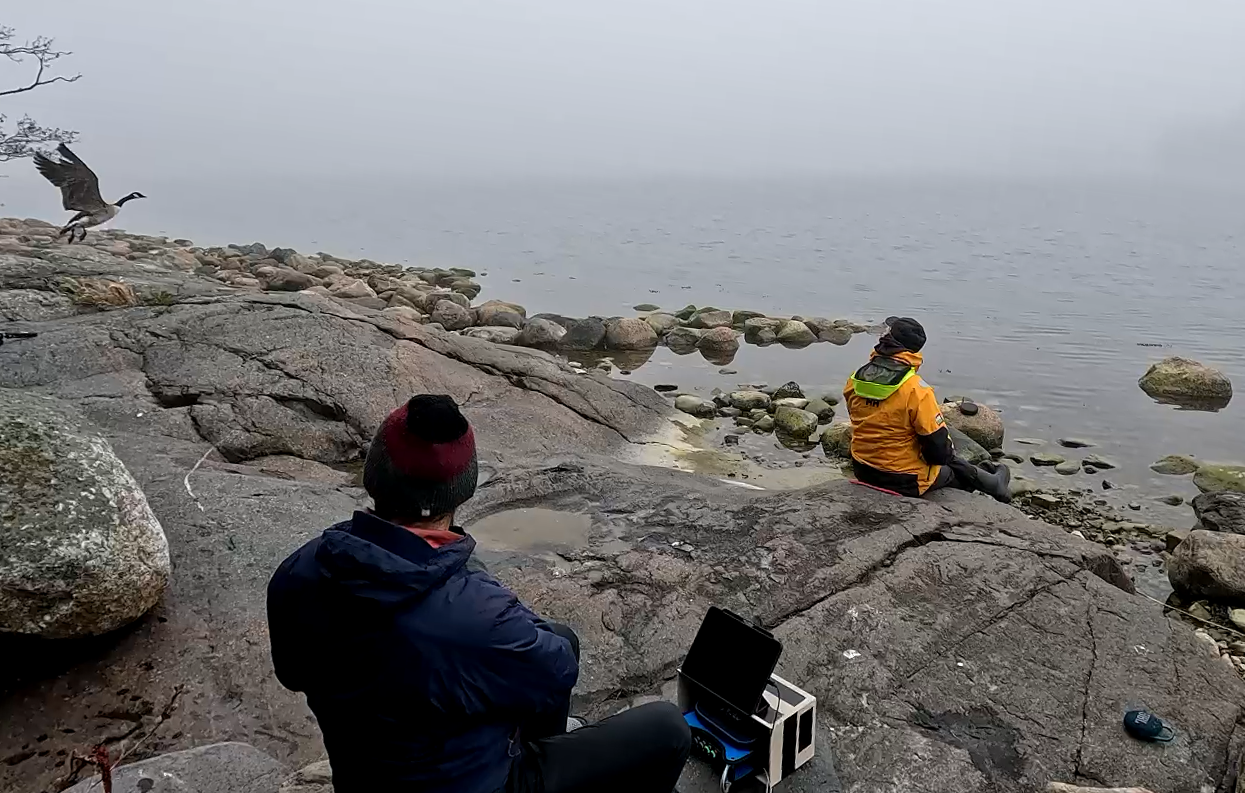
A poignant illustration of the practice’s place-fullness was an early spring boat trip to one of Helsinki’s small islands, Malkasaari (snippet of the video documentation: https://vimeo.com/1079687799). The two participant sounders were the only humans on the island for the entire day. Instead of humans, the island and its shorewaters were populated by migrant seabirds: Canada and barnacle geese, seagulls, terns, long-tailed ducks and eiders, among others. Early spring on the Baltic is a sonorous season. The birds voice out a mighty celebration of the spring, the air is vivid with calls and responses, songs, sounds of wings and water, mixing with distant city sounds and boats passing in the fog. Installed on some coastal rocks, we spent several hours sounding by the sea, and gradually our sonic material grew thinner and thinner. At the end of the session, our playing was reduced to high-frequency whispers and occasional soft rumbles. There was an impression of our sounds starting where the birds’ sounds ended, with the possibility of a sonic continuum at hand. A sense of deep connection with the place and its inhabitants was present.
Affordances and challenges of mobile sonic citizenship
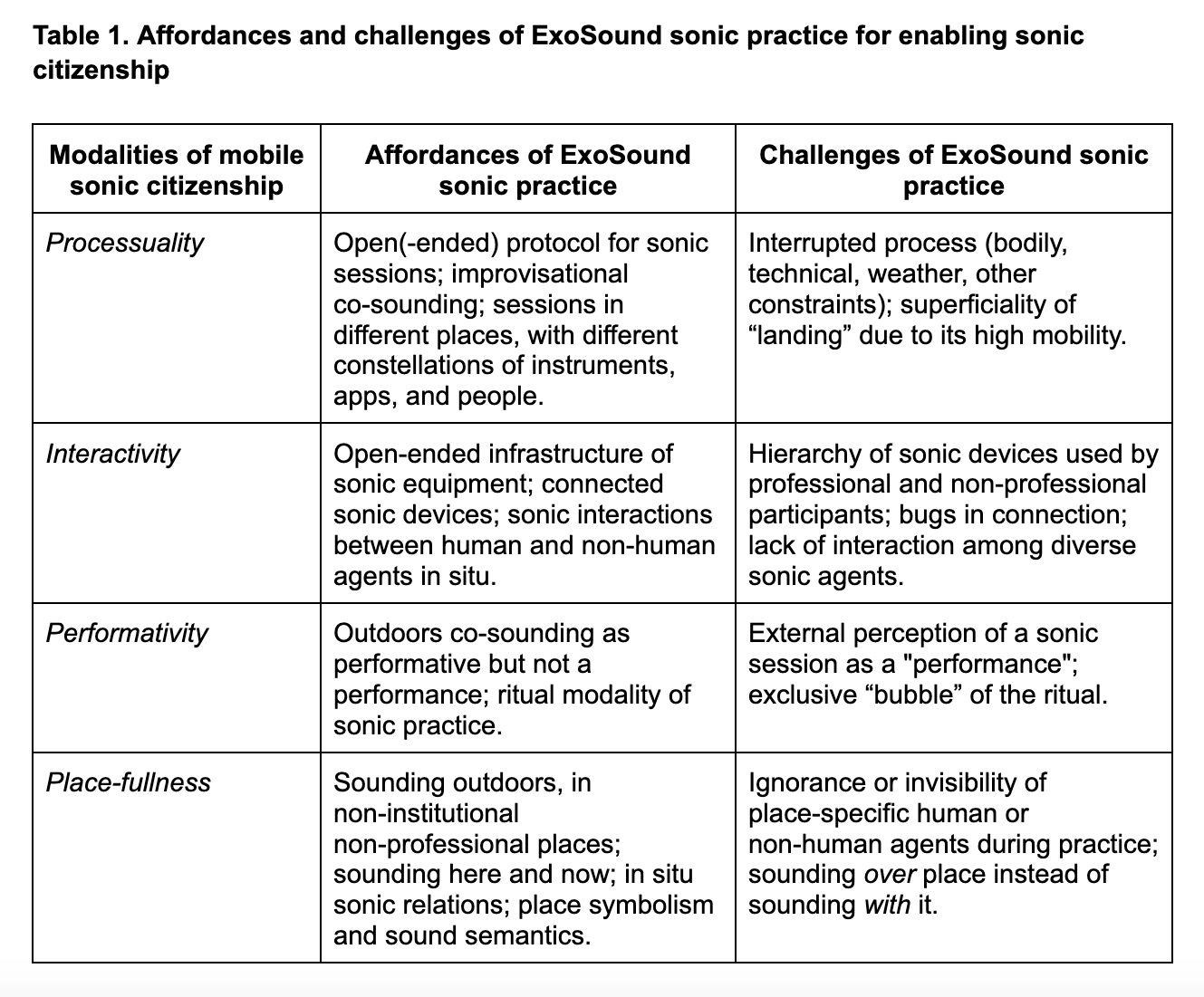
Mobile sonic citizenship and its four modalities are enabled by specific socio-material arrangements within the ExoSound practice. Following Heft (2010) and Raymond et al. (2017), we understand affordances as opportunities that emerge through the direct perception of environmental features during individual interaction with them, and through the actualisation of possibilities for action when these environmental opportunities are combined with individual abilities.The social, material, technological, and environmental aspects of each session create conditions that afford sonic citizenship to emerge, while at the same time posing challenges and tensions. The affordances point to the openness, inclusivity, and creativity of the practice; the challenges reveal its fragility, exclusions, and vulnerabilities.
Processuality is sustained through the open protocols of ExoSound sessions, which are deliberately improvisational and non-scripted. No fixed rules dictate what participants should play, nor are restrictions imposed on the sonic contributions of the environment itself. This openness makes it possible for each session to evolve as a unique sonic process, unfolding through experimentation and variation. The mobility of sessions – moving across diverse urban and natural locations – further underlines their fluid, processual character. Post-session reflection and scenic reconfiguration are also valued, reinforcing the iterative and ongoing quality of sonic citizenship. Yet this processuality is not without limits: bodily fatigue, technical breakdowns, unpredictable weather, or superficial “landings” in new places can interrupt the flow, threatening the depth and continuity of engagement.
Interactivity is facilitated by the portability and adaptability of the sonic equipment. Lightweight devices and apps can be easily connected, scaled, and rearranged, lowering the threshold for newcomers to join and enabling a broad range of sonic interactions. These interactions span from simple sound gestures to complex, multi-layered clusters that emerge collectively, blurring individual authorship. Outdoor practice also extends interaction beyond human participants to non-human agents and material elements, such as the resonance of sound waves against stone or the call of a bird. However, interactivity is challenged by hierarchies in access to equipment, differences between professional and amateur tools, technical glitches, and uneven engagement across diverse sonic agents.
Performativity lies at the core of ExoSound sessions, where sounding together is an act of collective enactment. The practice is performative without being a performance in the conventional sense, as it resists spectacle and emphasises participation. A ritual modality often emerges, through phasing, framing, or the shared temporality of co-sounding. Yet this very performativity can be double-edged. Outsiders may perceive the practice as a “performance” staged for spectators, while participants themselves may feel enclosed within an exclusive “bubble” of rituality. The tension between openness and enclosure highlights the careful balancing act required for sonic performativity to remain inclusive.
Place-fullness is perhaps the most tangible modality, as ExoSound practices always occur in situ, outside institutional and professionalised settings. Each session forges temporary but meaningful connections with the specific material, social, and atmospheric qualities of place. Sounding with attentiveness allows participants to align sonic impulses with the rhythms and textures of the environment, drawing out its symbolic and semantic resonances. Yet here, too, challenges persist: place-specific human and non-human agents may be ignored or silenced, and practices risk “sounding over” rather than “sounding with” the place. The affordance of place-based connection thus depends on sensitivity and reflexivity in practice.
The affordances and challenges of ExoSound’s sonic practice across these four modalities are summarised in Table 1.
Conclusions
As we discussed, based on concrete examples from the ExoSound sonic practice, the mobile sonic citizenship as a multidimensional, contingent, and meaningful way of landing into the city and into being a citizen can be opened through situated co-sounding outdoor sessions resonating with places. Processuality, as one of MSC modalities, is expressed in an open-ended practice, where rituals are not rules to be followed but results of constellations engendered by the other relevant modalities of interactivity and performativity. This leads to a place-fullness that does not stand in contrast with mobility: Rather than a fleeting visit of a disconnected (alienated) passer-by, sonic citizenship demands a sensorial and in situ engagement, that, although contingent – as all sonic realities are, is place-making. And, rather than imposing an authoritative sonic presence over an a priori existing environmental one, sonic citizenship finds a relationally performed identity that is defined through connectivity, sounding with the place. In answer to the question on how outdoor electronic sound practices enact mobile sonic citizenship in a sensorial and situated manner we point to the perspective of affordances and challenges as summarised in table 1: Openness, inclusivity and creativity may be challenged by fragility, exclusion and vulnerabilities. The ExoSound practice initiates mobility – a process of building new connections and ever-changing dynamic relations with sound – as a foundational framework for citizenship.
In the age of Urbanocene, mobile sonic citizenship, among other possible forms, can strengthen here-and-now sensorial attachments to places and people, counteracting the generalisations and detachments produced by norms of efficiency in the urban economy and rules of “normal” civic behaviour in urban culture. It also cultivates greater ecological awareness and aesthetic attentiveness to the fragile, the invisible, and the different. The practice of mobile sonic citizenship has been established in Helsinki; however, it is transferable to other urban and non-urban contexts when approached as a dispositif. In other words, mobile sonic citizenship can emerge in diverse settings provided that its core principles are maintained: an interactive and participatory orientation; open and adaptable technological design; the fostering of human-human and human-place connections through sonic action; an environmental focus of attention; the contextuality of sound; the use of improvised and uncontrolled sonic material; and, in principle, unconstrained sensorial, experiential, and ritual mobility of sonic agents and actions. At the same time, it is important not to underestimate the contextuality and place-specificity of mobile sonic citizenship in each new setting, as in every context it acquires distinct political, cultural, and social discursivity, as well as specific phenomenological dimensions.
Keywords
Bibliography
Aavanranta, O. and Bédard-Goulet, S. (2025) "Research-creation: Bridging practices of research between the arts and academia" In Counterpoints of Art and Research. Helsinki: University of the Arts Helsinki.
Aavanranta, O., Nenko, O., Montes de Oca, A., and Schlienger, D. (2025) "Connectivity and Adaptability: Evaluation of Signal Flow Scenarios in Shared Outdoor Electronic Practices on Mobile Devices". In Proceedings of the 17th International Symposium on Computer Music Multidisciplinary Research, 123–136. doi: doi.org/10.5281/zenodo.17496577.
Amin, A. (2012) Land of strangers. Cambridge: Polity Press.
Barak, N., and De-Shalit, A. (2025) "The Urbanocene: cities in the Anthropocene". In Handbook of Environmental Political Theory in the Anthropocene (pp. 227-234). Edward Elgar Publishing.
Barthes, R. (1985) "Listening". In The responsibility of forms: critical essays on music, art, and representation. Translated by Richard Howard. Hill and Wang, N.Y.
Bosch, T. (2025) "From Airwaves to Algorithmic Soundscapes: Sonic Citizenship in an Age of Populism and War". In RadioDoc Review 10(2). doi: doi.org/10.14453/rdr.1725
Chevalier, J.M. and Buckles, D.J. (2013) Participatory action research: Theory and methods for engaged inquiry. Abingdon: Routledge.
Collins, R. (2004) Interaction ritual chains. Princeton, NJ and Oxford: Princeton University Press.
Crano, R. (2020) "Dispositif". In Oxford Research Encyclopedia of Literature. doi: 10.1093/acrefore/9780190201098.013.1026.
Damsholt, T. (2008) "The Sound of Citizenship". In Ethnologia Europaea, 38(1), 56-65. doi: doi.org/10.16995/ee.1035
Denshire, S. (2014) "On auto-ethnography". In Current Sociology, 62(6), pp. 831–850. doi: 10.1177/0011392114533339.
Droumeva, M. (2017) "Soundmapping as critical cartography: Engaging publics in listening to the environment". In Communication and the Public, 2(4), pp. 335–351.
Ellis, C. and Bochner, A.P. (2000) "Autoethnography, personal narrative, reflexivity: Researcher as subject". In Denzin, N.K. and Lincoln, Y.S. (eds.) Handbook of qualitative research. 2nd edn. Thousand Oaks, CA: Sage, pp. 733–768.
Geertz, C. (1973) The interpretation of cultures. New York: Basic Books.
Heddon, D. and Klein, J. (2012) Histories and practices of live art. London: Bloomsbury.
Heft, H. (2010) "Affordances and the perception of landscape: an inquiry into environmental perception and aesthetics". In Thompson C. W., Aspinall P., and Bell, S. (eds.) Innovative Approaches to Researching Landscape and Health. Abingdon: Routledge, pp 9–32.
Højlund, M.K., Vandsø, A. and Breinbjerg, M. (2024) "Sonic citizenship: About the messy and fragile negotiations with and through sound". In Journal of Sonic Studies, 26. Available at: www.researchcatalogue.net/view/3032038/3032039/0/0 (Accessed: 17 September 2025). doi: 10.22501/JSS.3032038.
Isin, E. (2017) "Performative citizenship". In Shachar, A. et al. (eds.) The Oxford handbook of citizenship. Oxford: Oxford University Press, pp. 500–523.
LaBelle, B. (2018) Sonic agency: Sound and emergent forms of resistance. Goldsmiths Press.
Lacey, K. (2013) Listening Publics: The Politics and Experience of Listening in the Media Age. John Wiley & Sons.
Lähdeoja, O. and Montes de Oca, A. (2021) "Co-sounding: Fostering intersubjectivity in electronic music improvisation". In Organised Sound, 26(1), pp. 5–18. doi: 10.1017/S1355771821000017.
Latour, B. and the “Où atterrir ?” Collective (2025) Comment atterrir? Une boussole pour le monde qui vient. Paris: Les Liens Qui Libèrent.
Lynch, J., and Mannion, G. (2021) "Place-responsive Pedagogies in the Anthropocene: attuning with the more-than-human". In Environmental Education Research, 27(6), pp. 864–878. doi: 10.1080/13504622.2020.1867710.
Ménard, R. (2025) Vers la légèreté. Petite histoire énergétique des sociétés humaines. Wildproject.
Morizot, B. (2022) Ways of being alive. London: John Wiley & Sons.
Raymond, C., Kyttä, M. and Stedman, R. (2017) "Sense of Place, Fast and Slow: The Potential Contributions of Affordance Theory to Sense of Place". In Frontiers in Psychology, 8, pp. 1674. doi: 10.3389/fpsyg.2017.01674.
Rothenberg, D. (2006) Why birds sing: A journey into the mystery of bird song. New York: Basic Books.
Rovisco, M. (2019) "Staging citizenship: Artistic performance as a site of contestation of citizenship". In International Journal of Cultural Studies, 22(5), pp. 647–661. doi: 10.1177/1367877919849962.
Schafer, R.M. (1993) The soundscape: Our sonic environment and the tuning of the world. Rochester, VT: Destiny Books.
Strauss, A. and Corbin, J.M. (1990) Basics of qualitative research: Grounded theory procedures and techniques. Newbury Park, CA: Sage.
Suchman, L. (2007) Human–machine reconfigurations: Plans and situated actions. Cambridge: Cambridge University Press.
Trnka, S., Dureau, C. and Park, J. (eds.) (2013) Senses and citizenships: Embodying political life. Abingdon: Routledge.
Tsing, A. L. (2015) The mushroom at the end of the world: On the possibility of life in capitalist ruins. Princeton: Princeton University Press.
Tuan, Y.F. (1974) Topophilia: A study of environmental perception, attitudes, and values. Englewood Cliffs, NJ: Prentice-Hall.
Urry, J. (2007) Mobilities. Cambridge: Polity Press.
Voegelin, S. (2021) Sonic possible worlds. 2nd edn. London: Bloomsbury Academic.
Woodland, S., and Vachon, W. (2022) Sonic engagement: the ethics and aesthetics of community engaged audio practice. New York: Routledge.