© Anna Maggý
»For me, music is all that vibrates.«
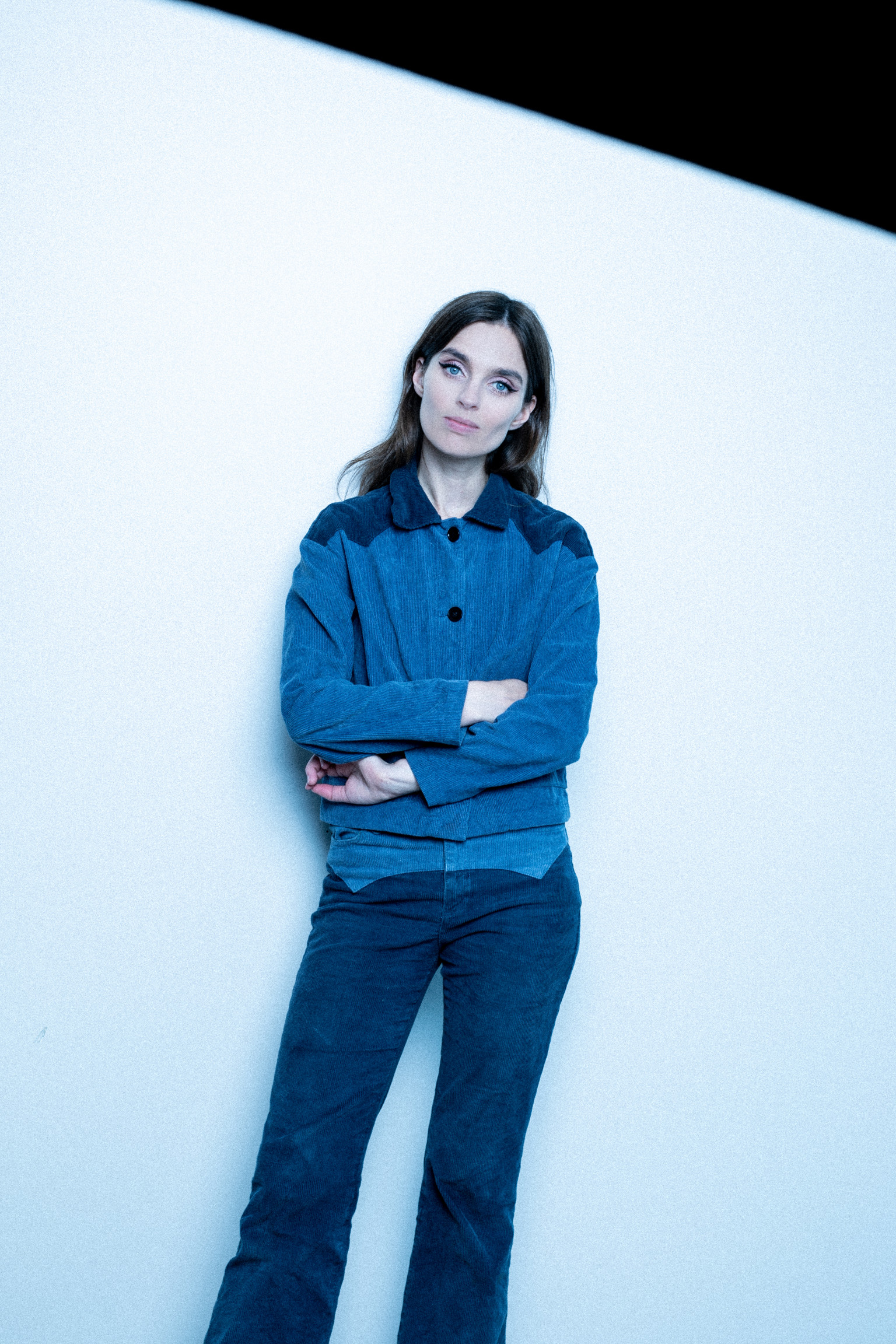
Bára Gísladóttir is an Icelandic composer and double bassist based in Copenhagen. Her work is generally based on thoughts regarding the approach and concept of sound as a living being.






The Amranthen is a peculiar string instrument, invented and built by Canadian instrument maker Gayle Young. It consists of a wooden box fitted with 21 steel strings and three bass strings, and its unique, organic timbre unfolds on From Grimsby to Milan, where Young improvises alongside American musician Robert Wheeler on synthesizer. The recordings from Grant Avenue Studios capture the encounter between the acoustic and the electronic in a loosely shaped, raw musical flow.
Across nearly 70 minutes divided into six parts, the listener is kept in a state of constant uncertainty. The sonic landscape resembles a noisy, dystopian construction site: on »Seaweed Slowly Shifting«, bows are drawn with a saw-like rasp, fingers scratch, machines whirr, and sharp electronic zaps flash like warning lights. Later, bells and pulse-like rhythms enter on »Mariana Trench«, while »Consonant Harmony« slows the pace, settling into a subdued, crackling atmosphere where sparse melodic gestures suggest a momentary lull in the turmoil.
The construction-site metaphor fits well, for the most compelling version of this project would likely be to experience Young’s handmade instruments live, in direct dialogue with Wheeler’s electronics. As an audio recording, however, the project remains closed-off and somewhat insular. And although From Grimsby to Milan contains a wealth of fine detail, the journey – from Grimsby in Canada to Milan in Ohio – ultimately feels long and monotonous, without ever offering the listener the key to unlock its dystopian worksite.
English translation: Andreo Michaelo Mielczarek
»For me, music is all that vibrates.«
Bára Gísladóttir is an Icelandic composer and double bassist based in Copenhagen. Her work is generally based on thoughts regarding the approach and concept of sound as a living being.

»Experience with music involves contact between humans and something beyond it. With contact I believe that people are affected in a way that changes them, even though the change can be very small. You may be transformed into something you still do not know what is.«
Kristine Tjøgersen is a Norwegian composer and clarinet player living in Oslo. Her compositional practice is characterized by curiosity, imagination, humor and precision. Through her work, she creates unexpected auditory situations through playing with tradition. She has a special interest in the interplay between the visual and the auditory and how they affect each other.
Nature in motion and process is often reflected in her works, and collaboration with researchers and biologists is for her a source of new sound and scenic ideas that allows her to incorporate organic forms into the music. As Tjøgersen puts it: »By giving nature a voice in the concert hall, I want the audience to get to know valuable forms of life, and to raise awareness of what can be lost if humans continue to change nature.«
Her works have been performed by Ensemble Recherche, Klangforum Wien, Arditti Quartet, Pinquins, SWR and WDR Symphonieorchester, Rundfunk-Sinfonieorchester Berlin, BBC Scottish Symphony Orchestra, and the Bergen Philharmonic Orchestra, as well as at festivals such as ECLAT, Ultraschall, Wien Modern, Tectonics, Wittener Tage für neue Kammermusik, and Ultima.
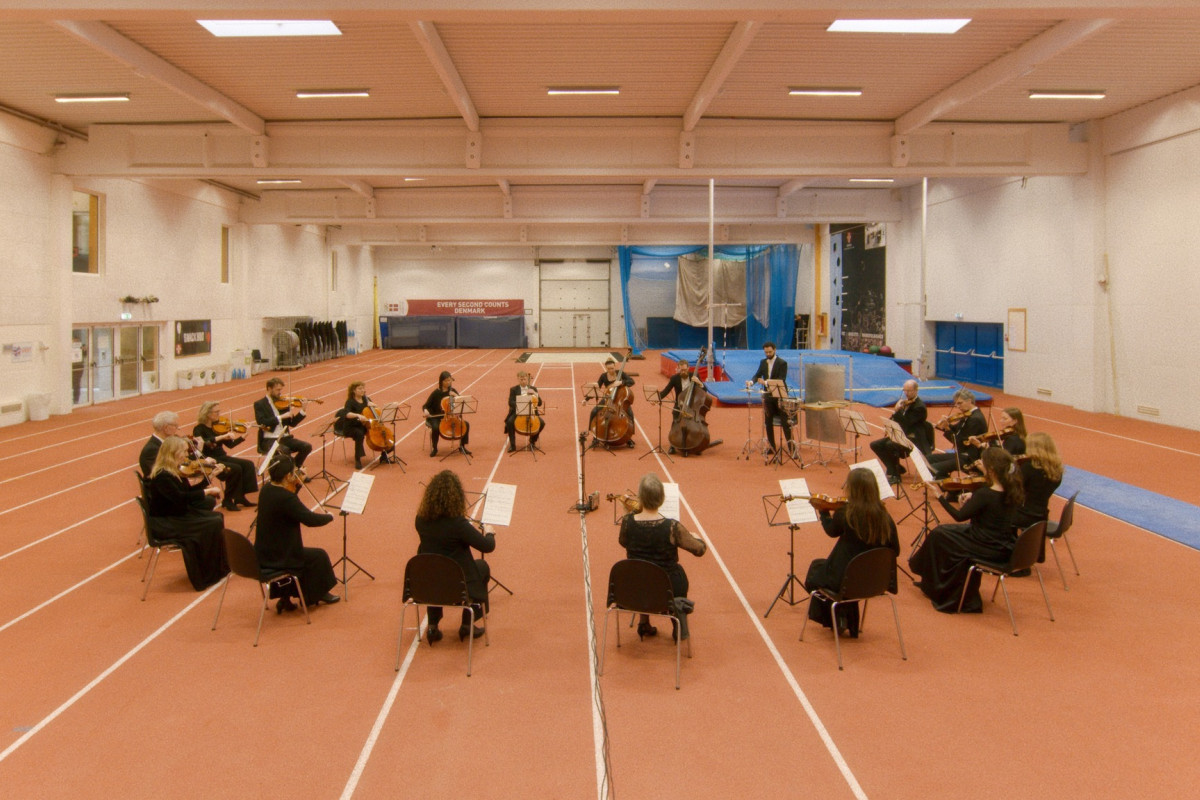
Allan Gravgaard Madsen’s and Morten Riis’s Away is a »mixed media« orchestral work. The physical orchestra is supplemented by sound and video recordings from the basement of Aarhus Theatre (woodwind quintet), Aarhus Cathedral (brass quintet), and Marselisborghallen (string orchestra). All of these locations have, at various points over the past 90 years, housed the Aarhus Symphony Orchestra.
Away opens with the final two chords of the overture to Rossini’s William Tell (1829), which are explored throughout the orchestra. Gradually, musicians leave the ensemble, only to reappear later in smaller constellations in recordings from the aforementioned locations. Through technology, the orchestra plays across time and space in a highly successful manner.
The work explores stasis and movement, with air as a central device: the wind players often blow into their instruments without producing tones, while the string players imitate the sound of wind using plastic bags. For me, Away has three highlights. Trumpets and percussion play phrases that turn out to anticipate a video of a flutist walking through the city. The trumpets mimic the sound of a truck – »beep-bop-beep-bop« – and the percussion becomes the flutist’s stilettos. Musique concrète turned on its head! At one point, half of the string players are seen sitting in a circle, playing intensely dissonant chords, only to kill them again – the physical shock activated my ears. The third highlight comes when the entire orchestra plays together again while all three projections are running simultaneously. Here, the work can truly begin, and one clearly senses the energy rising in the room. But – unfortunately – as soon as this climax is reached, the intensity drops again.
At just under 45 minutes, Away is, unfortunately, slightly too long and static for my taste. The effect of the aforementioned ruptures might not have been as strong in a shorter format, but I would have wished for just a bit more of the intensity the work so clearly was capable of delivering. I was left with a somewhat flat feeling. The piece also ended so quietly that several people were unsure whether it had actually finished and whether we could applaud.

»All sounds are loud,« we hear in Flammenwerfer – Hotel Pro Forma’s account of the Swedish painter Carl Fredrik Hill (1849–1911). Everything in this universe is transparent and layered. The orange hue in Hill’s art, flickering across the stage, crackles with both a beautifully golden noise and a psychedelic quality reminiscent of 1970s ceramics. In a central scene, Blixa Bargeld half-screams into a microphone and receives looped screams hurled back into his head. The patchwork of sound also includes five vocalists from IKI and selected pieces – the only music here that comes close to pop – by Nils Frahm.
The dark circles under the eyes are constantly pronounced. As are the letters that signal a new chapter, the next dive into the mind – for instance the section titled »Paranoia«. Here, IKI expands Einstürzende Neubauten’s »Halber Mensch« into five voices, allowing the hallucinations and anxiety to grow to full human scale. Yes, the sound was loud and numbing in itself. But it is largely thanks to IKI that we feel the extremes, the brain disease, and Hill’s experience of a »misarranged world«. They sang: »Heavy curtains drawn over the mind. A thick deadening cloud that blocks the use of senses.« And that is how it sounded. Cold. Like the saddest Instagram filter imaginable – with sound.
Unfortunately, Blixa Bargeld is used too sparingly in Flammenwerfer, which is not exactly a masterpiece from Hotel Pro Forma. Still, the gala audience sat very still in very soft seats and saw both a giraffe and a former queen on the same evening. The rest of Aarhus Festuge can only be more cheerful.

»Music for me is bumping, rubbing, colliding, sliding and sculpting... in space-time. AKA the gift that keeps giving <3 .«
Greta Eacott is a critically acclaimed British/Swedish composer based in Copenhagen, Denmark. She is primarily known for her boundary pushing experimental percussion works and her »sans-disciplinary« approach to music composition; which incorporates spatial aesthetics, design theory and physical movements as integral elements in the musical compositions. This manifests in a unique and modern musical aesthetic which is both playful and refined, agitating and welcoming, sensual and synthetic. Since 2014 she has been running the DIY record label One Take Records.