in briefrelease
25.05

Ecstasy After the Party

Olof Dreijer: »Loud Bloom«
© PR
© PR

With the debut album Loud Bloom, Olof Dreijer – best known from The Knife – comes across as someone who never quite realised the party was over. Or perhaps realised it before everyone else did.

For years, club music has been absorbed into popular culture and its aesthetic vocabulary – imported into the pop song as energy, irony, and texture through artists like Charli XCX, PC Music, and the entire hyperpop complex. On Loud Bloom, the opposite happens. This is not club music disguised as pop, but pop music subjected to the temporality of the club: circular, lingering, and uninterested in quick release.

Dreijer understands something essential about repetition – the melodies are catchy without being insistent. »Rosa Rugosa«, »Plastic Camelia«, and »Cassia« are instantly memorable, yet the melodies never harden into slogans. The sonic palette is airy and almost devoid of chordal surfaces. Steel drums, gleaming synth figures, pitched tom-toms, and sub-bass drift lyrically through the music, while castanets and cowbells flicker at the edges. Even the vocals function more as texture than as centre.

The album feels constantly in motion, as though its melodies are being refracted through prisms that continuously produce new luminous surfaces. On »Lantana«, tones drift away from their point of departure like blurred watercolours – not quite microtonal, but with a sense of intonation as something fluid. Precisely for that reason, one occasionally misses an element of estrangement. In The Knife, Karin Dreijer’s voice functioned as a disturbing counterforce – androgynous, childlike, threatening. On Loud Bloom, the sonic world is more homogeneous and smoothed out.

Still, the album feels like an heir to the half-clubbed, half-pop kaleidoscopic computer music of the mid-2010s – albums such as Our Love by Caribou and In Colour by Jamie xx – music that dared to be melodic without the safety net of irony. Dreijer’s music believes in ecstasy as a gentle experience. It is music meant for dancing, yet somehow shy at the very thought of celebration.

English translation: Andreo Michaelo Mielczarek

in brieflive
18.02

Serious Creeps

Simon Toldam: »Insecta«
© Daniel Buchwald
© Daniel Buchwald

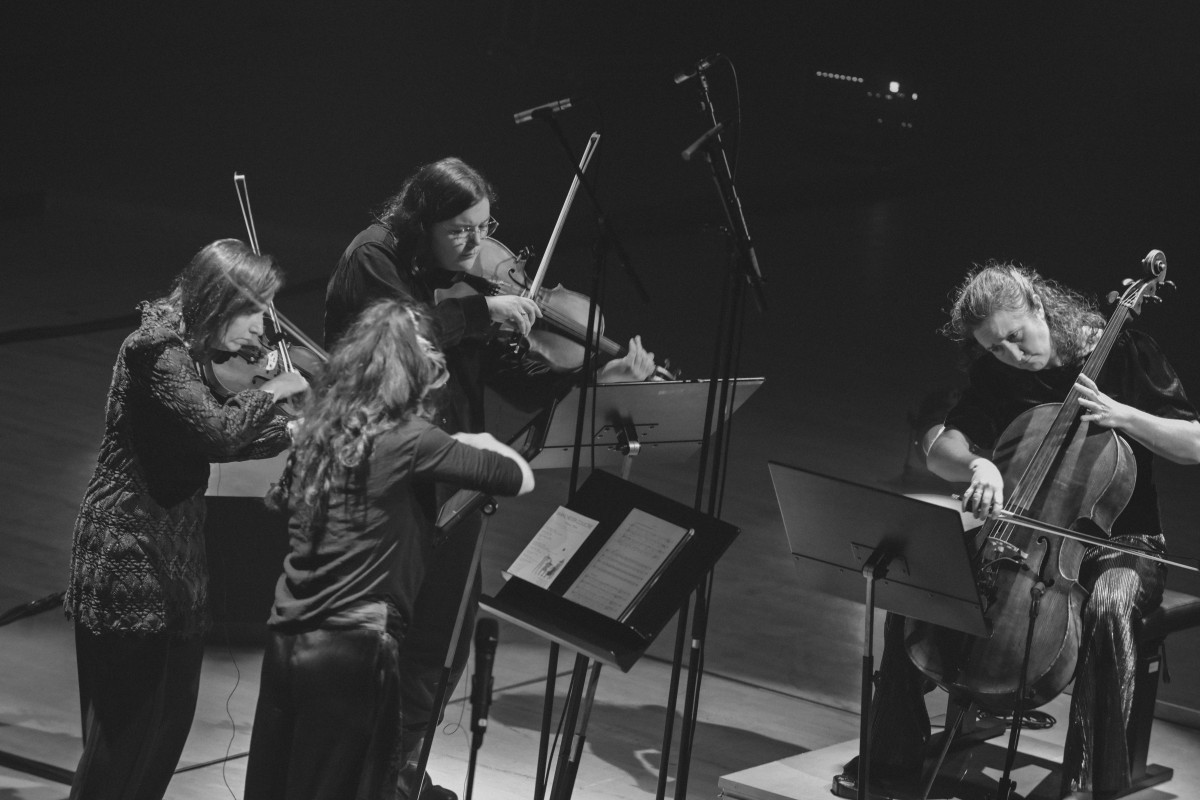
Some dream of discovering life in distant solar systems. Others – like Knud Viktor, Jacob Kirkegaard and now also Simon Toldam – turn the telescope around and uncover unknown life in the immediate yet hidden nature surrounding us. So what did Toldam, the 46-year-old pianist from the experimental jazz milieu, find last night when he turned his gaze toward English photographer Levon Biss’s ultra-close images of beetles, flies and grasshoppers in the world premiere of the hour-long audiovisual trio work Insecta?

First and foremost, he found a varied and inquisitive interpretation of insect life. Behind a transparent screen, Toldam transformed his prepared grand piano into a kind of gamelan instrument, while on either side of him sounds crept and hissed from saxophonist Torben Snekkestad and percussionist Peter Bruun. The production values were high, and the trio – collectively known as Loupe – moved deftly between the concrete and the spherical.

At times, however, there was something old-fashioned about the expression. As a yellow-brown grasshopper gradually took shape on the screen, nanometre by nanometre, the piano’s metallic cymbal-sounds placed it within an Eastern sonic realm. It resonated with exoticism, with old electronic EMS recordings steeped in atonal serialism, and soon Snekkestad let a plaintive Miles Davis-like trumpet drift through the soundscape.

Yet when, with dramatic flair, he blew air through the same instrument or attached a rubber hose and transformed it into a frothing bass monster – while Bruun stroked metal surfaces or pounded the drums in ritualistic patterns – we were out of the past again. And when Insecta finally leaned into the ambient, and Toldam began bending the gamelan tones with his hands inside the open piano, it was as if not only time but also the distance between oneself and the insects dissolved into a trembling dream image. At that point, it suddenly no longer mattered whether there is life on Mars.

English translation: Andreo Michaelo Mielczarek

© PR

»Music for me is the purest communication! We are constantly trying to understand each other, completely in vain, with our inadequate language, while music speaks pure. I can’t think of a more powerful and influential form of expression. It surpasses visual art, film, theatre, everything. Music is without exception the start of all my work; I often think, if this work were a song, what song would it be?« 

ihsan saad ihsan tahir (b. 1995, UK/DK) graduated from the Royal Danish Academy of Fine Arts (2025) and Goldsmiths University of London (2025) and lives and works in Copenhagen. tahir has previously exhibited at, among others, Kunsthal Kongegaarden, Korsør (2026), SKAL Contemporary, Skagen (2025); 13 Vitrine, Lausanne (2024); Kunsthal Aarhus, Aarhus (2023;2024); Collega, Copenhagen (2024); and All All All, Copenhagen (2023). tahir opens a new, large solo exhibition at O ​​– Overgaden (February 20–May 3, 2026).

in brieflive
16.02

Indigo over Mahler

Anthony Sahyoun, Nour Darwish, Larissa Sansour, Søren Lind: »As If No Misfortune Had Occurred In The Night«
© Joakim Züger
© Joakim Züger

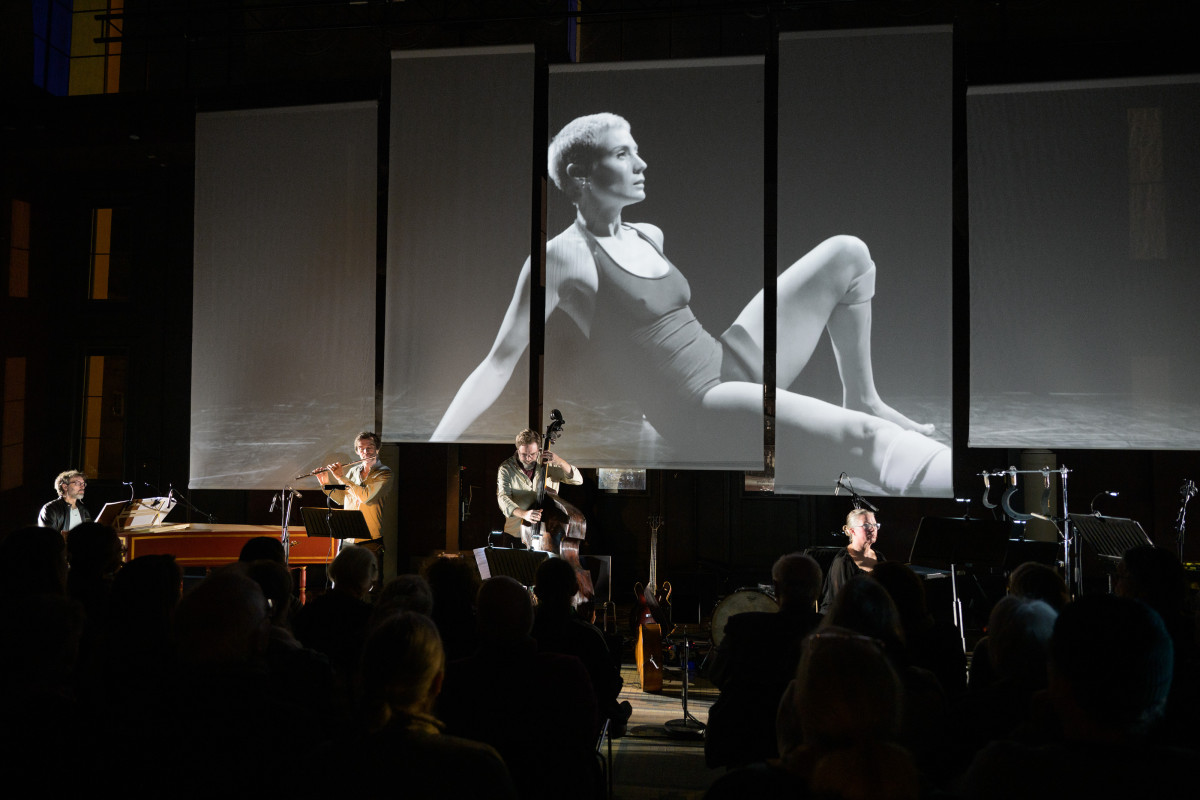
One of my most powerful art experiences of 2025 was British-Palestinian video artist Larissa Sansour’s intense work As If No Misfortune Had Occurred In The Night at Kunsthal Charlottenborg. The piece forms the basis of Thursday’s so-called »opera performance«, in which Palestinian soprano Nour Darwish performs in dialogue with Sansour’s visuals.

When Darwish steps onto the stage, it is before a vast screen where black-and-white scenes from an abandoned chapel establish a solemn atmosphere. It feels as though the entire hall is holding its breath as she begins to sing – tentatively, mournfully at first, then with spine-tingling force.

The composition draws on Kindertotenlieder (1905), in which Gustav Mahler sets to music Friedrich Rückert’s poems on the loss of two daughters. Composer Anthony Sahyoun allows Mahler’s music to merge with the Palestinian folk song »Al Ouf Mash’al«, a lament for a man who fell while serving in the Ottoman army during the First World War. Over time, the song has expanded into an oral account of Palestinian suffering. In its encounter with Mahler, it becomes a lament for centuries of grief – addressed to European ears that, through the colonisation of the region, bear part of the responsibility. Quite simply, it is a very good idea. At first, Darwish alternates between the two musical works, but gradually they fuse into a single narrative of sorrow, loss, and inherited trauma. She briefly leaves the stage, giving way to a filmed sequence in which she descends into a basin and is enveloped by indigo-blue water. In Palestinian tradition, indigo is the colour of mourning, because once it has stained skin and fabric, it cannot be washed away. It must be worn away – just as grief can leave us flayed.

Darwish returns in an indigo dress. At the climax, she falls to her knees as the screen behind her turns black, and I realise I have barely breathed for several minutes. The composition was created in 2022 – before the current war in Gaza – but on this evening, with her immense voice and intense presence, she adds yet another verse to the endless song. At times, art can feel brutally prophetic.

English translation: Andreo Michaelo Mielczarek

© Inga Records

»For me music is life. It contains everything and carries the strongest healing powers there is.«

Mika Akim is the solo project of the viola player, composer and songwriter Mika Persdotter. The project started when Mika found a viola d'amore outside of Prague and started writing songs for it, about and for the body. Exploring open forms, minimalistic approach and mixing influences from folk music, baroque and experimenting with sound. The music is cyclic and honest. Since the project started Mika Akim has released two albums and now the third solo album feb 28 will be released on the 27th of February on Inga Records. 

Besides the solo project Mika Persdotter is an active musician in the experimental music scene as well as the contemporary and baroque fields in Copenhagen. Member of Halvcirkel, Damkapellet, Wolfskin Ensemble and Stök among others. 

Bobo Moreno. © Thomas Roger Henrichsen

»Music is an element for me, along with earth, wind, fire and water. Music is a nutrient that is part of my personal food pyramid, along with cheese, eggs and tomatoes. Music is a relationship in my life that is just as important as the people I have around me. Music is like an extra organ through which I perceive the world.« 

Growing up surrounded by his parents’ eclectic record collection, Bobo Moreno developed a love for music across genres. Named after his stepfather, jazz and rock bassist Bo Stief, Bobo started out on the electric bass before, at the age of 22, finding his true instrument – ​​his voice. Self-taught, he developed his craft through countless live performances and garnered recognition for his expressive voice and stylistic range. His national breakthrough came with the pop duo Peaches & Bobo in 1993. After decades of performing, at the age of 60, Bobo now releases Missing Pieces – his deeply personal debut album, reflecting a life of musical exploration and self-discovery, while marking a new chapter in a lifelong musical journey.