in brieflive
12.04

Feel Yourself Becoming Nature Again

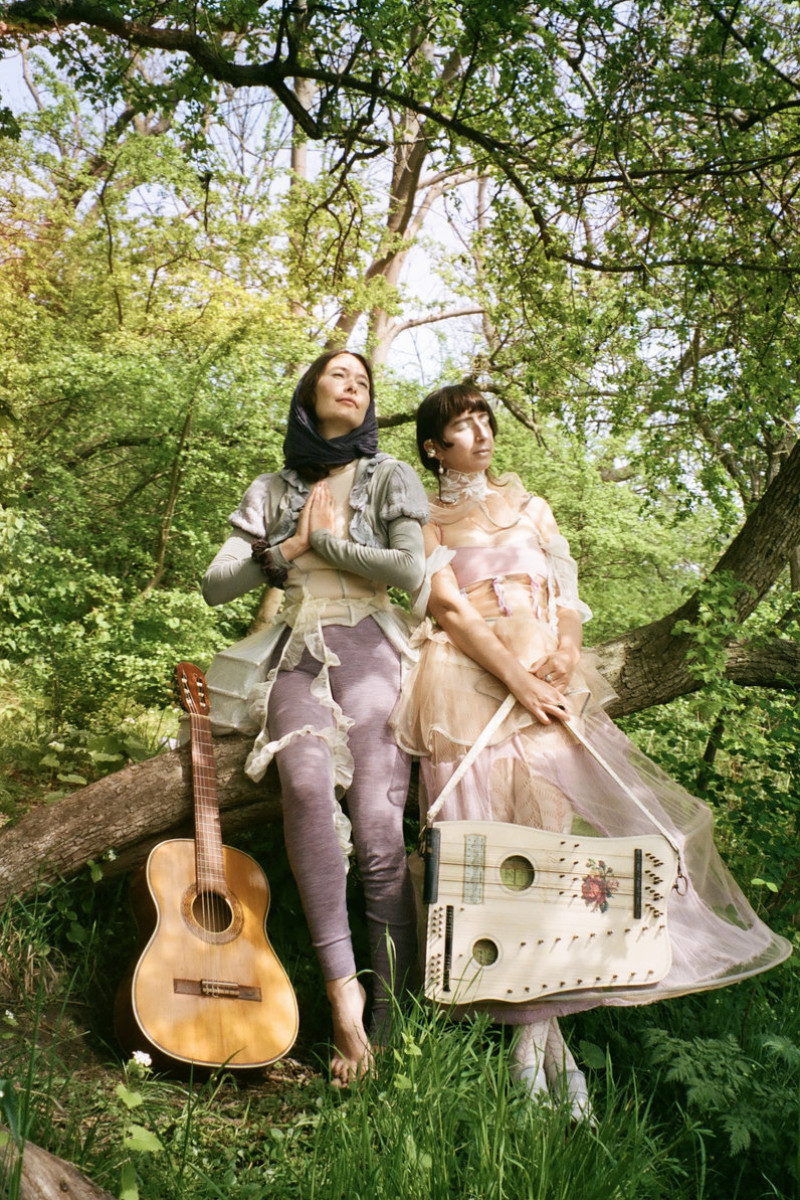
Cecilia Fiona, Sophie Søs Meyer: »Ghost Flower Ritual« 
© Farzad Soleimani
© Farzad Soleimani

Frozen human bodies and faces shaped and painted like ceramics are meticulously carried around by flower sculptures that have abandoned their static nature. The roles are reversed. Nature becomes the living environment that grants the clay humans small, temporary lives in Ghost Flower Ritual at Copenhagen Contemporary.

The piece is a live installation with musicians and performers, where 34-year-old composer Sophie Søs Meyer has collaborated with visual artist Cecilia Fiona, who is of the same age. It’s a sensorially overwhelming, yet dramatically subdued ritual. Over the course of forty-five minutes, we sit together beneath a giant flower and sense the performers’ meticulous, slow movements. Meanwhile, soundscapes and small pulsating figures from four string players and a flute shape a landscape of colors, tones, and movements that melt together – filling the high-ceilinged room with auditory and visual presence. We are part of a whole.

I love the wild costumes that descend strangely from the sky. I love being part of the ritual that heals our forgotten connection to nature, which is the very foundation of our lives. I love the sound of stroked, plucked, and blown wood from Athelas’ musicians. Culture is nature. The human animals and the flowers are part of the greater consciousness. It’s all a hyper-complex mechanism. Cecilia Fiona possesses an extraordinary visual and creative abundance in her intricate details, and Sophie Søs Meyer is precise and intriguing in her swaying tonal figures that change slowly and meticulously. Until one flower blows into the large conch shell. Then the ritual is over.

English translation: Andreo Michaelo Mielczarek 

in briefrelease
08.02.2024

Behind the Words

Alexander Tillegreen: »In Words« 
© PR
© PR

One of the most mysterious – and at times boundary-pushing – interviews ever captured on tape is Meatball Fulton’s 1967 interview with Pink Floyd’s Syd Barrett. Filled with broken sentences, incongruous word combinations, questions and answers that seem to bear no relation to one another, and pauses that feel endless, the interview pushes the limits of what can meaningfully be called communication at all. »Your impression of me… which you must have… would you care to tell me? And be like absolutely honest… Do you have one?« the interviewer asks at one point. »In words?« Barrett replies.

In Words is also the title of multidisciplinary artist Alexander Tillegreen’s debut album, whose closing composition samples a full seven minutes of the interview. It is not difficult to understand what Tillegreen hears in this peculiar exchange. For someone who, in his artistic explorations of psychoacoustics and phantom words, has consistently probed sound’s possibilities and limitations as a carrier of meaning, the interview must appear as a rather sensational example of the illusory nature of language.

None of this would, of course, be of any interest if the music were not as strong as it is: richly atmospheric, detailed, texturally varied, emotionally potent, and filled with pleasing, warm synth tones that recall 1970s German Kosmische Musik. The fact that a large part of the compositions originate in earlier installation works often leaves me with the strange feeling that there is a dimension or context I do not fully grasp – which, of course, is entirely in keeping with Tillegreen’s spirit.

© PR

Phil Battiekh (Basel, Switzerland) has been a Mahraganat  DJ and producer for over a decade. He is one of the first to dedicate himself to Mahraganat outside of Egypt. In addition to his most popular Mahraganat mixes on Soundcloud (over 450K streams worldwide),  he released the acclaimed Cairo Concepts compilation in 2019. Featuring DJ Plead, DJ Haram, Alaa Fifty, Nustaliga and others, Cairo Concepts contextualises the impact and developments of the Mahraganat scene and examines the way certain artists have appropriated Mahraganat for club scenarios.  

Mahraganat (Egyptian Arabic: مهرجانات( , which literally means »festivals«, is a mix of Egyptian Shaabi, electronic dance music, rap and trap. It is characterized by percussion-heavy rhythms,  massive bass and loads of autotune. Phil Battiekh is curating the SWANA night – a joint event by pantropical, turkis, and Volume Village, which takes place at the latter in Aarhus. Next to his own set, Phil will  also have a role as Wezza Montaser's DJ. 

Bill Frisell. © Carole D'Inverno

»I like when it's impossible to tell at first if something is black or white, or country or blues, or whatever.«

Bill Frisell’s career as a guitarist and composer has spanned more than 40 years and many celebrated recordings. From Aaron Copeland and Charles Ives to Bob Dylan and Madonna. Born in Baltimore, Bill Frisell played clarinet throughout his childhood in Denver, Colorado. His interest in guitar began with his exposure to pop music on the radio.

© PR

»Music has been a healing balm for me.«

John William Grant is an American singer, musician, and songwriter holding both American and Icelandic citizenship. He first came to prominence as a co-founder, lead vocalist, pianist, and primary songwriter of the alternative rock band The Czars. After releasing six albums between 1994 and 2006, the band disbanded, and Grant withdrew from music for four years before embarking on a solo career.

He returned in April 2010 with a critically acclaimed debut album recorded in collaboration with Midlake. Queen of Denmark was named Album of the Year 2010 by Mojo magazine and was also selected as one of the ten best albums of 2010 by The Guardian’s music critics and writers.

in briefrelease
23.01.2022

Finnish Space Travel

Tomutonttu: »Hoshi«
© Tomutonttu: »Hoshi«

The Finnish multimedia artist Jan Anderzén has, with the album Hoshi, released under the solo moniker Tomutonttu, created a true little star. Not only because »hoshi« literally means »star« in Japanese, but above all due to the music itself. There is something cosmic, yet infinitely minute, about the sonic worlds Anderzén conjures—like a galaxy reflected in a puddle, or a space journey in a rocket carved from a hollow tree trunk. Synths emit busy, warm blips and bloops, while ultra-short vocal and instrumental samples create a recognizable blur. At once artificial and organic – soft, rounded, jagged, crackling.

Anderzén approaches sound with a playfulness I simply adore. His music is strange in an incredibly comforting way. It places me in a kind of colorful, trance-like state, only interrupted when, several times over the course of the album, I find myself smiling in delight at a particularly great sound. The synths on »Katse osuu sähköön!« The choral samples on »Kesä oli äkkiä ohi!« Milo Linnovaara’s flute on »Malta lausua ‘AH’!« And many more. Hoshi is an album packed with microscopic moments that together form a frayed, exploding, radiant, idiosyncratic whole—a stellar moment of just under 38 minutes.