in brieflive
06.03

Labour of Birth

Katinka Fogh Vindelev, Sankt Annæ Pigekor, Kind of Opera et al.: »Elegier over jorden«
© PR

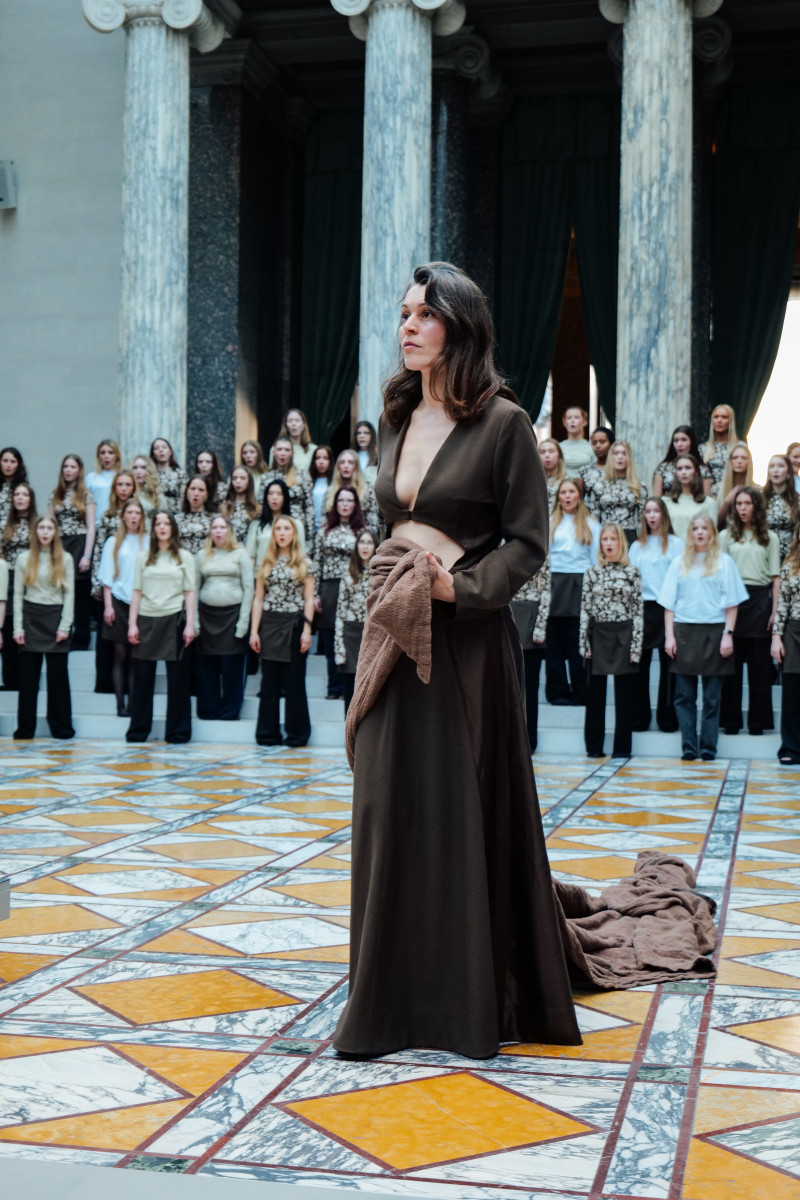
»This pain is not only yours,« chants a choir standing in a circle around the woman in labour. »This pain is not only yours,« comes the enveloping echo from the rest of the choir, positioned along the walls of the ceremonial hall, forming a circle around the audience and inscribing us into the labour of female fertility.

Elegier over Jorden (Elegies over the Earth) is based on Sofie Isager Ahl’s reworking of the myth of Persephone, daughter of the goddess of agriculture and queen of the underworld. The Greek myth is one of those that explains the barrenness of winter by Persephone’s descent into the underworld, but in this reinterpretation she returns to earth to give birth. We follow her labour over nine months while members of the choir work in the fields, struggling for crops under pressure from the current climate collapse. Here, the regeneration of nature is not a matter for higher powers but a struggle that begins in the body and in the soil – much like that of the woman giving birth.

The ecofeminist interconnectedness of the female body and nature has been a hot topic for several years now, and I am unsure what Elegies over the Earth adds to it. My hesitation stems mainly from the harsh acoustics of the ceremonial hall at Ny Carlsberg Glyptotek which, combined with Marie Topp’s choreography – often positioning singers with their backs turned to parts of the audience – makes it difficult to hear Ahl’s words.

When Elegies over the Earth works best, it is in the dialogue and timing between the choir, the soprano and composer Katinka Fogh Vindelev in the role of the labouring Persephone, and the minimal ensemble of two violins and a cello. When the voices of Sankt Annæ Girls’ Choir curl around the cello’s dark timbre, and when the primordial woman Persephone’s lament is allowed to hang in the room for a moment before the choir resumes, the performance touches on something real. Yet the experience never quite settles in the body, and the painful struggle of birth – despite the choir’s insistent chanting – never truly becomes mine.

Performances on 5, 7 and 8 March

English translation: Andreo Michaelo Mielczarek

in briefrelease
25.05

Ecstasy After the Party

Olof Dreijer: »Loud Bloom«
© PR
© PR

With the debut album Loud Bloom, Olof Dreijer – best known from The Knife – comes across as someone who never quite realised the party was over. Or perhaps realised it before everyone else did.

For years, club music has been absorbed into popular culture and its aesthetic vocabulary – imported into the pop song as energy, irony, and texture through artists like Charli XCX, PC Music, and the entire hyperpop complex. On Loud Bloom, the opposite happens. This is not club music disguised as pop, but pop music subjected to the temporality of the club: circular, lingering, and uninterested in quick release.

Dreijer understands something essential about repetition – the melodies are catchy without being insistent. »Rosa Rugosa«, »Plastic Camelia«, and »Cassia« are instantly memorable, yet the melodies never harden into slogans. The sonic palette is airy and almost devoid of chordal surfaces. Steel drums, gleaming synth figures, pitched tom-toms, and sub-bass drift lyrically through the music, while castanets and cowbells flicker at the edges. Even the vocals function more as texture than as centre.

The album feels constantly in motion, as though its melodies are being refracted through prisms that continuously produce new luminous surfaces. On »Lantana«, tones drift away from their point of departure like blurred watercolours – not quite microtonal, but with a sense of intonation as something fluid. Precisely for that reason, one occasionally misses an element of estrangement. In The Knife, Karin Dreijer’s voice functioned as a disturbing counterforce – androgynous, childlike, threatening. On Loud Bloom, the sonic world is more homogeneous and smoothed out.

Still, the album feels like an heir to the half-clubbed, half-pop kaleidoscopic computer music of the mid-2010s – albums such as Our Love by Caribou and In Colour by Jamie xx – music that dared to be melodic without the safety net of irony. Dreijer’s music believes in ecstasy as a gentle experience. It is music meant for dancing, yet somehow shy at the very thought of celebration.

English translation: Andreo Michaelo Mielczarek

in briefrelease
21.05

Artificial Intelligence on Autoplay

Slopcore: »Simon Littauer«
© PR
© PR

The logic of automation has long been part of modern music production. But what happens when it no longer merely assists, but takes over the creative process and artistic execution itself? Simon Littauer’s Slopcore is one of the latest attempts to answer that question. The sound of the AI-driven project is not radical as such, but it is interesting because Slopcore is several things at once: both a concrete take on an artistic practice shaped by recent developments in AI, and a symptom of the all-encompassing data models currently being debated so intensely.

Slopcore mimics the logic of a familiar streaming platform, except that the music here is generated in real time, with the audio stream continuously adapting to the listener’s behaviour, allowing users to proactively like the output or skip ahead whenever they want. The simple interface – featuring play, pause, and a heart icon – is accompanied by a pointillistic waveform that visually emphasises how Slopcore’s aesthetic winds its way through recognisable electronic terrains of house, 2000s electronica, IDM, techno, drum’n’bass, ambient synth textures, etc. etc. Most of it is rhythmically, harmonically, and melodically coherent, without being overly experimental.

As an AI-boosted extension of Littauer’s broader musical practice – which already contains strong aleatoric and algorithmic elements – the whole thing makes perfect sense. AI is not disappearing as a technology, and the parallels to Spotify’s growing AI ambitions or platforms like Suno are obvious enough. Littauer’s position as an established electronic musician becomes entangled in a deeply commercial and opaque data architecture (read: Google’s). And the title clearly references – perhaps ironically – the concept of »AI slop«, the term used to describe the generic, soulless overproduction of images and sound flooding digital platforms. Beyond being an entertaining listening experience, Slopcore can also be seen as a relevant – perhaps, in the current climate, even courageous – contribution to an ongoing and confusing debate about artistic integrity and authenticity in a cultural world that cannot decide whether it wants to resist or simply log in.

English translation: Andreo Michaelo Mielczarek

in briefrelease
18.05

Somewhere Between an Acid Dream and a Sound Garden

Kaloja: »A Body of Water«
© PR
© PR

On A Body of Water, you step directly into the singular sonic universe of Finnish multimedia artist Jan Anderzén(Tomutonttu, Kemialliset Ystävät). The album unfolds as a collage of whimsical melodies created in collaboration with British musician Paul Wilson (f.ampism, Yayoba), whose contributions subtly enrich the colorful patchwork of sonic threads. Subtle, perhaps, but unmistakable. The soundscape is densely detailed: beneath the constantly shifting melodies, countless tiny sonic shoots stretch eagerly toward the eardrum. It feels like an acid dream in which everything around you – from roadside flowers to airplanes crossing the sky – has suddenly begun to sing.

Paradoxically, this flood of chaotic and rapidly changing impressions gives the music an almost ambient quality. There is great pleasure in listening closely to the miniature details bubbling beneath the surface, occasionally bursting through to dominate the frequencies for a brief moment.

Yet strong, recurring melodies capable of anchoring the listening experience remain absent in favor of mood and texture. Importantly, this is not a flaw. Heard through an ambient lens, the album – which at first can seem slightly directionless – suddenly reveals its logic. Its playful depth and lack of rigid structure encourage endless free association. It is wonderful music for drifting thought: a multicolored universe where the imagination continually discovers new pathways through a dense undergrowth of details.

English translation: Andreo Michaelo Mielczarek

© Meseguer

»To us, music is the definitive companion. As listeners, it fosters a sense of communion, bridging the gap between souls through the shared experience of sound. As creators, however, music confronts us with our own inner void, that profound solitude that nourishes the creative spirit. At the same time, it dares us to leap into the unknown to decipher the ineffable. Music anchors us to the present moment, to the 'now' shared with a live audience; yet, it also touches the eternal.«

L'arannà is an electronic folk duo. With their last project, Turmarí, the duo dives deep into the folk music traditions of the Pityusic Islands, offering – through their blend of sound exploration– a perspective on Ibiza and Formentera. Synthesizers and keyboards share the stage with traditional instruments and aesthetics inspired by the ancestral ball pagès dance. Reviving cant redoblat (a unique form of singing from these islands preserved by fewer than twenty people) the group weaves a narrative that traces the roots and lived reality of two islands that are far more than just a dreamt-of paradise. The band will be touring around Denmark and Sweden, from 27th to 31th of May, playing at venues like Turkis, Dexter, Inkonst or ALICE.

© Ana Alexandrino

»Music to me is movement, trance, transformation. The rest I won't tell you.«

Marcela Lucatelli is a vocalist and composer. Born in Brazil and based in Denmark, she has gained international recognition for her boundary-pushing performances — sensuous, politically charged, and uncompromisingly original. Described by The Wire as a composer of »scores for the limits of bodies and voice,« Lucatelli challenges conventions with her fearless vocal experimentation and bold compositions. Her works have been performed by Danish National Symphony Orchestra, Danish National Vocal Ensemble, and Neue Vocalsolisten Stuttgart. She has appeared at major festivals and venues, including Theatro Municipal de São Paulo, DR Koncerthuset, Donaueschinger Musiktage, Darmstadt Ferienkurse, IRCAM, Copenhagen Opera Festival, Ultima Festival, Borealis Festival, Copenhagen Jazz Festival, Jazzfestival Saalfelden, Cafe Oto, A L’ARME!, DMA Jazz – Danish Music Awards, WOMEX, and many more. Lucatelli's work has earned her several prestigious awards, including the Carl Nielsen and Anne Marie Carl-Nielsen Talent Prize (2019), Pelle Prize (2021), and the Danish Music Awards' 2023 Vocal Jazz Release of the Year, which shows that vocal jazz has many faces – and does not necessarily belong only to the soft end of the spectrum.