Vocal Desire Between Deadpan and Renaissance
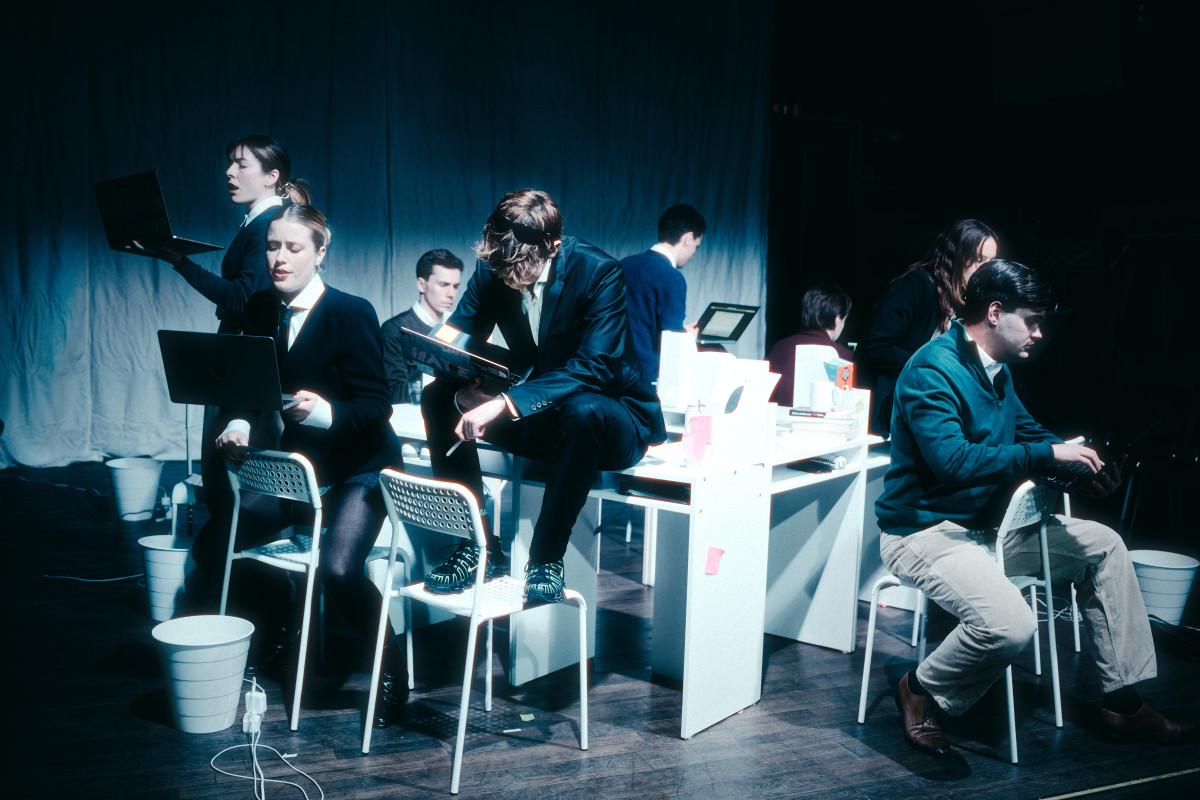
Eight people sit at their own office desks. One raises an elbow to their mouth and lets out a muffled groan into it; another starts lazily slapping their forearm; a third suddenly creaks like a worn-out spring mattress. But the young singers of ÆTLA don’t crack a smile – their deadpan is the main comic ingredient in Matias Vestergård’s Apollonian sketch show SEX in Concert.
They quickly move from a whore’s chorus to a Renaissance madrigal, the transition seamless, with the humor tagging along: an Italian word that sounds like »aquamarine« becomes »ah! kvamarin«, and in this way, 400-year-old works by Gesualdo and his like-minded peers are sprinkled with Vestergård’s salon-style wit. But the movement also goes the other way: Vestergård’s newly composed pieces are tastefully ornamented with moving voices and flirt with strict church modality.
The desks are constantly rearranged, the office workers shifting from tableau to tableau, while the task of writing lyrics into a Google Doc projected on a screen rotates among the singers: Amalie Smith, Marvin Gaye, outraged anti-capitalist critique, and cheerful chat language – everything tinged with desire, but above all with ambivalence toward desire. Everything flows, including Vestergård’s compositions, which in one moment test icy echo techniques, and in the next turn up the heat with perfectly crafted barbershop.
SEX in Concert is clearly an exercise, and as director, Johan Klint Sandberg has had a field day with the office comedy. But the exercise succeeds (even if the hands stay above the covers): before you know it, an hour has passed in which Vestergård, Sandberg, and ÆTLA have slipped poetry, madrigals, and new vocal music down the throat of a young audience. It can actually be quite fun!
Christianshavns Beboerhus, March 18–22
English translation: Andreo Michaelo Mielczarek

An Organ in the Dark Forest of Doubt
Last year, Builder released Poor_in_Spirit, an album in which he explored, on his own, the sonic possibilities of his self-built organ. It was an album shaped by this exploration, but ultimately also by the limitations of the organ itself. On Although Changed, I Arise the Same, the composer finds a way beyond them.
The organ is now joined by three additions: Builder’s own alto saxophone, along with the voices of Zola Mennenöh and Johanna Sulkunen. It makes all the difference, providing the diversity of instrumentation that Builder has repeatedly demonstrated his ability to compose for. At times, the organ’s bass sinks beneath the voices and saxophone like a light haze; at others, it envelops them in a heavy fog. It howls like wind in the trees and roars like a train in the night. Mennenöh and Sulkunen sing, chant and breathe simple, repetitive phrases about spiritual uncertainty and searching, as though lost in the dark forest of doubt.
It is a Spartan form of storytelling, giving the listener enough lyricism and atmosphere to set the mind in motion, but never so much that it becomes overwhelming. This is where Builder’s strength lies: his music clearly grows out of his life and experiences, yet he composes in such a way that the listener is invited to enter the story with their own imagination.
Builder determines the colours, but leaves part of the picture to the listener. It is an album that is far more restrained in its dramaturgy than previous releases. No less beautiful or inspiring for it.
English translation: Andreo Michaelo Mielczarek

»For us, music is a transcendent force with transformative potential – something we get to experience and shape when we create sound together. It is an opportunity to describe one’s innermost universes without words, and the best way for an introvert to express intense emotions at full volume.«
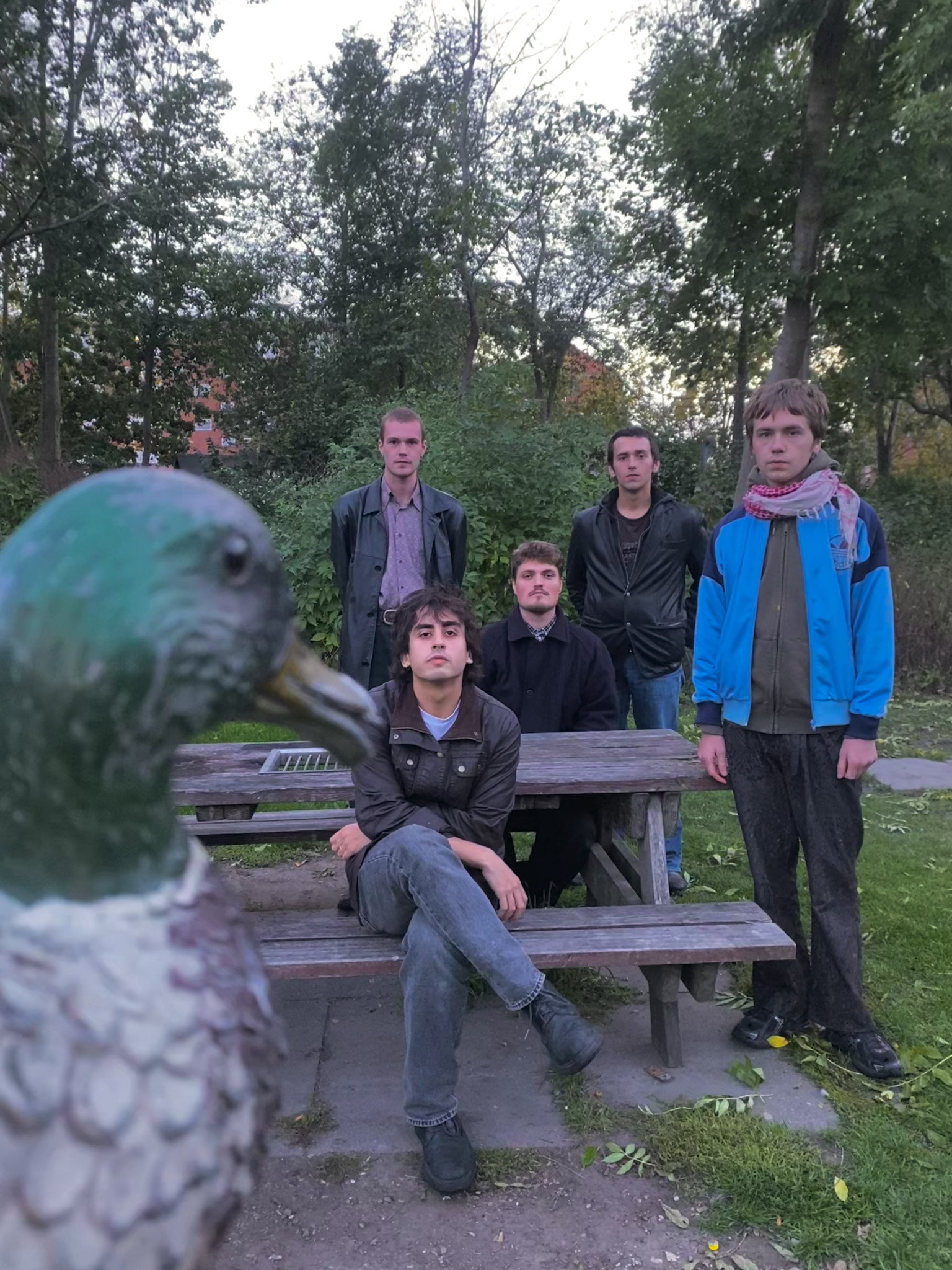
With roots in Copenhagen’s experimental jazz and punk scene, Echo, Bravo challenges the notion of what a rock band can sound like. The quintet blends post-punk, free punk, and noise rock into a raw and unpredictable soundscape. They describe the music themselves as a kind of »empty-the-fridge soup,« where various leftovers come together. »Best enjoyed as a hot meal in a cold industry.«
Thorbjørn Tønder Hansen has died. With Thorbjørn’s passing, the art music community has lost one of the Nordic region’s most significant producers, curators and cultural leaders.
»Music is the best way to discover myself and understand the world around me.«
Luca Quintavalle is a harpsichordist, fortepianist and conductor. He has performed with ensembles including Concerto Köln, Harmonie Universelle, the Mozarteum Orchestra Salzburg and the Kölner Kammerorchester at venues and festivals such as the Kölner Philharmonie, Salzburg Festival and Enescu Festival. He was harpsichordist of Les Musiciens du Prince, led by Cecilia Bartoli, for over five years, and has conducted ensembles including the Orchestra and Chorus of Teatro dell’Opera di Roma, Concerto Köln and Deutsche Kammerakademie Neuss. His recordings include Mirrors, released by Berlin Classics and awarded an OPUS KLASSIK.