in brief
02.07.2023

Trance Thursday

© Sanne Krogh Groth
© Sanne Krogh Groth

Why Gabber Modus Operandi from Bali was booked for Roskilde's »avant-garde scene« Platform, which my 20-year-old son called the »boomer« scene, is a mystery. In 2018, when they made their European debut, it was at the seminal Berliner festival CTM at the club Berghain. Since then, they have traveled around the world and were featured on Björk's new album in autumn 2022.

The music and the trance party, on the other hand, went straight in – a mix of new and previously released tracks, all produced by Kasimyn and spiced up by Ican Harem with his wild performance. The tracks provide the foundation to the trance, but it is Harem who controls it with song, recitation and growl and with an insistent audience address primarily in Indonesian. 

It was loud and intense, and the trance-happy festival audience, who had turned up in large numbers, had plenty of opportunity to dance. The individual character of the tracks is found in characteristic and slower pentatonic themes played by samples that sound like slompret (Javanese wind instrument, as in the track Sandikala), bonang (small gong) and synth (Genduwuro), and Indonesian song/speech (Hey Nafsu). A local Indonesian jumble woven into a global borderless music machine.

Jathilan is the name of an Indonesian ritual dance in which knights on reed horses travel out to defend the sultan, but along the way are possessed by the spirits of the forest. Jathilan is currently particularly popular in Java in local contexts in city and countryside, where both dancers and the audience can get in trance, which is led by a "fusion gamelan" consisting of Indonesian gamelan, drum set, synthesizer and whatever else is in the neighborhood. Everything is electrically amplified and blown out through distorting speaker towers – preferably with over 110 DB. The aesthetics are breathtaking and something quite unique.

Gabber Modus Operandi precisely finds, among many other on- and off-line curiosities, inspiration in jathilan. They too have travelled out, however, without reed horses, classic Indonesian dance costumes and instruments. Instead, they have brought us high-tempo electronic dance music (EDM). Hard pumping metallic noisy beats here reaching 120 DB. Towards the end, they invited us to sit on the floor. The trance now took form as a call to prayer, meditation and contemplation.


Louise Beck
Louise Beck

When Louise Beck presented her first opera at Copenhagen Opera Festival in 2022, the audience was asked to bring ski wear and thermal suits. Den Sidste Olie (The Last Oil), about the colonisation of Greenland and the exploitation of nature, unfolded on the ice at Østerbro Skøjtehal. It marked the beginning of a fruitful collaboration on newly written works that expand the frames and spaces of opera. Now that collaboration enters a new phase: from 1 September, Louise Beck will become the festival’s new artistic director.

»Music for me is peace.« 

Iris Gold is a Danish singer. She was born in London but raised in Christiania. She made her recording debut in 2015 with the single »Goldmine« and has since released a number of singles. Her debut album Planet Cool was released in 2019. She has just released the album Sugar on My Lips.

© PR

»Resonance – music is for me an indispensable inspiring resonance. In music, the big emotions fall into place, and the small ones bubble up. My grandfather introduced me to opera as a child – so loudly that my heart jumped in my ears, and I fell head over heels and deeply in love with these grand and dramatic compositions. Through it, I was introduced to the big emotions in the world – in music there was room for them in a way that I had not experienced anywhere else before.«

Astrid Kruse Jensen (b. 1975) is a Danish visual artist living in Copenhagen. Throughout her artistic career, she has been preoccupied with photography and its relationship to memory. With her poetic shifts of reality, she explores the borderland between the apparent and the hidden, between the real and the imaginary, between past and present. She has exhibited widely both in Denmark and internationally, with exhibitions in galleries and museums – from solo to group exhibitions in Slovenia, Lithuania, Poland, Sweden, Iceland, Finland, France, Belgium, the Netherlands, Germany, Spain, Italy, India, China, Korea, Ghana, Canada, the USA and the UK. In Denmark, her works have been exhibited at, among others, the Brundlund Castle Art Museum, Esbjerg Art Museum, Heerup Museum, Rønnebæksholm, Brandts, Aros, Kunsten, Skagen Museum, Willumsen Museum, Sorø Art Museum, Odsherred Art Museum and Johannes Larsen Museum. Astrid Kruse Jensen is represented by Martin Asbæk Gallery in Copenhagen and Wetterling Gallery in Stockholm & Gothenburg.

© PR

The red Husqvarna sewing machine stood centre stage, buzzing relentlessly like a tireless drummer locked in an endless blast beat. »Järnrör«, »Cyanid«, »Tramadol«, Tehran hissed between squealing guitar amplifiers and in front of videos showing idyllic Swedish roadside art and images of the many Husqvarna weapons. For behind Husqvarna’s innocent garden and household products lies an industry of death – a prism of growing up in Jönköping and an illusion of Swedish neutrality, which the Swedish-Iranian artist Tehran underscored with the concert Husqvarna The Movie.

Each track came with a new video bathed in sewing machine, guitar and growl vocals. But the song »Delam gerefteh« was more subdued, not least because Tehran leaned back in a chair, cigarette in mouth, letting the music and the video speak for themselves.

The evening’s second name, the Canadian-Iranian Saint Abdullah, spent the entire concert with a marker pen in his mouth, occasionally using it to jot down the course of the music. Saint Abdullah’s performance was like watching a radio operator adjusting a crackling signal – from birdsong to acoustic guitar, from news broadcasts to field recordings, the sampler at the centre of the table became a focal point for fragments of faith, culture and migration.

Where Tehran’s concert felt like a rehearsed, healing ritual, Saint Abdullah’s unfolded as an impulsive dialogue between a sea of sound bites. Both performances revolved around Iranian heritage. Not a heritage that necessarily needs to be understood, but one that appears as a mosaic of contradictions – and can only truly be processed in one place: in music.

in brieflive
18.02

Serious Creeps

Simon Toldam: »Insecta«
© Daniel Buchwald
© Daniel Buchwald

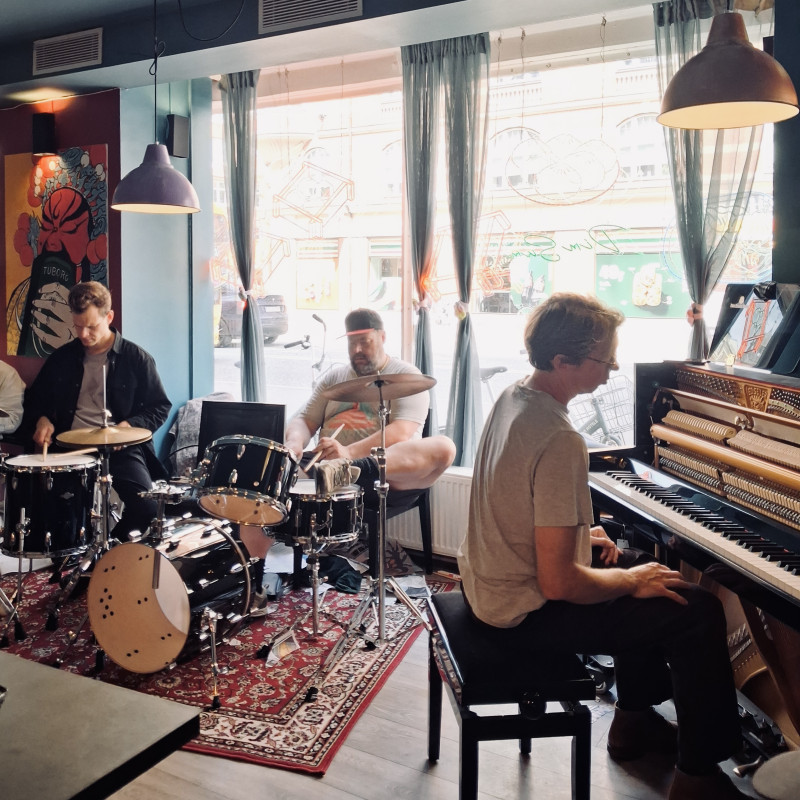
Some dream of discovering life in distant solar systems. Others – like Knud Viktor, Jacob Kirkegaard and now also Simon Toldam – turn the telescope around and uncover unknown life in the immediate yet hidden nature surrounding us. So what did Toldam, the 46-year-old pianist from the experimental jazz milieu, find last night when he turned his gaze toward English photographer Levon Biss’s ultra-close images of beetles, flies and grasshoppers in the world premiere of the hour-long audiovisual trio work Insecta?

First and foremost, he found a varied and inquisitive interpretation of insect life. Behind a transparent screen, Toldam transformed his prepared grand piano into a kind of gamelan instrument, while on either side of him sounds crept and hissed from saxophonist Torben Snekkestad and percussionist Peter Bruun. The production values were high, and the trio – collectively known as Loupe – moved deftly between the concrete and the spherical.

At times, however, there was something old-fashioned about the expression. As a yellow-brown grasshopper gradually took shape on the screen, nanometre by nanometre, the piano’s metallic cymbal-sounds placed it within an Eastern sonic realm. It resonated with exoticism, with old electronic EMS recordings steeped in atonal serialism, and soon Snekkestad let a plaintive Miles Davis-like trumpet drift through the soundscape.

Yet when, with dramatic flair, he blew air through the same instrument or attached a rubber hose and transformed it into a frothing bass monster – while Bruun stroked metal surfaces or pounded the drums in ritualistic patterns – we were out of the past again. And when Insecta finally leaned into the ambient, and Toldam began bending the gamelan tones with his hands inside the open piano, it was as if not only time but also the distance between oneself and the insects dissolved into a trembling dream image. At that point, it suddenly no longer mattered whether there is life on Mars.

English translation: Andreo Michaelo Mielczarek