In brief
15.07.2023

There are holes in these tones from Theresienstadt

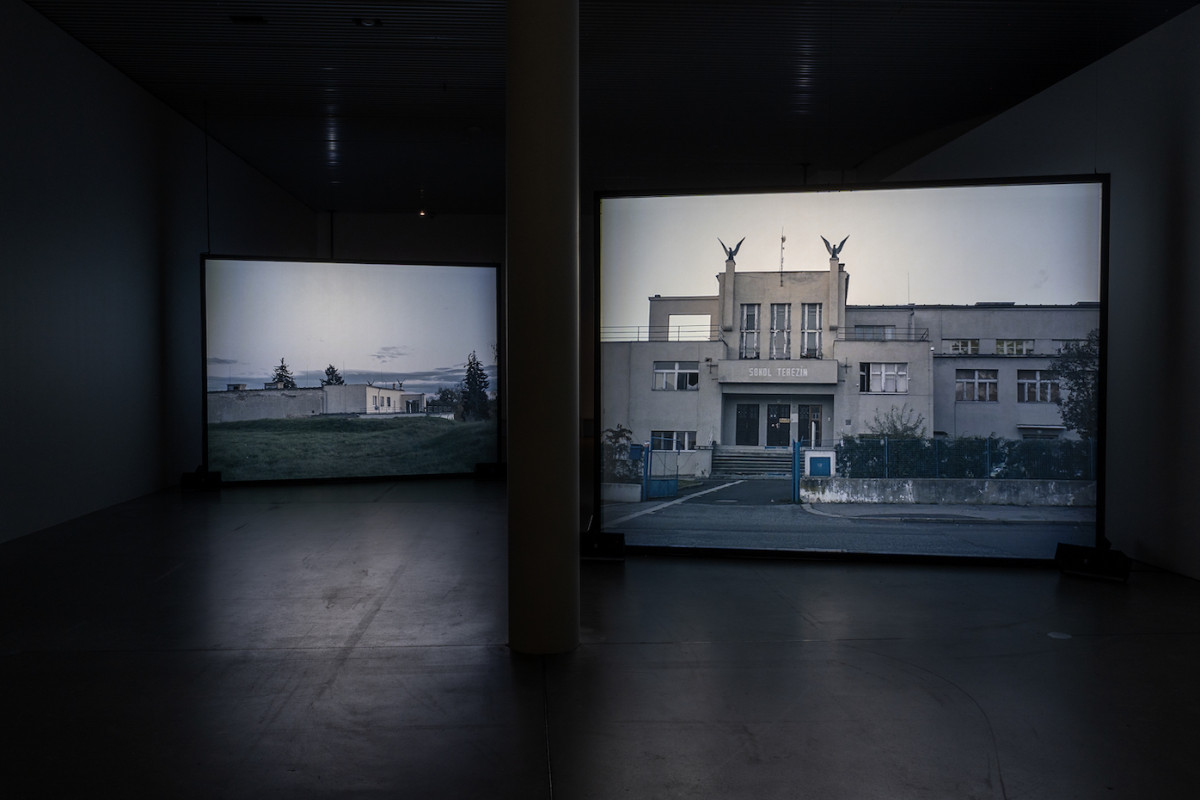
Susan Philipsz: »Study for Strings Sokol Terzín«
© Jens Henrik Daugaard

Two solitary instruments – viola and cello – are heard on separate soundtracks by separate video screens showing footage from the former concentration camp Theresienstadt: peeling walls, cobwebs, a lifeless gym hall. The composition they play was created here; the Czech-Jewish composer Pavel Haas (1899-1944) wrote an orchestral piece that the Nazis used as the soundtrack to a propaganda film about Theresienstadt. We don't hear any orchestra. This is why the two instruments sound so abandoned. Although they also talk together; tones are repeated many times, as if they are trying to breathe life into the empty spaces. The melodic lines are detached from the context they should be in, but cannot be in, because the composer was taken to Auschwitz and murdered shortly after he performed the piece.

Like other Holocaust representations, Turner Prize-winning Scottish artist Susan Philipsz lets us see that the visible traces of the atrocities have disappeared. The camera makes an effort. In that resounding emptiness, ghostly garlands of mismatched tones resound. They are full of holes – there should have been more musicians to make this piece of music sound right. In the speakers, the cello and viola sound almost electric, eerie, it's all so slow, the tones are stretched until they can't do it anymore. In his book Images in Spite of All the art theorist Georges Didi-Huberman defended using all images that exist from the atrocities. The same here: Haas' music calls to be heard, not forgotten. They are sounds, after all. Amputated, seeking for beauty, or remnants of something seeking for beauty. For no composer – even under the worst conceivable conditions – makes music that is deliberately evil.

© DMF

»Music for me is a tool of infinite expression. It’s where I’ve had the most complex conversations and open-minded experiences. It is the highest form of energy I know.«

Nana Pi is a saxophonist, composer and conductor working within the experimental music scene. She has developed a unique musical vocabulary on the saxophone by incorporating objects and extended techniques, pushing the boundaries of sonic expression. Beyond her work as a saxophonist, she is known for conducting improvisation using her music sign language, Extemporize, for which she received the P8 Jazz Award Årets Ildsjæl in 2020. She is a member of the well established record label Barefoot Records. In addition to her musical career, Nana Pi is organizing events such as Impro Camp and FredagsJAM that focuses on creating networks and inspiring music environments between musicians.

© PR

»For me, music is an emotional refuge. When I sit at the piano I feel safe, it's where I can release everything I carry inside. It's not about performing, it's about being honest, vulnerable and free.«

Samanta Yubero, known artistically as Samyula, is a composer, pianist, and neuroscientist based in Barcelona. Trained as a classical pianist and holding a PhD in her scientific field, Samyula bridges the worlds of art and science in her work. Her music – often within neoclassicism – blends both serene and intense piano melodies with vivid, dynamic string arrangements, creating emotionally resonant and immersive soundscapes. With a deep passion for both composition and performance, Samyula offers audiences a uniquely powerful and moving experience.

© PR

»Music is the ultimate gateway to presence, a true expression of the moment.«

Praised by DownBeat Magazine as one of Europe’s most versatile and inquisitive musicians, Polish-born, Scandinavian-based trumpeter and composer Tomasz Dąbrowski creates music that whispers before it screams – blending open, lyrical melodies with raw, unconventional trumpet sounds. Dąbrowski has revealed an unceasing curiosity, stretching and expanding his jazz roots in an ever-widening circle of exploration. From the beginning he’s rejected hierarchies, preferring to see creative music as a boundless practice that can accommodate ideas drawn from every spot on the stylistic map. While plenty of musicians pivot toward new directions, sometimes transforming their aesthetic wholesale, Dąbrowski has long revealed a more ruminative and holistic mindset that has allowed him to retain a clear artistic identity through countless projects, whether driven by improvisation or composition. 

© Malthe Ivarsson

»Music is where my heart is. The place where I feel the most freedom and possibility to express myself. It's also the place I seek to when I need to calm down.«

Anna Roemer is a Danish guitarist and composer from South Zealand, now based in Copenhagen. She has performed with artists like Hannah Schneider, Jacob Bellens, and Guldimund. Together with saxophonist Cecilie Strange, she forms the acclaimed duo K A L E II D O, known for music that constantly evolves. The duo has received national and international praise and won the Carl Prize for »Jazz Composer of the Year« for their albums Elements and Places (2024).

In brieflive
02.06

Not the Royal Rock Star We Might Have Wished For

David M. A. P. Palmquist: »King Frederik X’s Honour March«
© Kongehuset
© Kongehuset

Surely, I can’t be the only one who nearly choked on my oyster on New Year’s Eve, when King Frederik X delivered his first New Year’s speech. What a modern take on the old tradition! Instead of sitting solemnly at a desk, he calmly walked into the room – a room demanding attention, where a futuristic mural stole the show. I could barely focus on the speech itself, distracted by the psychedelic imagery behind him: a visual nod to Yellow Submarine by The Beatles. Was this a sign of a rock star ascending the throne?

Wishful thinking, as it turned out. The speech turned into a parade of predictable platitudes. The same can be said about the King’s new Honour March, composed by David M. A. P. Palmquist, former conductor of the Royal Danish Life Guards Music Corps. A traditional and sluggish piece that plays it entirely by the book.

Since H.C. Lumbye gifted a march to Frederik VII in 1861, it has been a tradition for members of the royal family to be granted personal marches. Take the lively and self-ironic Parade March for Queen Margrethe, which includes quotes from both »I Danmark er jeg født« and »Daisy Bell«. Or Crown Prince Frederik’s brisk and quirky Honour March in 6/8 time – written by Fuzzy for the now-King’s 30th birthday – tipping its hat to Carl Nielsen’s »Som en rejselysten flåde«.

But where is the personal character in Palmquist’s march? The composer approaches the task far too conceptually, attempting to give the piece a musical signature with a kind of rebus at the beginning. The first note is an F, followed by one ten steps higher – thus spelling »Frederik the 10th« in musical code. The many references to other military music are just as internal. What’s missing is something that breaks with protocol – just like King Frederik himself has done in his most memorable and beloved moments. In the end, it sounds like a march that has forgotten who it was written for.

English translation: Andreo Michaelo Mielczarek. Proofreading: Seb Doubinsky