

© Rene Passet
© Rene Passet

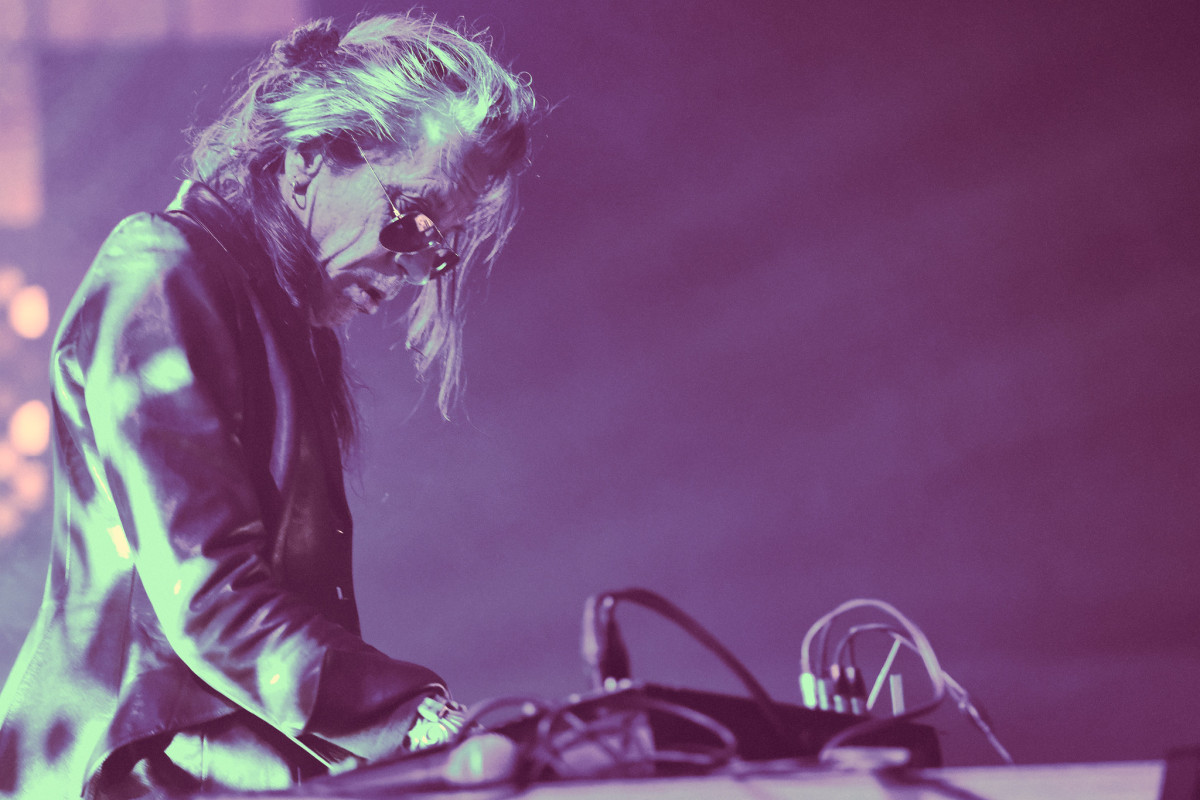
The only thing  that might be missing was a yippie ki-yay from William Basinski when he took on the Copenhagen Distillery as part of The Last Symphony tour. »Buckle up bitches«, it sounded so raw that for a moment you thought it was Bruce Willis on stage. Basinski's riveting superstar charisma is the perfect contrast to his crumbling and self-indulgent ambient music.

The concert was refreshingly far from the extended space of contemplation I associate with Basinski's recorded works. His famous series The Disintegration Loops (2002-2003), in which the mortal world of tape loops crumbles in slow motion, was emblematic of the concerns many had around the turn of the millennium: Was the infinity of the brave new digital world actually the beginning of the end? Like no one else, Basinski manages to let the question of technological determinism sound open in his music: The patinated tape recordings contain no answer, but instead a curious state, where repetition and impermanence stop pulling at the sense of time from either side and instead come full circle.

It was fascinating to experience the way Basinski processed his loops. Every time he put a new sound into rotation, it seemed as if it was his first encounter with it. Quickly, a sucking field of reverberation and feedback arose, forming a sphere from the orbits of the tape loops. The analog sound sometimes gnawed at the music with its small clips and grinding compression.

The distance between the ambient terrains was short and the concert, which was followed by two encores, was more collage-like than the wasteland Basinski usually paints. The landscape was particularly captivating as a six-note motif consumed itself in reverberation and gave way to what sounded like Arabic ornamented chant. Basinski found transcendence in the high frequencies, and when at one point he extended a bright vocal sound beyond the murky tape environment, the boundary between heaven and earth disappeared. It was incomprehensibly beautiful to hear how the vocals hovered  like a radiant deity over the profane tape-recorded world. 

English translation: Andreo Michaelo Mielczarek

in briefrelease
04.07

When Machines Dream: The Electronic Poetry of Oh No Noh

Oh No Noh: »As Late As Possible«
© Nikolas Fabian Kammerer

There’s something distinctly mechanical about Oh No Noh’s album As Late As Possible. Like a warped, crumpled tape, melodies bubble to the surface, and the offbeat rhythms repeat with the halting tempo of a scratched LP. It’s easy to place Oh No Noh within the esteemed German tradition of blurring the lines between human and machine, but on As Late As Possible, the machine sounds more like a distant relative than a deliberate artistic objective.

Behind Oh No Noh is Leipzig-based guitarist Markus Rom. In addition to a wealth of synthesizers and tape loops, the album’s 11 tracks are performed using guitar, drums, banjo, clarinet, and organ. The absence of vocals sets the album in a subdued, cinematic mood, and the music feels like a nostalgic inner monologue, told with a warm affection for the melancholy of outdated technologies.

Although mechanical sensibilities are prominent throughout the album, several tracks are driven by more melodic band arrangements. But to me, As Late As Possible is clearly most compelling on the less melodic pieces. The crooked and noisy »Fawn« or the hesitant closing track »Ore« are moments where the dialogue with the machine elevates the music in ways that the more melodic, band-oriented pieces don’t quite reach. These are places where the machines sigh nostalgically and form small, imperfect thought bubbles that cut off and restart again.

English translation: Andreo Michaelo Mielczarek

© Hreinn Gudlaugsson

»Music for me is like a sourdough. If you don't feed it right it is going to die. If you feed it correctly a lot of people can benefit from it.« 

Halym Kim is a drummer, composer and project coordinator based in Copenhagen. His music is mainly based in free improvisation and experimental music but performs also as a traditional Korean percussionist. He has a Master and an Advanced Postgraduate Diploma in Music Performance from RMC in Copenhagen. Together with Nana Pi he organizes Impro Camp which is a music camp for free and structured improvised music that is happening every year in Fredericia, Denmark.

© DMF

»Music for me is a tool of infinite expression. It’s where I’ve had the most complex conversations and open-minded experiences. It is the highest form of energy I know.«

Nana Pi is a saxophonist, composer and conductor working within the experimental music scene. She has developed a unique musical vocabulary on the saxophone by incorporating objects and extended techniques, pushing the boundaries of sonic expression. Beyond her work as a saxophonist, she is known for conducting improvisation using her music sign language, Extemporize, for which she received the P8 Jazz Award Årets Ildsjæl in 2020. She is a member of the well established record label Barefoot Records. In addition to her musical career, Nana Pi is organizing events such as Impro Camp and FredagsJAM that focuses on creating networks and inspiring music environments between musicians.

© PR

»For me, music is an emotional refuge. When I sit at the piano I feel safe, it's where I can release everything I carry inside. It's not about performing, it's about being honest, vulnerable and free.«

Samanta Yubero, known artistically as Samyula, is a composer, pianist, and neuroscientist based in Barcelona. Trained as a classical pianist and holding a PhD in her scientific field, Samyula bridges the worlds of art and science in her work. Her music – often within neoclassicism – blends both serene and intense piano melodies with vivid, dynamic string arrangements, creating emotionally resonant and immersive soundscapes. With a deep passion for both composition and performance, Samyula offers audiences a uniquely powerful and moving experience.

© PR

»Music is the ultimate gateway to presence, a true expression of the moment.«

Praised by DownBeat Magazine as one of Europe’s most versatile and inquisitive musicians, Polish-born, Scandinavian-based trumpeter and composer Tomasz Dąbrowski creates music that whispers before it screams – blending open, lyrical melodies with raw, unconventional trumpet sounds. Dąbrowski has revealed an unceasing curiosity, stretching and expanding his jazz roots in an ever-widening circle of exploration. From the beginning he’s rejected hierarchies, preferring to see creative music as a boundless practice that can accommodate ideas drawn from every spot on the stylistic map. While plenty of musicians pivot toward new directions, sometimes transforming their aesthetic wholesale, Dąbrowski has long revealed a more ruminative and holistic mindset that has allowed him to retain a clear artistic identity through countless projects, whether driven by improvisation or composition.