in brief
16.12.2023

Orgel, ynde og bad ass-minimalisme

Organ Sound Art Festival: Hampus Lindwall, Matt Choboter, Ying-Hsueh Chen, Simon Mariegaard, Paulina Rewucka & Neža Kokalj, Ellen Arkbro, Hanne Lippard
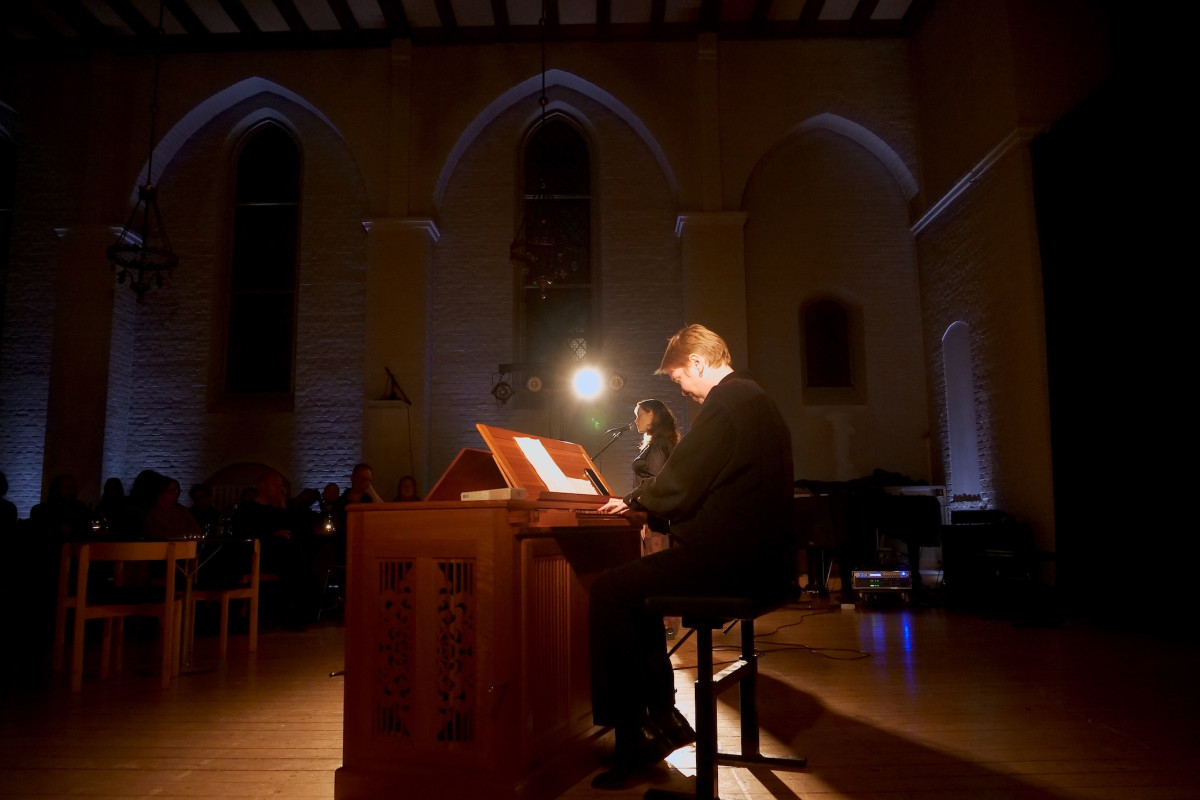
© Daniel Oxenhandler

Det er muligt, at julen er hjerternes fest, men det er bestemt også orglets. Mange støder i løbet af december på kirkeorglets mægtige klang i forbindelse med julens mange kirkekoncerter, men i Koncertkirken på Nørrebro er december blevet en helt særlig slags fest med orglet som hovedperson og med et efter fremmødet at dømme til andendagen af Organ Sound Art Festival ganske dedikeret publikum, fascineret af orglets klang, struktur og mangfoldige muligheder.

Aftenen åbnes af den svenske organist og komponist Hampus Lindwall, der også runder aftenens program af i et trioformat med organist Ellen Arkbro og vokalist Hanne Lippard. Solosættet indledes af værket Unmounted / Muted Noun af amerikanske Phill Niblock, som Lindwall præsenterer som en bad ass-minimalist. En form for bad ass-minimalisme, der egner sig godt til orglets rige væld af klange og overtoner, og med langstrakte droner får Niblocks værk da også hele kirken til at knirke og knage, mens Lindwalls eget Music for Organ & Electronics byder på et kvadrofonisk set-up, hvor publikum opfordres til at sætte sig i midten af kirken for at lade sig omslutte af både orglets klang og de elektroniske toner.

I det hele taget er det en aften, hvor publikum opfordres til at flytte sig meget efter, hvad det enkelte værk kræver. I det efterfølgende bestillingsværk, And Then There Were The Sounds of Birds, af den herboende canadiske komponist Matt Choboter, må publikum trække helt ud til siderne for at give plads til to ekspressive dansere, der sammen med to orgler, et præpareret flygel, percussion og elektroniske collager skaber et både melankolsk, legende og meget fysisk rum, der kredser om fugles stemmer og bevægelser. Orglet indtager her en mere tilbageholdende rolle, men værket synes samtidig at indkredse et paradoks ved netop orglet som et instrument, der med sin klang stræber mod det sfæriske, men som samtidig er ladet med en tyngde, som også kommer til udtryk i danserne, der snart nærmest svæver, snart falder klodsede til jorden, samtidig med at de indgår i symbioser med de instrumenter, der er fordelt ud i hele rummet. 

At udforske orglet er således også at udforske rum for musikken, både for komponist, performer og publikum, og på sin vis bliver det næsten en del af aftenens oplevelse, at vi, mens vi drikker ud og snakker om aftenens koncerter, er vidner til det franske ensemble Pancrace, der omdanner hele salen til en sand orgelbyggeplads for at gøre klar til deres koncert den efterfølgende dag. Nysgerrigheden bliver i hvert fald vakt på mere. 

in brieflive
06.03

Labour of Birth

Katinka Fogh Vindelev, Sankt Annæ Pigekor, Kind of Opera et al.: »Elegier over jorden«
© PR

»This pain is not only yours,« chants a choir standing in a circle around the woman in labour. »This pain is not only yours,« comes the enveloping echo from the rest of the choir, positioned along the walls of the ceremonial hall, forming a circle around the audience and inscribing us into the labour of female fertility.

Elegier over Jorden (Elegies over the Earth) is based on Sofie Isager Ahl’s reworking of the myth of Persephone, daughter of the goddess of agriculture and queen of the underworld. The Greek myth is one of those that explains the barrenness of winter by Persephone’s descent into the underworld, but in this reinterpretation she returns to earth to give birth. We follow her labour over nine months while members of the choir work in the fields, struggling for crops under pressure from the current climate collapse. Here, the regeneration of nature is not a matter for higher powers but a struggle that begins in the body and in the soil – much like that of the woman giving birth.

The ecofeminist interconnectedness of the female body and nature has been a hot topic for several years now, and I am unsure what Elegies over the Earth adds to it. My hesitation stems mainly from the harsh acoustics of the ceremonial hall at Ny Carlsberg Glyptotek which, combined with Marie Topp’s choreography – often positioning singers with their backs turned to parts of the audience – makes it difficult to hear Ahl’s words.

When Elegies over the Earth works best, it is in the dialogue and timing between the choir, the soprano and composer Katinka Fogh Vindelev in the role of the labouring Persephone, and the minimal ensemble of two violins and a cello. When the voices of Sankt Annæ Girls’ Choir curl around the cello’s dark timbre, and when the primordial woman Persephone’s lament is allowed to hang in the room for a moment before the choir resumes, the performance touches on something real. Yet the experience never quite settles in the body, and the painful struggle of birth – despite the choir’s insistent chanting – never truly becomes mine.

Performances on 5, 7 and 8 March

English translation: Andreo Michaelo Mielczarek

© PR

»For me, music is... I was about to say everything, but that's still an exaggeration. I'm a sensitive person, and therefore all art - but especially music - affects me in different ways. Music has both a therapeutic and an artistic meaning for me. Music affects my mood and gives me energy. It can also put me in a certain state where I see things differently and reflect in a different way than I would otherwise. I always have headphones in when I'm alone, I sleep to music, I work to music. The first thing I did as a new councilor was to set up my father-in-law's old B&O system in the councilor's office. It plays every day, and I very rarely close the door.« 

Jesper Kjeldsen is councilor for Culture and Citizen Service in Aarhus and a member of the city council for the Social Democrats. He graduated from Kaospiloterne and has a background as an entrepreneur, including with the company Postevand. Before his political career, he worked creatively with culture and music – he has released music, been a DJ and taught as a dance teacher. Jesper Kjeldsen has lived and worked in Greenland for a long period of time, which has influenced his view of community, culture, climate and society.

© PR

»Music for me is translation. Music for me is a musical score that can be released into sound in a thousand ways, depending on who picks up the instrument. Music for me is the attempt to embody the idea of sound in lines and dots and floor plans. Music for me is both a sought-after sound that does not ring, and a sought-after sound that does. Music for me is a song game, a parallel universe with its own temporality and its own rules.«

Matias Vestergård is a trained composer and pianist from the Royal Danish Academy of Music in Copenhagen. Since his debut in 2022, he has particularly distinguished himself with music-dramatic works – his first opera Murder on the Titanic will be performed for the third time this year, and his second opera Lisbon Floor won the award for Opera of the Year at the 2023 Reumert. He is currently working on orchestral works, a piano concerto and choral music, but dreams of writing more operas.

© PR

»Music for me is a way to stay curious. It can feel completely overwhelming to hear some music you don't know, or revisit something you haven't heard in a long time. Music makes my heart race, it makes me cry, laugh, and gesticulate wildly. It's a way to understand myself at different times in my life, and a way to create bonds with others around me.«

Hannah Schneider creates cinematic alternative pop with electronic soundscapes and strong melodies. She has released several critically acclaimed albums, toured Europe and the US, and has established herself as one of the country's most original voices. Her music has been used in film, television, and on major Scandinavian theater stages, and in recent years she has also composed commissioned works for leading museums and cultural institutions.

On her new album In This Room (February 27, 2026), she chooses – in an era marked by artificial intelligence – to insist on presence, intuition, and craftsmanship as driving forces. The album was written and recorded during a two-month residency at Thorvaldsens Museum.

© Tom Ingvardsen

»I listen to music at all hours of the day when I’m at home – surrounded by family – or when I’m working and travelling. My playlist changes every day. It reflects my state of mind here and now, and the ideas, memories, joys and sorrows that currently occupy me. The last piece, Salve Regina, was only added late this evening, after I experienced Poulenc’s magnificent opera Dialogues des Carmélites at the Royal Danish Opera.«

Louise Beck is a scenographer, stage director and artistic director of OPE-N – and from the 2027 season, artistic director of Copenhagen Opera Festival. For nearly three decades, she has developed opera as a living and contemporary art form at the intersection of the established opera field and the independent music-theatre scene. She has created a number of critically acclaimed and award-nominated works, including Den Sidste Olie and LOL – Laughing Out Lonely, and, together with Niels Rønsholdt, stands behind the opera trilogy Den Stærkes Ret – Den Svages Pligt, whose second part will be presented at the University Library of Copenhagen during the 2026 festival.