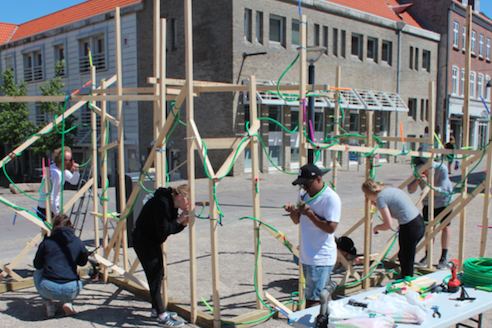
2-18. juni lægger Struer gader, pladser, parker m.m. til landets hidtil eneste festival for stedsspecifik lydkunst. Festivalleder Jacob Kreutzfeldt fortæller om Struer Tracks, som festivalen er døbt.

“Struer Tracks er en festival for lydkunst. Kernen er udstilling af lydkunstværker, og værkerne er stedspecifikke i den forstand at de er tænkt eller tilpasset til Struer og til de konkrete steder. Uden om udstillingen har vi en række arrangementer, koncerter, workshops og præsentationer, hvor vi inviterer borgere og besøgende til at lytte og give lyd”, indleder Jacob Kreutzfeldt.

Han uddyber, hvordan de urbane og offentlige rammer spiller med på lydkunstens præmisser på en helt anden måde end eksempelvis de traditionelle, hvide gallerirum.

“Vi ville gerne skabe situationer, hvor publikum møder kunst i hverdagen – frem for på museer eller i koncertsale. Her er der mulighed for at kommunikere på andre planer, end når det foregår på institutioner. Ved at arbejde i det offentlige rum er der en anden mulighed for at værkerne kan overraske folk i hverdagen. Det gælder for al kunst i det offentlige rum, men måske i særlig grad for lydkunst, hvor kan komme komme snigende og blande sig med omgivelsernes lyd”, forklarer han.

Valget af lige netop Struers offentlige rum som ramme for festivalen er langt fra tilfældig. Det lokale byråd har med en strategisk satsning brandet den midtjyske købstad under navnet Lydens By. Knap en femtedel af de ca. 10.000 indbyggere er da også beskæftiget hos byens største virksomhed, B&O, der er verdenskendt for især lyd-elektronik af høj kvalitet.

“Man har gennem de seneste 5 år arbejdet med at opbygge en identitet og kultur omkring lyd i Struer – ikke mindst baseret på at Bang & Olufsen har ligget i Struer i mere end 90 år. Det betyder at vi kan trække på initiativer og kompetencer, som vi ikke ville kunne finde i andre byer – og slet ikke i byer af Struers størrelse. F.eks. har Ursula Nistrup haft mulighed for at samarbejde med folk med stor teknisk kompetence på B&O, og vi kan spille Jacob Kirkegaards og Peter Albrechtsens Dolby Atmos-værk Den Usynlige By i en af de mest veludstyrede provinsbiografer, jeg nogensinde har set”, konstaterer han.

Udover at bidrage med gode tekniske faciliteter og samarbejdsmuligheder, kan Struer også noget andet, som kunst-hovedsæderne Aarhus eller København ikke kan.

“Struer Tracks er også et forsøg på at aktivere en anden lokalitet end de metropole omgivelser, som samtids- og lydkunsten tit præsenteres i. Struer er en provinsby, og med festivalen vil vi gerne undersøge mødet mellem samtidskunst og provinsby. Det er håbet at værkerne kan være med til at sætte fokus på steder, identiteter og kulturer, der kendetegner provinsdanmark – der jo trods alt er den største del af landet”, afslutter Jacob Kreutzfeldt.

Det er ambitionen, at Struer Tracks skal udvikle sig til at blive en international biennale for lydkunst, der således indtager Struer næste gang i 2019 og hvert andet år derefter.

Hvad? Struer Tracks
Hvor? Forskellige lokationer i Struer
Hvornår? 2-18. juni 2017

Læs mere om festivalen og se det komplette program af udstilling og arrangementer på festivalens hjemmeside.


in briefrelease
29.05

Gintė Preisaitė Lets Uncertainty Sing

Gintė Preisaitė: »Instruments of Forgetting and the Singing Bone«
© Lukas Mykolaitis
© Lukas Mykolaitis

You increasingly encounter Gintė Preisaitė in different contexts and under different names – solo as Baraboro and as part of the trio Treen. With Instruments of Forgetting and the Singing Bone, the Lithuanian-Danish composer releases her first album under her own name, and it certainly feels like her most personal work to date.

Above all, this is because Preisaitė sings on seven of the album’s eight tracks. She treats her voice as an instrument equal to all the others, and although the singing is lyrical, she primarily uses it to create texture, depth, and contrast. On »Summary Saint Mary«, for instance, layers of vocals in different registers intermingle with scraping background noise, rapid pulses, resonant bass, and a multitude of sounds of both digital and analog origin. It feels refreshingly fragmentary – a willingness to play with uncertainty. Not everything coheres, yet it is precisely this lack of cohesion that makes the music feel alive and compelling.

Only on »Nippon Dreams« – a dense collage of percussion, samples, and field recordings of Japanese voices – is Preisaitė’s vocal absent. And it is only then that one realizes how essential it has been as a point of orientation throughout the album. Its absence leaves a void that underscores the duality Preisaitė works with: the music feels both intimate and cool, present and distant.

Instruments of Forgetting and the Singing Bone does not provide many answers. Instead, it becomes yet another fascinating piece in the puzzle of Preisaitė’s singular oeuvre.

in briefrelease
28.05

A Violinist with Fire in His Bow

Darragh Morgan, Ulster Orchestra & David Brophy: »Spin – New music for Violin & Orchestra from Northern Ireland«
© Brian Morrison
© Brian Morrison

There is nothing quite like true enthusiasts. They champion composers and works that might otherwise have remained dormant. Here we have the exuberant violinist Darragh Morgan, who since the age of fifteen (!) has promoted and performed contemporary music. He knows what works and has a keen instinct for new pieces and composers – especially on this album with the not exactly catchy title Spin – New Music for Violin & Orchestra from Northern Ireland. Four relatively recent violin concertos, all centred around Morgan as soloist. Two of them are dedicated to the musical firebrand himself.

There is fire in Brian Irvine’s violin concerto À mon seul désir from the very beginning, where sparkling motifs and riffs erupt everywhere. Almost too much energy and activity – but it works, and all the fierce gestures are carefully balanced. The movement is titled »With a big life embracing energy«. Concrete and descriptive – the Irish leave the grand spheres of abstraction to the contemporary music scene in Central Europe. I have replayed the dramatic climax of the second movement several times out of sheer enthusiasm, and the entire concerto (which lasts only fifteen minutes) ends with angelic beauty on Morgan’s highest, finest strings.

Ryan Molloy’s three-movement violin concerto, stretching beyond twenty minutes, by contrast tends to drift somewhat aimlessly, although the final movement reaches a strong level. Bill Campbell’s Swim is unmistakably Irish in tone throughout, conjuring images of rolling fields and the proud Irish landscape. Midway through the quarter-hour work, Darragh Morgan delivers a heartfelt and expansive solo cadenza. 

Fortunately, Frank Lyons’s Spin 3 is also a small gem, leaving the listener uplifted by this new Northern Irish music performed by the Ulster Orchestra and the fascinating Darragh Morgan, whose deep personal dedication gives so much to the music.

English translation: Andreo Michaelo Mielczarek


© PR

»Music, for us, is a fusion of different consciousnesses into a single shared focal point.«

The band Selvhenter was founded in 2010 by trombonist Maria Bertel, saxophonist Sonja LaBianca, violinist Maria Diekmann, and drummers Jaleh Negari and Anja Jacobsen. In 2017, Maria Diekmann left the group, and Selvhenter continued as a quartet.

Selvhenter’s sound is driven by a deep fascination with sonic textures, rhythmic displacements and polyrhythms, acoustic and electronic melodies, hard-hitting compositional choices, improvised beauty, and a sheer joy of creating and performing music. Selvhenter has played concerts both in Denmark and internationally. The group is also the nucleus of the artist collective Eget Værelse, which houses the members’ solo projects as well as collaborations such as Valby Vokalgruppe, SOLW, Nina Garcia & Maria Bertel, and G.E.K.

© PR
»Music for me is a constant movement (in me). It is a constantly changing song in my head. Music can be calming and uplifting, and it can give me answers that I didn’t know existed. Music guides me through life – whether it is the biggest and best moments of my life, or difficult periods. Music is also a community where new thoughts and ideas can come to life. Community is not a competition, but a way to move forward together.« 
 
Troels H. Sørensen is the booking and program manager at the Skråen venue in North Jutland. He is a former manager at 1000Fryd. Together with Casper Clasen, he runs the Lasher Agency and is responsible for the Lasher Fest festival, among other things. Sørensen plays in the band Vægtløs and has previously been in various bands from the Aalborg underground and has released records through his cooperative record label 5FeetUnder Records.


© Clemens Schmiedbauer
»Music for me is osmotic refuge.«
 
Jungstötter is the solo project of Berlin-based songwriter and musician Fabian Altstötter, whose sounds linger in lyrical softness and formal fragmentation. Using voice as a centre point, as an axis that hinges off an assembly of instrumental experimentation, his work pulls together shifting lyric compositions with textured layering, and whispered moments of release. 
 
Jungstötter has released two albums on [PIAS], and has played shows across Europe, at renowned venues and festivals includingVolksbühne, Silent Green and the Zeiss Major Planetarium (all Berlin), Kampnagel (Hamburg), the Nuremberg State Museum of Art and Design, Palac Akropolis (Prague), Desertshore Festival (Vienna), and more. He’s supported acclaimed acts including Owen Pallett (Final Fantasy, Arcade Fire) and Petra Hermanova.