




From Cringe to Cosmos – and Back Again
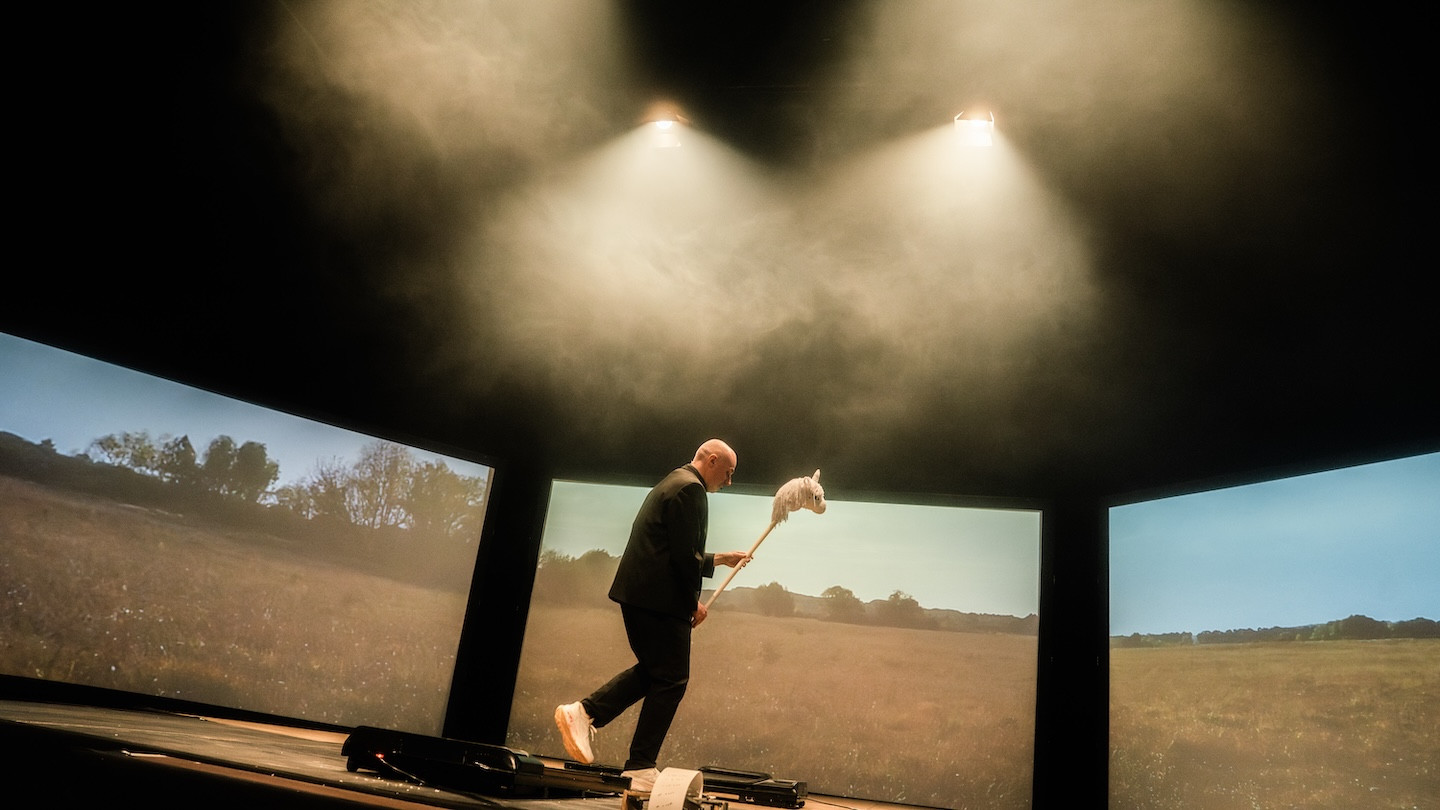
Did I really just witness a sexual encounter with a hobby horse/unicorn? Yes. Can something like that really last 45 minutes? No. But only because bass-baritone Jacob Bloch slipped into a glitter suit halfway through the piece and instead let himself be chased by a digital teddy bear. It was strange, but still preferable to the first part’s blush-inducing collective violation. This electronic opera, Me & Stjärna by Alexandra Hallén, premiered on the opening night of Spor Festival and was repeated the following day, where I had eagerly taken my seat at Godsbanen’s Åbne Scene.
Did I really just witness a sexual encounter with a hobby horse/unicorn? Yes. Can something like that really last 45 minutes? No
The work was described as an opera staged with treadmills, where physical exhaustion would affect the singer’s breathing and thus the musical structure, while the Stjärna figure (that is, the hobby horse) would function as an object of unrequited and unresolved desire. But believe me – there was both release and reciprocity from Stjärna’s side.
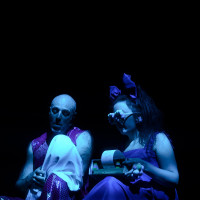
The exaggerated sexualization was amplified by moaning breathwork, and it was so cringe-inducing that I could barely remain seated. Despite the performers’ obvious skill, the form was self-contained in a way that became far too intimate. And there were children present! If only someone in the audience had dared to burst out laughing (which the performers surely invited) instead of shaking their heads in disbelief and exchanging what-have-you-dragged-me-into giggles. Thankfully, it ended with a successful lament for the deceased Stjärna, accompanied by an analog punch-card music box. A moment to breathe again. I was left with many thoughts about the power of theatre to keep audiences within the provocative and the grotesque. With that power comes a responsibility to actually want something for the audience. I don’t know what that unicorn wanted from me. The worst part is that the piece succeeded in affecting me deeply. I truly felt violated – and that, in itself, was something worth writing home about. Damn it.
I truly felt violated – and that, in itself, was something worth writing home about. Damn it
The talk show as compositional machine
Something that was genuinely fun, on the other hand, was Michael Hope’s Late-Night Lineup at Turkis on Friday evening. Strolling down the aisle wearing a T-shirt printed with his own face, Hope brought new music to the people.
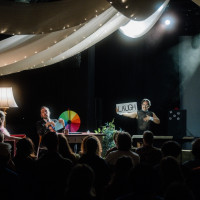
In a tightly structured composition, he commented on the talk show genre in relation to contemporary music, joined by three other performers and the ensemble K!ART, installed for the occasion as a house band with guitar, bass, drums, and synth. They had been given what must have been a highly opaque score, yet the tones that seemed randomly scattered throughout the talk show were razor-sharp.
It was funny because it was pure form: greetings repeated endlessly, interviews consisting only of filler words, the stage flooded with excessive merch – even pacifiers bearing Hope’s face. A scantily clad man waved random reaction signs, and one had to stay constantly alert, as the audience was quite literally played as an instrument – prompted to sigh, gasp, clap, laugh out of context until one began to fear his relentless demands.
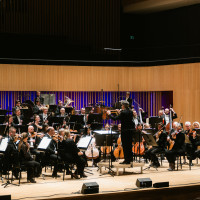
One of the festival’s highlights was Simon Steen-Andersen’s Grosso, a large-scale composition for symphony orchestra and a quartet of Hammond organs and percussion
It was pure form – until even the form dissolved. Audience members were pulled onstage one by one to assist with new tasks within these useless compositional elements. Normally, I consider audience-participatory theatre my personal version of hell (introvert), but this felt strangely safe. As if we, the audience, had been part of the piece all along. I didn’t entirely grasp the connection to contemporary music, except that it was embedded within the talk show and thus presented in a new format. But could this just as easily have taken place at any other festival as a comment on genre-driven, commercialized forms? Or was it a critical jab at an insular, over-formalized compositional practice that, like a machine, produces new music by simply rearranging known elements – until the form collapses?
Symphonic machine power
One of the festival’s highlights was Simon Steen-Andersen’s Grosso, a large-scale composition for symphony orchestra and a quartet of Hammond organs and percussion. Fortunately, such a quartet exists in the form of the American group Yarn/Wire, who performed in Denmark for the first time alongside Aarhus Symphony Orchestra. Grosso lasted precisely 38 minutes, and with deep concentration and superhuman coordination, the four soloists mastered percussion, Hammond organs, power drills, harmonicas, kalimbas, and a massive, iconic Leslie speaker that had to be rhythmically switched on and off.
Its whirring machinery stood center stage, stealing the sonic image by adding a deep, buzzing energy to the work – like a fifth soloist. Mechanical sounds, clicks, noise, and overtones took center stage, while the symphony orchestra, as a gigantic machine, sharply imitated drills, low undertones, and spinning textures. There was hissing from the winds and thunder from the percussion, creating a roaring experience impossible to replicate on a home sound system. This work lives in the resonance of body and space. And it requires a highly specialized quartet to carry those crucial solo roles. The question is whether the piece can even be performed without Yarn/Wire.
Grosso was thus difficult to follow, and Anna Thorvaldsdottir’s AIŌN did not quite match its energetic force. Instead, it was profoundly… Icelandic. An open sound with vast sonic surfaces. The first movement, »Morphosis«, opened with a long chord without a third, gradually transforming into various scalar passages. The following movements, »Transcension« and »Entropia«, shared a similar energy and structure, though not to their detriment. It sounded like nature’s grand counterpoint to the mechanical grandeur of Grosso. Rhythmic discrepancies, woody string textures, storm, whispering winds, and dissonance – as if the music itself were shaped by an uncontrollable natural force.
The mechanics of water
Beyond the symphony orchestra, the Leslie speaker, and the punch-card music box, several works grappled with the musical-mechanical. The video installation Boy World Effigy II by the artist duo Hart Lëshkina at the Dokk1 library explored the choir as a social machine shaping identity.
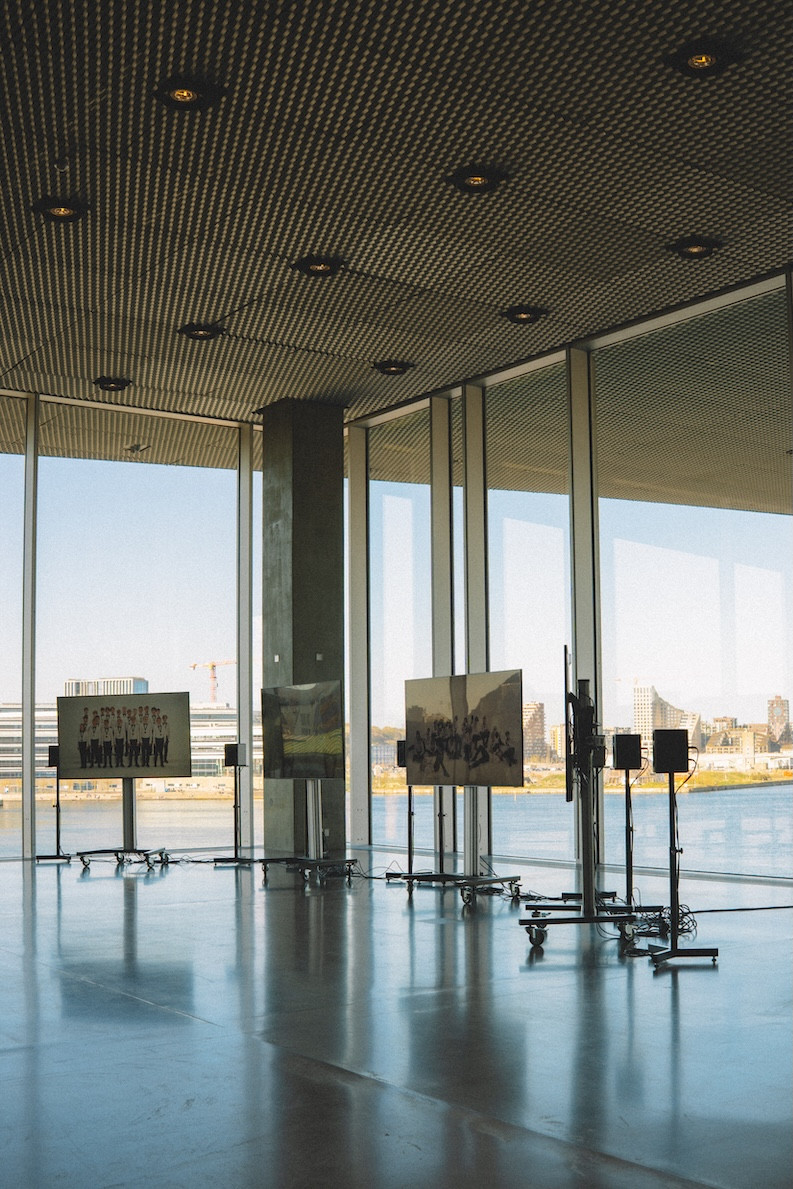
Like Marie Højlund’s Svanesang, it featured Herning Church Boys’ Choir (even using the same choral piece!) as a microcosm of broader social dynamics between discipline and improvisation. Staged as audiovisual fragments sustained by the choir’s goodwill and professionalism, I also sensed a slightly unsettling undertone of incel culture – as if the work pointed toward larger masculine structures, perhaps especially in the contemporary context of the Netflix series Adolescence.
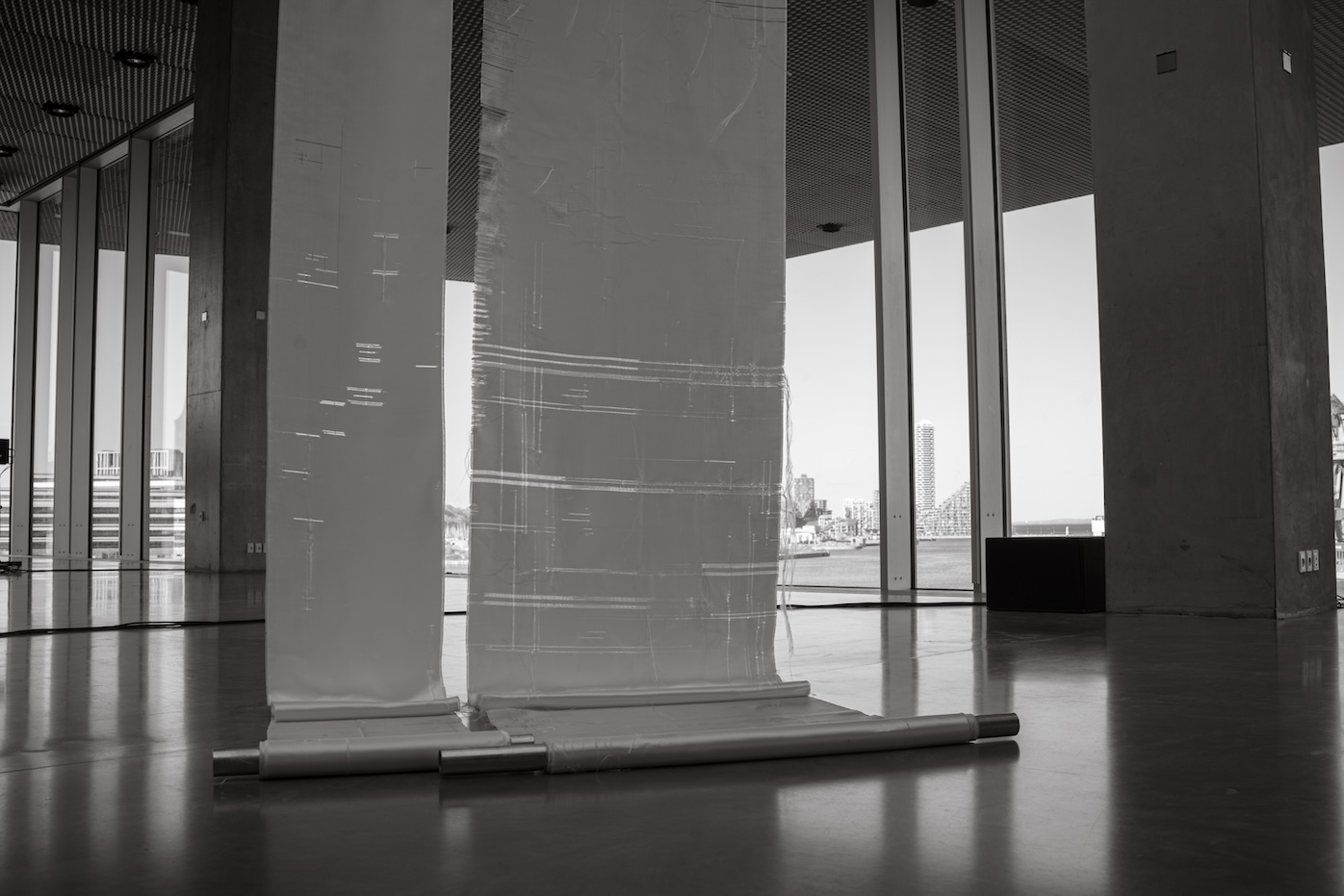
The neighboring installation, Strategic Opacity, Opus 26 by Toke Højby Lorentzen, was a mesmerizing piece that resisted comprehension: a fiberglass score resembling a perforated textile hung from the ceiling. A video showed, though never fully revealed, its performance and its sound/noise (which often clashed with Boy World Effigy II – how does one delimit sound works?). It is a work that deeply explores the materiality of sound as machine – something one can examine for a long time, strangely satisfying and unresolved at once.
The most captivating electronic contribution was Feeling Body by Kenyan composer Nyokabi Kariuki and the Finnish ensemble defunensemble
The festival’s final installation, Bird Choir by Sandra Boss and Katrine Würtz, was placed in the foyer of Godsbanen. It consisted of various water-filled ceramic birds and a composition of air bubbles blown into them through a mechanical system, producing birdsong-like sounds.
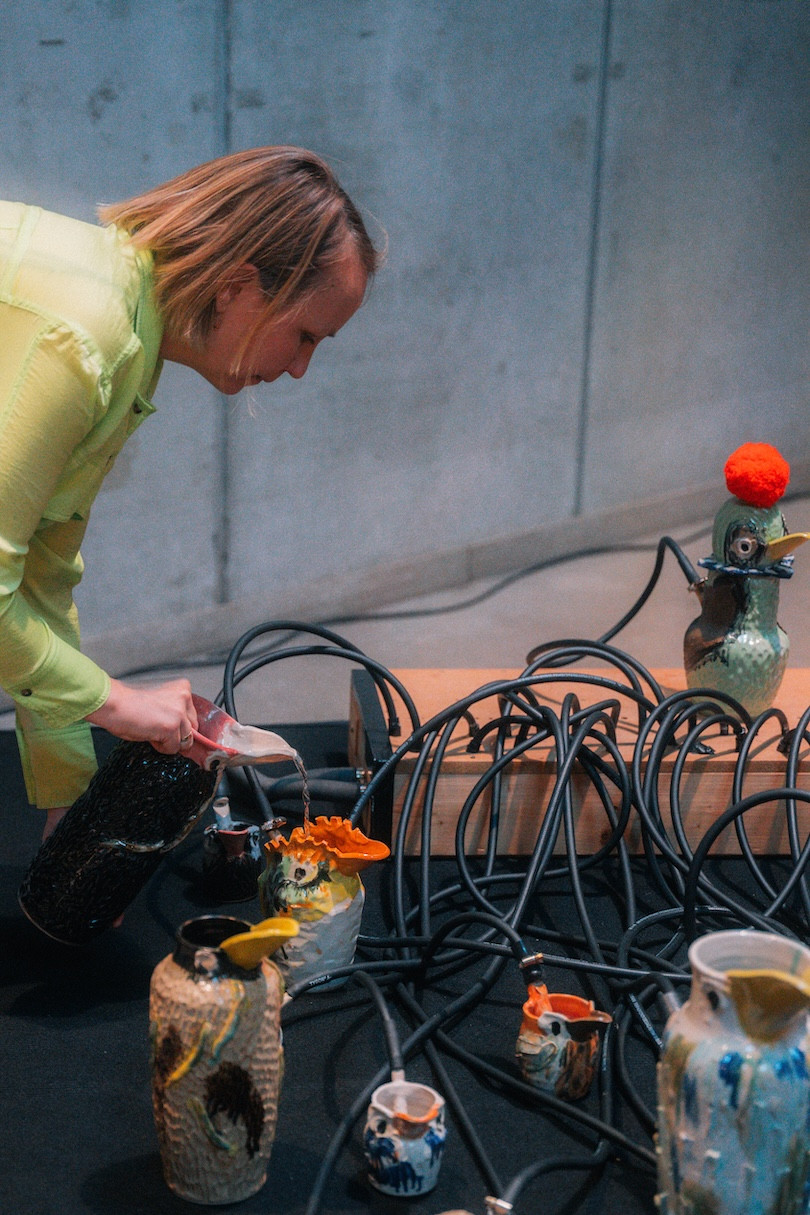
The work commented on biodiversity and the climate crisis by presenting fictional bird species that might one day inhabit Danish soil. A similar interest in water’s mechanical and musical properties appeared in Japanese artist Tomoko Sauvage’s Water Bowls, which concluded Thursday’s program at Radar.
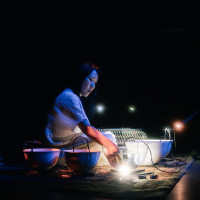
The bowls functioned as an electroacoustic instrument, supplemented by natural sounds from stones and water. At times it became almost tinglingly ASMR-like, while other sounds had the opposite effect, making the body recoil in discomfort. In this way, the work – and sound as physical force – directly entered the nervous system.
Naturally, more purely electronic music was also represented at this year’s Spor Festival. Klara Lewis’ Thankful delivered the same thunderous experience that Steen-Andersen pursued with the Leslie speaker and symphony orchestra – but on speed. Accompanied by contrapuntal videos of flowing silk fabrics, the sound surged through the ear canals and set the room vibrating, though at times the volume became too high and intense to remain pleasurable. Sophia Sagaradze’s Therewas another purely electronic piece, introduced as loud and aggressive, yet maintaining a fitting level through gradual buildup and crackling thunderstorm textures.
Turkis was packed to the brim, and the performance became a hybrid between pop concert and ensemble music
The voice as transformation
The most captivating electronic contribution was Feeling Body by Kenyan composer Nyokabi Kariuki and the Finnish ensemble defunensemble (piano, cello, and bass clarinet). A collaboration both simple and monumental, where electronic and acoustic elements met symbiotically – like electronic water sounds blending with the woody sounds of the pianist’s bracelet and subtle strikes on the piano’s case.
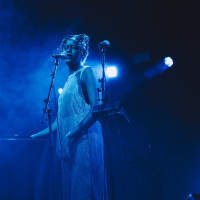
Turkis was packed to the brim, and the performance became a hybrid between pop concert and ensemble music, with cheers, storytelling between songs, and experimental sound formats – at times with clear jazz influences in the piano accompaniment.
And then there was the voice… A register I have never heard before. Kariuki began in a stable whistle register, bright and focused, only to be overtaken by something from an unknown darkness – deep groans looped in a language we did not understand. In the pauses, she spoke in yet another voice: fragile and hoarse, stripped of the singing voice’s power. The chameleon Kariuki constantly shifted form – and it was extraordinary. »Taste me like language,« she sang, and we tasted the words, the voice, the language, the phrasing. The concert ended with a sneak peek of her upcoming album – dark, cello-driven, with forceful piano attacks, more outward-facing and almost aggressively insistent on the sound of her mother tongue, Gĩkũyũ. Something to look forward to.
The chameleon Kariuki constantly shifted form – and it was extraordinary
Thus, Spor presented audiences with many kinds of musical machines: those we know (the choir, the symphony orchestra, the Leslie speaker), and those less familiar – fiberglass scores, punch cards, and various sound machines driven by water. Water appeared in bird choirs and bowls, in electronic sounds inside and outside the body – all with female creators. Is this a conscious or unconscious engagement with hydrofeminism – the theoretical framework concerned with bodies’ interconnectedness through water? Or simply a drive to find music in all elements – preferably in analog materials that were already here?
Spor Festival, Aarhus, April 22–24, 2026