


It Sounded Wild – But Did it Last?
Andreo:
On paper alone, it already sounded wild. A work for no less than 50 pianos. Georg Friedrich Haas’ 11,000 Saiten opened MaerzMusik, a festival known for its spectacular openings. In MaHalla, a former factory, the pianists sat in a large circle around the audience, gradually unfolding a microtonal space. Almost-identical tones were shifted by minimal intervals. Single notes surged and coalesced into dense drones before dissolving again; the entire soundscape was in motion. Among the pianos were musicians from Klangforum Wien on harpsichord, saxophone, and trombone.
Dazzling! At the end, the pianists put on gloves and slid up and down the keys
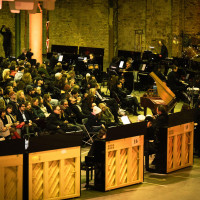
Some passages rose like massive blocks of sound, some were rhythmically coarse, others had a more ghostly pulse. Dazzling! At the end, the pianists put on gloves and slid up and down the keys. I mean, how on earth did Haas write this score?
Mathias:
I discussed it with another composer at the festival, who said it must have been a purely speculative compositional process. Fascinating! Perhaps conceptually it suited Kamila Metwaly’s programming, which relied on formats that opened up the concerts, combining the classical with unexpected instruments and improvising musicians. I don’t think these combinations always fully delivered, but overall they offered new perspectives.
Andreo:
Sound artist Andrei Cucu and writer Svenja Reiners’ performance Sound and Syntax explored the tension – and the embedded hierarchies – between text and sound. A prepared guitar creaked and glowed like a mechanical animal, cassette tapes played on and rewound, and a voice layered itself into fragile loops. It was like a road movie, alternately guided by words and sounds. At one point a line appeared about a train starting to move. Movement – rhythm – was the true engine of the performance. Words accelerated, changed direction, disappeared.
The interplay between his electronics and percussionist Dirk Rothbrust was some of the coolest I’ve heard in a long time
Mathias:
That sounds like a more productive encounter than the one the following weekend, where Jan St. Werner and writer Louis Chude-Sokei tried to assemble an essay on migration, identity, and rootlessness with Werner’s bubbling, glitchy electronics. The two layers competed more than they complemented each other: the listening experience was split between following the essay or the music. This could in itself have been a point, but the interplay between the two was not developed enough. Glimpses of potential appeared, but after fifty minutes I was left disappointed – especially frustrating because Jan St. Werner’s concert the previous evening had been my musical highlight of the festival. The interplay between his electronics and percussionist Dirk Rothbrust was some of the coolest I’ve heard in a long time.
Andreo:
I was, however, disappointed by the exhibition Partitur on Else Marie Pade at KW. Only a handful of scores were on display. Yet it was good to hear Pade’s works on proper speakers. And it’s great that the international audience is discovering the Danish composer, who would have turned 101 today. But why hasn’t anyone in Denmark – where she once graced the cover of Ud & Se – come up with EMP merch? KW sells lovely EMP tote bags!
Okkyung Lee handed out large trays of chocolate to the audience. Cute, but not much more
Mathias:
And the Danish darling Pade even received another tribute from experimental cellist Khabat Abas – in two concerts I unfortunately missed. But we did get free tote bags for Okkyung Lee’s Aurora (Mesophase)! With the concert date printed on them. Anyone who has wrestled with budgeting for cultural events notices things like that, haha. The bags were for our shoes, which we had to remove. Then the audience gathered on stage in socks to hear the cello-improvisation marvel Okkyung Lee.
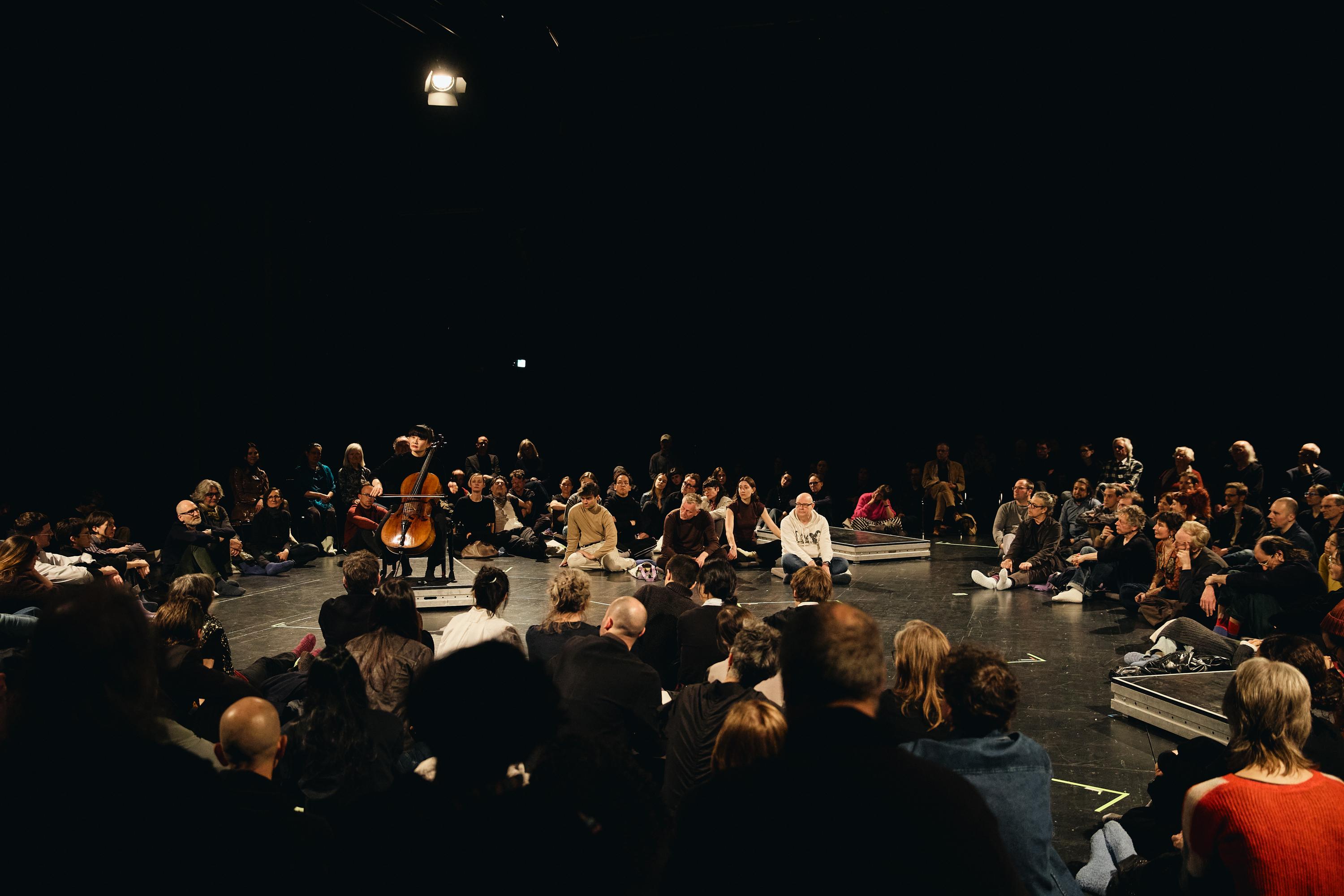
Her solo improvisation displayed a virtuosity rarely seen – she became one with the instrument, shaping sounds I don’t recall hearing from a cello before. I would have been satisfied with an hour of solo improvisation, as she failed in creating a full-fledged performance incorporating viola, double bass, keyboard, and video and light projections. Scaffolds with rainbow-colored foil were moved into new constellations. It was reminiscent of fluxus, but visually not particularly compelling, and the music never gained momentum. In the end, fog machines were turned on while a giant disco ball spun its mirrored dots around the room. The music stopped abruptly. And then Okkyung Lee handed out large trays of chocolate to the audience. Cute, but not much more.
Andreo:
So you got both a tote bag AND chocolate?
Mathias:
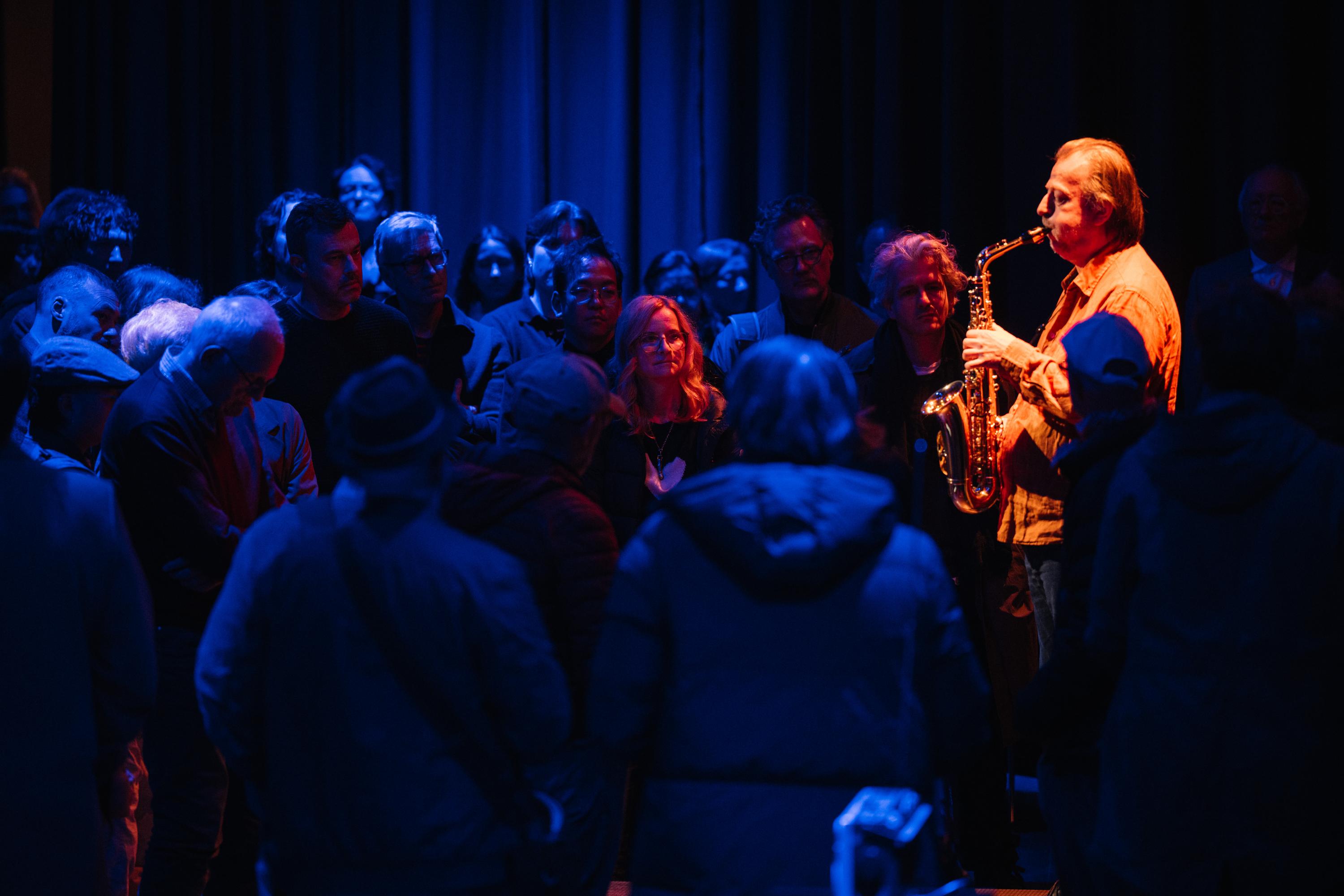
Yes – and it was welcome after the first concert in the Haus der Berliner Festspiele garden, where we shivered through beautiful works by Carola Bauckholt and Lou Kilger, performed by double bassist Florentin Ginot. His elegant playing was accompanied by eight-channel electronics, transforming the garden into a soundscape that became part of the city’s ambient noise. Airplanes and nightingales entered into dialogue with Bauckholt’s whimsical electronics and Kilger’s dystopian, distorted bass.
Had it been a bit warmer, one could have meditated here for a long time
There was a lightness to this fine concert, rounded off by Pelle Schilling’s LongStringInstallation: long metal strings stretched between crates and trees, and lying with your head inside a box, you could look up into the still-bare treetops. Had it been a bit warmer, one could have meditated here for a long time.
Andreo:
Peter Ablinger, who died in 2025, was also whimsical – a master at pushing the audience into a space of uncertainty. Silent Green’s Betonhalle was a fine place to hear his music; time stood completely still as Ensemble Dedalus performed Ablingers’ cycle WEISS / WEISSLICH 17. In excerpts such as »17b: Violin and noise« and »17p: Trumpet and noise«, instruments were set against the sound of noise. The sounds drilled into a material that both resisted and absorbed them.
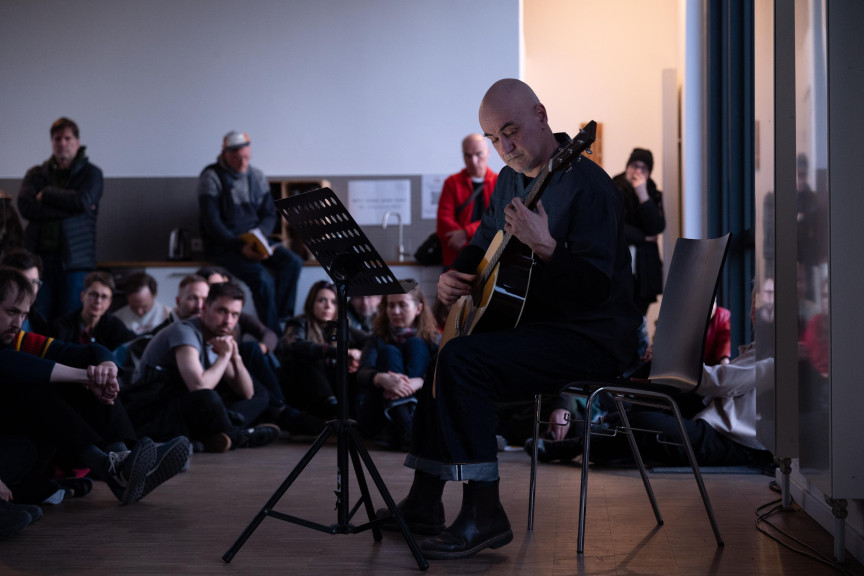
Something similar happened in Catherine Lamb's point/wave, where Didier Aschour navigated his guitar into an electronic shadow landscape. The ascetic thread continued in Dedalus’ performance of three works – Process, Steppings, and Streams – by French sound philosopher Pascale Criton. The music’s dramatic momentum was minimal; seemingly static tones were in motion. Sounds gently collided like a decentralized organism in constant change. The microtonal movements of the trombone were almost inaudible, but they existed somewhere in the auditory landscape – as psychoacoustic shadows flickering in my mind.
What was the point of the cryptic video of the composer in the dramatic Lofoten landscape?
Mathias:
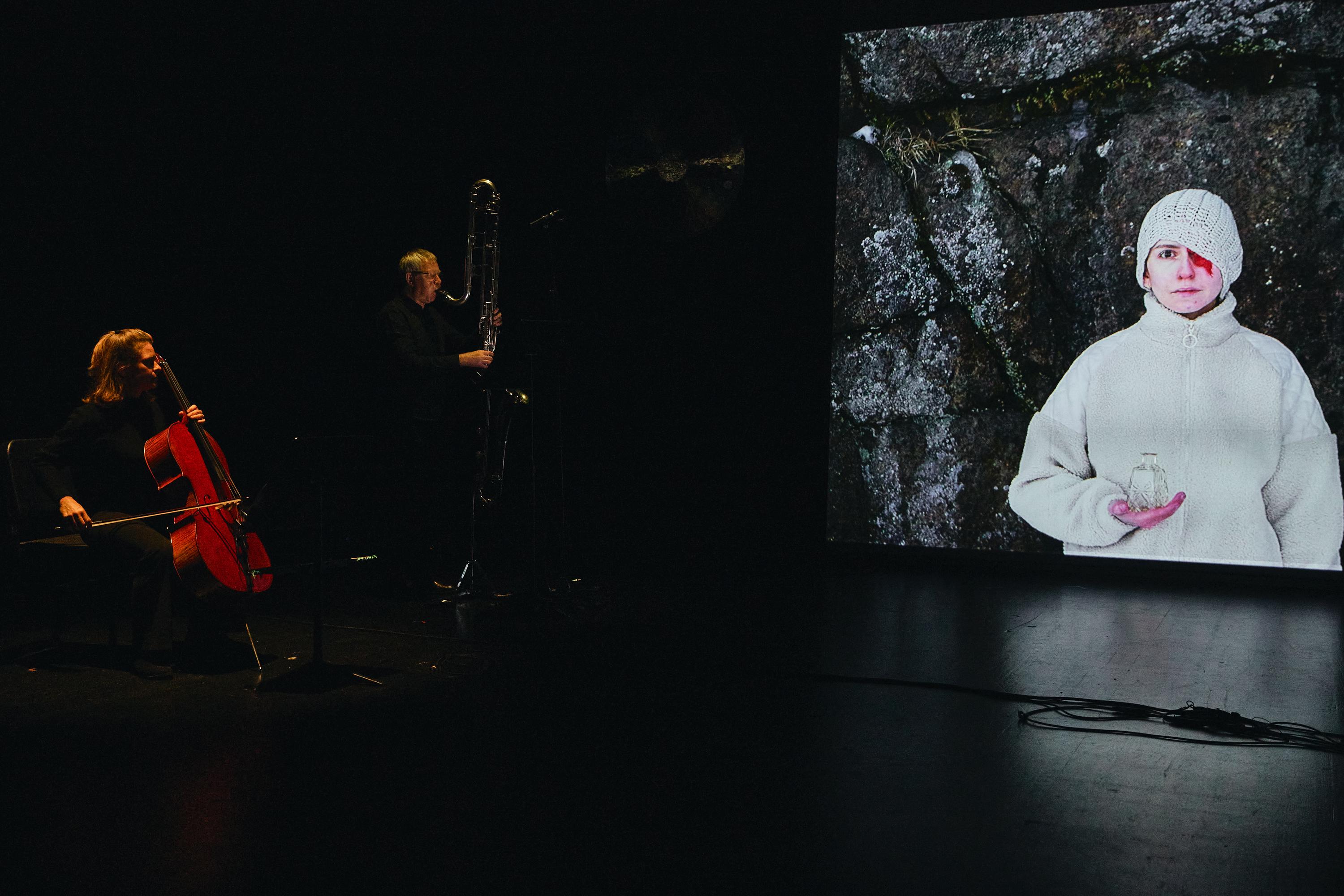
Sounds more conceptually striking than the works KNM Ensemble Berlin presented at Haus der Berliner Festspiele. They performed four pieces from three continents. Despite very different contexts, each presented a single idea that the composers did not further develop. The result was a long evening. What was the point of the cryptic video of the composer in the dramatic Lofoten landscape, in Tine Surel Lange’s Apotheosis? The person behind me whispered, »I didn’t get it«, and quietly I had to agree.
In Ana Maria Rodriguez’ Nomenclature of Colours, the string trio’s tones resonated on two suspended gongs, which also served as projection surfaces for colorful patterns. A psychedelic experience – who would have thought a video projected on a gong could look so beautiful? – but again, the music couldn’t sustain the energy. Fang-Yi Lin’s percussion solo GUA was framed by a Taiwanese recording of a poem, without translation provided. Alas. Zesses Seglias’ …a drop on my fingers, two lips as a fuzz, a sun on our heads (is the pattern) was the most fully composed work of the evening, but got lost in ever shorter sections with repeatedly extinguished and re-lit lights. Program notes – (»…with sound impressions at the edge of human perception,« »like the sun beyond the universe, the sound disappears above our heads«) – should have been unnecessary if the work could stand on its own.
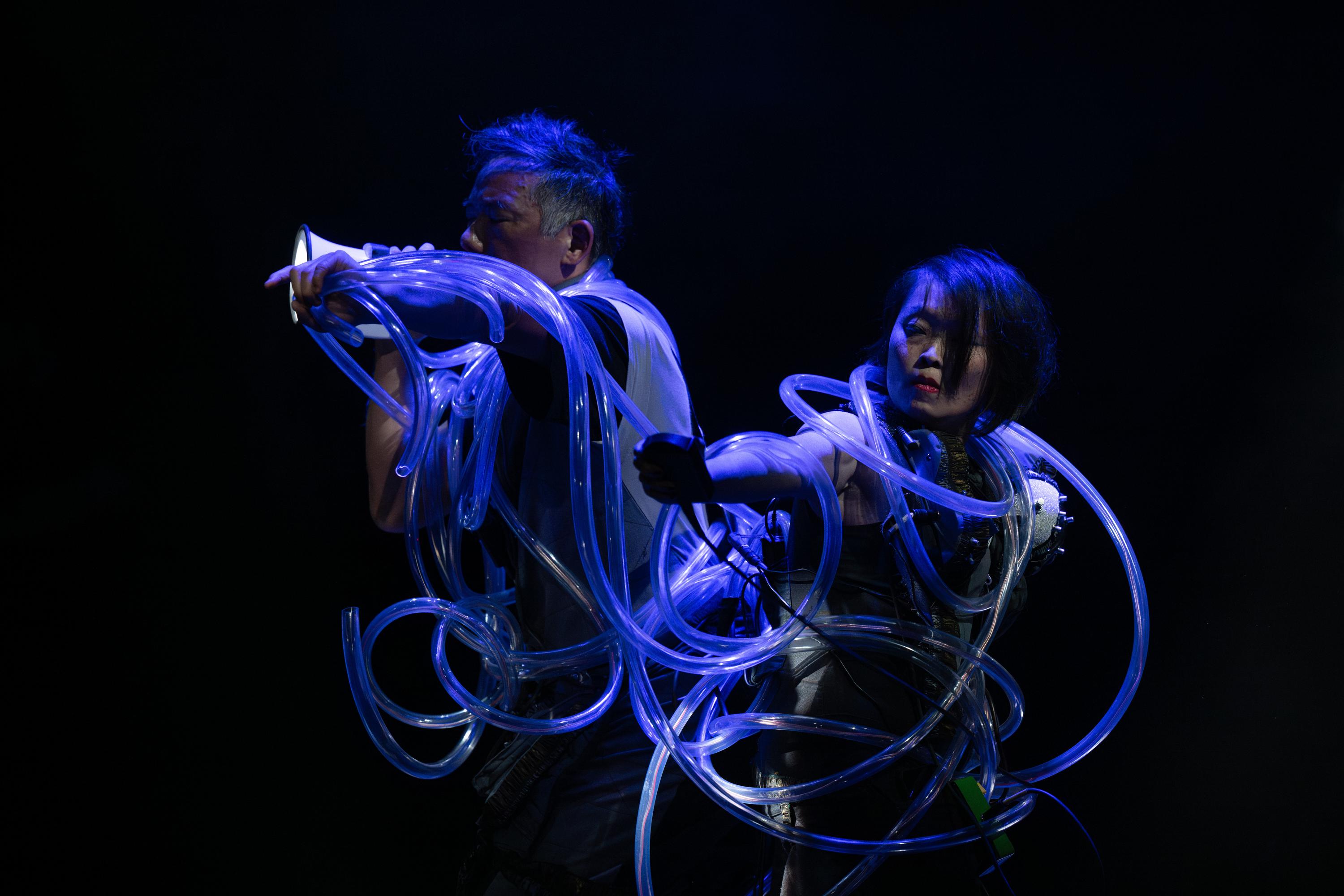
The next two festival nights took place at Radialsystem. Viola Yip and Ken Ueno’s Cybernetic Entanglements showed the two performers entangled in plastic tubes with sensors – a new instrument, »neither costume nor prosthetic.« As they slowly moved and disentangled themselves from the tubes and each other, they produced a powerful noise-like soundscape, culminating with Ueno standing alone, screaming at full volume. Perhaps an attempt to be reborn as a human without technology – or even as a »man«, after being connected to both instrument and woman?
Andreo:
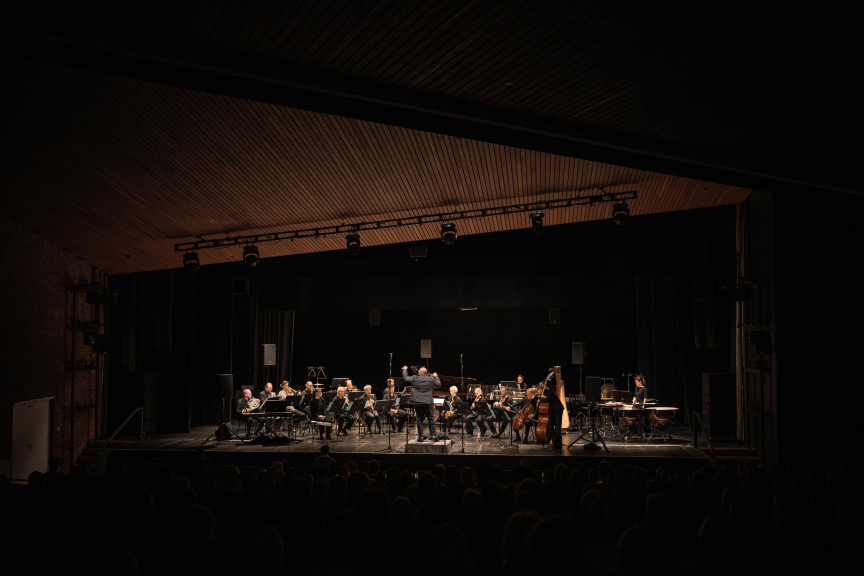
Schade! During the concert Archipelische Klänge with Klangforum Wien, it was fun to see how an American garbage truck inspired Gerhard Stäbler’s work Den Müllfahrern von San Francisco. Ein Akronym aus akustischen Erinnerungen an eine Reise (1988/1990). Young German composer Laure M. Hiendl’s Chronochromatic Variations IV (2026) drew inspiration from Vaughan Williams: a sampled fragment »stuck sad all the time,« with tones constantly drifting away from any stable groove. Yet this electroacoustic algorithmic assemblage was surprisingly groovy, even a bit jazzy.
Mathias:
I was blown away by Luxa Schüttler’s i wd leave leaf & dance (2022/26), presented in a new ensemble version in the concert’s second half. A wild ride through ever new and surprising musical ideas. I felt as if the crisp electronic sounds were vibrating in the air in front of the ensemble.
Andreo:
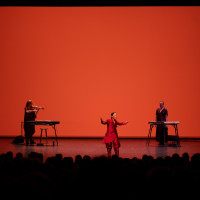
Agreed. It’s a shame you missed Meredith Monk. People were lining up in long queues. She could easily have filled another hall. The 83-year-old American sounded like a slumbering volcano, or like several animals at once; tingling, clicking, she moved across the stage like a kabuki dancer, flanked by the vocalists Katie Geissinger and Allison Sniffin.
She concluded by singing »Happy Woman«. So much hope wrapped up as art
The great storyteller’s range remains unpredictable. The voice still enigmatic in »Gotham Lullaby«. Amid the festival’s often concept-heavy program, Monk – who has been described as a post-minimalist – represented something elemental: the voice as our oldest technology. During her stay, Monk received the Berlin Art Prize and concluded by singing »Happy Woman«. So much hope wrapped up as art on a March day in Wilmersdorf!
MaerzMusik, Berlin, March 20–28, 2026
English translation: Andreo Michaelo Mielczarek