






We’ve Never Needed Pulsar Festival More
Something remarkable has happened since I first attended Pulsar Festival ten years ago. Not to the festival itself, which remains, broadly speaking, much as it was in 2016: young musicians in training at the Royal Danish Academy of Music in Copenhagen performing works by composition students at various stages in their search for a personal voice.
Something remarkable has happened since I first attended Pulsar Festival ten years ago
Occasionally, there are guest appearances – an orchestra, a specialist ensemble, sometimes an international soloist – and from time to time the programs are enriched with works by significant figures from recent music history or former students. In every sense, Pulsar feels like what it is: a conservatory festival. Add a handful of public lectures across the ten days, and the experience would be complete.
What has changed is the world outside. While one can still encounter something as wholesome as a string quartet at Pulsar, the country’s three major composer festivals – SPOR, MINU, and Klang – have more or less abandoned traditional formats and are increasingly indistinguishable from one another. The performances and audiovisual works that define those festivals are also present at Pulsar to some extent, but the balance is markedly different. Some will say this makes Pulsar old-fashioned; others will argue that it now represents a much-needed alternative to the creeping uniformity of its »competitors«.
In terms of profile, this means that the conservatory festival stands sharper than ever. Nowhere else can you hear such a volume of newly written works performed primarily on traditional instruments. If Pulsar had freer hands than those allowed by its role as an educational platform, it would be an obvious move to expand the festival into the country’s main offering for anyone longing for a concert-hall-focused alternative to SPOR, MINU, and Klang. That is something we genuinely lack.
The most beautiful moments at this year’s Pulsar concerts were precisely those where you sensed someone finding their voice
Tutti, friends, TUTTI!
For obvious reasons, the quality is too uneven for Pulsar to fully assume that role as long as the music is primarily written by students themselves. Yet even within this limitation, the festival has made a significant mark on Danish musical life in one particular area. While the Danish National Symphony Orchestra – otherwise a relatively regular collaborator – has largely deprioritized new music in its programming, it comes alive when it visits Pulsar.
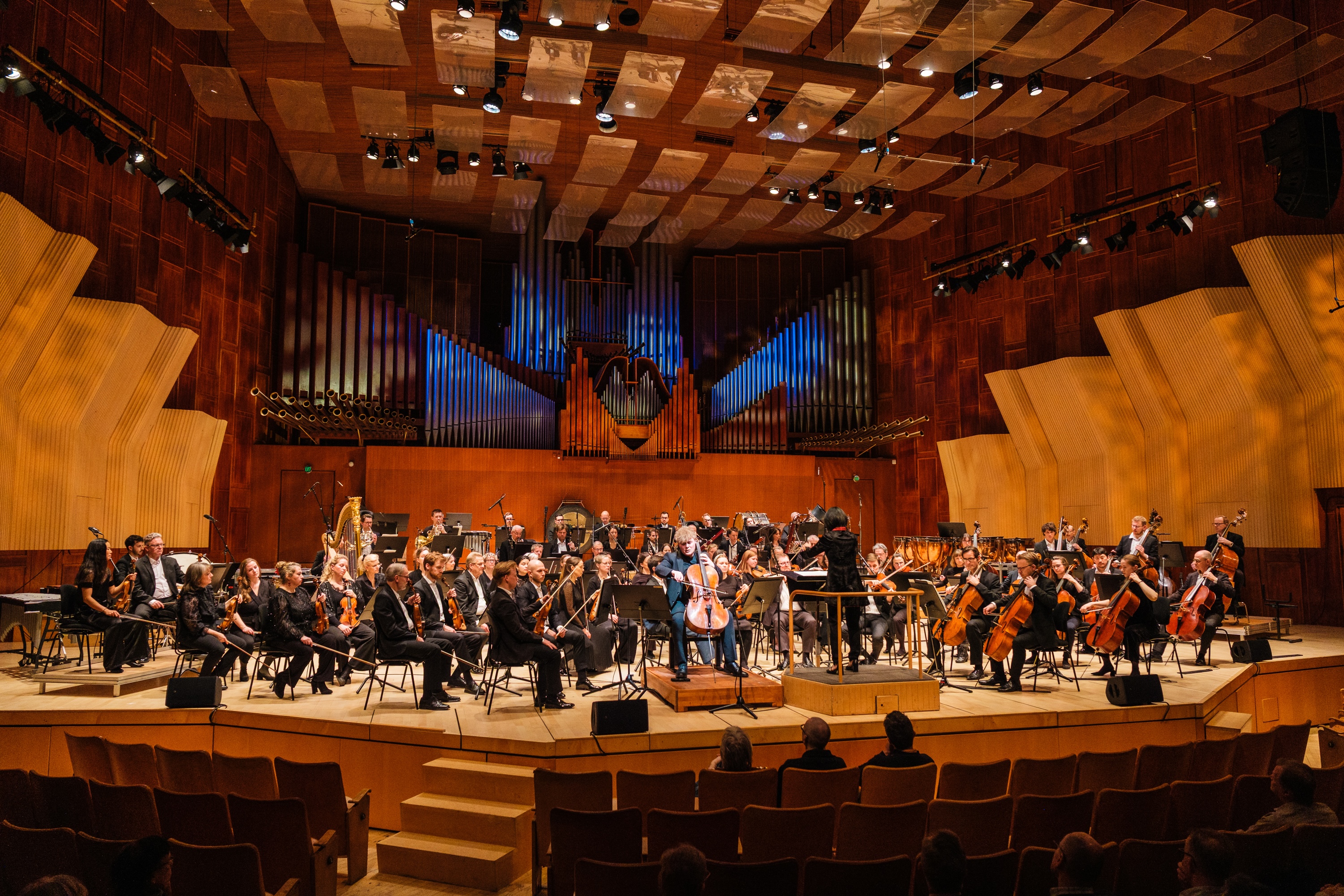
In 2022, it was under the banner of Pulsar that Simon Steen-Andersen’s monumental TRIO was performed at the DR Concert Hall, and last year the orchestra joined forces with Nordic Voices for one of the most striking symphonic events of the decade: the festival opening featuring Luciano Berio’s wild Sinfonia from 1968. This year, the orchestra’s visit was scaled down – with just a single soloist as guest – but the symphonic concert still served as the kind of beacon every small festival needs: something that draws in the uninitiated.
As always, the orchestra began with works by young composers, and both Veronika Voetmann and Frederik Zeuthen seized the rare opportunity to extract as much sound as possible from nearly ninety musicians.
The music evoked equal parts postwar Times Square and Schoenberg’s Vienna
Voetmann – whom I remember from my own student days as sharp and spirited – sought a warm, almost cinematic beauty in Halo. She opened with sliding violin tones, their sound tastefully extended by water glasses and bowed metal, then gradually added weight as the music swelled between instrumental groups. The timbre constantly morphed seamlessly from one color to another: a resting point with repeated tones in harp and celesta turned into deep brass chaos; acidic string gestures evolved into sonar pulses in the trombones – all orbiting a luminous fundamental tone.
What Voetmann offered was a shimmering bath of sound. What was missing, however, was a strong sense of propulsion. Halo held onto its gliding core motif, everything beneath the surface vibrating between two semitones, resulting in a lack of direction. Several times the piece seemed to approach a landing, only to continue, until light harp and bright bowed gongs finally brought it to a close. The fully formed personal voice was not yet there – but the talent for sonic craftsmanship certainly was.
Zeuthen, too, is still searching for answers, but one senses an eccentric voice
Frederik Zeuthen was different. His Muralis was, by contrast, overflowing with motifs. The opening raindrop figures on claves, harp, and pizzicato violin may have been somewhat generic, but the mood quickly shifted as Zeuthen moved toward drama: forceful pointillistic gestures, interrupted by geyser-like contractions of sustained sound, led into large, hectic loops of atonality and percussive chase sequences. The music evoked equal parts postwar Times Square and Schoenberg’s Vienna – delightfully dramatic, if somewhat episodic.
Zeuthen, too, is still searching for answers, but one senses an eccentric voice with a fondness for an otherwise outdated modernism and for peculiar sonorities – such as the deep, half-spherical contrabasses that rounded off the work alongside paper strokes on bass drum.
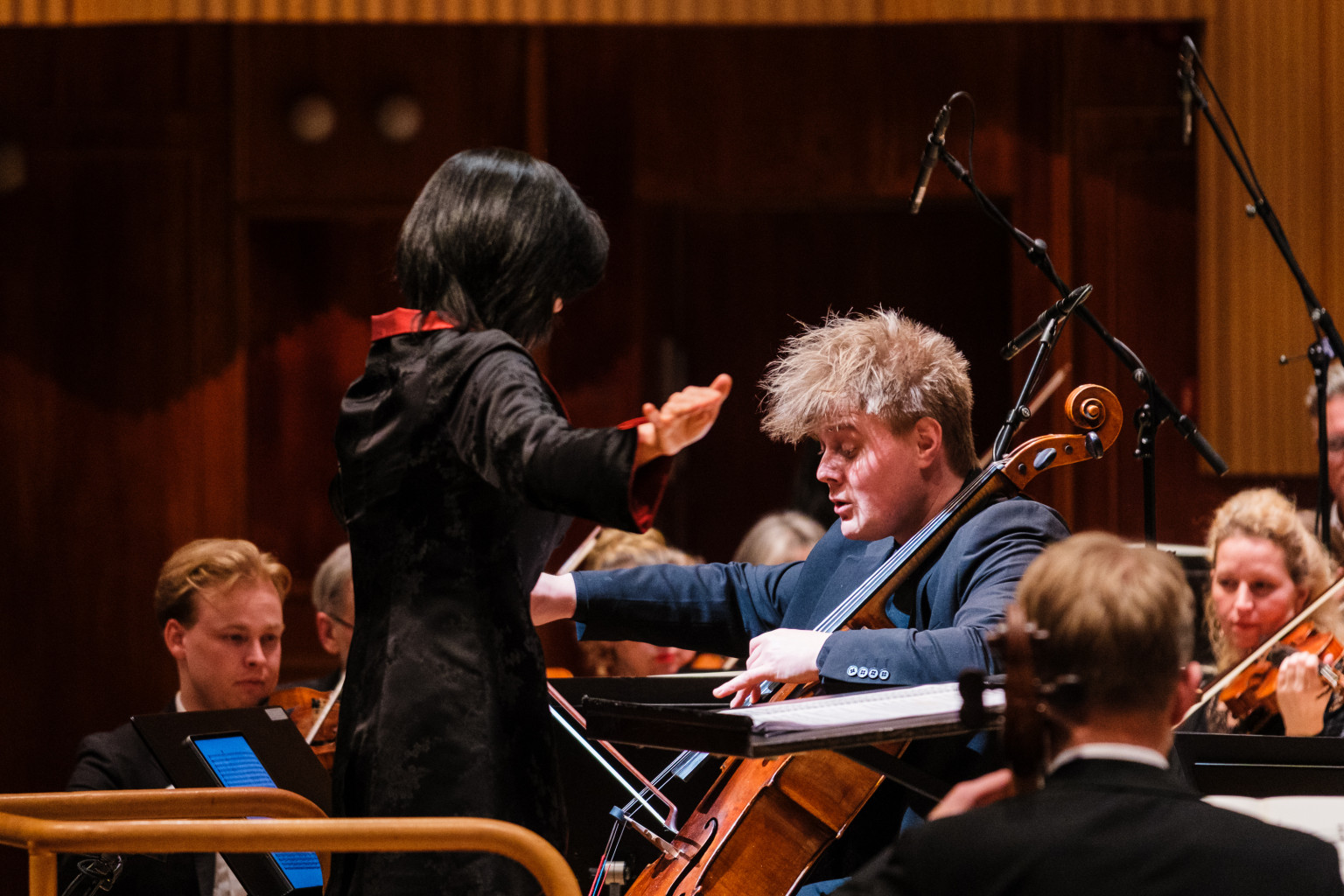
Both composers could benefit from taking a cue from Morton Feldman, whose Cello and Orchestra (1972) followed after the interval, with the ever-expressive Jonathan Swensen as a surprisingly restrained soloist in an otherwise dry, abrasive sound world. Feldman’s cool restraint allowed beauty and drama to appear only in fleeting glimpses above the strings’ long, knotted hum. Occasionally, a dissonant exclamation in the winds, a brief woodblock roll, or a single ping on a small cymbal – but otherwise a cool, strangely compelling energy from the hollow resonance of clusters.
Feldman’s advice: you don’t need the whole orchestra all the time – if you know exactly what you want to say.
A voice is born
The most beautiful moments at this year’s Pulsar concerts were precisely those where you sensed someone finding their voice. Sometimes it was a performer alone on stage, forced to see their instrument anew. Take Lucy Ruuskanen, who played the long trills in Albert Laubel’s Frost with ever-changing tone, discovering a personal sound in her violin that will serve her well – even if she one day ends up as a soloist in Mozart or Brahms.
Everyone should play more new music. On real instruments
Gradually, Frost expanded with bow drops, staccato gestures, and large broken chords. It may have resembled a study piece, but Ruuskanen’s responsiveness to new playing techniques made it a model example of how new music sharpens a performer’s sonic awareness with nuance and originality. In other words: everyone should play more new music. On real instruments.
Among the composers, Athanasia Kotronia stood out as a fully formed voice. The Swedish-Greek Copenhagen-based composer will officially debut at Klang in June (so tradition isn’t entirely abandoned), and it is always a joy to witness a composer finding a personal language during their studies.
Destremau emerged as perhaps the clearest heir of his generation to Simon Steen-Andersen – or even Christopher Nolan
At Pulsar, this was evident in something as intimate as a chamber work for violin and viola. In her Tre sånger, Kotronia began – like Laubel – with whispering trills, but from the outset there was a more intense focus on sound. Vasilisa Koroleva and Njord Fossnes played on both sides of the bow, interrupting wind-like textures with brief, real tones. The piece was simple, yet never redundant. Kotronia economized strictly between silence, small irregular leaps within phrases, and glimpses of a distant folk melody – but it never felt austere. It felt alive, personal, and constantly exploratory.
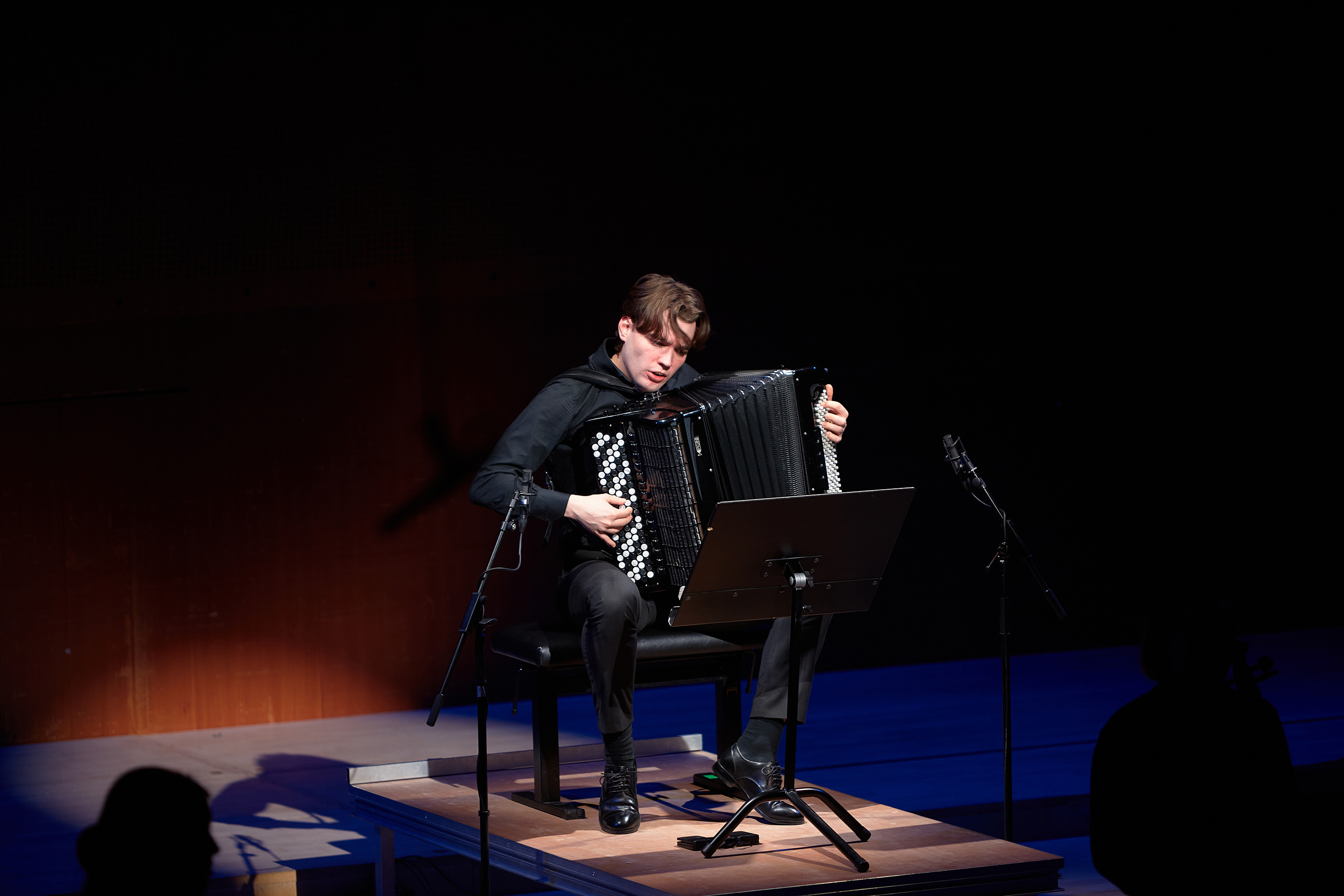
The same qualities appeared in her Hydraulis for accordion. Beneath a rough cluster lay fragments of melody, and Kotronia recognized the beauty in both. Luca Bello explored the instrument’s resonance, and gradually light broke through like a shimmering surface tension. It could have been a schematic transition from night to day – but Kotronia’s curiosity about her material, and her ability to develop it without exhausting it, made everything she presented feel both original and compelling.
The Next Step
Of course, not everything at the festival impressed. Some composers fell into schematic thinking – two instruments starting at opposite extremes and meeting in the middle – while others rode the performance wave with little more to offer than flip-flops, theatrical gestures, and ramshackle chamber music at a high-school level.
That is Pulsar’s constraint. And when a former student like Loïc Destremau appears on the program with a technically dazzling work such as Mutual Intelligibility for cello, accordion, video, and electronics – performed by duo Ekki Minna – the gap becomes evident. Destremau emerged as perhaps the clearest heir of his generation to Simon Steen-Andersen – or even Christopher Nolan – while Jónas Ásgeir Ásgeirson and Andrew Power heroically navigated his whirlwind of linguistic and symbolic play.
Perhaps it is time to take the next step – and become the fully realized alternative to the other composer festivals
In fact, it was more exciting to hear from composers like him – those who have graduated since my first Pulsar in 2016 – than to encounter established figures such as György Kurtág, Betsy Jolas, and Hans Werner Henze on the program. Better to give the next generation a rare platform to explore more traditional chamber formats within a festival setting.
Is it the academy’s role to provide that platform? Probably not. But the developments of the past decade mean that Pulsar is now the only festival in Denmark capable of doing so. Perhaps it is time to take the next step – and become the fully realized alternative to the other composer festivals that we are increasingly realizing we truly lack. Surely external funders and partners can see the potential. I certainly can.
Pulsar Festival, March 3-12 at the Royal Danish Academy of Music
English translation: Andreo Michaelo Mielczarek