



Verdi in the War Zone

In the foyer, before we are let into the performance, the stage attendant welcomes the audience. She immediately catches my attention by saying that, of course, one may leave the auditorium during the show if needed. I hear her words as a kind of trigger warning: this might well become intense. If so, the logistics are helpful, because she concludes with a caution: »The ventilation has just broken down, so it will be hot in there.«
A good formulation. Because that is exactly how I feel about the world these years: suddenly the ventilation broke down, and it got very hot. There is, however, a remedy – if not in the world, then at least in the theatre: good old-fashioned hand fans have been placed on every seat, and they are used diligently throughout.
The legendary visionary power of Joan of Arc – and her short life spent fighting against England’s occupation of France, which she helped repel – forms the dominant narrative axis of the piece.

I hear her words as a kind of trigger warning: this might well become intense
Musically, the axis is the rather strange encounter between, on the one hand, an originally conceived sonic world informed by industrial, electronica, and death metal, and, on the other, a series of vocal excerpts lifted from Verdi’s opera Giovanni d’Arco (1845), written to a libretto loosely based on Friedrich Schiller’s 44-year-older play Die Jungfrau von Orleans.
Verdi as living residue
SØS Gunver Ryberg has composed the work and arranged all the Verdi sequences. Because she consistently uses the solo vocal parts from the opera as they are – without orchestral or choral accompaniment – they seem almost to float freely in the air, even when the four singers, who in the opera portray fathers, kings, and military figures, perform a cappella passages together.
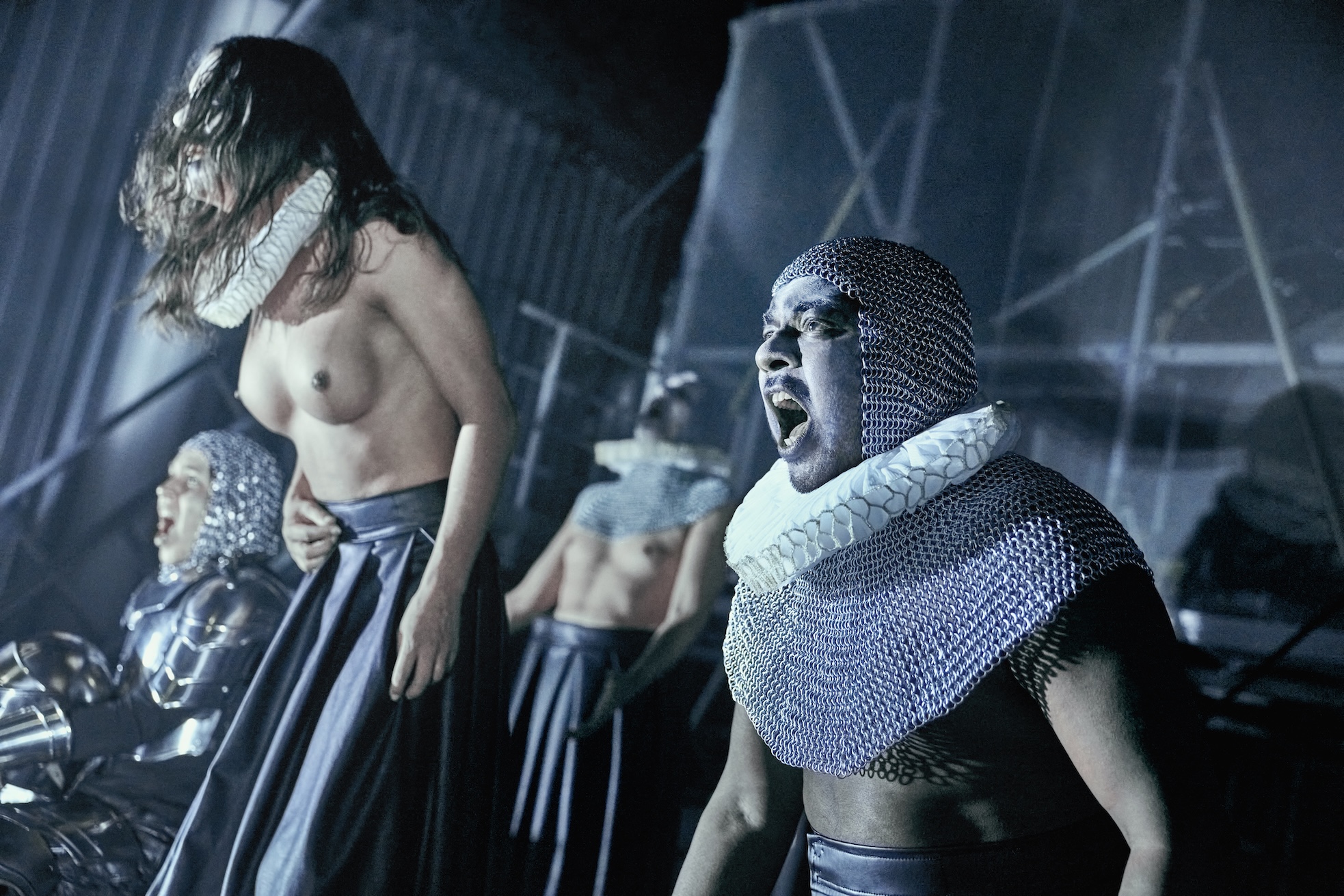
Both visually and sonically, the piece is intense, at times downright uncomfortable
The dystopian and at times violent universe of the scenography, combined with Ryberg’s uncompromising sonic landscapes, is about as far removed from 180-year-old Italian bel canto opera as one could imagine. Yet the combination works remarkably well, not least because the contrast never leaves one in doubt about what is what. It is as if all the Verdi in the performance sounds like gigantic samples – performed live, no less. They create a constant alienation effect, where Verdi’s in some sense conformist sound serves as a reminder that war and conflict belong – or at least ought to belong – to a distant past.
Of course, one does not understand precisely what is being sung unless one knows Italian—but one senses it, because the scenography helps the audience follow the narrative, in which Joan of Arc, true to history, ultimately ends up at the stake. The actual libretto of the piece instead consists of seven inserted Danish-language texts, delivered as spoken monologues and, in some cases, sung.
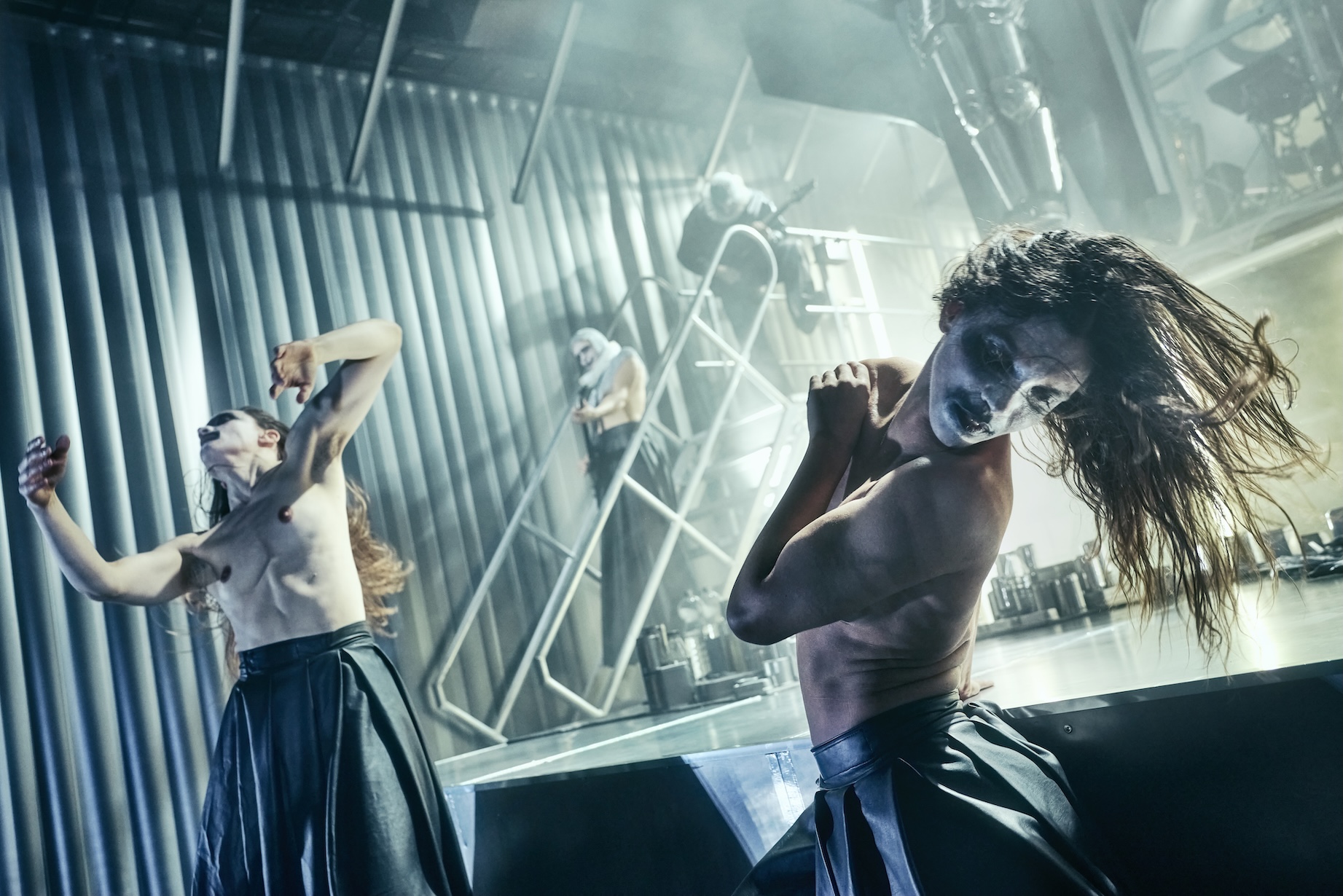
A drone hovers in the same spot above the stage, and the lighting makes it resemble a grotesque giant spider in an enormous web
Both visually and sonically, the piece is intense, at times downright uncomfortable, and I had almost forgotten how explosively powerful timpani can sound. It could hardly be otherwise in a depiction of the brutality of war. Yet it is a brutality with a kind of meaningless theatrical effect:
A drone hovers in the same spot above the stage, and the lighting makes it resemble a grotesque giant spider in an enormous web. On a screen at the back, one reads the words: »It’s not a war crime if you’re having fun,« followed by a hand-drawn smiley.
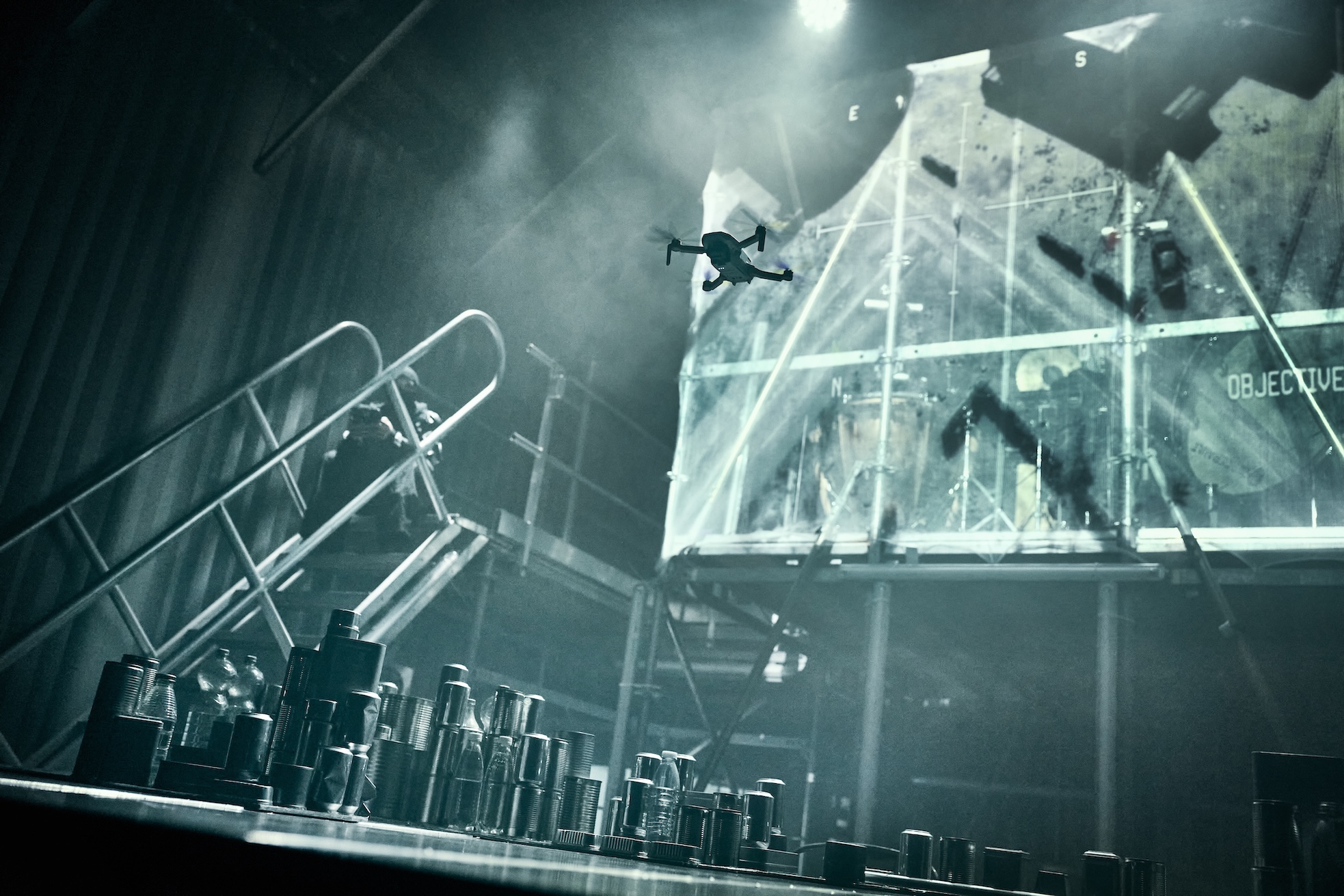
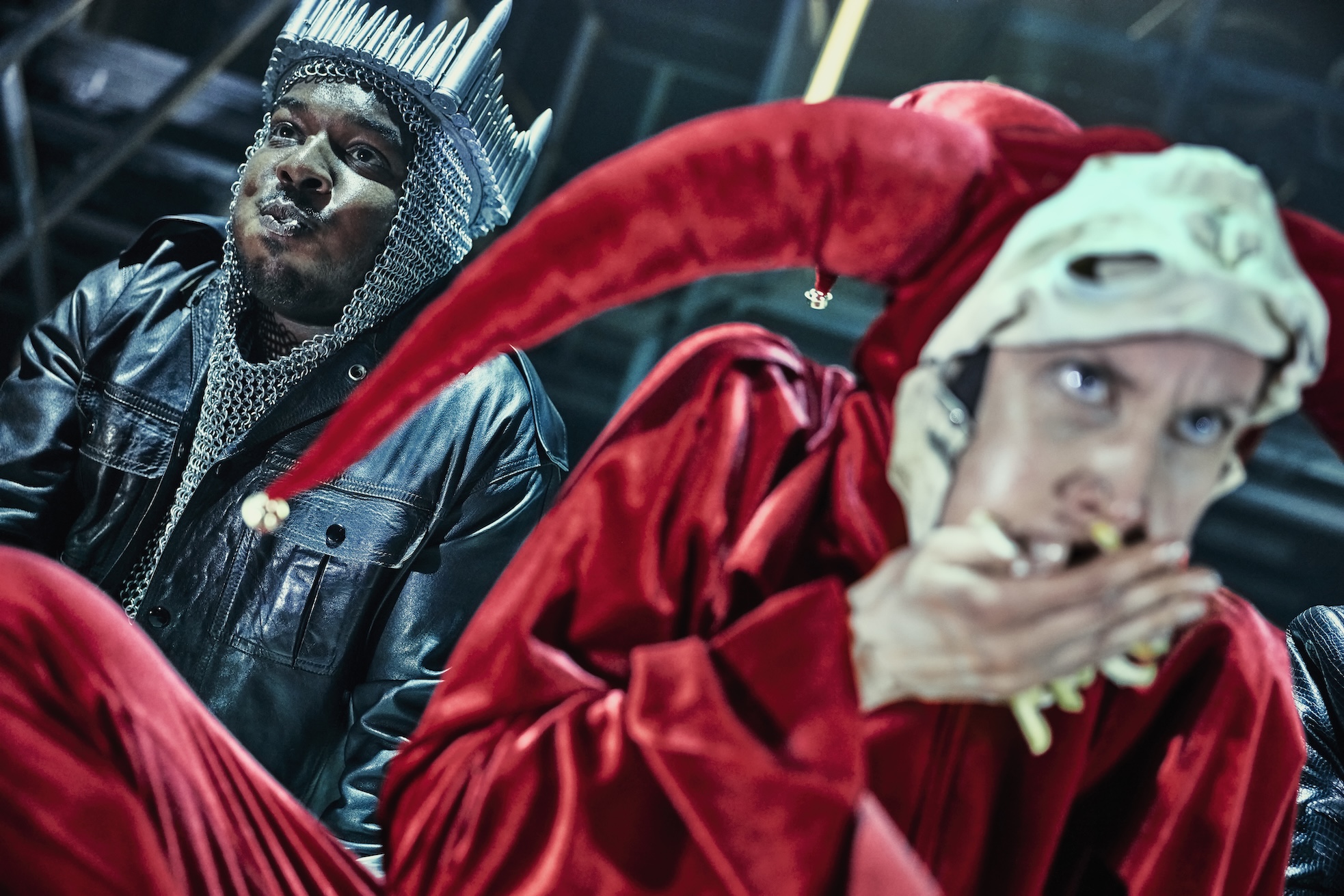
A large, heavy prop suddenly appears under the ceiling, startling me for a split second: it resembles an unforgiving warplane, soon lowered to the ground and transformed into the stake to which Joan of Arc is bound. Before that, in a grotesque scene, the four singers and two dancers demonstrate their consistently convincing ensemble work: dressed in chainmail and skull masks, they stuff themselves with enormous quantities of French fries while reciting Mycelium’s text about everything being on fire, including these lines:
Look
The stock exchange is burning
The parliament is burning
The congress is burning
The demilitarised zone is burning
The weapons are burning
The city is burning
The bodies are burning
The children are burning
The guilty are burning
The innocent are burning
As is well known, it can be quite unpleasant when people speak with their mouths full – so imagine how it feels when six people do it simultaneously for several minutes. One by one, they leave the stage after spitting out half-chewed piles of deep-fried potato strips, as if they deservedly die from this spectacular eating orgy – a display of everything that is wrong with humanity and its complete lack of situational awareness: a humanity that is wasteful, thoughtless, uneducated, and animalistic. That the scene is at once comic, suffocating, and utterly disgusting makes it a striking allegory of the current state of the world.
The grotesque choreography of war
Through the seven texts, Joan of Arc articulates her universal vision – across time and space – of a world cleansed not only of injustice and war, but also of hypocrisy and spiritual laziness. In Ursula Andkjær Olsen’s writing, the latter seems to thrive all too well in contemporary Denmark, and her veritable scolding of a life not truly lived leaves a strong impression. In part, it reads:
(…)
You let yourselves be fobbed off with comfort instead of meaning!
You let yourselves be fobbed off with desire instead of pleasure!
You receive goods as prizes for all your work, your stress, your
bad conscience, as prizes for your time, LIFE!
You receive entertainment and consolation prizes for your SACRIFICES,
Comfort instead of meaning
Comfort instead of access to the sacred inner space where
meaning is created – just beneath the heart – where pain and
pleasure mix and form life
Instead, you cling to your sausages of death, meat sauce & Tesla
Instead you sit here with:
the disease of »you cannot get out«,
the disease of »you sit in a wheel that takes all your time,«
the disease of »it takes all your creative power«,
the disease of »you know nothing about the foundation of your life«
I tell you: I come with piss and shit, all the filth, waste,
noise pollution, olfactory hallucinations
YOU KNOW NOTHING OF LONGING!!!!

In the midst – or perhaps rather around – all this stands the immense achievement delivered by SØS Gunver Ryberg. She messes with Verdi’s pathos-laden yet compelling material like perhaps no one before her, and although his work is heavily mangled in her itlaiano moderno remixes, it also survives, respectfully, as the relic it is – while never overshadowing the deeply compelling takes on the Joan of Arc narrative that she herself has composed.
After being subjected to this massive flow of sonic and visual impressions for nearly an hour and a half, my body begins to tremble
Ryberg’s own contributions feel present, necessary, and refreshingly restrained, without ever appearing elitist or cheap. In short: feet on the ground, head in the sky.
The balance between the simple and the complex in the musical staging feels perfect, as does the balance between grand lines and minute details. The latter comes into its own in moments when the singers perform Verdi phrases a cappella, their voices – amplified by microphones – processed with a subtle yet highly effective echo/reverb that draws the entire musical expression onto Ryberg’s electronic terrain, away from Italian opera houses and into the differently pulsating spaces of Copenhagen’s Meatpacking District, away from a male domain into a female one, away from the 1840s into the 2020s.
When the body begins to understand
After being subjected to this massive flow of sonic and visual impressions for nearly an hour and a half, my body begins to tremble. Unexpectedly, I become aware of the suffering, shame, confusion, and powerlessness that not only my intellect but also my body has been living with over the past four years, beginning with the invasion of Ukraine and unfolding into global chaos. My body begins to put bodily words to what is happening, just as my heart begins to find its own language.
Before leaving the auditorium, I slip three fans into my bag to bring home to the kids. Then they can practise fanning away the injustices and wars of this world
It feels like the release of something I did not even know could be released. And when the performance ends, it is as if the world has somehow become new again.
Before leaving the auditorium, I slip three fans into my bag to bring home to the kids. Then they can practise fanning away the injustices and wars of this world – while the rest of us may only dream of it. And when they are old enough, I will tell them about Joan of Arc.
P.S. Apologies to Sort/Hvid about the fans – I’ll make up for it with a round of French fries sometime.
Theatre performance with music by SØS Gunver Ryberg, including adaptations of music by Verdi.
Sort/Hvid, April 24 – May 22
English translation: Andreo Michaelo Mielczarek