




In the Silence Between Voices
There is a certain generosity embedded in the fact that Nørrebro Teater has begun opening its doors to other artistic activities, including something as relatively niche as sound installation art. The generosity lies in offering space to something that might otherwise never have taken place in Copenhagen, and doing so with the authority this theatre possesses and now uses to bring broader attention to avant-garde art.
On paper, it undeniably sounded promising that the two great A’s would exhibit together
This is happening through the exhibition In the Presence of Others, curated by the French gallery Le Son 7. The exhibition was shown in Berlin last year and is now running for just over two weeks in Denmark. None other than Laurie Anderson, Miranda July and Marina Abramović are featured, the first two with one work each, while the latter – already currently exhibiting Seven Deaths at Cisternerne – contributes two works.
On paper, it undeniably sounded promising that the two great A’s would exhibit together, and I was genuinely curious beforehand because the two unfamiliar works by Abramović were created early in her career, before she had even turned thirty, whereas Anderson’s piece was brand new, created more than fifty years later. But when I left the theatre, I had to conclude that the exhibition as a whole was disappointing. Its scope was simply too narrow, and the curatorial framing lacked sufficient perspective for the exhibition to stand as an independent presentation at a cultural institution as high-profile as Nørrebro Teater.
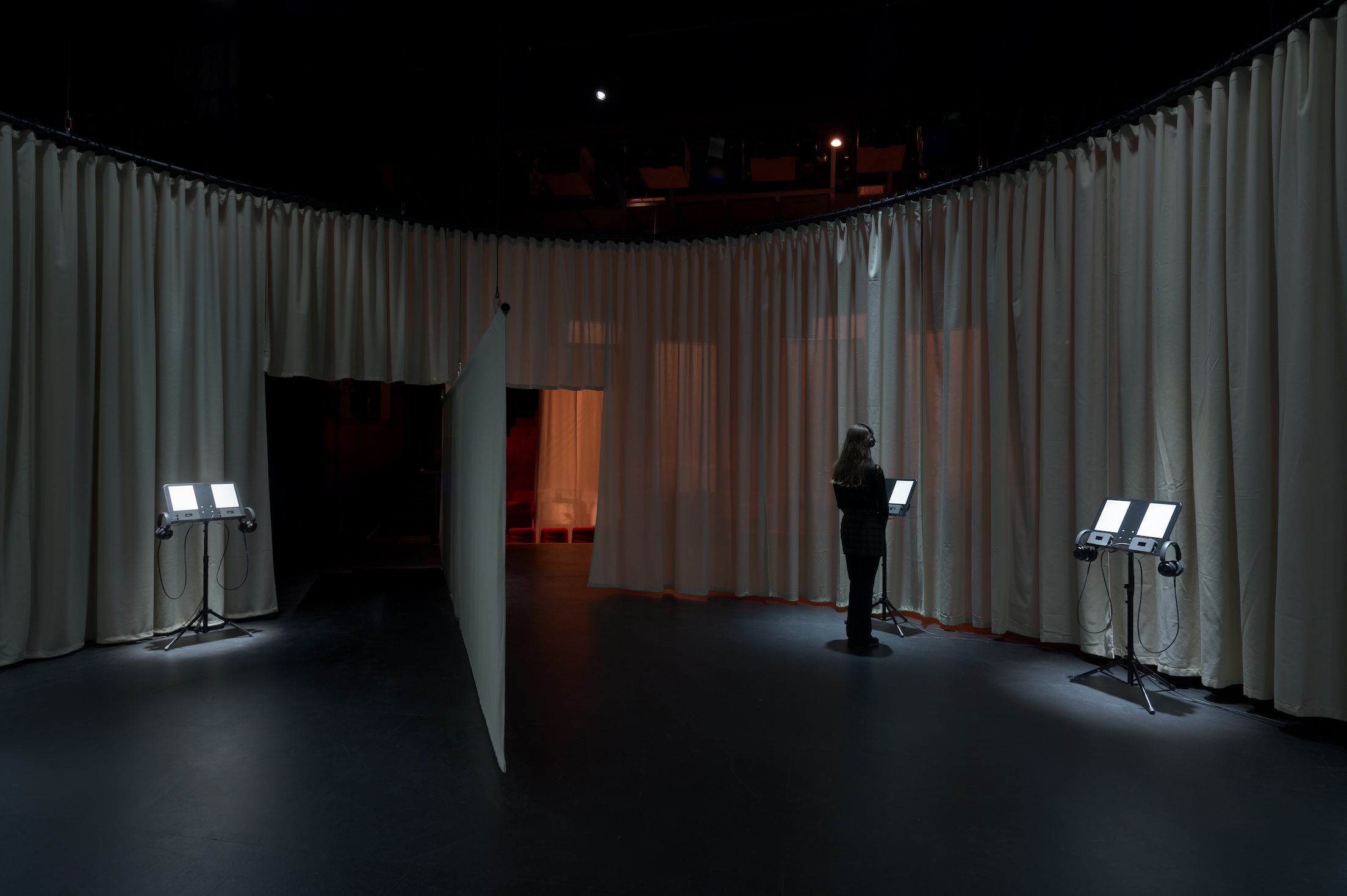
The problem is not that the exhibition consists of only four sound works; in principle, the small number allows for greater immersion in each piece. Rather, the issue is that only one to one-and-a-half of the works – Laurie Anderson’s, and to some extent Miranda July’s – possess enough weight and substance to truly justify the time and money visitors spend experiencing the exhibition.
The problem is not that the exhibition consists of only four sound works
The two works by Marina Abramović felt so generic that I could barely sense the artist behind them. The artist is not present, they almost seemed to say. In one of them, The Airport (1972), the installation consists of the sound of her voice making fictitious loudspeaker announcements in a fictitious airport to various destinations around the world. Then there is silence. That is: one announcement, followed by a long pause. So long, in fact, that during the press preview those of us present eventually became confused: was this really intentional? It was, as it turned out, after one of us asked the staff. The work really does consist of a single sentence lasting perhaps thirty seconds, followed by ten minutes of nothingness. Exactly like in an airport, where, according to the logic of the piece itself, the announcements are the only thing that truly »exists«. Everything else is irrelevant.
According to the wall text, The Airport reflects on living in Belgrade and wanting nothing more than to escape. That was how Abramović felt at the time, and although one understands that in the otherwise noisy and hectic atmosphere of an airport behind the Iron Curtain there was “silence” whenever the announcements stopped, the point becomes too blunt to fully unfold.
The same is true of her other work, The Tree (1971), in which a loudspeaker hanging from a tree plays bird sounds and the sound of blowing wind. The accompanying text explains that in a communist regime such as former Yugoslavia, loudspeakers were always instruments of power, and Abramović therefore turns this upside down by allowing the speaker to broadcast only sounds of nature. Hearing these sounds in the solitary, narrow courtyard tree behind Nørrebro Teater, while a real pigeon sat in the branches relieving itself, made the installation appear more successful than it actually was. The artist herself would undoubtedly have loved the scenario, but that does not change the fact that the heavy-handed concept made the work difficult to experience.
Abramović’s ascetic aesthetic finds a kind of counterpoint in Miranda July’s The Drifters (2002), where ten so-called sound stories, each around a minute long, are played. Visitors must move from listening station to listening station to hear all ten stories, and the inconvenience of constantly removing one set of headphones and putting on another is part of the point: a reflection of the cumbersome lives described in the narratives.
These are humorously sad stories about difficult love and the longing to be loved. Nearly all the audio pieces include music, though it is always relegated to the background while the dialogues unfold. This creates interesting encounters between the intended and the unintended, as the conversations in the stories spiral unpredictably while the underlying music sounds exactly as it always does. At times the work is remarkably well-crafted, and at times genuinely moving, even if it is also uncomfortable to overhear the speakers’ awkward handling of their desires and dreams. I found myself wondering whether the work is ultimately too fragmented and, at only ten minutes in total, perhaps too brief to sustain its place as one of only four works in an entire exhibition.
In reality, you are brushing the teeth of a shrunken head, Anderson says with her characteristic twinkle in the eye
Laurie Anderson's living sense of wonder
By contrast, Laurie Anderson’s Your Eyes In My Head (2025) is exceptionally strong. Her tribute to the human head as a body part expresses, as always in her work, a phenomenal capacity for wonder. Wonder at existence in all its confusing yet amusing absurdity; wonder at everything we otherwise take for granted in daily life.
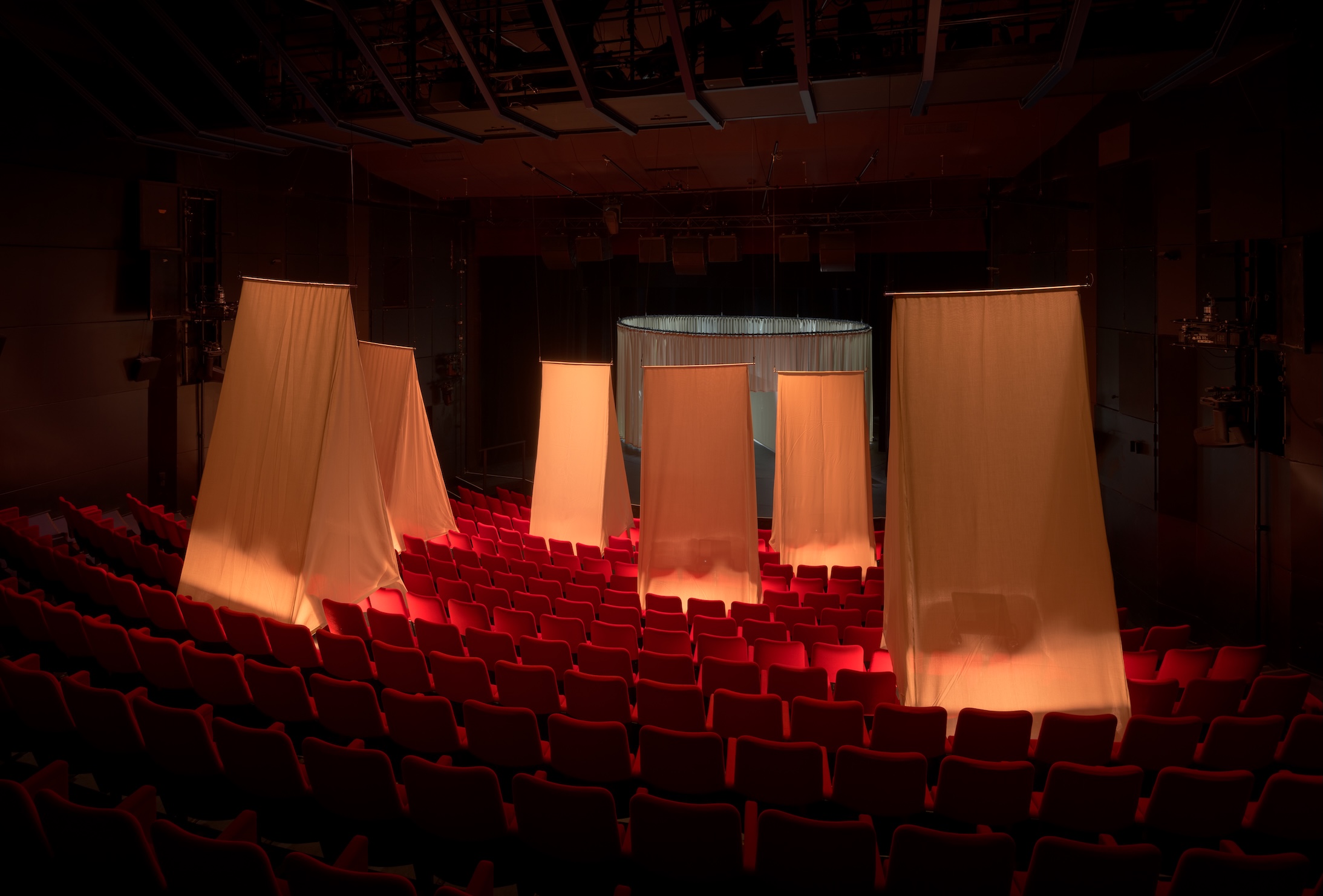
It is a capacity that has driven Anderson throughout her entire career, and now, after more than half a century, it remains fully intact. Over the course of just more than twenty minutes, the work unfolds in a rhapsodic sequence that leaves the listener astonished by the vitality emerging from Anderson’s encounters between voice, sonic environments and ritual.
The human head that produces sound when its teeth are brushed and when its mouth is filled with food is actually always twice as large in reality as it appears when we see ourselves in the mirror. In reality, you are brushing the teeth of a shrunken head, Anderson says with her characteristic twinkle in the eye. Yet heads are not always so small. In fact, babies’ heads are so large that if they grew proportionally with the rest of the body, adults would constantly lose balance while forever clutching their heads in an attempt to make them weigh a little less. So thinks Anderson.
If only I had felt the presence of Marina Abramović – and also Miranda July – even more strongly
With Your Eyes In My Head still lingering in my mind, I head out into the good weather and start walking home, reflecting on the exhibition’s title, In the Presence of Others. Because that is exactly what is happening now: the sound of all the other people walking, running, whistling or talking towards me, and their bodily movements making me feel part of the crowd as Nørrebrogade and soon after Queen Louise's Bridge slide by behind me.
This presence of others that I encounter in the street stands in contrast to the exhibition’s others: if only I had felt the presence of Marina Abramović – and also Miranda July – even more strongly. Then perhaps there would have been more to write home about.
The exhibition »In the Presence of Others« with works by Marina Abramović, Laurie Anderson and Miranda July can be experienced at Nørrebro Teater, Copenhagen, from 30 April to 17 May 2026