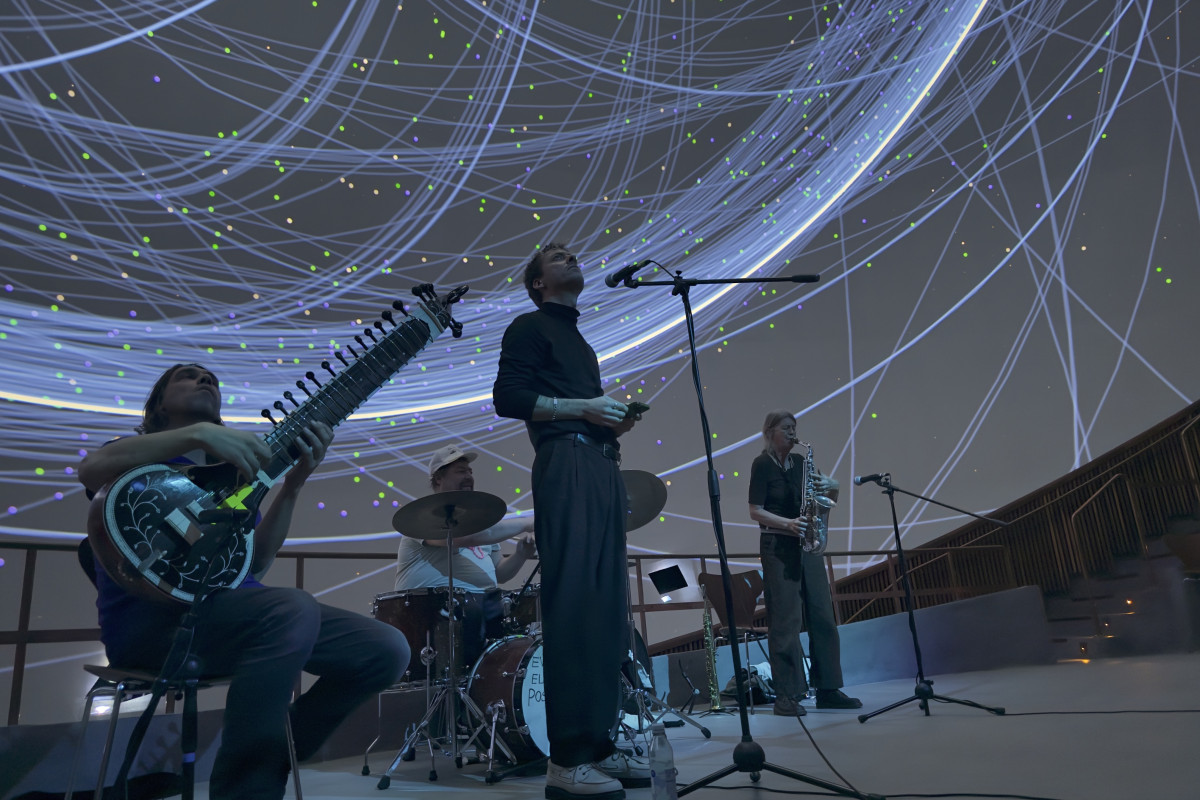
Against enemies in outer space, »music is the strongest weapon we have,« Mads Brügger recently stated here in Seismograf. Snöleopard and musical friends made this idea strikingly concrete by sending music directly from the Planetarium in Copenhagen out into space, targeting satellites between 500 and 35,000 kilometers away. The tones returned altered by delay, radio noise, and cosmic interference. On the large screen, the Earth’s surface – seen from a satellite – rolled by with all its illuminated cities, while Theis Ørntoft read from his forthcoming climate-conscious novel, delivering lines such as: »The day there is no more oil, the lights will go out in the world.« Meanwhile, we could see small green dots of confused satellites racing across the Earth’s beautiful curvature and hear Lotte Anker, Kresten Osgood, and Snöleopard free-jazzing on saxophone, drums, and sitar respectively.
The small crackling beep-sounds from the satellites’ resonance also generated music, but the most interesting moments came when the musicians received fragments of their own motifs back – thrown down from outer space – and a kind of internal interplay emerged. Is there something out there, or are we merely talking to ourselves?
Cosmic resonance filled the dome, but one could wish for more internal resonance. There is a beautiful trend in ensembles that include a poet, allowing many delightfully twisted formulations to surface, but the musicians must also interpret the words – enter into a musical exegesis, as they would with a traditional jazz singer – otherwise the music easily becomes background or secondary. As if each musician were a green satellite dot in their own orbital path. Many good ideas were in play – and music is not a weapon. But it does require internal resonance. Not only cosmic.
English translation: Andreo Michaelo Mielczarek