in briefrelease
11.09

A Strange Instrument, a Familiar Sound

Mike Sheridan: «Touch«
© André Hansen
© André Hansen

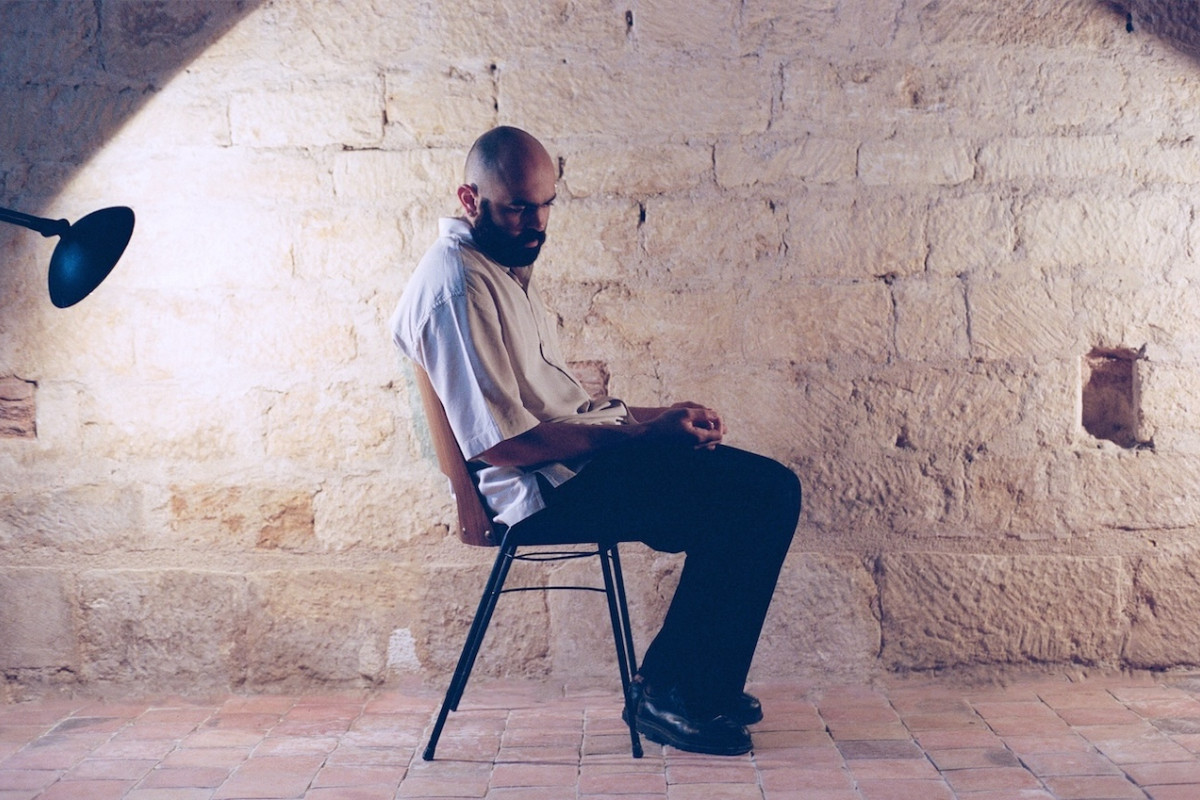
There is something almost dogmatic about Mike Sheridan’s latest album, Touch. Everything leads back to the Cristal Baschet – a peculiar instrument from the 1950s in which sound is produced by running wet fingers over glass rods, setting metal resonators into vibration. No strings, no keys, just glass, water, skin and friction, slowly making the metal sing.

The Cristal Baschet is not merely an instrument on Touch. It is the album cover, the subject of the press photos, and almost the very argument for the album’s existence.

It recalls the material fetishism found in the American duo Matmos, whose music is often built around a single material or sound source: metal on Metallic Life Review (2025), plastic on Plastic Anniversary (2019), a washing machine on Ultimate Care II (2016). What is interesting about such constraints is that they ought to force the music somewhere it otherwise might not be able to go.

While listening to Touch, a question therefore begins to press itself forward: Which of these sounds could not have existed without a Cristal Baschet?

There are glassy tones that hang in the air and slowly change texture. Thin, cutting vibrations. Metallic surfaces that flutter, ripple, open and close. A constant sense of droning resonance; of something vibrating just on the other side of the audible.

Sheridan’s layering is meticulous. There is a precision to the mix, an almost surgical sense of the distance between the different textures. The best moments occur when the surface is disturbed: something that scratches at or short-circuits the otherwise tightly controlled resonance. On »BOW / GROUND«, for instance, deep bass pulses suddenly enter, creating a different physical quality – crackling, heavy, like something hitting the floor.

But Touch is first and foremost a well-produced ambient album. It moves through different degrees of the same state, changing nuance without ever truly changing its skin. That is not necessarily a weakness. There is something consistent, almost meditative, in Sheridan’s insistence. But the longer one remains in the same sonic state, the more one begins to miss what ought to be the Cristal Baschet’s particular possibility.

This is where the disappointment lies: in the gap between the instrument’s strangeness and the music’s conventional appearance. The sounds have been assimilated into a familiar ambient vocabulary, where the extraordinary instrument ends up producing something surprisingly familiar. You can hear that something unusual is happening at the source of the sound. But you cannot necessarily hear why it had to be this particular instrument. Had one not been told that a rare, almost otherworldly acoustic sculpture was standing in the room, one would hardly have guessed it.

in briefrelease
26.01.2025

She Makes the Music Vibrate Like a Living Organism

Astrid Sonne: »Great Doubt« 
© PR
© PR

When I first listened to the Danish violist, singer, and producer Astrid Sonne’s new album, Great Doubt, I honestly wasn’t quite sure what to make of it. I immediately noticed how extraordinary Sonne’s viola sounds on the album – such a powerful presence that it almost feels like a deeply complex living organism, breathing, feeling, and moving dramatically through the album’s nine songs.

My favourite track was without a doubt »Almost«, where Sonne’s fragile, subtly intense voice is accompanied solely by the viola’s minimalist pizzicato melody, which reminds me of a forgotten composition from Japanese new age pioneer Hiroshi Yoshimura’s masterpiece Green.

On most of the tracks, however, voice and viola are also joined by electronic rhythms, piano chords, and synth figures which, in contrast to the viola’s organic, vibrating sound, initially struck me as almost plastically artificial. To me, it sounded as if the viola and the electronics were being transmitted from two very different universes, unable to fully coexist. There was something about the contrast that felt slightly… uncanny.

Yet with repeated listens, everything begins to make sense. Sonne’s coolly understated voice is the glue that binds the entire soundscape together, as if it itself exists in the porous space between the viola’s raw natural force and the electronics’ tamed purity. I like it more and more – and perhaps I may even come to love it. Great Doubt is an album that, despite its modest running time of just 26 minutes, demands immersion and reflection – and ultimately rewards the listener for it.

© PR

»Music for me is a highway hotel. Open 24 hours a day. There are no receptionists, and you are not given keys. You wander sleepily around the hotel's many corridors, from door to door. Some doors are ajar, others you have to pry open. Behind them all are rooms. Some are sparsely furnished, others are filled to the brim with dancing people. You can stay in there for a few minutes. Some rooms you return to. Many are a bit boring, others almost knock you over. What I like most is the ones I can't really orient myself in. The rooms where I have doubts about what is floor and what is wall. And what the furniture is actually used for. All the rooms fit together. You leave the hotel and drive on along the highway of life. A different person than when you arrived.« 

Anders Søgaard is a poet and professor of artificial intelligence and philosophy at the University of Copenhagen. He has written eleven books and more than 300 research articles. He has three children and lives in a housing community in Roskilde.

in brief
08.01.2025

Love and Poetry under Black Streetlights

Jørgensen/Botes: »Dråberne 5, 7, 8 og 11«
Marina Botes og Steen Jørgensen. © Isak Hoffmeyer

While many still sigh at the thought of seeing a full Sort Sol once again illuminate the dark grey Danish sky, the band’s eternal crooner Steen Jørgensen, together with his equally strong other half, pianist Marina Botes, has created music that is something entirely different – something deeper. And yes, I have seen words like »pretentious« and »boring« hurled at the duo, but none of that sticks to their new release, which consists of a series of intimate suites where Jørgensen’s spoken word is woven together with Botes’ magnificent piano playing. If the ambition is to build a bridge between the classical and the electronic, it succeeds convincingly.

As a lyricist who moves through the same pitch-black landscape as Jørgensen, I tip my hat to the strong poetic imagery that characterizes Dråberne 5, 7, 8, and 11 – especially on the album’s longest track, the dramatic »Hul – Dråberne 7«. As Jørgensen muses on the luminous melancholy of the inner city, the music becomes a transformation, a sphere of change made of ambient surfaces, muted strings, and a female vocal that slips in like a shadow—until the song rises in dramatic momentum, centering on the line »En nat i indre kvarter«.

The music is primarily grounded in piano-heavy terrain, where Botes’ keys find repose in muted pedal strikes and light strings. Only in rare moments do the compositions break free, as on the opener »Glemsel – Dråberne 5«, where chamber orchestra and jazzy breakbeats create a compelling and almost cinematic atmosphere.

Dråberne 5, 7, 8, and 11 is a seductive, inspiring, and downright sumptuous experiment in which the love between the two artists can be felt in every tone. If this is Jørgensen’s career winter, I will gladly accept more dark, warm moments.

in briefrelease
16.12.2024

A Riddle I Am Not the Right One to Solve

Abdullah Miniawy: »Nigma Enigma«
© PR
© PR

I believe I am not the right person to grapple with all the existential questions of faith and culture that the multidisciplinary artist and political experimentalist Abdullah Miniawy grapples with on his latest album, Nigma Enigma. The record is equal parts Arabic chant, folk music, and sound art, based on modular synths and field recordings. The Egyptian composer uses the album’s eleven abstractions as the soundtrack to what he himself calls »an Arabic opera of doubt and faith«. But as a non-Arab, lifelong atheist, it is difficult for this reviewer to fully engage with the big questions Miniawy poses in his mother tongue, while samples of crackling fires and layers of filtering create an otherwise enigmatic atmosphere that resonates well with the album’s title. As the music also functions as the soundtrack to an immersive video game, we are taken even further from familiar territory, given that the reviewer has not touched such things since Quakein 1992.

If one sets aside the search for meaning and allows oneself to be colored by the music’s immediacy, what emerges is a strongly conceptual, sonically accomplished work, in which Miniawy’s voice – most often chanting Arabic phrases from old folk songs – is interwoven with electronic noise. In particular, the transition from the beautiful two-part chanting on »Jayhano Al Kawahi« – with strong religious undertones – to the deeply anarchic noise vignette »Half a Year II«, featuring filtered sine tones and pounding bursts of bass noise, serves as an apt characterization of a minimalist piece of sound art.

Yet without being able to share Miniawy’s cultural and spiritual context, the album feels like a riddle I cannot solve. Like drinking an Irish coffee without the whiskey: the real praise is withheld. Nigma Enigma will speak to those who can relate to the spiritual and philosophical questions Miniawy raises, while others may experience it as a musical journey without fully understanding its destination.

English translation: Andreo Michaelo Mielczarek

in brieflive
14.12.2024

The Dust Would Not Settle on the Organs

Organ Sound Art Festival: Mads Emil Dreyer, Gamut inc., Aron Dahl & Mija Milovic
© www.francoadams.com

These days, Organ Sound Art Festival is taking place in its familiar setting at KoncertKirken, and yesterday marked the festival’s second day. The concert opened with revivals of Mads Emil Dreyer’s Vidder 1 and 4, along with a newly composed interlude for pump organ, house organ, keys, and bass flute – all instruments amplified. In this way, Dreyer obscured the sources of the sounds and created a beautiful interplay between the acoustic, the amplified, and the played-back. Was it the flute or the organ I was hearing? And did the sound come from an instrument or a loudspeaker? The music bore the mark of drone music, with beautiful dissonances and a tonal development that occasionally peeked through. Enchanting and compelling.

In the next performance, the German duo Gamut inc. had fitted the church organ with two robots, allowing a computer to control the instrument. Unfortunately, I was left wondering whether the robots were properly calibrated, or whether the music had been composed for a church space with significantly more reverberation. In any case, it sounded »MIDI-dead« – a bit like a silly »piano roll« video of an obscure serial work.

The duo Aron Dahl & Mija Milovic concluded the evening with music whose tenderness and honesty might recall The xx – if the British indie rock group were playing on out-of-tune house organs. Still, the music became somewhat monotonous, and their setup appeared underutilized.

The slightly mixed experience of the evening’s program does not change the fact that Organ Sound Art Festival is an atmospheric and ambitious festival that dares to take chances when presenting us with new works for an instrument that many still associate with bygone days. This Copenhagen-based festival is anything but dusty.