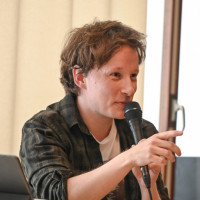
James Black
28





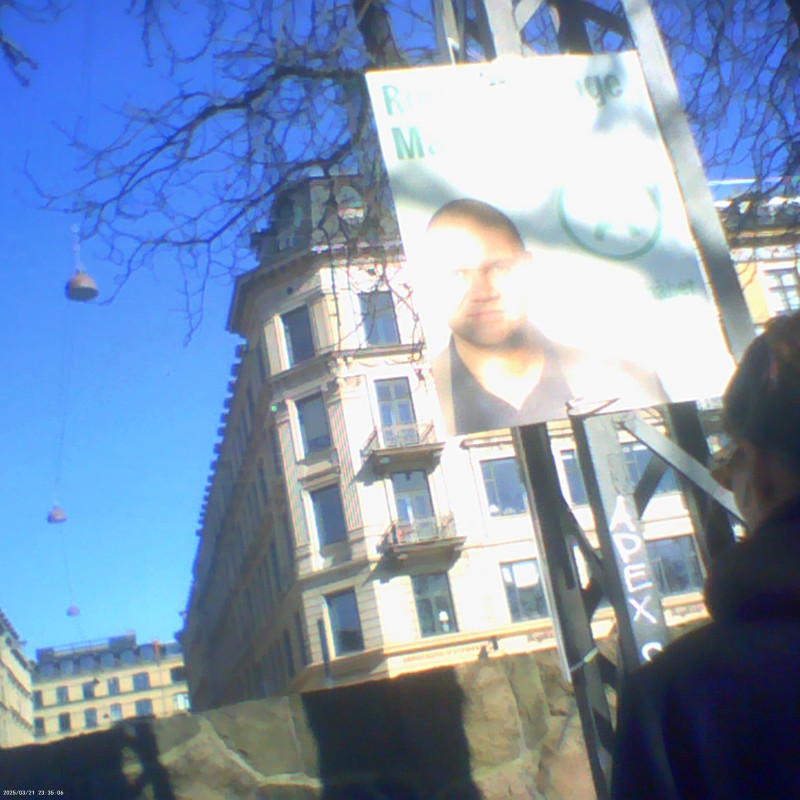
James Black and Connor McLean, the two composers behind the tongue-in-cheek outfit The Ensemble That Loves You, are, as newcomers, not yet eligible to vote in Tuesday’s general election. They can, however, intervene – and that is precisely what they did on Saturday with a good old-fashioned podwalk.
Over the course of three hours, you could stop by the pair, who had set up camp on the northern bank of Sortedams Sø in Copenhagen. There, you were handed a QR code, guided to the nearest campaign poster, and left with a SoundCloud link. »Alright, see you in 16 minutes,« Black said, and suddenly I was standing in front of political scientist Thomas Rohden of the Danish Social Liberal Party, confronted with his peculiar, toothless plastic smile.
»It’s important to connect with the election, so look the candidate straight in the eyes,« a synthetic female voice instructed as I pressed play. So I did. Stood still, listened, stared. Became a kind of artwork myself, I suppose – certainly looked like an idiot. And while the voiceover sent me onward to new posters, Black and McLean worked to complete the sense of alienation with brief sonic interventions.
The voice first took on a slight echo, then locked into a groove – »vote-for-me-vote-for-me-vote-for« – before dissolving into short-circuited 8-bit electronics, a faltering barrel organ, and flickering monologues over live jazz, mimicking an absurd media reality.
Gradually, the glossy, guileless eyes of the posters came to express just how artificial the election really is. »The person you are looking at is not real,« the synthetic voice concluded – remarkably agitated for a computer. »The party will replace you with a robot.«
Alright, alright. From the voiceless, one must hear the truth – wrapped in British political sarcasm and MIDI jingles: a light – and perhaps somewhat cheap – dish, but who has the energy for more after four weeks of campaigning? On my way back to Black and McLean, I saw a woman point at a poster of 26-year-old Maria Georgi Sloth, also from list B: »She gave me a piece of chewing gum down at the station.« And just like that, the election was decided.
English translation: Andreo Michaelo Mielczarek
»Music is the infinite sound of humanity, in all of its manifestations. It is the essence of who we are, what we fear and what we hope for. Nobody owns music, and yet it is absolutely who you are, the very DNA of your soul.«
Seb Doubinsky is a bilingual French dystopian fiction author and academic. His »city-states cycle« has put him on the map of notable authors of the genre. He has been long-listed for an Arthur C Clarke award, won the Foreword Reviews bronze award for Missing Signal and his latest novel is short-listed for the 2025 Foreword Reviews award. He lives in Aarhus, Denmark, where he teaches French history, literature and culture at the university.
»For me, music is a particular engine for diversity, identity, individuality, and community. Music has an immediate ability both to create and strengthen safe spaces and to expand and tear apart the boundaries of existence.«
Artist, curator, and educator Jacob Eriksen works between Struer and Berlin. He is head of Sound Art Lab, festival director of Struer Tracks, director of studies at 89 Sound Art School, and teaches Sound Studies and Sonic Arts at UdK Berlin.

Back in the day, people watched Beverly Hills 90210 simply because it filled the flow-TV schedule. Artist Niels Lyhne Løkkegaard, too, spent his youth wandering through those virtual Californian landscapes. In the project Fata Morgana, Løkkegaard and American composer Michael Pisaro-Liu explore this strange experience between place and fiction. With the alto recorder as their weapon, they invite us both home and away. And, as a nostalgic homage to bygone media realities, the project comes with an A-side and a B-side. It begins with »Visit«: the crackle of forest floor near Løkkegaard’s childhood home in western Jutland, recorded in 2021. The microphone is placed somewhere, a few steps are taken – and then silence... Far away, the alto recorder begins a melody surrounded by birdsong. This homely soundscape is woven into the listener’s own sense of place. Was that a car driving by – here? Or there?
On the B-side, »Visitation«, Pisaro-Liu repositions the flute piece in California in 2024. The tension rises; the melody is visited and haunted from the other side of the globe. It is disturbed and distorted by electric signals, siren tones, interfering noise, and fragments of American voices murmuring things about »fever dream« and »not anything in particular.«
For indeed, there isn’t really anything. It’s classic Løkkegaard: an imagined world unfolding in the listener’s mind. It could have been done in less than 2x22 minutes, but the idea is strong, simple, and well executed. Like the sonic version of a cartoon mirage shimmering falsely in the sharp Californian sunlight.
English translation: Andreo Michaelo Mielczarek
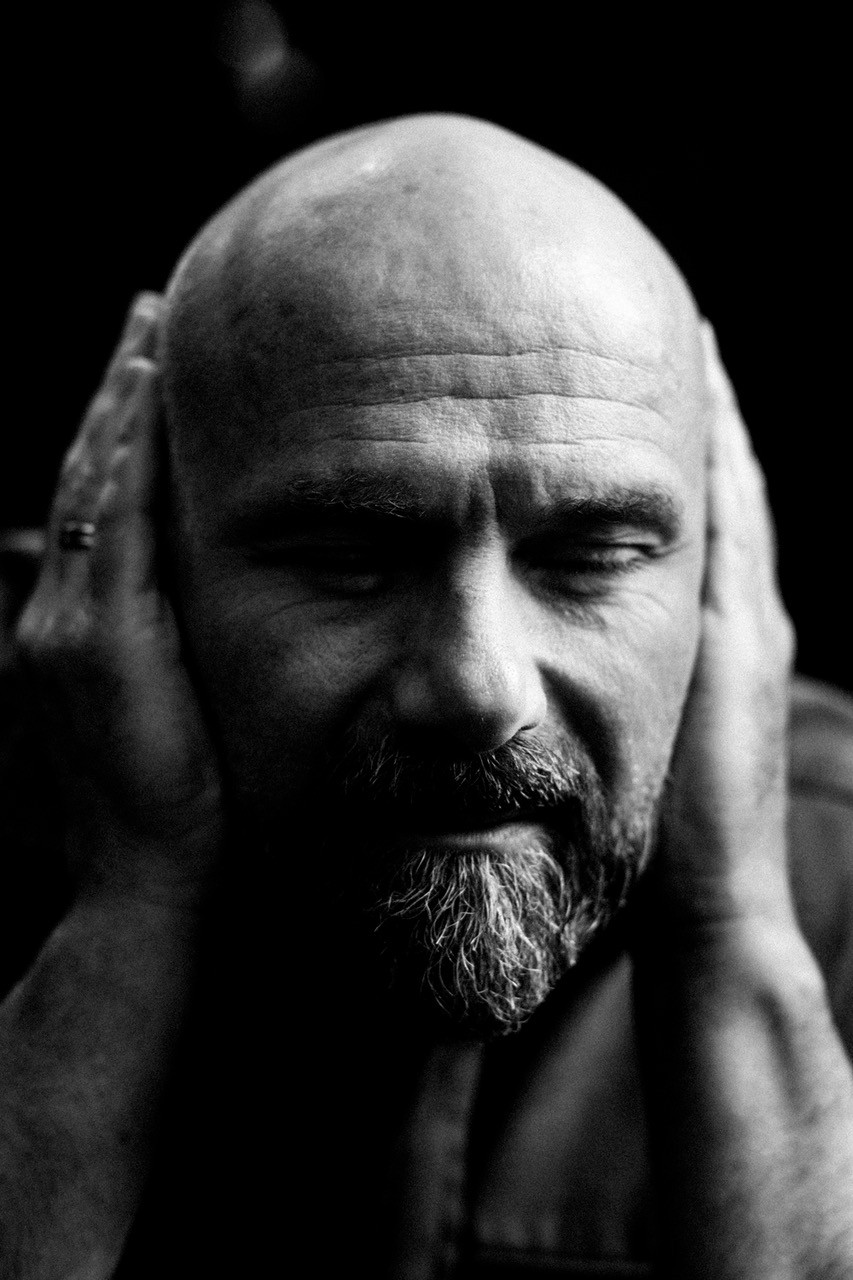
»For me, music is the light that streams in through our windows and touches the human mind. Music is community – something we create together. Music is the other language – the one that can be spoken when all words and conversations have been worn to pieces.«
Mark Solborg is a Danish-Argentinian guitarist, composer, and improviser, educated at institutions including the Rhythmic Music Conservatory and New School University in New York. He has released 28 albums of his own works and collaborated with figures such as Evan Parker, Susana Santos Silva, and Herb Robertson – often on the artist-run label ILK, which he co-founded. His music has been performed in 23 countries and involves musicians from 15 nations. Projects such as TUNGEMÅL and BABEL explore the role of the electric guitar in acoustic spaces, and his practice also includes collaborations with theatre, film, and visual art. Solborg is a recipient of a Reumert Award, has been honored by the Danish Arts Foundation, and in 2024 was nominated for a Danish Music Award as Composer of the Year. He is currently releasing the album Confluencia.

There’s something distinctly mechanical about Oh No Noh’s album As Late As Possible. Like a warped, crumpled tape, melodies bubble to the surface, and the offbeat rhythms repeat with the halting tempo of a scratched LP. It’s easy to place Oh No Noh within the esteemed German tradition of blurring the lines between human and machine, but on As Late As Possible, the machine sounds more like a distant relative than a deliberate artistic objective.
Behind Oh No Noh is Leipzig-based guitarist Markus Rom. In addition to a wealth of synthesizers and tape loops, the album’s 11 tracks are performed using guitar, drums, banjo, clarinet, and organ. The absence of vocals sets the album in a subdued, cinematic mood, and the music feels like a nostalgic inner monologue, told with a warm affection for the melancholy of outdated technologies.
Although mechanical sensibilities are prominent throughout the album, several tracks are driven by more melodic band arrangements. But to me, As Late As Possible is clearly most compelling on the less melodic pieces. The crooked and noisy »Fawn« or the hesitant closing track »Ore« are moments where the dialogue with the machine elevates the music in ways that the more melodic, band-oriented pieces don’t quite reach. These are places where the machines sigh nostalgically and form small, imperfect thought bubbles that cut off and restart again.
English translation: Andreo Michaelo Mielczarek