in brieflive
23.05.2024

En sorg der ikke kan spejles i verden

Faun Vium, Amanda Drew, Freja Højland Høj, Hávard Magnussen, Amanda Drew, Karoline Banke, SORT/HVID Teater, Noisy Beehive m.fl.: »Dronning Annabel«
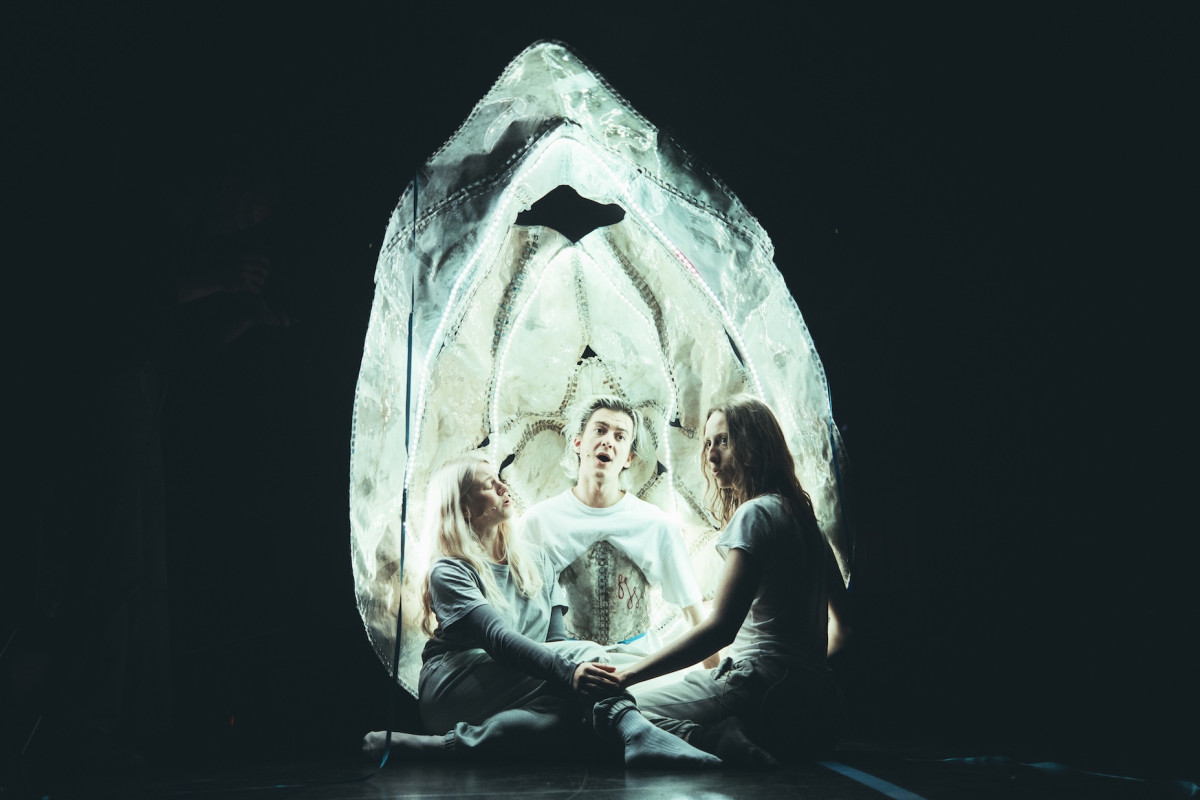
© Rumle Tornhøj Skafte

»Jeg er ikke slettet«, oplæste kunstneren Faun Vium. Et brev fra hendes søster indledte operaperformancen Dronning Annabel, der tager afsæt i søsterens indlæggelse. Vi stod foran Brønshøj Vandtårn. Med champagne i hånden, sang vi sammen en mol-dunkel sang, som havde startet hele processen. »Vi forsøger at forvandle psykosens poesi fra en ensom til en delt oplevelse«, stod der i programmet. En champagneprop sprang på vej ind i tårnet. Stemningen var premiere-let og tungsindig på samme tid. 

Brønshøj Vandtårn er med sine svimlende betonsøjler nærmest et værk i sig selv. De mest uskadelige lyde bider fra sig i tårnets kolossale rumklang. Mellem søjlerne blev vi bænket og oplevede, hvordan værket byttede en båndet samtale mellem Vium og søsteren med performance i rummet. Tre sangere – to af dem spillede også cello og kontrabas – bevægede sig rundt i det kølige rum med skulpturelle skaller, som de udklækkede fra og forpuppede sig i. Men på grund af den anti-sceniske arkitektur, var det frustrerende svært at tage deres energi ind. Alting foregik i øjenkrogen, delvist hengemt bag en søjle. Derfor fik jeg – til trods for det inkluderende oplæg – en ærgerlig følelse af en halv oplevelse. 

Måske var det pointen: Som publikum var man, ligesom den tvangsindlagte, låst i sin stol. I stedet gav jeg mig hen til klangen. Det var betagende at høre, hvordan samtalerne om »en sorg, der ikke kan spejles i verden« og sprogets utilstrækkelighed blev forlænget i sangernes fraser, hvor ordene blev opløst i den umådelige klang. Nogle gange sang sopranen, så det hvinede i ørene. Til sidst voksede en optagelse af de to søskendes fælles sang fra den personlige relation og ud i rummets sfære. Poesien forplantede sig i tårnets potentiale og satte et smukt klingende punktum for værket.

© PR

»What is music to me? Here’s a quote from Nietzsche: ‘The people dancing all seemed crazy to the people who couldn’t hear the music.’«

Salim Washington is a saxophonist, multi-instrumentalist, composer, academic, and activist from Detroit who has been highly active on the American jazz scene since the 1970s, and also in South Africa, where he became a central figure. The spirit of John Coltrane hovers over his music, which carries both spiritual and social dimensions.

© Aske Jørgensen

»Music for us is the perfect language that we love to speak. A language where it is the individual's feelings and imagination that determine what is right and wrong. Everyone can speak the language. You don't have to be able to write or understand, but just listen. Some music requires that you listen carefully and maybe hear it several times. A bit like when you talk to someone from Norway or Sweden, you also have to listen a little extra.«

DØGNKIOSK is a Danish punk rock band with roots in Silkeborg. The band consists of bassist and singer Anders Ejner, who has been active on the Danish underground scene for several decades. Musically, DØGNKIOSK moves in a field between classic Danish punk and alternative rock. In the spring of 2026, the band will release their second album, Tæt på kanten.

© Bastian Zimmermann

It is difficult to comprehend that Andreas Engström is no longer with us. Just a couple of months ago, he wrote – as he had done so many times before – with an ambitious proposal: he wanted to review a box set of twenty releases by Dror Feiler. In the same message, he mentioned plans to come to Aarhus for the recently concluded Spor Festival.

in briefrelease
04.05

The Escape From a Hotel That May Not Exist

RÖM: »Whispering Dub«

Ladies and gentlemen, we’re deep underground – indeed, all the way to France. This EP is the latest conceptual release from French electronic producer Romain Martin, who works under the name RÖM in the borderland between ambient and techno. Whispering Dub unfolds across five tracks, drawing heavily on dub while telling a story about an escape from a fictional hotel. Escomel’s background in African percussion studies and his fondness for analog gear surface in the mysterious sonic textures and the stark contrast between arranged percussion and dubbed-out echoes, underscoring the concept’s tension between mysticism and reality.

»Oilbird« opens in dystopian ambient before sliding into the rhythmic »Eastern Temple«, which constantly shifts between filtered synths, frantic percussion, and sudden breakbeats. Things cohere more fully on the title track, which blends minimal techno into the mix and stands out by maintaining a steady pulse, while echo-laden drums cast an unsettling atmosphere within the dance framework. On the closing »Hotel Amnesia«, the narrator awakens again in a collage of the record’s electronic tendencies, questioning their own existence in the album’s only use of vocals.

Whispering Dub isn’t wildly groundbreaking or bizarre enough to push the senses into extreme reactions. But as a well-produced and effective piece of electronic music, it invites the listener into a compelling game of whispers.

English translation: Andreo Michaelo Mielczarek

in brieflive
04.05

A Trumpet, Two Illusions and a Fjord

Kasper Tranberg / Mesmer
© PR
© PR

The stage was set for a special experience on Wednesday evening at KU.BE on Frederiksberg. In the borderland between tradition and joyful madness stood birthday celebrant Kasper Tranberg, blowing his trumpet. What emerged was an insistent blend of jazz and avant-garde, laced with understated humor and delivered by a virtuoso with a calm, unmistakably Danish presence. With a wry sense of ease, he made even the most complex passages surprisingly accessible.

Tranberg presented excerpts from 12 Melodic Illusions for Solo Improviser and Melodic Illusions for Sextet with both devotion and a glint in his eye. He demonstrated how the trumpet can stand alone while still conveying abstract emotional states. Sharp trills dissolved into growling undertones, merging with the resonance of the room. At times, he employed backing tracks, creating duets with himself.

The evening’s main attraction was the trio Mesmer – Emil Jensen, Victor Dybbroe, and Anders Filipsen – who performed works from their new piece Terrain Vague II, developed through several residencies in Northern Jutland. The three compositions moved within a field of electroacoustics, contemporary music, and analogue improvisation, carrying a distinctly cinematic and nature-infused sensibility. The sonic plunges into the Limfjord were particularly striking: Dybbroe’s metal percussion and Filipsen’s lapping synth textures carved out a dark, magnetic space. In the piece inspired by Aalborg Harbour, Jensen’s trumpet cut through with long, mist-laden tones, like signals drifting in from distant ships. The result was both enchanting and, at times, deeply inspiring. It was a concert that, for now, refuses to loosen its grip on me.

English translation: Andreo Michaelo Mielczarek