



Sacred, Profane, and Unsettlingly Alive
To call a festival Sacrum Profanum is to invite extremes. Kraków’s international festival of new music, founded in 2003, lived up to that promise from the outset, presenting a programmatic range that stretched from Cat Roberts’ organic electronica to Mariam Rezaei’s industrial turntable scratching, produced on her fiercely percussive decks.
I was not present at the dawn performances, where the birds reportedly took over completely as co-composers. Stephen O’Malley would hardly have minded
Yet the festival’s most striking gesture took place far from the concert halls. The Swiss ensemble Alponom performed Stephen O’Malley’s You Origin four times: twice at sunrise and twice at sunset. First, the musicians were positioned in five pairs on a mountain outside the city. The distant roar of traffic slipped between the tones as alpine horns built deep, cyclical resonances. Passing dog walkers – and their dogs – stopped and listened.
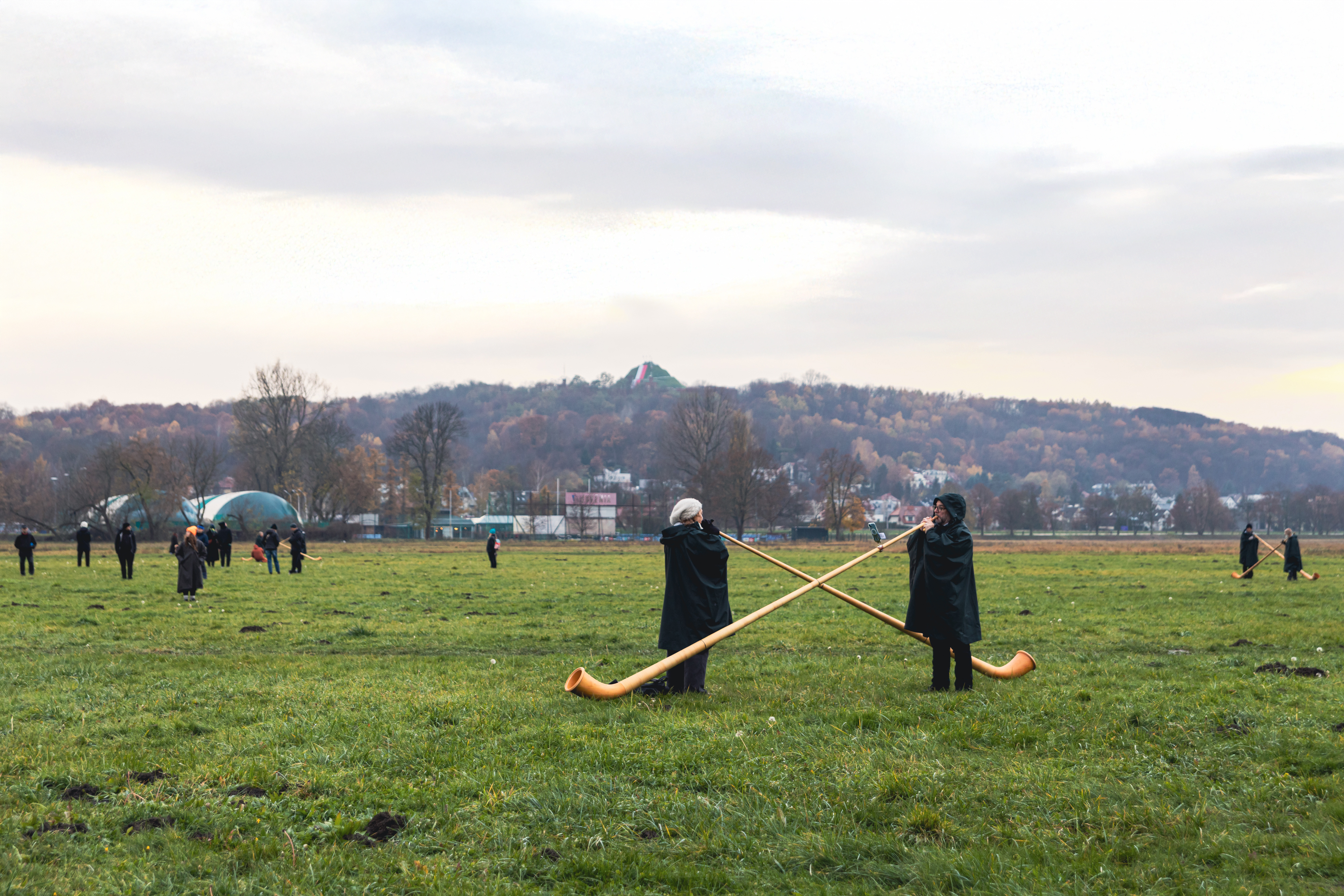
The following day, on a flat plain in the middle of the city, birdsong wove itself into the elongated drones. The work consists of just five notes, played continuously for an hour, but the surroundings inevitably expand it. There was something both intimate – one could stand very close to the musicians – and monumental, as the sounds spread across Kraków’s landscape and turned the city into one vast resonating space.
It was wonderful to inhabit this prepared-piano universe, where screws, rubber and plastic turned the instrument into a small percussion machine
I was not present at the dawn performances, where the birds reportedly took over completely as co-composers. Stephen O’Malley would hardly have minded – rumours had it that he himself wandered the mountain listening, though it was more likely a Polish look-alike than O’Malley himself, known from Sunn O))).
Norwegian Shakespeare serenades and French anarchy
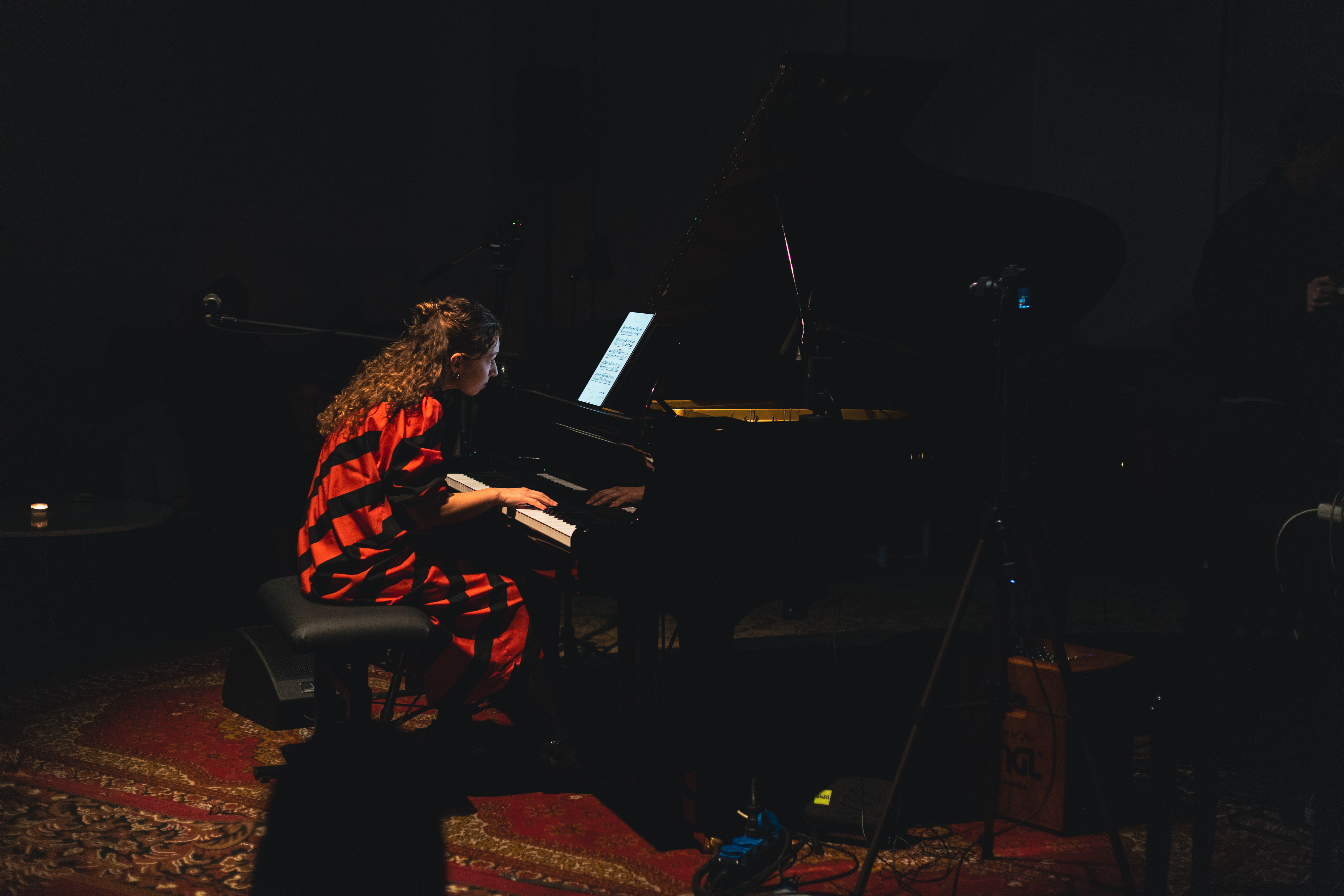
A series of »home concerts« transformed the bar Hevre, located in a former synagogue in Kraków’s Jewish quarter, into an informal listening room. In this setting, Martyna Zakrzewska’s performance of John Cage’s Sonatas and Interludeswas close to perfect. It was wonderful to inhabit this prepared-piano universe, where screws, rubber and plastic turned the instrument into a small percussion machine, while the audience sat on Arabic rugs around the grand piano.
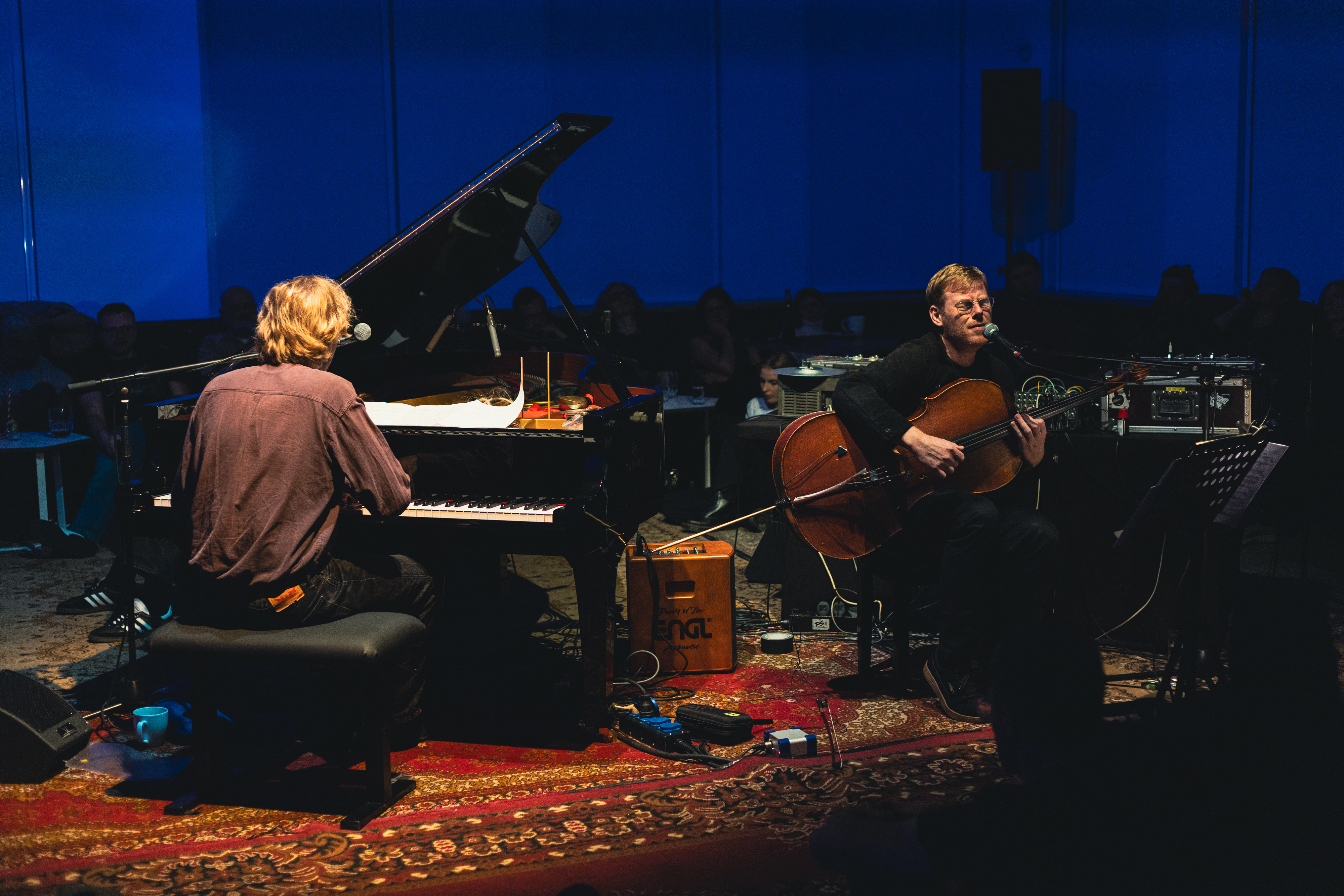
Cellist Jakob Kullberg and pianist Matt Choboter also contributed an eclectic tone with The Grotesque Songs – songs that moved between pop, improvisation and chamber music.
The encounter between pianist Andrzej Karałow and tape artist Jérôme Noetinger proved hypnotic. Here, the piano’s sound was distorted and mirrored through analogue tape manipulations, so that the acoustic and the electronic constantly dissolved into one another in a tightly controlled intoxication.
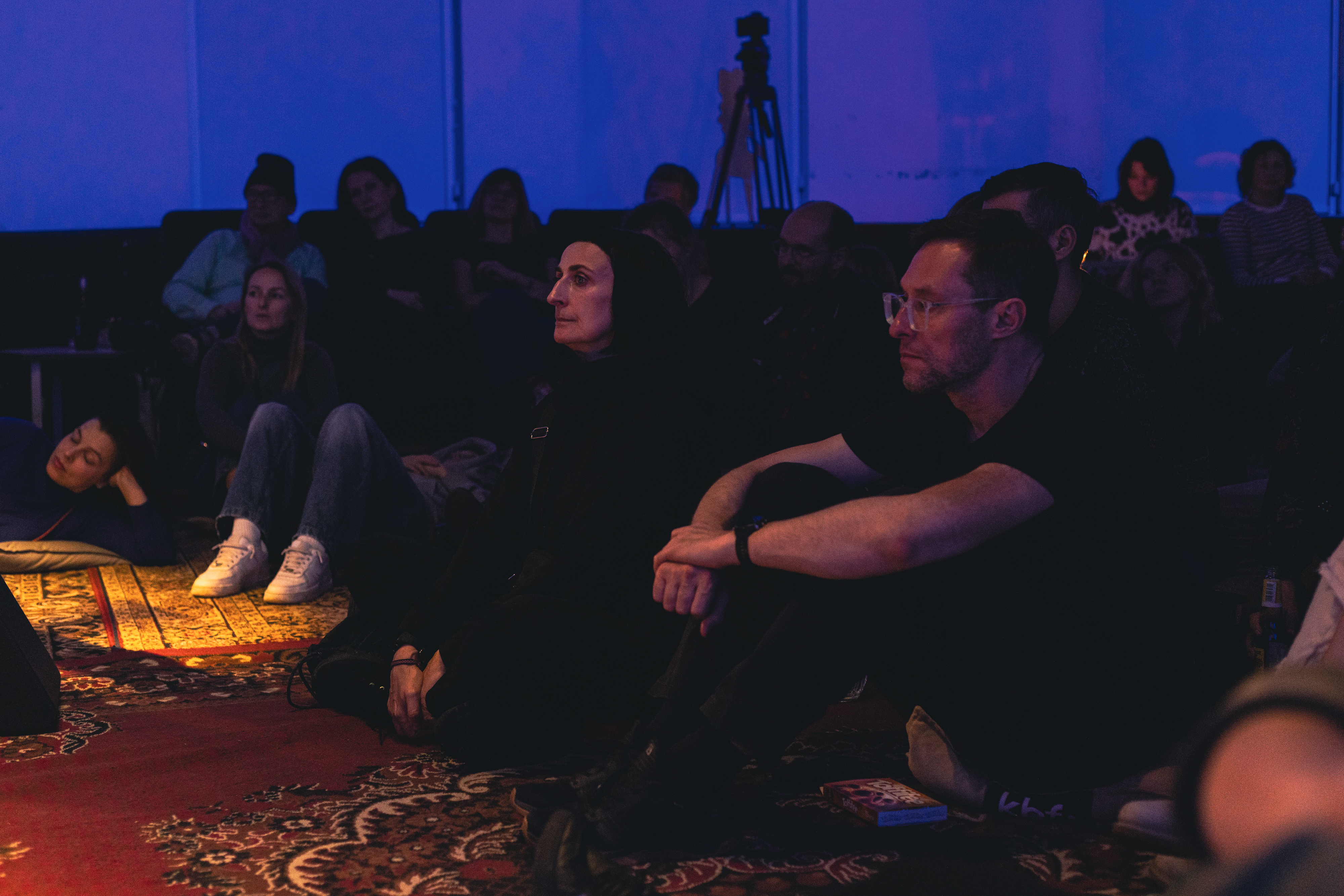
At a festival unafraid of extremes, Maja Ratkje and Stian Westerhus’ acoustic, Shakespeare-inspired serenades felt almost inevitable. Ratkje’s pump organ and hissing voice cast diabolical shadows, while Westerhus’ guitar and rasping vocals laid down a thick, rough foundation beneath the tear-choked, skewed and slightly messy indie songs about both beauty and darkness.
The bagpipe was distorted, and guitarist Guilhem Lacroux – in a skull shirt – danced across his pedals in Sonic Youth-like grooves

Later, La Baracande launched into a reinterpretation of traditional French folk song: the bagpipe was distorted, and guitarist Guilhem Lacroux – in a skull shirt – danced across his pedals in Sonic Youth-like grooves. A trashed-out update of Virginie Granouillet’s laments, run through a megaphone. The music drowned in effects and overgrown rock’n’roll anarchy.
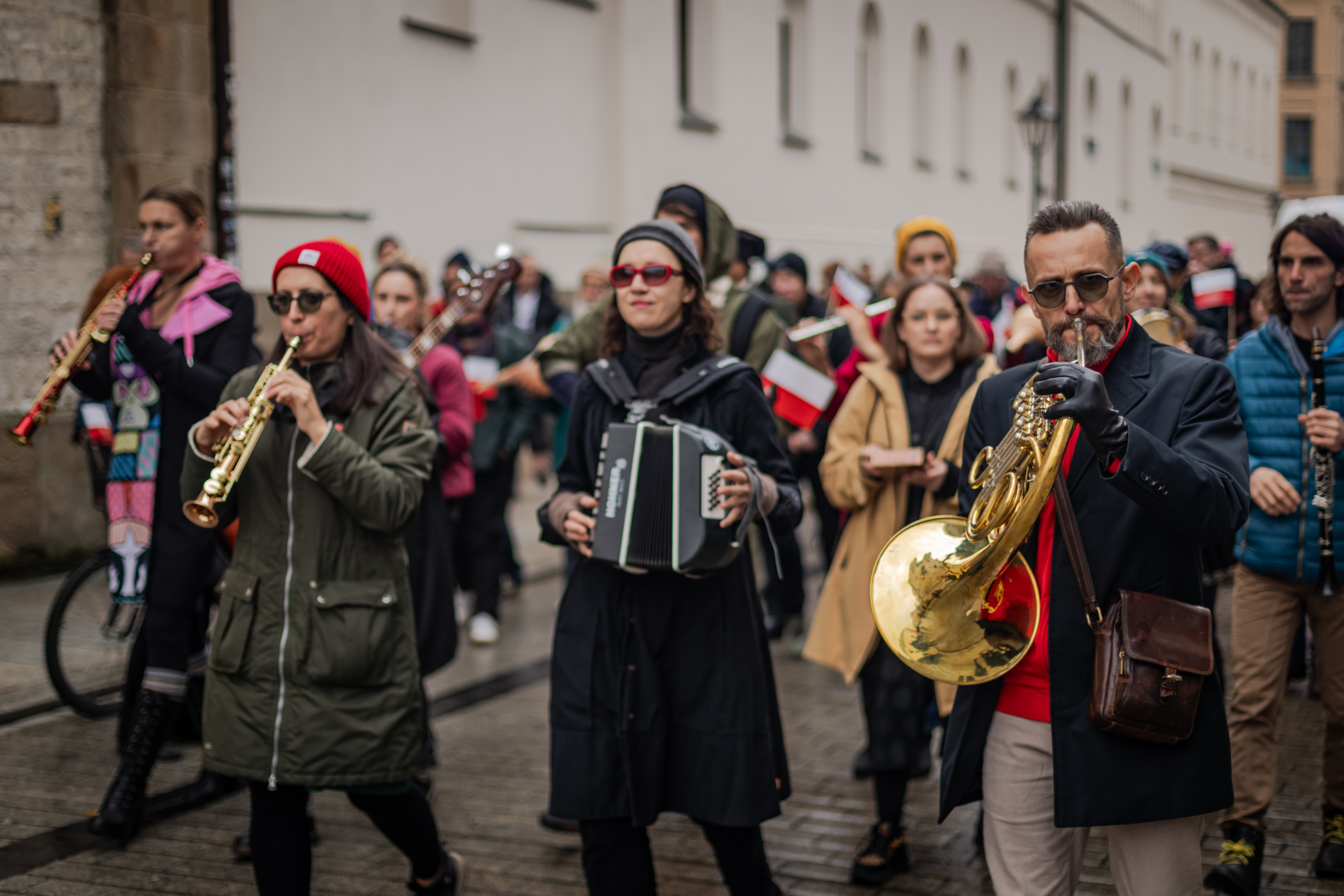
The troubadour vibe was stronger when the Kraków Improvisers Orchestra (joined by guest musicians from the festival) played their way through the medieval city on Poland’s National Day.
Improvisation as combat
A recurring thread at this year’s festival was a series of musical encounters staged as outright battles: Malediwy faced off against the duo Colin Webster and Borja Díaz – with improvisation as the mode of combat. Pospieszalski’s saxophone surged aggressively with fragmented melodic traces; Webster answered back. It was confrontation and communication at a high level.
The piece unfolded in a crime-film universe, with the composer standing behind a curtain, assembling a billiard cue
The battle theme was taken entirely literally in a concert held in a scout gymnasium. Wearing boxing gloves, composer Dominik Strycharski punched, kicked and roared his way through Box of Boxing, while the ensemble Kwartludium scattered sounds around him. He lashed out at the punching bag, but the energy never coalesced into a genuine musical idea.

Anna Sowa’s Practice Makes Perfect sought to translate a PE lesson into performance, while Magdalena Gorwa’s Flow drew inspiration from yoga’s slowness and breath.
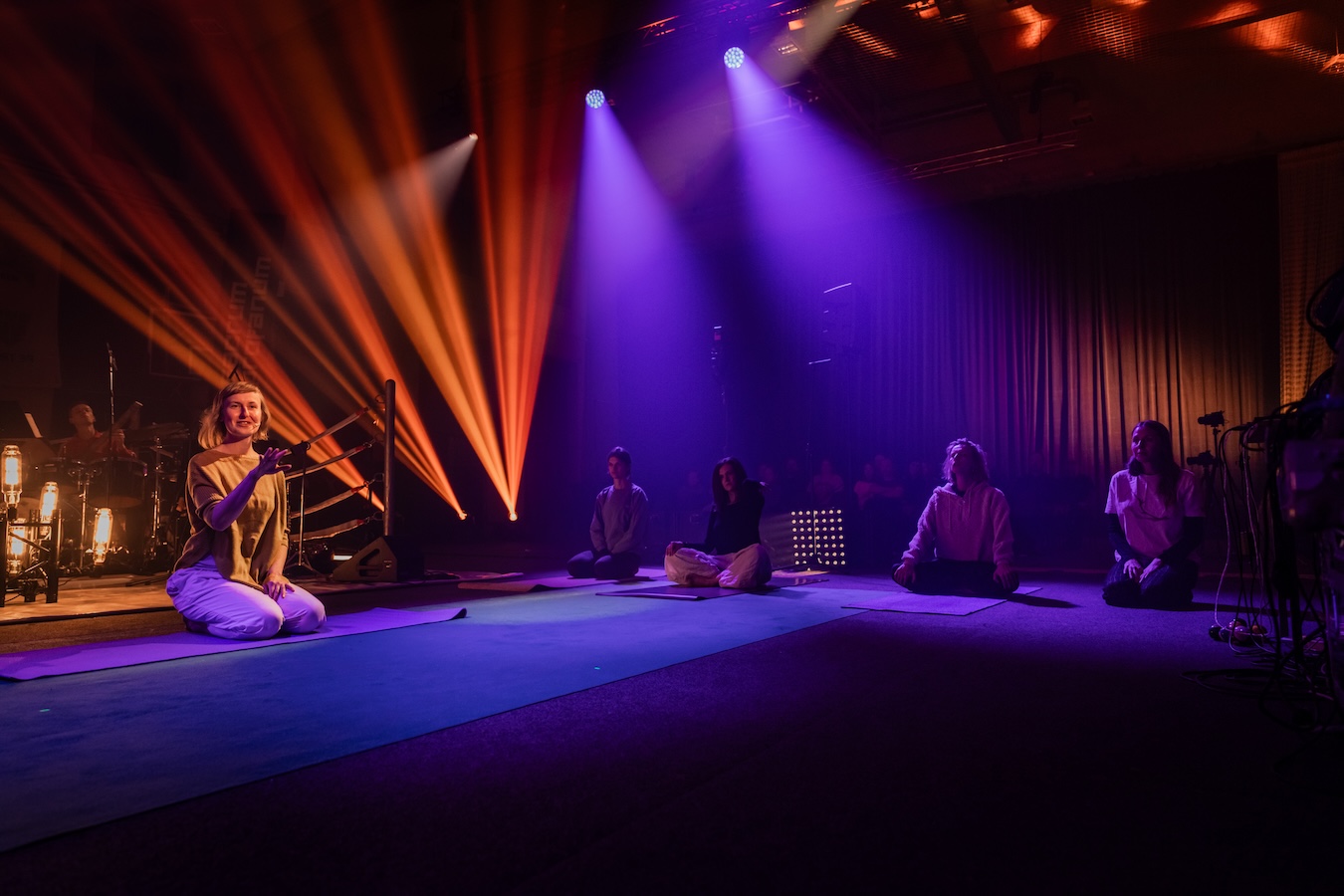
The composer – acting as yoga instructor – rolled out a mat at the centre of the stage and guided the audience through breathing exercises woven into the music. It amounted to an exercise in empty wellness aesthetics. Adam Porębski’s Pool Dance also worked far better on paper. The piece unfolded in a crime-film universe, with the composer standing behind a curtain, assembling a billiard cue.
Perhaps these loose experiments might have worked in a family concert, where the audience is primed for play and openness. Here, the concert instead appeared as a series of unfocused attempts that never found their own tone – despite the entertaining contrast between musicians in sportswear and caps and a lighting design borrowed from the world of athletic arenas.
The festival’s closing concert was likewise less successful. Eva-Maria Houben’s seascape harmonies did contain a certain poetic potential in its fragile, ascetic string surfaces. But the festival’s own resident artist, saxophonist and composer Marek Pospieszalski, delivered with Nadnaturalny a work for string orchestra, tape recorders and saxophone that lacked direction. He began by sustaining a single saxophone tone for several minutes while Sinfonietta Cracovia’s strings slowly swelled in drone-like movements. Beside him stood two reel-to-reel tape machines emitting retro-electronic sounds. At its best, it recalled Erkki Kurenniemi’s early synthesizer experiments. All in all, however, it was a forty-minute musical walk without narrative and without a real arc of tension.

By contrast, it was a joy to experience Aleksandra Słyż – one of Poland’s most interesting young composers – in the premiere of po horyzont for flute, voice, piano and percussion. Here there was a rare confidence in the handling of sound and form. The flute’s airy lines, a fragile falsetto voice and wine glasses filled with water melted into a delicate yet refined sonic universe.
Equally moving was witnessing young percussion students in the American musician and activist Marshall Trammell’s project Anti-Monumental Music, where improvisation functioned as a tool for exploring and articulating their own individual musical voices.
»The floor was just all over the place,« he remarked afterwards – and for the audience on the platforms it felt exactly like that: like sitting on a double bass
Silence after the noise
The festival’s real coup turned out to be the so-called insta-improvisations at the Museum of Contemporary Art in Kraków (MOCAK). Musicians who had never played together before met inside Konrad Smoleński’s Venice Biennale installation Everything Was Forever Until It Was No More: two bells, a massive wall of loudspeakers, and a vibrating wooden platform. First, the musicians played for twenty minutes, after which the installation began recording the sounds and feeding them back into the space. From that moment on, they continued playing with the work.

During the concert by British saxophonist Colin Webster and American percussionist Marshall Trammell, Smoleński’s speaker wall became a physical wall of sound, filling the room with raw, trembling noise. Trammell struck one of the bells with an intensity reminiscent of a march through hell. »The floor was just all over the place,« he remarked afterwards – and for the audience on the platforms it felt exactly like that: like sitting on a double bass.


At times the two bells sounded like deep strings; at others, the sampled sounds from the speakers resembled a train rumbling through an endless tunnel. Each performance within the installation was different, especially because the musicians approached it from silence rather than sheer force. Marek Pospieszalski’s saxophone merged with Guilhem Lacroux’s steel-brush-harsh guitar. Jérôme Noetinger’s tape machines threw old analogue echoes over Jakob Kullberg’s cello, which suddenly sounded like a viola da gamba from a distant past.
The bells chimed. She pointed towards the audience, as if warning us of a danger only she could hear
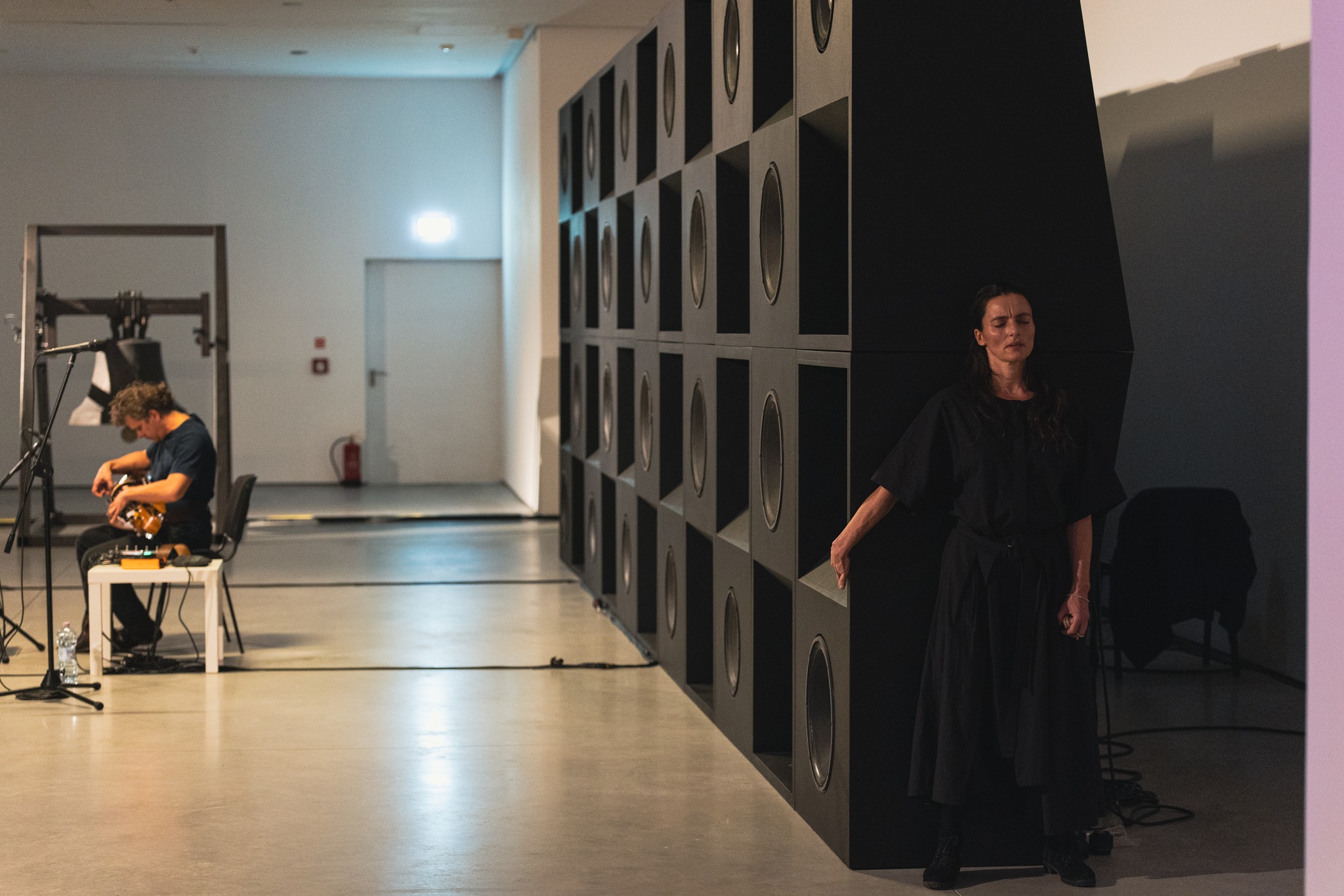
The most wondrous performance came from Maja Ratkje and Yann Gourdon – the latter on his homemade hurdy-gurdy. Ratkje struck the bell with small pieces of metal and sang as if she were exorcising something from the room. Her voice and the hurdy-gurdy found a shared drone, which she repeatedly broke with tiny mouth explosions, whispered prayers and pure screams. It looked as if she were conducting the bell’s resonance with her hand; the room vibrated like an airplane coming in to land. The bells chimed. She pointed towards the audience, as if warning us of a danger only she could hear.
Then the hurdy-gurdy stopped abruptly, as if the battery had run out. The music fell silent. And then: the purest silence. Perhaps it was precisely here that Sacrum Profanum made complete sense. Here the festival’s extremes found their most precise form. The sounds settled – but continued to vibrate in the body.
Sacrum Profanum, Kraków, 6–11 November 2025