


Who Is Playing?
An instrument is usually imagined as something with an identifiable edge. A violin ends where the air around it begins. A synthesizer occupies a casing; a computer sits on a table; a performer stands before an audience and acts upon these things. However complex the technique, agency appears to travel in a familiar direction: from human intention, through an instrument, towards sound.
At Ars Electronica 2026, this sequence repeatedly came apart. A bassoon extended into software, sensors, recorded voices and bodily gesture. A group of small electronic creatures listened to sunlight, shadows and one another. Motors slowly turned shells filled with water, allowing air and matter to produce sounds that no loudspeaker reproduced. Meanwhile, at Sonic Saturday, a twenty-point-four-channel loudspeaker dome, a listening room, an open-air garden, curatorial selection and the movement of audiences between them organised several distinct ways of attending.
The question raised by these situations is not simply whether machines can become autonomous. That formulation preserves the very opposition the works make unstable: active human on one side, passive technology – or threateningly active technology – on the other. The more interesting question is relational: who or what participates in producing the event, and how are the capacities to act, respond, resist and listen distributed among bodies, instruments, algorithms, materials, environments and institutions?
This is the second of three articles on sound art and listening at Ars Electronica. The first examined spatial reorientation: how architecture, acoustic technology and environmental conditions produce the place from which listening occurs. Here the emphasis shifts from where listening happens to who or what makes something happen. The two questions cannot be completely separated. Agency always unfolds somewhere, and the spaces of performance are already organised by technologies and conventions. Yet the shift matters. Once we ask who is playing, the apparent unity of performer, instrument and work begins to divide into a more complicated ecology.
The instrument after the digital
This complication was explicit in the Post-Digital Instruments Concert at Anton Bruckner University. »Post-digital« does not mean that digital technology has been left behind. Computers, algorithms, sensors and electronic processing remain present. The term instead marks a change in emphasis after digitalisation has become ordinary. Rather than celebrating immaterial information, perfect reproduction or frictionless interfaces, post-digital instruments return attention to bodies, weight, texture, resistance and failure.
Digital systems are often designed to disappear into effortless operation. A successful interface should not interrupt the user; a successful algorithm should deliver its result without exposing the chain of decisions through which that result was produced. A musical instrument works differently. It may become familiar through practice, but its resistance does not simply vanish. Breath meets a column of air. Fingers negotiate keys, strings or surfaces. The performing body tires, misses and adjusts. Technique develops through the encounter with constraint.
In the material available from my conversation with Sandra Muciño, this bodily dimension is central. She describes her body not as an external operator but as the primary instrument within a larger ecology of bassoon, software, algorithms and electronic sound. This does not dissolve the performer into a system. It changes the system’s boundaries. Musical action is produced through the relations among its components rather than delivered intact by an intention that exists before them.
Her work Vultus makes this especially tangible. The bassoon enters into relation with electronics and with a recording of Muciño’s grandmother’s voice. The voice is fragmented and transformed through synthesis and real-time control. Breath, fingers, acoustic instrument, ancestral recording and digital processing meet within one performance, but they do not become interchangeable. The grandmother’s voice brings a history that cannot be reduced to data; the bassoon brings a material tradition and embodied technique; software brings designed operations and possibilities of transformation. Muciño’s performance is not located in any one of these elements. It occurs between them.
This is more than »interaction« understood as a person supplying input and a computer returning output. The performer listens and responds while acting. The instrument affords some gestures and resists others. Software transforms sound, but only within programmed and composed limits. A recorded voice can be triggered and altered but retains an excess of personal and historical meaning. Agency circulates, yet it does not become anonymous.
This distinction is important because distributed agency is easily romanticised. Describing an assemblage of bodies and machines can make every component sound equally active. But equality is not the point. An algorithm does not perform in the same sense as Muciño. A sensor does not possess her musical training, vulnerability or intention. Relational agency allows differences of capacity to remain visible. It asks what each component makes possible, what it constrains and how the encounter changes the actions available to the others.
Curating the conditions of listening
My conversation with Enrique Mendoza Mejía makes it possible to extend this question beyond the individual performance. Mendoza, a Mexico City-born composer based in Vienna, teaches electroacoustic music at Anton Bruckner University and has coordinated and produced Sonic Saturday for four years. His work brings another kind of agency into view: the institutional, technical and curatorial organisation of listening.
Sonic Saturday is not one concert. It combines the MEDIUM SONORUM closing concert with a listening room, open-air works, audiovisual projects, performances and workshops. At the centre of its infrastructure are the university’s production studio and Sonic Lab, built around a 20.4-channel loudspeaker dome. Students can develop spatial works in one environment and present them through a closely related system in another. The infrastructure does more than reproduce completed compositions. It shapes what can be imagined, rehearsed and heard.
This became particularly clear when Mendoza described the annual call for contributions. The first edition he coordinated received around forty works; later calls brought approximately 140 to 160. Submissions can use discrete multichannel formats, octophony or ambisonics. From this material, a committee identifies works for the listening room, while six or seven are assembled into the MEDIUM SONORUM concert.
Mendoza calls Sonic Saturday »an artist meeting« rather than a competition. Yet selection remains an active compositional process. Technical quality matters, but the final programme is not simply a ranking of the supposedly best pieces. Mendoza looks for contrasts in geography, aesthetics, duration, technology and spatial behaviour. A dense work of granular synthesis may be followed by a drone; an analogue synthesizer piece may sit beside manipulated field recordings or tape-machine noise. A short work can function, in his phrase, as »a nice little candy« within a programme dominated by longer compositions. The concert becomes a journey made by arranging differences.
Curating here resembles instrument building. It constructs conditions through which an audience moves, compares, anticipates and remembers. The loudspeaker dome is one instrument, but so is the sequence of works that activates it. The listening room and the garden organise other temporalities. In the concert hall, listeners tend to remain for an hour. In the listening room, they can enter, stay for a single work and leave. Outdoors, spatial compositions merge with cars, voices, wind and the wider environment.
Mendoza described the programme as an attempt to show »different ways of how we can listen to music.« In the studio, acoustic variables can be carefully controlled and the virtual space constructed inside the speaker array becomes the focus. In the garden, that virtual space meets an uncontrolled acoustic environment. In audiovisual and dance projects, listening enters relations with light, movement and sensors. The audience’s attention is not identical across these situations because the formats give it different possibilities.
This is also a distribution of agency. The curator selects and sequences, but composers have designed the works; technical systems translate them into a particular speaker configuration; architecture colours the result; listeners decide where to sit, how long to remain and what relations to hear. None of these acts alone constitutes Sonic Saturday. The event is produced by their coordination.
The politics of such coordination cannot be wished away. Mendoza emphasised the ambition to represent different electroacoustic traditions and contributions from Europe, Asia and the Americas, while acknowledging the continuing gender imbalance among submissions. He also resisted excluding artists on the basis of the actions of their governments. Whatever one makes of that position, it demonstrates that curatorial openness is not the absence of politics. It is a decision about where lines will or will not be drawn, and about what kind of temporary public the event attempts to assemble.
Agency at this level concerns not only who produces a sound, but who obtains the conditions to be heard. Calls, committees, selection criteria, formats, educational infrastructures and available technologies all participate. Listening is socially organised before the first sound reaches an ear.
Instruments that suggest actions
Mendoza’s discussion of synthesizers returns this institutional question to the scale of the instrument. A keyboard, he observed, already directs a musician towards particular actions and inherited musical structures. Remove the keyboard and the relation changes. Modular connections, knobs, unstable circuits and touch-sensitive contact points invite other gestures. »You have to make the music and approach the instrument in a different way,« he said.
This is not technological determinism. A keyboard does not dictate a single musical result, and an unconventional interface does not guarantee experimental music. But instruments are never neutral channels for pre-existing ideas. Their layouts, materials and affordances organise possibilities. They train hands, suggest sequences and make some actions immediate while rendering others difficult.
The post-digital instrument exposes this organisation because its elements often remain visibly heterogeneous. One can see a performer negotiate an object, a sensor or a cable. A computational process meets a resistant surface. Error and delay become perceptible rather than being corrected invisibly behind the interface. What might appear to be technical imperfection becomes musically productive because it gives the performer something to hear and answer.
This helps explain why the post-digital is not a return to an imaginary analogue purity. The point is not to replace software with wood, metal or breath. It is to make the relations among them tangible. A hybrid instrument can reveal that digital sound has always depended upon physical devices, electrical energy, trained gestures and listening bodies. The »post« in post-digital marks a loss of innocence about digital immateriality.
A swarm that listens
The human performing body is conspicuously absent from Matteo Holyoke Marangoni and Dieter Vandoren’s Komorebi. Small electronic creatures are distributed throughout a hospital garden. No musician stands before them. Their sounds alter according to sunlight, moving shadows and acoustic events detected by microphones. When under-stimulated by light, they enter what the artists call a talkative mode, attending especially to click-like sounds produced by other creatures. Detected pitches and rhythmic fragments feed into subsequent phrases. Patterns evolve as they pass through the swarm.
It would be tempting to describe this as nature composing autonomously through technology. But that account would conceal the artistic labour responsible for the system’s apparent independence. Marangoni and Vandoren designed the devices, sensitivities, behaviours and musical limits. The creatures respond only through capacities that have been built into them. As Vandoren explained, the project has involved years of going back and forth between “letting the swarm be autonomous” and reaching the aesthetic qualities the artists want to present.
What is composed, then, is not a fixed sequence of sounds but a field of possibility. The artists define how the system can respond, but they do not determine every event it will encounter. A cloud changes the distribution of light. Wind moves foliage. A visitor casts a shadow. One creature hears another. The work emerges through relations among designed behaviours and contingent conditions.
This is a specific form of distributed agency. It neither grants full authorship to the machine nor reserves every meaningful action for the artist. The creatures possess operational autonomy without artistic intention. Their behaviour matters causally and aesthetically, but they do not become miniature human composers. Weather participates without deciding. Visitors affect the system but do not control it.
Marangoni and Vandoren explicitly connect their practice to embodied, non-human-centred approaches to artificial intelligence. Their work is far removed from the disembodied statistical models dominating current public discussion. Intelligence here develops through situated sensory relations, limited energy, local perception and physical interaction. The question is not how convincingly a machine can imitate human expression, but what kind of behaviour can emerge when computation remains attached to a body and an environment.
This changes the image of technological creativity. Creativity does not sit inside the machine as a mysterious substitute for human invention. Nor does it remain entirely in the prior intentions of the artists. It resides in the construction of relations capable of producing situations that surprise even their makers.
Micro-oceans and modest machines
Moritz Simon Geist’s Hard Times – Soft Sounds provides a quieter and more materially concentrated counterpoint. Geist is known for robotic musical systems in which mechanical actions remain visible. Here, found, gifted and second-hand shells are partly filled with water and slowly rotated by small motors. Air bubbles move inside them, generating fragile, repetitive and continuously varying textures.
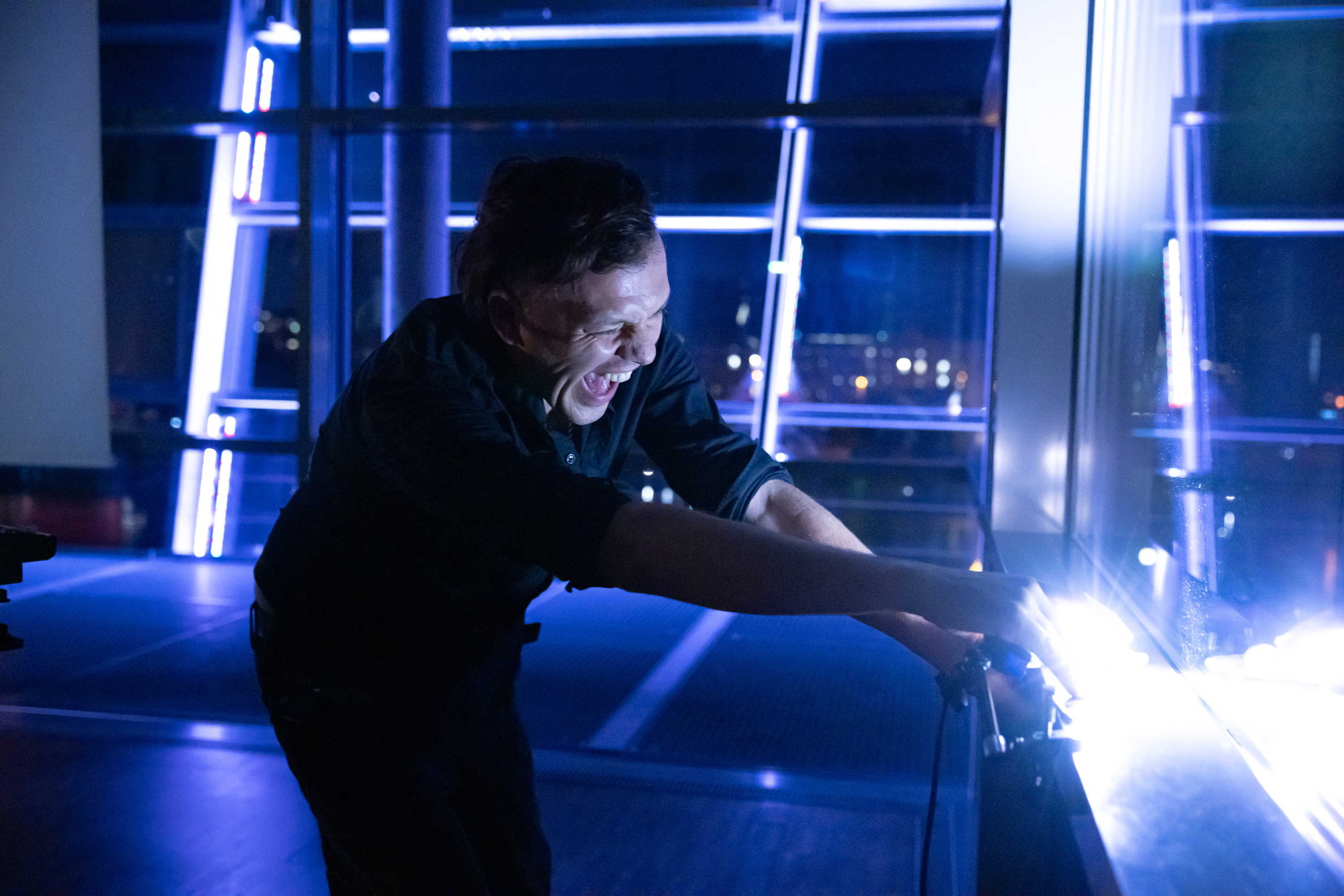
There are no loudspeakers hidden inside the installation and no microphones amplifying a separate sound source. Each shell is simultaneously object, resonator and acoustic instrument. The motor’s role is deliberately modest: it turns the shell. What becomes audible depends upon the shell’s form, the quantity and movement of water, trapped air, rotational speed and the listener’s proximity.
The work therefore resists the fantasy of a machine as a self-sufficient author. Its technical action is minimal, but that action opens a relation among materials. The shell-and-water assemblages operate like miniature oceans rather than completely controllable mechanisms. Each contains a small moving environment whose sound varies with physical conditions.
The piece emerged during the pandemic, when repetition, slowness and fragile beauty acquired particular urgency. Yet its material constellation also carries broader ecological associations: oceans, coastlines, tourism, collection and extraction. The shells come from different places and have passed through different hands. Geist intends eventually to return them to nature. The life cycle of the artwork therefore challenges the assumption that artistic agency culminates in permanent possession and preservation.
In Hard Times – Soft Sounds, agency is distributed without becoming spectacular. The motors act, but they do not dominate. Water and air respond according to physical forces. Shells shape resonance through forms produced by other lives. Human arrangement makes the encounter possible. The listener must move close to sounds that remain soft and local. What results is less a display of robotic mastery than an exercise in technological restraint.
Who – or what – is playing?
Across these cases, the boundaries of the instrument expand in different directions. In Muciño’s performance, the instrument includes breath, bassoon, body, algorithm and recorded voice. In Mendoza’s Sonic Saturday, it expands towards curatorial sequences, loudspeaker infrastructures, institutional spaces and audience movement. In Komorebi, it extends into weather, foliage and a network of sensing creatures. In Geist’s installation, it contracts around a small mechanical gesture whose consequences are delegated to water, air and shell.
None of this eliminates authorship or skill. Muciño’s performance depends upon highly developed musical technique. Mendoza’s programmes require acts of judgement and exclusion as well as technical knowledge. The construction and tuning of Komorebi result from years of experimentation. Geist’s apparent simplicity is carefully engineered. Distributed agency does not mean that things simply happen by themselves.
It means that making is not exhausted by command. The performer acts by listening and adjusting. The curator composes conditions for encounters among works and publics. The artist designs behaviours that remain open to circumstances. The machine initiates physical processes it cannot symbolically understand. Materials introduce differences that exceed calculation. The audience participates through attention, movement and duration.
Mendoza’s distinction between music and sound art makes this question even more pointed. He proposes development, form and structured temporal movement as characteristics of music, while sound art may remain open, installation-based or repetitive. The boundary is debatable – as our conversation made clear – but his larger observation is valuable: practices once understood as experimental are becoming institutionalised. They enter universities, recurring festivals, technical standards, pedagogies and canons. What began at the margins acquires infrastructure and tradition.
Institutionalisation is itself a redistribution of agency. It can preserve knowledge, provide equipment, create communities and make demanding work possible. It can also stabilise categories, reward familiar techniques and determine whose experimentation becomes legible. The post-digital instrument, the spatial concert and the autonomous swarm do not exist outside such structures. They are enabled and framed by them.
The question »who is playing?« therefore has no single answer. A human body plays, but it is also played upon by the affordances and resistance of an instrument. An algorithm acts, but only within designed constraints. An environment enters a work without acquiring artistic intention. A curator assembles a journey while listeners produce their own pathways through it. Agency circulates, but unevenly.
This may be the most productive way to negotiate humanity through sound. Rather than defending a purified human creativity against machines, these works show human action as already entangled with instruments, materials, infrastructures, memories and environments. The task is not to decide once and for all which participant is the true author. It is to listen closely enough to hear how the capacity to act is being arranged—and who, or what, that arrangement allows to sound.