


What Remains Audible?
Ingeborg Bachmann’s voice appears and disappears as one moves along the Ars Electronica Festival Walk. Her poem Die gestundete Zeit – Deferred Time – does not arrive as a historical document sealed within the year 1953. It reaches the listener through contemporary loudspeakers, urban movement and the accidents of proximity. One fragment becomes audible while another is lost beneath footsteps, conversation or traffic. The poem is transmitted, but never without transformation.
Its central image is postponement rather than disappearance. What has been deferred remains outstanding. Time has not passed cleanly beyond catastrophe; something unresolved enters the present and alters it. Heard in Linz in 2026, Bachmann’s warning – »There come harder days« – does not explain the works encountered at the festival. It provides a lighter, more oblique orientation: sounds do not begin at the instant we hear them, and they do not end when their acoustic signal fades.
The first two articles in this series examined where listening happens and how agency is distributed among bodies, instruments, algorithms, materials and environments. This final article asks what those relations transmit. Instruments carry histories of manufacture and use. Materials arrive through economic and political systems. Technologies embody decisions about what can be sensed, translated or ignored. Species communicate environmental conditions across timescales different from our own. Voices persist after the bodies that produced them have disappeared. Institutions preserve some practices, forget others and transform experimental work into tradition.
Listening therefore takes place not only in space but in time and society. It places us within histories that precede our arrival and among relations that cannot be reduced to an encounter between an isolated subject and a sounding object. Heike Kaltenbrunner’s Noise of War, Erze Dinarama’s Drumming for Love and Enrique Mendoza Mejía’s work with Sonic Saturday approach this condition from markedly different directions. One activates history through metal, air and architectural resonance. Another listens to drought through the rhythmic communication of aquatic insects. The third constructs institutional and curatorial pathways through which diverse musical practices can circulate. Together they suggest that memory and sociality are not secondary meanings added to sound. They are conditions of its transmission.
Metal after war
Heike Kaltenbrunner’s Noise of War begins with a material substitution. The pipes in her proximity organ are made of zinc, a metal used in European organ building as a cheaper replacement for alloys of lead and tin.
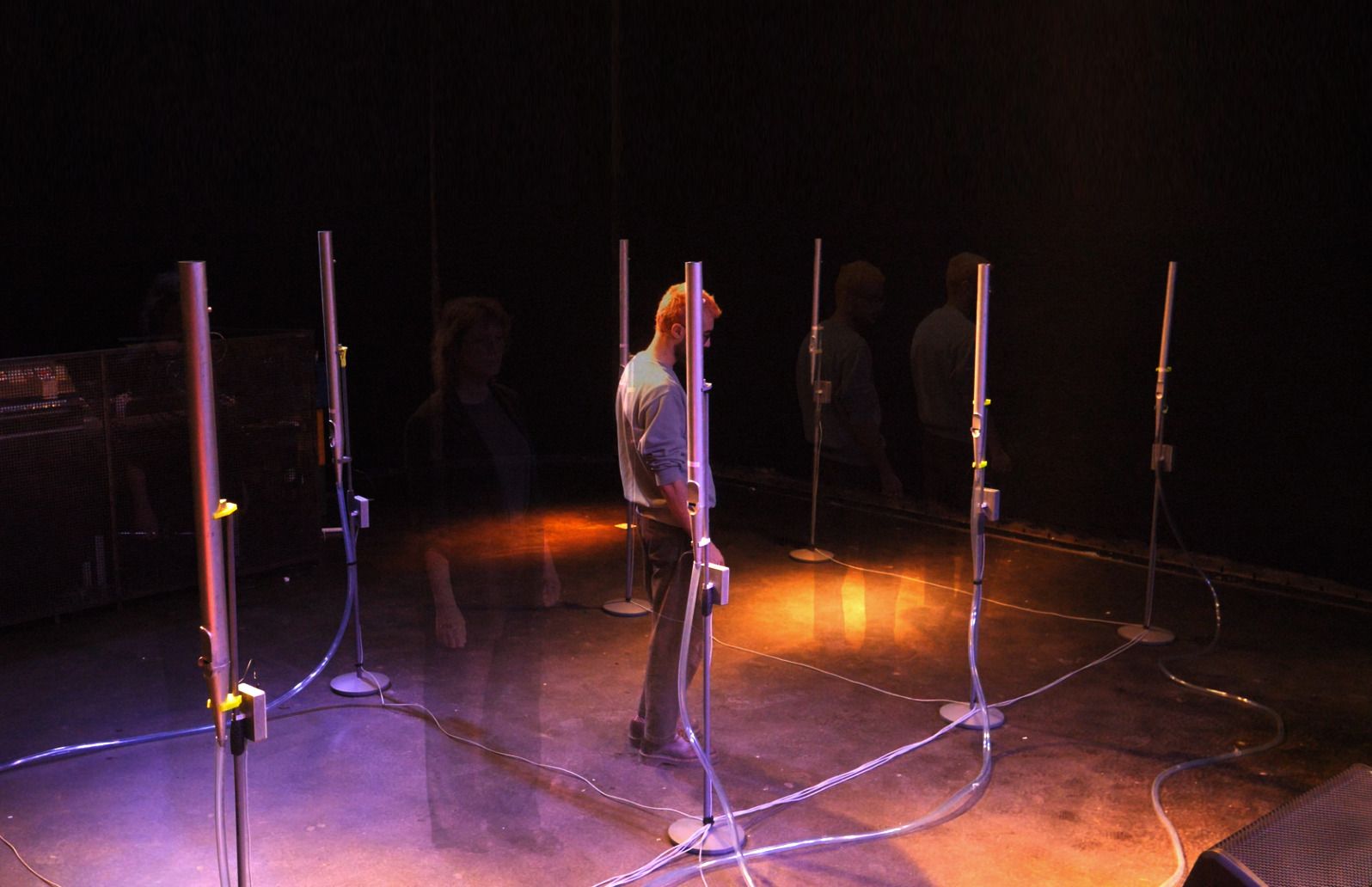
The substitution acquired a particular historical force during the World Wars, when organ pipes containing valuable metals were requisitioned and melted down for military use. Materials associated with sacred music and collective ritual entered the production of ammunition; zinc subsequently entered organs in their place.
The work does not narrate this history through archival images or explanatory sound recordings. It works with the acoustic consequences of the substituted material. Zinc produces a rougher and more metallic timbre than traditional lead–tin mixtures. Kaltenbrunner attends especially to the unstable threshold at which air becomes noise and noise begins to acquire pitch. Under reduced pressure, a pipe tuned to a particular fundamental does not simply deliver that note. Its pitch may shift; overtones emerge at slightly altered intervals; beating patterns appear when frequencies meet.
Visitors affect this behaviour through proximity. The pipes form part of a responsive system in which movement alters airflow and sounding. Yet the relation is not instantaneous or completely legible. Air takes time to accumulate and escape. A visitor can initiate a change whose audible result continues after they have moved away. Another person may hear the consequence of an action they did not witness. The work makes transmission palpable as delay.
This delay matters politically as well as acoustically. Conventional monuments attempt to stabilise memory by giving it a durable, visible form. They identify an event, assign it a place and promise some continuity between past and future. Noise of War is durable and unstable at the same time. The pipes persist as objects, but their sounding is contingent upon air, bodies, tuning and room acoustics. Memory is not stored as a fixed content waiting to be retrieved. It must be activated, and every activation differs.
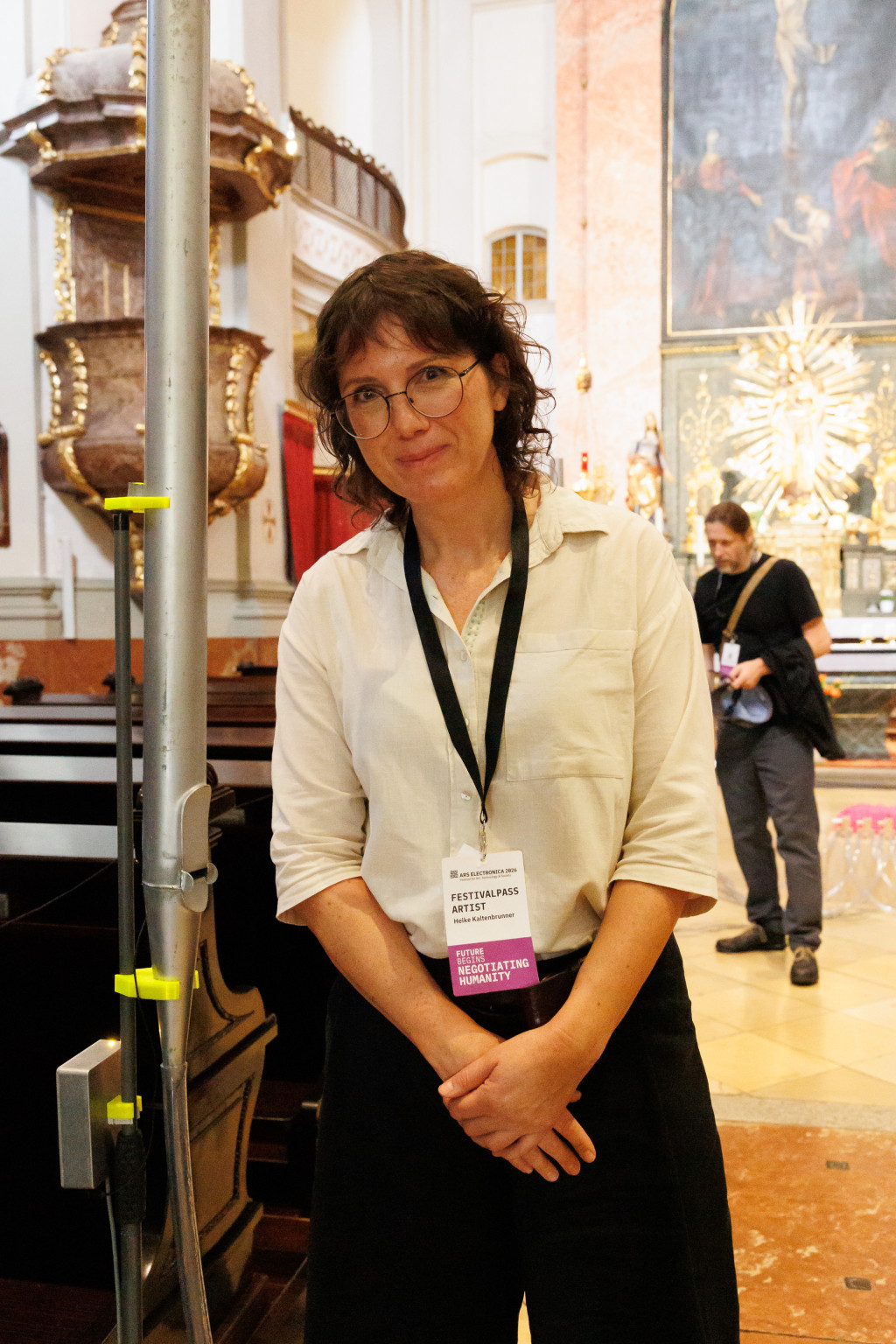
The interview with Kaltenbrunner reveals how carefully she listens to those differences. She speaks about fundamental tones and overtones that deviate by a few cents, about the exhaustion of concentrating too analytically and about the need to hear what the instrument is doing. When I suggested that one has to let the instrument play as it plays, she agreed. The exchange was brief, but it identified a crucial quality of the work: historical matter cannot simply be made to deliver a predetermined message. It has its own acoustic behaviour.
The architecture participates as well. At Ars Electronica the work occupied the Church of the Sisters of St. Elizabeth, where the pipes’ material history entered a space already associated with organ music, sacred listening and European cultural continuity. Kaltenbrunner had previously worked with the instrument in a barn attic with approximately ten seconds of reverberation and anticipated a future white-cube presentation that would be, as she said, »acoustically totally different.« The work travels, but the history it carries is never heard in exactly the same way.
This prevents the zinc from becoming a simple symbol. The metal does not contain a complete memory of war that sound magically releases. Historical knowledge is necessary: without it, one hears a particular timbre; with it, the same timbre becomes charged by the conditions through which zinc entered the organ. Memory is produced through the relation among material, contextual information, sounding and listener.
The sacred and the militarised consequently remain entangled. The instrument associated with transcendence bears the consequences of industrial warfare in its metallurgy. But the work does not resolve the contradiction through accusation or reconciliation. It lets the relation sound precariously – through breath-like noise, unstable pitch and tones that appear and fall away.
The slow rhythm of drought
Erze Dinarama’s Drumming for Love shifts the temporal scale. Noise of War listens into a historical rupture whose material consequences remain present. Dinarama listens to an environmental history that is still unfolding and whose beginnings and endings are difficult to define.
The work developed from research into drought in the Po River basin and the suspension of regulations guaranteeing a minimum ecological water flow during extreme scarcity. Dinarama’s background is in architecture, urbanism, landscape and spatial practices. Yet drought challenged the tools of spatial mapping. It could be represented through data, remote sensing or images of dry riverbeds, but those representations often capture it only when its effects have become spectacular.
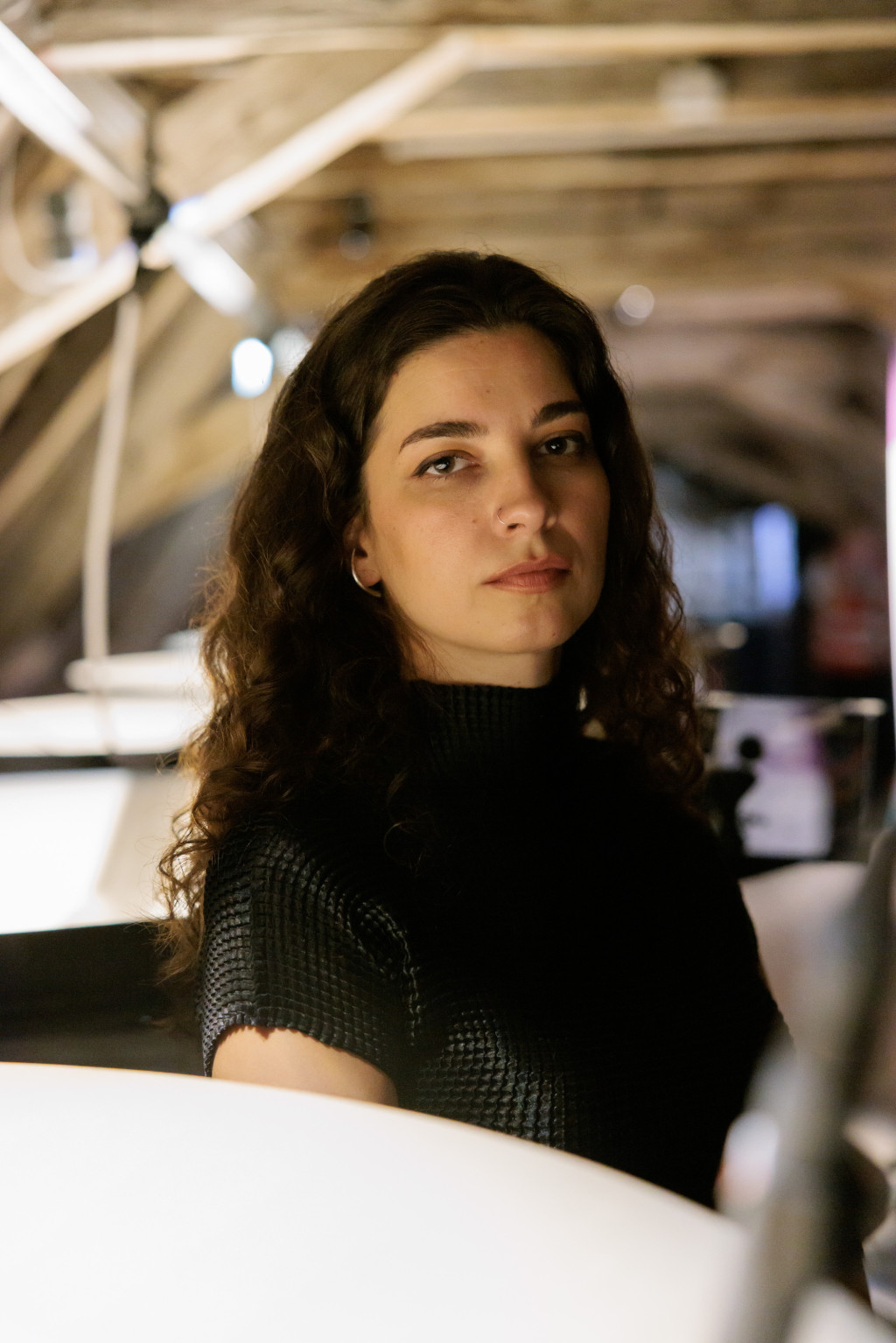
»Drought is so slow«, she observed in our conversation. Unlike a flood, which can often be narrated through a discernible before, event and aftermath, drought develops through changing rhythms whose starting point remains uncertain. Familiar media images – cracked soil, stranded fish, an empty channel – tend to arrive when the crisis is already undeniable. Dinarama wanted to find another language for a phenomenon that gradually reorganises relations among species, institutions, agriculture and water users.
Her research led from environmental agencies and mathematical models to volunteers who rescue fish from drying sections of rivers, and then to species that seldom become public emblems of ecological crisis: aquatic insects. Unlike bears, pandas and other charismatic animals, these insects do not easily attract visual identification or sympathy. Yet their presence and behaviour provide sensitive information about river conditions. They function, in Dinarama’s phrase, as highly advanced environmental sensors.
More importantly for the work, aquatic insects communicate through rhythmic substrate-borne vibration. They drum or tap against stones and other surfaces rather than using air as their primary medium. Species have distinctive patterns, and rhythms may vary between rivers, habitats and sexes. Communication requires a shared material substrate and an adequate rhythmic relation. It is situated not merely in an environment but in contact with a surface.
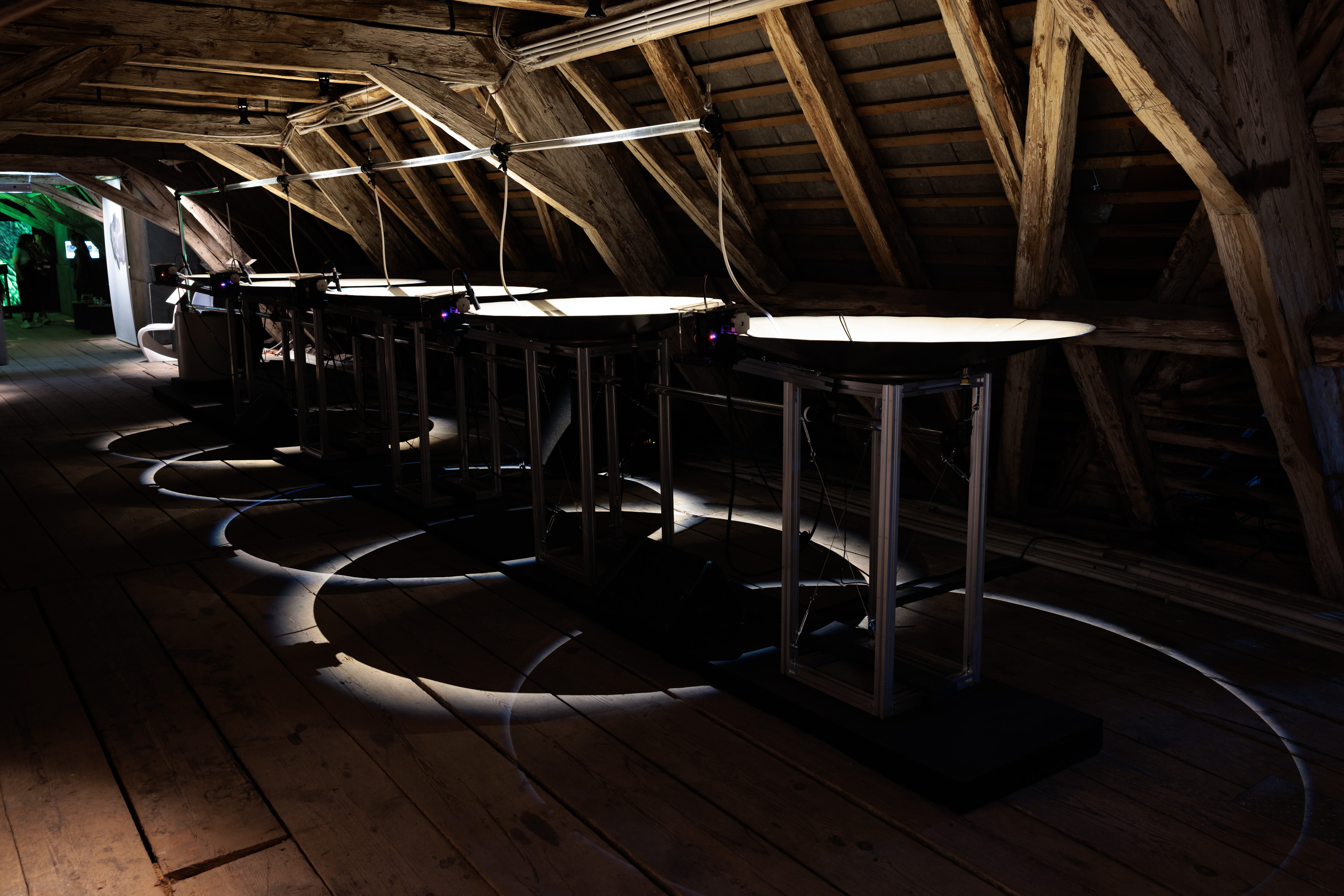
Drumming for Love draws on recordings of these signals and transfers their temporal structures into specially constructed devices. The result preserves the call-and-response quality of insect communication while making it perceptible to human visitors. The mediation is not concealed. Recordings are slowed or processed; signals become voltages and mechanical actions; the installation’s quasi-scientific appearance foregrounds the apparatus of translation. We are not hearing the insects as they perceive one another. We encounter an aesthetic and technical reconstruction made for the scale of human attention.
This is a strength rather than a failure. The work does not claim transparent access to another species. It stages the distance between forms of perception while allowing a relation to emerge across it. Dinarama describes the insect rhythms as more affectively powerful than the conventional image of drying soil: »I don’t think it’s stronger. I think it’s more emotional.« Knowing that the sounds derive from the love calls of aquatic insects allows drought to be experienced not only as absence or catastrophe but as a disturbance within ongoing communication.
The title Drumming for Love consequently carries more than poetic softness. Reproductive communication, environmental monitoring and political allocation meet within the same rhythmic field. The insects are not simply metaphors for vulnerable life. Their signals belong to actual ecological relations affected by changing water conditions.
Dinarama’s most provocative statement is that »drought is designed. It’s not a natural phenomenon.« Taken without context, the sentence could sound like a denial of climatic and hydrological processes. Her explanation points elsewhere. Contemporary drought is inseparable from infrastructures of agriculture, sensing, regulation, modelling and distribution. Institutions decide who receives water, how much and when. Technologies promise more precise control at the moment scarcity makes such control increasingly consequential.
Drought, she explains, »starts very slowly« and »leaves room for negotiating.« But those negotiations are unequal. Not every affected being has standing, and not every form of life enters the calculation with the same force. Fish may receive attention because they are visible; insects may appear primarily as indicators; river systems cannot represent themselves at a regulatory table. Listening to insect rhythms therefore becomes a way of moving among scales: intimate communication, local habitat, scientific monitoring and political governance.
This also reorients memory. Drought is not remembered only after it has occurred. Its histories are being written during processes too gradual to appear as events. The insect rhythms register a present already becoming archival: signals of relations that may adapt, migrate or disappear. Dinarama’s work asks whether listening can attend to a history before it is declared past.
From transmission to institution
Sound requires means of transmission. A vibration must pass through stone, water, air, metal, electrical systems or bodies. Cultural practices require transmission too: teaching, notation, recording, archives, studios, festivals, organisations and shared vocabularies. Enrique Mendoza Mejía’s reflections on Sonic Saturday introduce this institutional scale.
Mendoza is a composer and lecturer in electroacoustic music at Anton Bruckner University. Over four years of coordinating and producing Sonic Saturday, he has watched its call for spatial-audio works grow from around forty submissions to as many as 160. The event now connects a listening room, open-air installations, workshops, audiovisual works and the MEDIUM SONORUM closing concert.
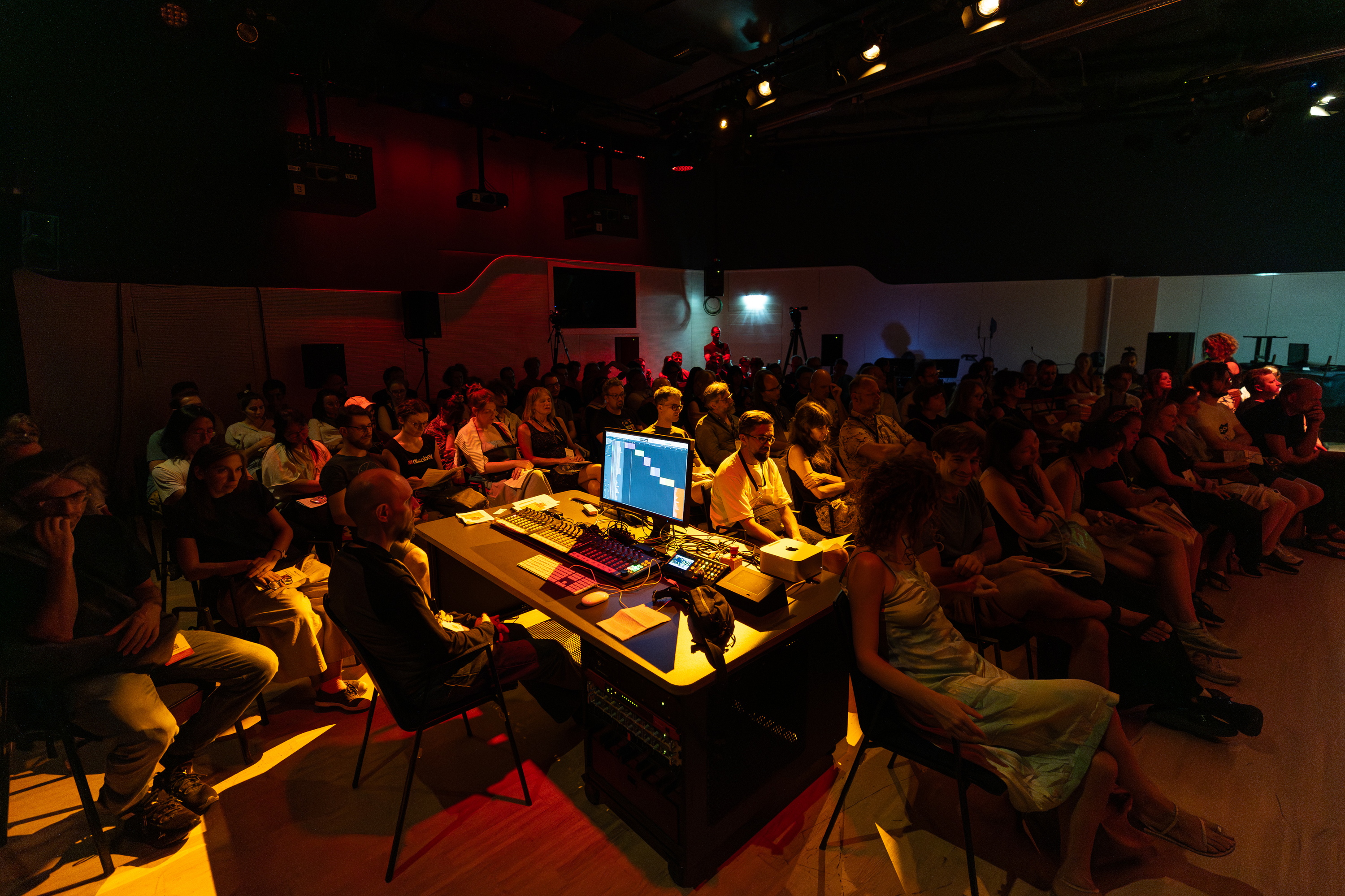
Its 20.4-channel Sonic Lab and related production studio allow students and invited composers to develop, test and present multichannel and ambisonic works.
These systems transmit more than audio signals. They transmit competencies. Students learn how to compose for spatial arrays, how to move work between studios and concert conditions and how to listen analytically inside a loudspeaker dome. Formats such as ambisonics make it possible to reproduce a spatial composition across differently configured venues. The result is never perfectly neutral – rooms and systems still matter – but a work can travel without being rebuilt from the beginning.
Mendoza’s annual call constructs another form of circulation. Contributions arrive from Europe, Asia and the Americas and represent different styles of electroacoustic composition. A committee evaluates them; works selected for the listening room enter one context, while six or seven form the MEDIUM SONORUM programme. Mendoza describes Sonic Saturday as an »artist meeting« rather than a competition, yet its openness is necessarily organised through decisions about technical quality, duration, aesthetic contrast, geography and representation.
This curatorial work is part of transmission. A tradition does not continue simply because works exist. It requires places where they can be heard, compared, discussed and taught. It requires technical standards and knowledgeable listeners. It also requires decisions about which works exemplify the field at a particular moment.
Mendoza’s distinction between music and sound art makes the stakes visible. He associates music with structured development and form, while sound art may operate through installation, repetition or more open temporal organisation. The boundary is contestable, especially because many sound artists compose complex temporal and mediated structures. But the discussion led to a more consequential observation. Practices once positioned as experimental or avant-garde become institutionalised. They enter university programmes, recurring festivals, specialist ensembles and established histories.
When I proposed, somewhat provocatively, that sound art might be becoming a »new classical« form, Mendoza preferred the word institutionalised. Classical music, he noted, is itself a culturally and geographically loaded category, often tied to European written traditions at the expense of much longer oral histories. Institutionalisation is more precise. It describes how practices acquire infrastructures of continuity without assuming that they become classical in one universal sense.
This acquisition is double-edged. Institutions can protect knowledge, give artists access to costly technology, develop audiences and sustain practices beyond the life of a single work. They can make transmission durable. But they can also stabilise categories, reproduce exclusions and turn yesterday’s experiment into today’s norm. Mendoza remarked that ensembles once at the “tip of the spear” may continue, decades later, as keepers of a tradition. What was new becomes recognisable; what becomes recognisable becomes teachable; what becomes teachable may eventually define the limits of legitimate practice.
Gender imbalance within the Sonic Saturday submissions provides a concrete example. Mendoza described efforts to include women composers while acknowledging that the initial pool remains heavily unequal. Global representation likewise depends on who knows about the call, has access to spatial-audio facilities, can master the required formats and possesses time to produce a technically competitive work. An open call is not an unconditioned space. It inherits the infrastructures and inequalities of the field it convenes.
Social listening therefore involves more than people gathering around sound. It concerns the conditions under which practices and voices can circulate. Who has access to studios? Which technologies become standards? What kinds of formal development count as compositional skill? Which experimental histories are preserved, and which remain inaudible because their media, communities or institutions disappear?
Mendoza’s programme aims to offer »different ways of how we can listen to music.« The phrase describes a plural event, but it also names an institutional responsibility. Creating different ways of listening requires different situations: the controlled studio, the porous garden, the concert hall, the installation, the audiovisual encounter. Each format constructs a temporary social body with its own norms of duration, attention and movement.
The fragile social body
Barbara Kapusta’s The Fragiles, encountered on the Festival Walk rather than through one of my interviews, sharpens this relation between transmission and social organisation.
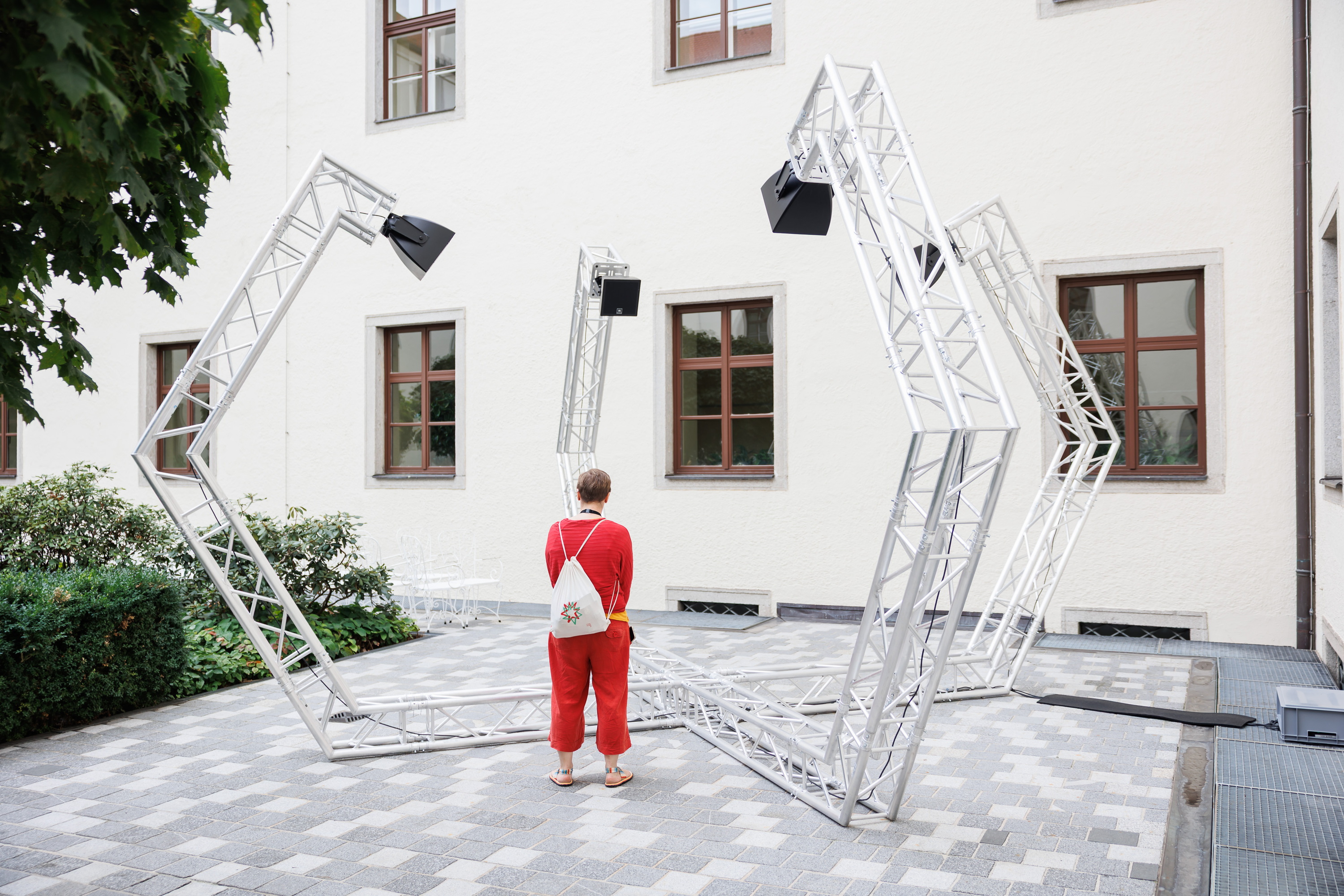
Its enlarged hand-like or tentacular structure carries speaker boxes at the ends of its metal limbs. Voices circulate through a technological body that is simultaneously inviting and unsettling. Human expression appears distributed across an infrastructure whose scale and form exceed the individual speaker.
The work introduces a question already implicit in the other cases: how are voices organised into collectives? In Drumming for Love, insect calls enter systems of ecological monitoring and human representation. At Sonic Saturday, compositions enter calls, committees, formats and programmes. In The Fragiles, voices enter a networked and sculptural body. In each case, transmission connects participants while also classifying and positioning them.
Sociality is not simply the free interaction of autonomous individuals in the present. Communities are shaped by inherited categories, technical infrastructures, previous exclusions and stories about who belongs together. The social field, like the acoustic field, is already organised before we enter it. To become audible within that field is also to enter systems that transform what a voice can mean and how far it can travel.
The title The Fragiles resonates across the three cases. Zinc pipes survive, but the conditions that gave them historical meaning are easily forgotten. Aquatic insects communicate, but their habitats and signals remain vulnerable to ecological transformation. Electroacoustic works circulate through sophisticated digital systems, but the institutions, formats and knowledge required to replay them are not permanent. Transmission makes continuity possible; it also exposes dependence.
What listens back?
Across these works, listening loses its apparent innocence. A tone in Noise of War carries a history of material substitution that becomes audible only through knowledge and activation. An insect rhythm in Drumming for Love connects courtship to drought, scientific monitoring and political decisions about water. Sonic Saturday’s spatial works reveal that listening is organised by infrastructures, institutions and curatorial choices before it becomes an individual experience.
This is why memory and sociality belong together. Memory is not simply the preservation of an event safely located in the past, and sociality is not simply interaction among people in the present. Both concern transmission. Materials transmit consequences. Species transmit signals. Technologies transmit and transform voices. Institutions transmit techniques and categories. Communities transmit histories, expectations and silences.
The question »what listens back?« should not be understood as though pipes, insects or loudspeaker systems possessed human ears. It names a reversal of position. We begin by imagining ourselves as subjects listening to a world of objects. The works reveal that the relations in which listening occurs already act upon us. The instrument resists and delays. Environmental rhythms exceed the scale of immediate perception. Institutional formats train attention and determine what becomes available to hear. Historical materials alter the meaning of a tone.
Bachmann’s voice returns somewhere along the Festival Walk. A historical text becomes an acoustic event through contemporary infrastructure. It is situated in a particular street or courtyard, yet it exceeds that place through the time from which it arrives. The listener meets it bodily in the present while recognising that the present is not self-contained.
Kaltenbrunner’s zinc, Dinarama’s insect rhythms and Mendoza’s listening infrastructures carry their histories differently. Metal transmits the consequences of war through substitution and timbre. Insect signals transmit ecological relations whose transformation is still underway. Institutions transmit practices by turning experiment into knowledge, repertoire and convention. None offers memory as a stable object that can simply be possessed.
Eventually Bachmann’s voice becomes quieter as you walk beyond the loudspeaker. The acoustic signal disappears, but the relation it opened does not. Something has entered the present and changed what it contains. What remains audible is not always a sound. It may be the historical, ecological or social obligation that listening leaves behind.
This is the third article in the series »Listening Otherwise: Three Reorientations at Ars Electronica«
Dansk oversættelse: Andreo Michaelo Mielczarek