
In brieflive
18.02

Serious Creeps

Simon Toldam: »Insecta«
© Daniel Buchwald
© Daniel Buchwald

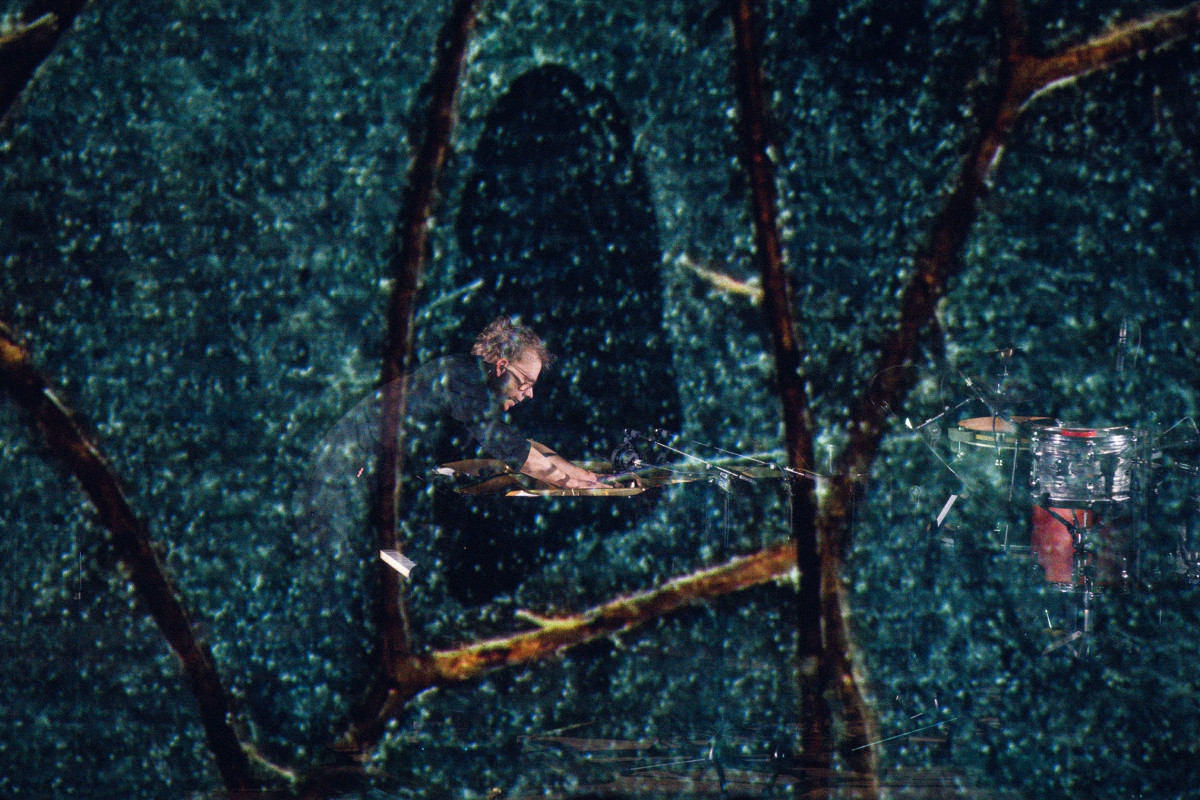
Some dream of discovering life in distant solar systems. Others – like Knud Viktor, Jacob Kirkegaard and now also Simon Toldam – turn the telescope around and uncover unknown life in the immediate yet hidden nature surrounding us. So what did Toldam, the 46-year-old pianist from the experimental jazz milieu, find last night when he turned his gaze toward English photographer Levon Biss’s ultra-close images of beetles, flies and grasshoppers in the world premiere of the hour-long audiovisual trio work Insecta?

First and foremost, he found a varied and inquisitive interpretation of insect life. Behind a transparent screen, Toldam transformed his prepared grand piano into a kind of gamelan instrument, while on either side of him sounds crept and hissed from saxophonist Torben Snekkestad and percussionist Peter Bruun. The production values were high, and the trio – collectively known as Loupe – moved deftly between the concrete and the spherical.

At times, however, there was something old-fashioned about the expression. As a yellow-brown grasshopper gradually took shape on the screen, nanometre by nanometre, the piano’s metallic cymbal-sounds placed it within an Eastern sonic realm. It resonated with exoticism, with old electronic EMS recordings steeped in atonal serialism, and soon Snekkestad let a plaintive Miles Davis-like trumpet drift through the soundscape.

Yet when, with dramatic flair, he blew air through the same instrument or attached a rubber hose and transformed it into a frothing bass monster – while Bruun stroked metal surfaces or pounded the drums in ritualistic patterns – we were out of the past again. And when Insecta finally leaned into the ambient, and Toldam began bending the gamelan tones with his hands inside the open piano, it was as if not only time but also the distance between oneself and the insects dissolved into a trembling dream image. At that point, it suddenly no longer mattered whether there is life on Mars.

English translation: Andreo Michaelo Mielczarek

In briefrelease
27.03

The Cello Within the Comfort Zone

Josefine Opsahl: »Cytropia«
© Lis Kasper Bang
© Lis Kasper Bang

There are twelve tracks on Josefine Opsahl’s album Cytropia, each with the duration of a rock song. Remarkably, there is a straight line from the first to the last – both in timbre, rhythm, melody, atmosphere, and playing. The ears are embraced by a gentle melancholy created by small cello figures in long sequences, with a slow-moving cello melody on top. Some parts in minor, others more open.

She is receiving quite a lot of praise these days for her many projects – an opera and a ballet – alongside her work as a cellist-composer, and it must almost be due to the highly accessible, cohesive, and dreamy sound she consistently delivers. I must admit that I have become somewhat skeptical along the way. Both as a musician and as a composer, I wish she would challenge herself with new approaches and new visions for the stories her music should tell. On Cytropia, we approach a constant state of uniform sound, evoking thoughts of the deliberate inertia of New Age composers.

There are quite beautiful moments along the way. The track »Cyborg« is crystal-clear in its surface. A piece like »Leaverecalls«, in its mechanics, the American minimalism of Philip Glass. But once again, one misses displacements and rhythmic additions that could challenge the static soundscape. The last hundred years of experimentation have expanded the battlefield of cello playing. Opsahl draws on some of these experiences to create her own small mechanical accompaniments for herself. Yet, the setup with a sequencer and a cello seems limiting in allowing Opsahl to explore timbres and ideas where the gravity of melancholy can truly be felt.

»Music is like an ancient mineral, containing a history of wisdom reaching over centuries, stratifying and evolving into new forms. It is like a black hole, wrapping around us and allowing us to temporarily escape the noise of the world.
An emotional safe zone, a place for solace, a bringer of light, a unifying factor. It is us.«
 
NEKO3 is a Copenhagen-based experimental music group consisting of: Fei Nie, Lorenzo Colombo and Kalle Hakosalo. The group is working towards the creation of a new musical language, flexibly moving between various performance media and artistic expressions. Continuously collaborating with composers and other creators of art, it seeks to integrate music and other forms of art into one conceptual whole.

NEKO3 has performed at Festival Internacional de la Imagen, SONICA Glasgow, cresc... Biennale, Time Of Music, Rondò, MINU festival, Copenhagen Light Festival, Unerhörte Musik and Spor Festival. They have been featured as soloists with the Danish National Symphony Orchestra and the Aarhus Sinfonietta, and given workshops and presentations at ie. Standford University, the Royal Danish Academy of Music, Hochschule für Musik und Theater Hamburg, University of California San Diego and Kungliga Musikhögskolan (SE). The ensemble has recorded multiple EP’s and released their first full length album Angel Death Traps in collaboration with Alexander Schubert in 2024.
In briefrelease
23.03

New Central American Tales

Xenia Xamanek: »Germinate [Imprint] Wilt [Stay]«
© PR
© PR

There is plenty of space around the many different sounds and voices narrating Central American horror stories on Honduran-Danish artist Xenia Xamanek’s album Germinate. The words »germinate« and »wilt« appear in the title, serving as fitting markers for the blossoming, bubbling, futuristic, and slightly eerie soundscape. A handful of voices fill the ears with mechanical, intense connections, swirling impressions of nature and language into the brain.

The album is a rare reinvention of the oratorio, the 18th-century religious opera genre featuring sung text fragments and wordless music. A significant departure from the dance floors Xamanek used to curate. Here, singers and an electro-acoustic soundscape tell stories through two simple, word-heavy recitatives, two arias with chanting narration, and electronic soundscapes.

There’s a calmness in Xenia Xamanek’s approach that can become utterly addictive. The material from their ancestral storytelling – and perhaps even the chanting narrative style – sets a scene that feels both warm and familiar. Yet at the same time, it turns original and alien as the calm of the words is challenged by dense patterns of simple sonic elements interacting with each other.

Oratorios in the 18th century lasted three hours and can easily feel distant and irrelevant today. But Xamanek’s album, rooted in the cuentos y leyendas de Honduras they heard in their childhood, offers three-quarters of an hour of presence – one that unexpectedly points forward.

© Emilia Jasmin
© Emilia Jasmin

Saturday night at Huset’s Xenon stage was a true laboratory of sound, body, and technology. Two vastly different artists explored the expressive possibilities within sound and performance art. First, the Icelandic composer Sól Ey presented her performance Hreyfð («she is moved« in Islandic) wearing a suit equipped with microphones, speakers, and gyroscopes, her movements were transformed into sound. Through slow, deliberate motions, Ey tuned into different frequencies. Each gesture created a new auditory universe – ranging from soft, ethereal tones with the finest textures to distorted and aggressive noises, from cosmic whispers to fragmented radio signals that reminded me of NASA’s Voyager recordings. In complete silence, the audience observed Ey as she explored the sounds of outer space.

Afterward, the Japanese drummer Ryosuke Kiyasu stepped forward like a sonic warrior. With nothing but a snare drum, a table, and a microphone, he unleashed a relentless 30-minute sonic assault. He screamed, pounded, and perspired. He used both his own body and drumsticks. The audience held their breath as Kiyasu attacked his snare drum like a man determined to break through the limits of sound from within. And when he finally collapsed onto the floor, the room erupted in cheers.

While Sól Ey wove an intricate dialogue between technology and movement, Ryosuke Kiyasu launched a frontal attack on the material’s resistance. Both confronted the boundaries of sound with uncompromising dedication, demonstrating that sound art is not just about playing – but about transformation.

In brieflive
20.03

The Power of Trance: A Journey from Indonesia to Roskilde

Andreas Johnsen: »Cosmic Balance«
© PR
© PR

In 2022, the Indonesian group Juarta Putra turned the Roskilde Festival upside down and captivated a large audience with a trance dance called reak. In the documentary Cosmic Balance, director Andreas Johnsen takes us back to the time just before, to Putra's hometown of Cinunuk in West Java, Indonesia. Through 24-year-old Anggi Nugraha, we are introduced to reak and how both the young and the old, to the sound of booming drums, distorted tarompet (a reed wind instrument resembling an oboe), and reciting song, surrender to the ancestors who visit them in their wild trances. Anggi himself, who has just become the leader of the reak group, is haunted by his stern grandfather, who orders that traditions must be preserved and upheld.

However, Anggi is unsure about his new role. He is not of the bloodline of the predecessor Abah or any of the other members in the group, but he grew up in the village among the musicians after his parents, for unknown reasons, left him there. We also meet Anggi's girlfriend, whom he wants to marry, but whom he has not received his parents' approval to marry for the same reason. Anggi is a sensitive and sympathetic young man, whom one can only wish the best for. He himself seeks help from a fortune-teller, who gives him the strength to travel to Denmark and to marry his chosen one. How the marriage will turn out is unknown, but the journey to Roskilde is a clear success. 

The film's soundtrack works predominantly well with field recordings and the group's own music. Less fitting are the passages with lyrical piano and strings accompanying the trance scenes from Cinunuk, which come across as unnecessarily staged. This does not change the fact that Cosmic Balance gives a sympathetic and fascinating portrait of music that, on the one hand, fits perfectly with the global and diverse profile of the Roskilde Festival, but which also comes from a world so distant from the inferno of Roskilde that one can hardly see where the ends meet. But they do, that night at Roskilde.

English translation: Andreo Michaelo Mielczarek