Det danske sommervejr minder os – på godt og ondt – om, at det er tid til at holde fri og koble af. Ferien er oplagt til at få læst og lyttet til nogle af de ting, der måske ikke er tid til i en travl hverdag, og her bidrager Seismograf med en god stak indhold til lidt digital sommerfordybelse. Vi holder lukket i juli, men går ikke på ferie uden at sikre os, at der er masser af lytte- og læsestof på både dansk og engelsk til at holde hele sommeren.

Komponister på scenen
Du kan starte med at fordybe dig i 
vores seneste engelsksprogede fokus, der under overskriften Composer/Performer gennem syv artikler beskæftiger sig med komponister, der går på scenen og tilfører musikken nye performative aspekter såvel som en indbygget udforskning og genovervejelse af komponistens rolle. Fokusset udspringer af et forskningsprojekt anført af Sanne Krogh Groth, der også har redigeret fokusset, og de grunlæggende idéer opridses og diskuteres i hendes egen artikel. Norske Trond Reinholdtsen reflekterer over det 20. århundredes komponister, idet han præsenterer sit énmandsprojekt The Norwegian Opera. Juliana Hodkinson genbesøger en personlig krise i sin tekst, mens Niels Rønsholdt identificerer sig med lytteren, når han positionerer sig som fremmed i forhold til sin egen musik. Den femte artikel er en transkriberet paneldebat mellem Louise AleniusKristian Hverring og Simon Steen-Andersen fra Nordic Music Days i Reykjavik. Alenius er tilmed omdrejningspunktet for en artikel af Torben Sangild, som har oplevet en én-til-én-koncert med komponisten i sit soveværelse, der midlertidigt blev omdannet til koncertsal. Musiker, komponist og forsker Henrik Frisk afslutter med at undersøge mulighederne i det amatøristiske aspekt ved komponister, der går på scenen og påtager sig musikalske opgaver, de ikke er skolede til.

Lyt Dybt
Vores podcast Lyt Dybt har netop afsluttet sin første sæson, og der er sammenlagt 15 afsnit om alt fra undervandsoptagelser og hverdagslyd til voksvalser, midi-violiner og lyttemeditation, som du kan give dig hen til, hvis du ikke allerede har gjort det. De seneste afsnit er en del af den serie, vi kalder 
Lyden af planeten Jorden, som helliger sig fænomenet The Voyager Golden Records – to guld-LP'er indeholdende musik og lyde fra vores klode, som blev sendt ud i det interstellare rum i 1977.
I serien møder vi lektor og kunstner Jenny Gräf, mediearkæolog Jussi Parikka, forfattersaxofonist TS Høeg samt kurator og NASA-buff Jacob Lillemose, der alle forholder sig til dét at sende jordlyde ud i rummet.
Søg på Lyt Dybt i din podcast-app eller lyt med her på siden.

Senest på seismograf.org

»Hvis man præsenterer noget meningsløst vrøvl, sker der ingenting.« Søren Møller Sørensen mødte ved et tilfælde en af sine bekendte på et konditori i Cairo – den egyptiske komponist Bahaa El-Ansary. Det kom der et spændende interview ud af.

»Det umiddelbare indtryk af mødet med værkerne forandredes gradvist, og efter et stykke tid udvikler udstillingen sig i retning mod det, jeg opfatter som kernen i de fleste af Norments værker; arbejdet med materialer og titler, hvor lyd ofte er et grundelement.« Andreas Engström anmelder Camille Norments aktuelle udstilling på Oslo Kunstforening.

»Struer Tracks er på mange måder godt nyt for den danske lydkunstscene. Åbningsweekenden tegner i hvert fald et billede af en forfriskende uformel og særdeles vedkommende formidling af et meget bredt udsnit af lydkunst anno 2017.« Jakob Gustav Winckler har besøgt Danmarks eneste festival for stedsspecifik lydkunst, Struer Tracks.

Fik du vist, hvem komponisten Allan er? »Det er det, jeg er lidt i tvivl om. Derfor ville lidt mere musik have været godt,« siger han. »Men personen Allan var der – for første gang.« Læs Sune Anderbergs portrætinterview med debutanten Allan Gravgaard Madsen.

in briefrelease
14.03.2025

Caught Between Too Much and Too Little

Amphior: »Disappearing«
Amphior. © Rikke Broholm

Electronic musician Amphior, aka Mathias Hammerstrøm, opens on a positive note: »Under the Stars« exudes a Twin Peaks–like melancholic romanticism infused with an unsettling timbre that raises expectations. By the second track, however, it becomes clear that the listening experience will not be quite as positive as one might initially have hoped.

»Time Is a Thief« simply does not impress in the same way. On top of the clichéd ticking clock in the background, neither the piano melody nor the atmospheric elements make much of an impact, stuck in the nondescript middle ground between too much and too little. Unfortunately, this alternation between compelling tracks and more filler-like pieces comes to characterize the release as a whole.

Both »Healing« and »Disappearing« feature strong melodies with a delicate, ethereal, bittersweet melancholy. Like »Time Is a Thief«, »Bloom« also employs a ticking clock as a background element, but to far better effect, as the music above it is much more captivating – not least thanks to Stine Benjaminsen’s (aka Recorder Recorder) clipped vocal samples, which lend the track a welcome sense of strangeness. The release does, however, contain a number of tracks that never manage to leave a lasting impression, no matter how many times one listens. A melody that simply needed a bit more life. An effect that could have benefited from being turned up. It is a shame, because on roughly half of the tracks Hammerstrøm demonstrates that he is capable of creating truly beautiful music.

© PR

»How comforting, after so much menial self-investigation, to finally be told exactly what it is that you need. The delirious British post-punk outfit The Fall, in their song on the very subject, will have you convinced it’s a bit of Iggy Stooge, a reduced smoking habit, sex without having it, slippery shoes for your horrible feet; to that solid list, I’ll append an injunction to hear out a few minutes of other music, specifically chosen to corrupt your personal spacetime. And sure, drink water, wash your face, go outside – like that’s doing anything.« 

Jennifer Gersten is a violinist and writer from New York City. Her feature reporting, essays, and music criticism appear in The New York Times, The New Yorker, Bloomberg, Rolling Stone and Seismograf, among other publications. A former tenured tutti violinist with Helsingborg Symfoniorkester (Sweden), Jennifer pursues solo and collaborative projects in new and improvised music in the US and Scandinavia, some of which earned her an honorable mention for Darmstadt Ferienkurse’s 2023 Kranichsteiner Musikpreis. 

in briefrelease
07.03.2025

A Daring Vision of Flute and Voice

© Samantha Riott
© Samantha Riott

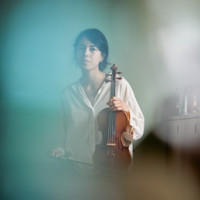
So dextrous a musician is the flutist Laura Cocks that, at shows, their instrument occurs to the eye as merely another limb. A powerhouse New York-based collaborator and interpreter within new classical and experimental music, notably as director of the leading-edge new music group TAK Ensemble, Cocks now releases their first solo statement of improvised compositions with FATHM, an acrobatic intertwining of flute and voice that nods to strange and fleeting visions: among them, birds, string, seeds between the teeth. On FATHM, Cocks applies all the facility of their work as an interpreter of commissioned works – on extensive display in their last solo venture, 2022’s field anatomies – towards the development of an uninhibited, yet highly focused musical language. 

If the album’s mysterious tracklist reads as a sort of cryptogram, then listening to FATHM evokes a process of decoding, parsing the bounds between vocalization and instrument. The album’s opening track, »A thread held between your fingers«, finds Cocks as their own flickering shadow, simultaneously playing the flute and squealing in tones just slightly removed in pitch. »Illinois« is then reclaimed from Sufjan Stevens’ relentless grip as a furious mumble of half-blown notes with underlying trickles of voice. Cocks experiments further with these hoarse timbres on the three infinitive tracks: »To beget« and its later variations »To outstretch« and concluding track »To fly«, which trace the evolution of a dancelike triplet motif. »FAVN«, apparently a faithful depiction of an elephant with severe sleep apnea, may reconcile itself to the sensitive listener through its sheer commitment to the grotesque, while »A seed sucked between your teeth«, orbiting languidly around a major ninth, invites more celestial considerations. »A marsh wren« might take the titular bird as a point of departure, but it quickly imagines a species of its own, singing a song of bustle and snaps and smacks. On »YARN«, Cocks suggests another sort of animal song by making a counterpoint of mews and growls. The flutist’s skill with balancing these peculiar hybrids ultimately distinguishes FATHM as much as Cocks’ ferocious energy; this is an album as happy to shout as it is to slither. 

in brieflive
03.03.2025

Cosmic Resonance

Satellite Synthesizer – Ørntoft/Anker/Osgood/Snöleoparden
© Mia Mathilde Andersson

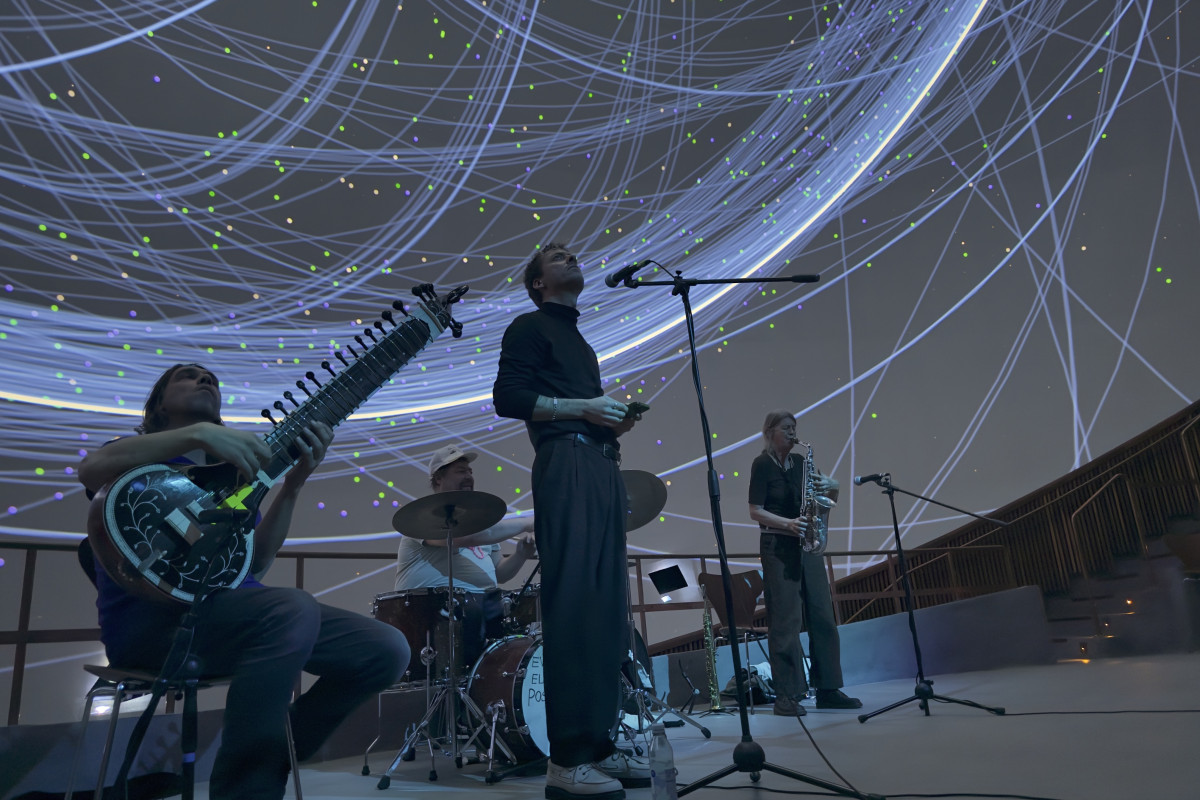
Against enemies in outer space, »music is the strongest weapon we have,« Mads Brügger recently stated here in Seismograf. Snöleopard and musical friends made this idea strikingly concrete by sending music directly from the Planetarium in Copenhagen out into space, targeting satellites between 500 and 35,000 kilometers away. The tones returned altered by delay, radio noise, and cosmic interference. On the large screen, the Earth’s surface – seen from a satellite – rolled by with all its illuminated cities, while Theis Ørntoft read from his forthcoming climate-conscious novel, delivering lines such as: »The day there is no more oil, the lights will go out in the world.« Meanwhile, we could see small green dots of confused satellites racing across the Earth’s beautiful curvature and hear Lotte Anker, Kresten Osgood, and Snöleopard free-jazzing on saxophone, drums, and sitar respectively.

The small crackling beep-sounds from the satellites’ resonance also generated music, but the most interesting moments came when the musicians received fragments of their own motifs back – thrown down from outer space – and a kind of internal interplay emerged. Is there something out there, or are we merely talking to ourselves?

Cosmic resonance filled the dome, but one could wish for more internal resonance. There is a beautiful trend in ensembles that include a poet, allowing many delightfully twisted formulations to surface, but the musicians must also interpret the words – enter into a musical exegesis, as they would with a traditional jazz singer – otherwise the music easily becomes background or secondary. As if each musician were a green satellite dot in their own orbital path. Many good ideas were in play – and music is not a weapon. But it does require internal resonance. Not only cosmic.

English translation: Andreo Michaelo Mielczarek

in briefrelease
28.02.2025

A Clammy Kawaii Crescendo

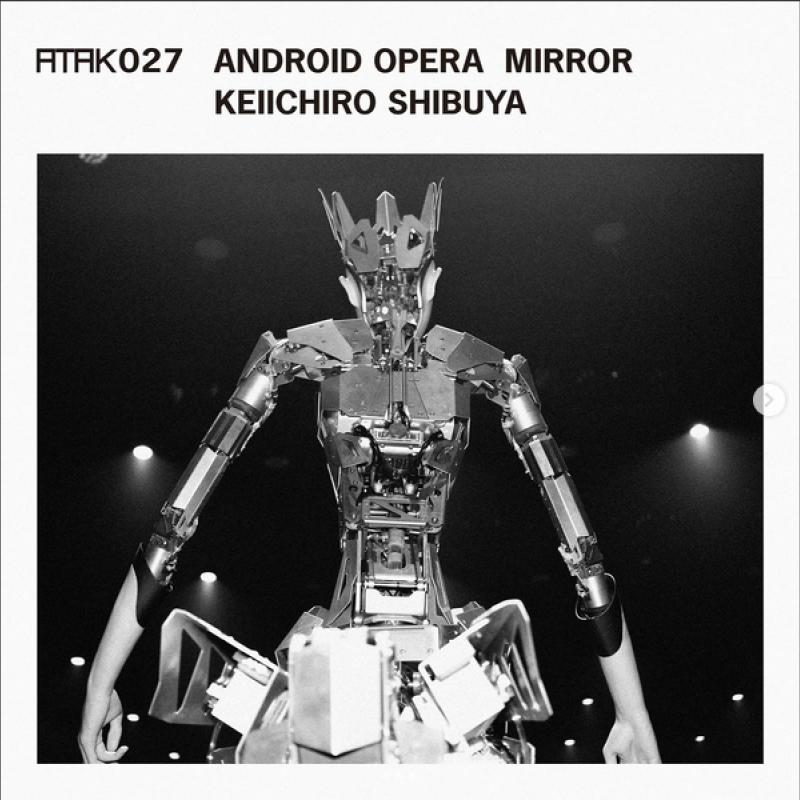
Keiichiro Shibuya: »ANDROID OPERA MIRROR«
© PR

If the Japanese composer and musician Keiichiro Shibuya’s new album ANDROID OPERA MIRROR were to be summed up in a single word, that word would be »bombastic«. From the very first track, »MIRROR«, the listener is bombarded with gliding synth violins, brass, and a robotic voice intoning existential questions – ironically written by an AI.

There is something charmingly awkward about Shibuya’s pop-oriented, over-the-top compositions and the android vocal’s cloying kawaii factor. But before the album is halfway through, the constant pomposity begins to wear thin. »On Certainty«, with its ever-present strings and densely packed arrangements, rarely gives the music – or the listener – room to breathe. Shibuya and his android voice are saying an awful lot all the time, and it is so overwhelming that very little of it actually carries weight. When everything feels like an epic crescendo or the expected release from one, the effect is lost.

Taken individually, several of the tracks are otherwise quite compelling: »Midnight Swan (Android Opera ver.)«, which sounds like the opening theme to a dark and romantic anime, and the closing track »Scary Beauty (Vocal and Piano ver.)«, which shines precisely by trimming away the excess and focusing on the emotional core of the composition – an impact made far stronger by the simpler instrumentation. When the listener is not constantly overwhelmed, the romance, melancholy, and existential questions are allowed to make an impression. Unfortunately, ANDROID OPERA MIRROR is a listening experience that frustrates through its lack of subtlety – something it would otherwise have benefited greatly from.

English translation: Andreo Michaelo Mielczarek